Physiology - LEARNING
 Call Kai
 Learn
Learn Practice Test
 Spaced Repetition
 Match
Match Flashcards
 Knowt Play
1/94

There's no tags or description
Looks like no tags are added yet.
Name | Mastery | Learn | Test | Matching | Spaced | Call with Kai |
|---|
No analytics yet
Send a link to your students to track their progress
95 Terms
what is electricity?
the flow of all charged particles, from a negative pole to a positive pole down a conducting path.
what is conductance?
the flow of an electric charge that is opposite to that of the electrons
what are conductors?
materials with high electron mobility
what are insulators?
materials with low electron mobility, that do not propagate the flow of electrons well
how can our bodies conduct electricity?
most of the solutions in our body are salt solutions, the presence of these ions in our intracellular and extracellular solutions are what allows electricity to be present in the body.
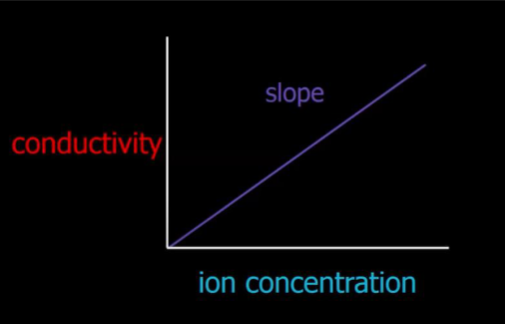
describe the relationship between conductivity and ion concentration.
linear relationship, the more ions the better the conductivity
what occurs when a battery is turned on?
positive ions will be attracted to the negative terminal, and repelled by the positive terminal, and travel in a clockwise direction. negative ions will be attracted to the positive terminal, and repelled by the negative terminal, and travel in an anticlockwise direction.
what does an ampere measure?
how much current flows
what is 1 amp equivalent to?
1 coulomb per second
what is a coloumb?
unit of electric charge
what is voltage used to measure?
how strong current flows/how much pressure the flow of electricity possesses
what occurs at an anode?
has a surplus of electrons so loses electron
what occurs at a cathode?
has a shortage of electrons, so gains electrons
what is the equation for voltage?
energy/charge
what is resistance?
the opposition to current flow
how can you calculate resistance?
resistance = voltage/current
what is conductance measured in?
siemens
what is the equation for conductance?
current/voltage
what is an electrical amplifier?
something that increases the gain of an electrical signal using an external power supply to make it more measurable in the case of a biological current
explain voltage around a circuit loop.
each point has a unique voltage, if you go completely around the circuit loop, you get back to the same voltage.
what is the function of a battery?
converts chemical energy into electrical energy, creating a voltage between its terminals.
what needs to be done for current to flow through a resistor?
work must be done, so potential energy is used, converted to heat, and thus voltage decreases along the resistor in the direction of current flow
describe the concentration of intracellular ions?
high K+ and Na+, low Cl-
describe the concentration of extracellular ions?
low K+, and high Na+ and Cl-
what is the consequence of the lipid bilayer being hydrophobic?
Na+, K+ and other ions which are hydrophilic cannot pass directly through
what are the two key components of the phospholipid bilayer?
sandwiched between two ionic solutions, and acts as a capacitor
ion concentration gradients and channels act as batteries with internal resistance
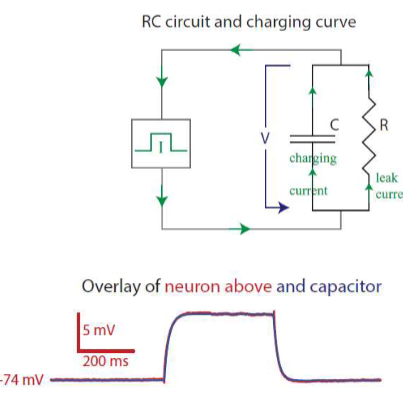
describe experimental evidence that shows real neurones have membrane capacitance and resistance?
charging curves show same as a resistor and capacitor in parallel
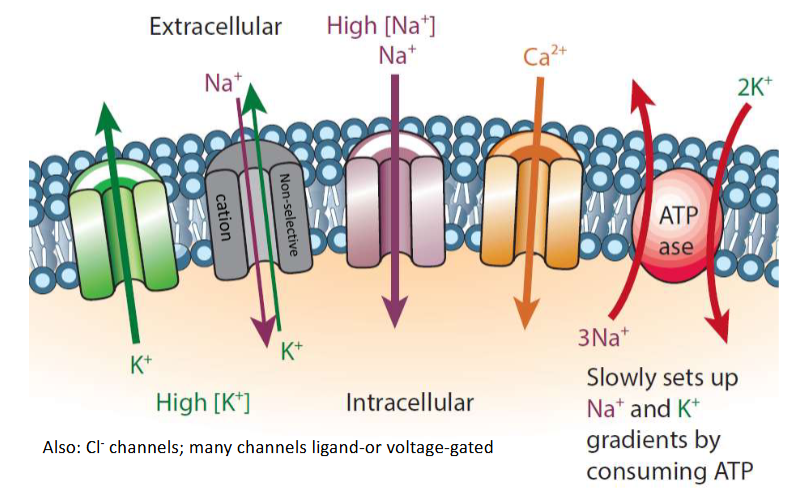
what are the main intrinsic components of membrane underlying bio-electricity?
potassium leak channel, non-selective cation channel, sodium channel, calcium channel, sodium-potassium pump
describe single ion channel currents?
pulse-like opening and closing, with rapid gating between 0 and fixed conductance level, with some flickering
what determines direction of current?
direction of net positive charge flow
how can you measure current experimentally?
count the net number of proton charges going past a given point per second, divide by 6.24 × 10^18
what are capacitors?
storers of charge, can separate opposite charges, and accumulate/store them, producing a voltage between them
how is membrane potential produced?
membrane capacitance adds up currents over space and time
what is Q total?
the time integral of current between time 0 and time T is the area under the curve and the total charge (Qtotal.) that has accumulates between 0 and T
how to find Q total at a given time T?
split up preceding time into brief time slices, and add up the charge in each of those using Q=It, where t is duration of time slices and I is the current during it.
why is capacitance crucial in cells?
lipid membranes have capacitance which separates and accumulates charge producing a voltage across the membrane
how is battery voltage approximated when channels are selectively permeable to one type of ion?
by the Nernst Equation

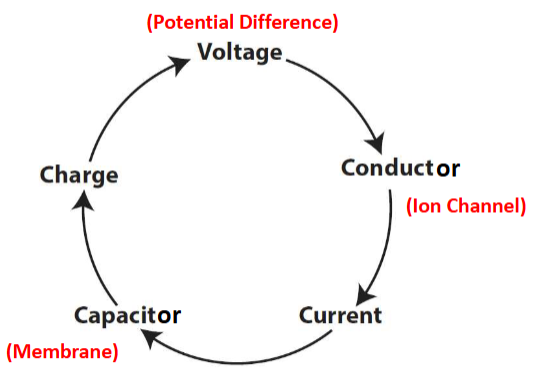
describe the membrane integration cycle.
ion channels inject currents, which membrane capacitance integrates, producing the membrane potential. membrane capacitance accumulates charge, producing membrane potential. ion channels work as mini-batteries, working together via the membrane integration cycle.
what are the key components of semi-permeable membranes?
lipid bilayer, pump proteins, ion channel proteins
what is the significance of the lipid bilayer?
a sandwich of lipid between ionic solutions is a capacitance, separating and accumulating charge and producing a membrane potential between separated opposite charges
what is the significance of pump proteins?
consume metabolic energy to set up ion concentration gradients, mainly by Na+/K+ ATPase
what is the significance of ion channel proteins?
can pass ions much faster, rapidly harnessing energy stored in concentration gradients to send signals, and to change voltage across membrane
how is membrane potential given by charge stored/capacitance?
lipid membranes have capacitance which separates and stores charge, producing a voltage across the membrane
what happens if both chemical and electrical gradients are in the opposite direction?
net driving force on ion is the difference between the two gradients
what is the reversal potential?
the membrane potential at which there is no net flow of ions across a membrane
what is extracellular recording?
metal, hollow saline-filled glass or silicon electrode
what is intracellular recording?
electrolyte-filled hollow glass spear
what is patch recording?
clean ~1+um tip diameter glass pipette
what is voltage recording (current clamp)?
record the voltage, inject constant current or defined pulses/waveforms of current into the cell. allows membrane potential to act independently in response to inputs
what is voltage clamp?
control/clamp the voltage, take complete control of the membrane potential and record the current needed to do so. this will be opposite of any biological currents flowing through channels near the recording electrode tip
explain voltage clamp in practice?
to hold membrane potential constant, experimenter often injects an equal and opposite current to the one being injected by the ion channel, to cancel it out. no net current = no net charge into cell = no voltage change
how do sharp electrodes work?
impale a cell, membrane seals onto outside of glass, may be leaky, electrode has small tip so high resistance, noisy, limited current passing or voltage control
how do patch electrodes work?
sucking patch of cleaned membrane into clean pipette so it sticks to inside of glass, very tight seals possible, as well as lower pipette resistance, wider tip allows better current passing, voltage control and lower noise
what is a giga seal patch recording?
ensures negligible current leaks out under rim of pipette, reduces the noise, enables the detection of very small currents coming from single channels
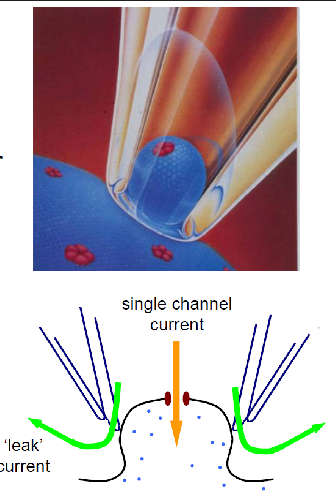
what are the types of patch configurations?
cell-attached, inside-out, whole-cell, outside-out, perforated patch
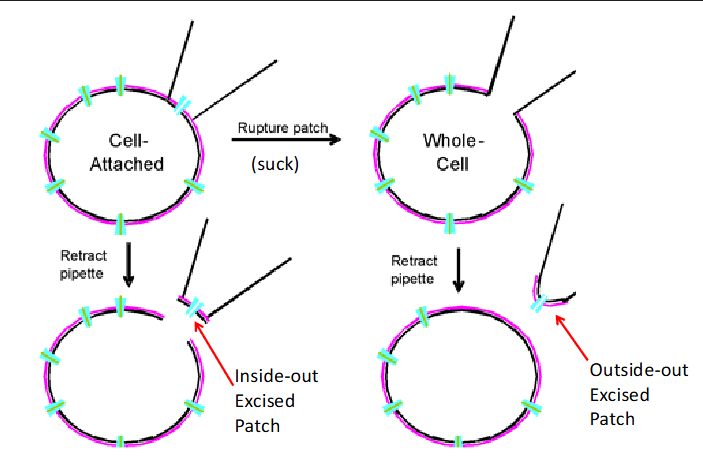
describe a perforated patch?
antibiotics in pipette solution, forms transmembrane pores
what allows patch clamps to record currents from single channels?
tight G-omega seal between pipette glass and membrane
describe single channel currents?
stochastic openings, open probability = fraction of time open, so average conductance = open conductance x open probability
how do channels draw membrane potential closer to their reversal potential?
K+ currents hyperpolarise membrane potential, Na+ currents depolarise membrane potential, Cl- currents can do either, depending on membrane potential and chloride reversal potential
what is the rate of net current flow for a particular ion proportional to?
the difference between the membrane potential and the equilibrium potential for that ion
explain leak conductance.
much is from non-specific cation channels, where the reversal potential is 0 as there is the same total concentration of cations in and out of the cell.
what is the golden rule of membrane potentials?
membrane potential is driven towards a conductance’s reversal potential
when do we get a steady-rate membrane potential?
when there is zero net current flowing onto intracellular surface of the membrane capacitance, so no change in charge.
how much ions need to cross sides to establish RMP by charging up membrane capacitance?
only about 1 in 10^5 for a cell
why do pumps only make a minor intermediate contribution to RMP?
pump transport rates are low compared with channels despite having a higher density. although Na+/K+ ATPase is electrogenic, under normal conditions it only makes a minor contribution to RMP. blocking the pump with ouabain or vanadate or by removal of ATP typically only produces a few mV immediate depolarisation of the RMP.
what is the pumps main role?
indirect, to set up and maintain the concentration gradients of Na+ and K+.
what is the Goldman-Hodgkin-Katz voltage equation?
nernst equation for multiple ions, for channels permeable to multiple ion species, with different ion permeabilities or speeds of movement through channel.
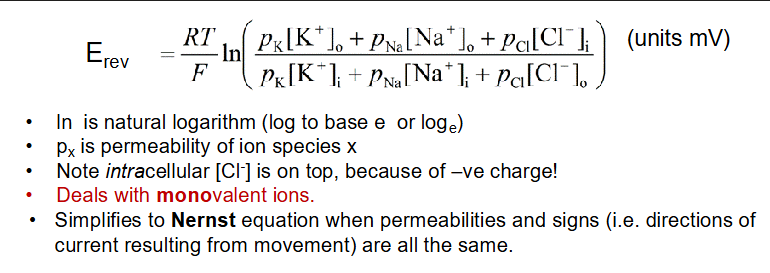
what do you use if conductances are voltage-dependent?
I-V plots
how can we predict RMP from voltage dependent channels?
add all steady-state I-V curves, and find where the total current is zero.
what conductances should be considered when predicting RMP?
Kir, Kleak, non-selective cation
what causes variety in resting membrane potential?
mainly due to different channel type and sub-type mixes, or their modulation
what are action potentials?
digital-like output pulse of neurones and other cells, leading to a biological action
what is the threshold of action potentials?
all or none response, membrane potential at which net current flips sign from outward to inward
what are the key ion channels involved in action potentials?
depolarisation-activated Na+ and K+ channels
what is the sequence of events involved in an action potential?
depolarisation of rapidly opening Na+ channels causing even more depolarisation.
depolarised Na+ channels close again.
depolarisation opens K+ channels slowly, repolarising then hyperpolarising the membrane.
refractory period.
what is an EPSP?
excitatory post synaptic potential, response to a single input
describe the anatomy of an action potential.
a tiny increase in input, just pushing membrane voltage over threshold, results in huge change in output, with a digital-like voltage pulse waveform that plays out fully, by itself, via internal mechanisms.
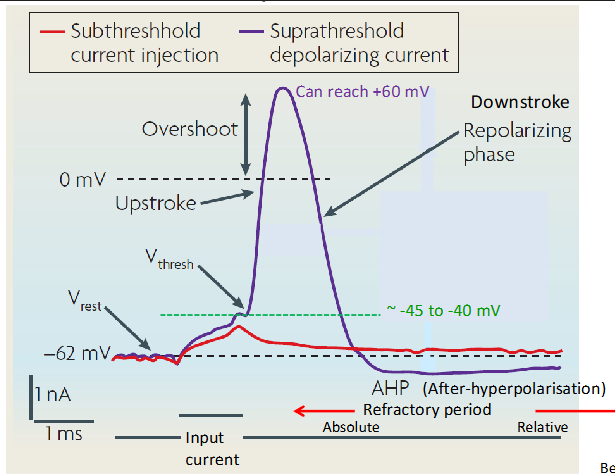
what does a huge change in output cause in an action potential?
either decays back towards RMP or a digital-like voltage pulse plays out fully by internal mechanisms
what is the role of an absolute refractory period?
puts a ceiling on firing rate, cannot fire faster, however strong the stimulus
what is an upstroke?
depolarisation-activated Na+ channels are excitatory, and inject positive current into cell across membrane, causing even more depolarisation
what is a downstroke?
depolarisation-activated K+ channels are inhibitory, and inject negative current into cell causing re- and hyper-polarisation
how can you reduce extracellular Na+ in a Na+ dependent AP?
substitute with glucose or an impermeant cation
what is tetrodotoxin?
occurs in puffer fish and blue-ringed octopuses, synthesised by symbiotic bacteria, both a toxin and tool that specifically block Na+ channels by binding to the extracellular site.
describe a single Na+ channel clamp current under voltage clamp steps?
cell-attached patch with single sodium channel isolated from rest of membrane. individual voltage-gated channels open in all-or-none stochastic fashion, within a probability distribution of timings, yielding the ensemble average or macroscopic current.
describe conductances, currents, and gates during action potentials.
current of Na and current of K is what charges membrane capacitance. membrane potential tracks the total change injected and accumulates, and peaks when the current of K balances the current of Na
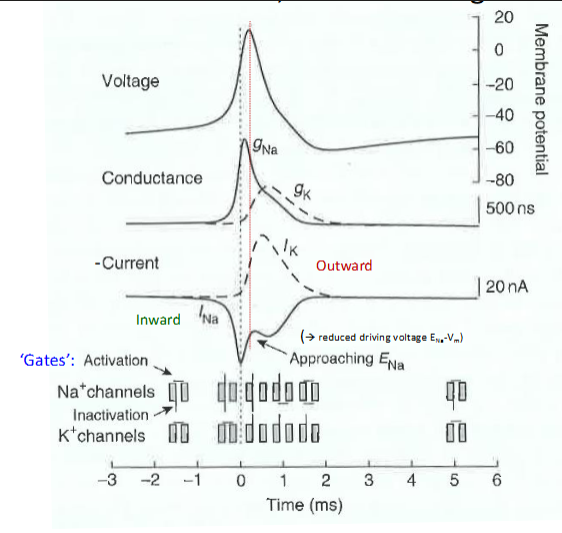
how do measured conductances change during action potential?
from instantaneous pure K+ or Na+ currents flowing when Vm stepped suddenly to ENa or EK at various times during action potential
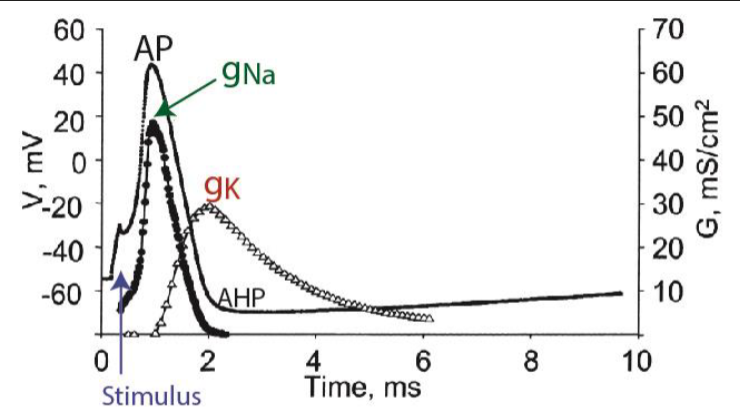
what does Na+ channel inactivation with depolarisation cause?
disrupts positive feedback loop underlying upstroke
what does K+ channel activation with depolarisation cause?
injects negative current causing re-/hyper-polarisation
what does fewer openable Na+ and more open K+ channels cause?
no threshold, an absolute refractory period, then higher threshold and lower action potential peak/relative refractory period.
what happens during recovery from an action potential?
more Na+ channels de-inactivate, more K+ channels close, membrane potential returns towards RMP. thresholds decrease, and action potential peak increases.
what causes different firing patterns?
subject to neuromodulation, firing patterns can be changed by certain modulatory transmitters, like acetylcholine, noradrenaline, serotonin, histamine, dopamine, peptides, and hormones.
what are complex spikes?
fast somatic Na+ spikes riding on slower dendritic Ca2+ spikes
how can cells carry on firing without ATP supply?
using energy stored in the ion concentration gradient.
how can action potentials be improved?
myelination

