Waves
 Call Kai
 Learn
Learn Practice Test
 Spaced Repetition
 Match
Match Flashcards
 Knowt Play
1/43

There's no tags or description
Looks like no tags are added yet.
Name | Mastery | Learn | Test | Matching | Spaced | Call with Kai | Chat |
|---|
No analytics yet
Send a link to your students to track their progress
44 Terms
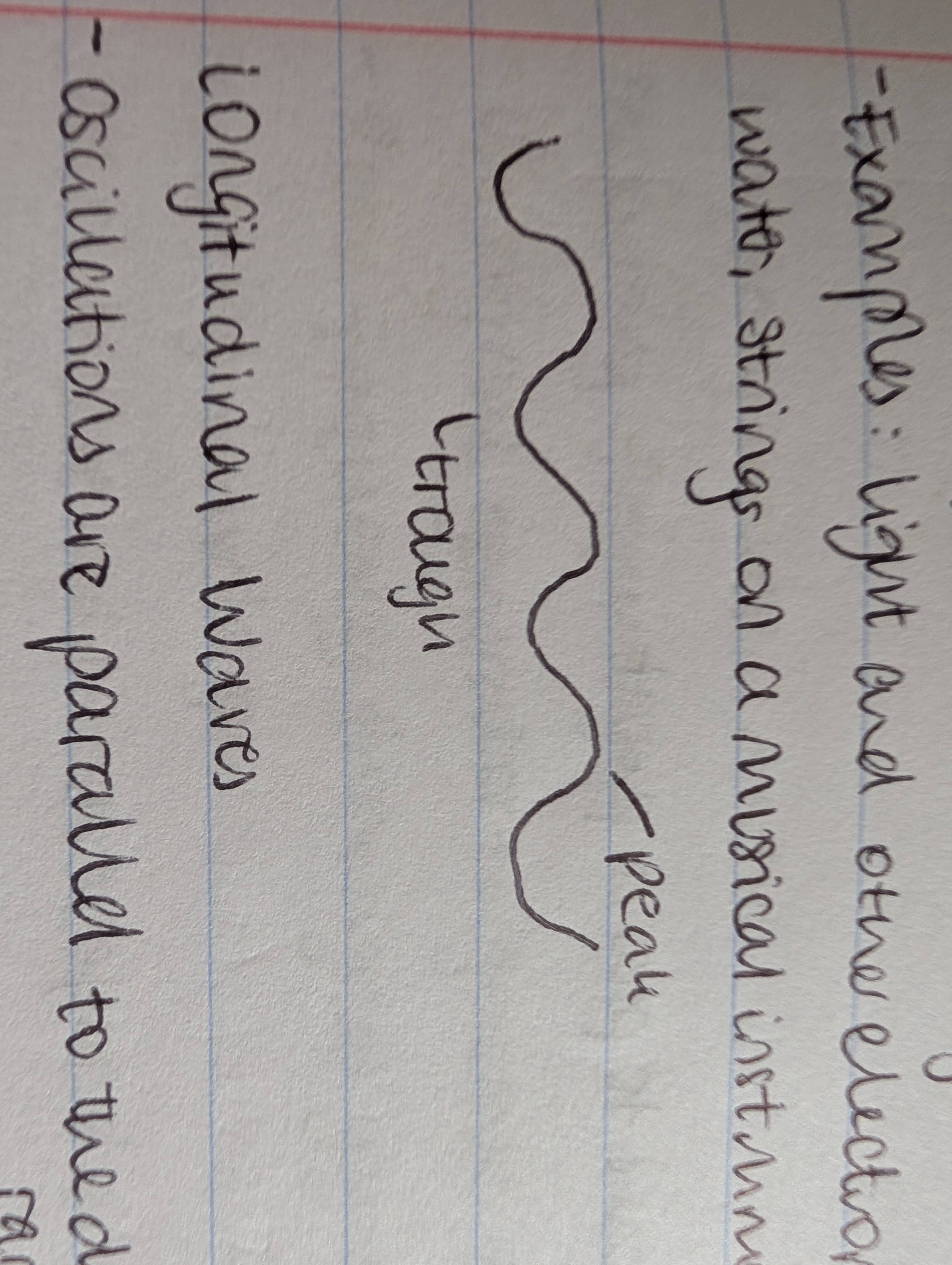
Describe Transverse Waves.
The oscillations are perpendicular to the direction of energy transfer.
Waves have peaks and troughs.
Examples: light and other electromagnetic waves, ripple on water, strings on a musical instrument.
Describe Longitudinal Waves.
Oscillations are parallel to the direction of energy.
Waves have compressions and rarefactions (particles spread apart)
Examples: sound waves.
Describe the differences between longitudinal waves and transverse waves.
In longitudinal waves, the particles oscillate parallel to the direction of energy transfer, causing areas of compression and rarefaction. In transverse waves, the particles oscillate perpendicular to the direction of energy transfer, causing peaks and troughs
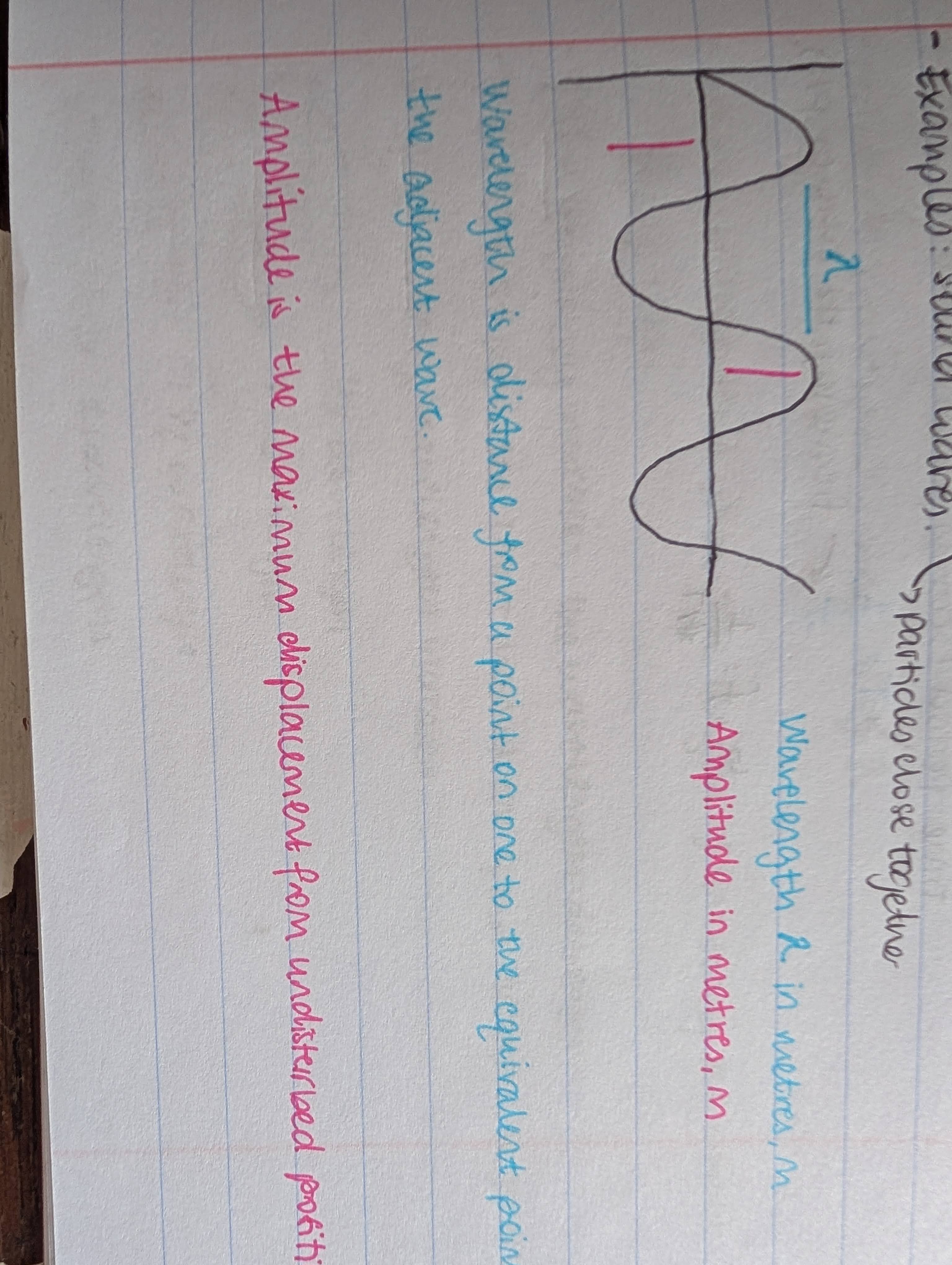
What is wavelength measured in?
Metres, m.
What is amplitude measured in?
Metres, m.
What is wavelength?
The distance from a point on one to the equivalent point on the adjacent wave.
What is amplitude?
The maximum displacement from its undisturbed position that a point on a wave moves.
What is frequency? (And what it’s measured in).
The number of waves passing a point each second.
Hertz, Hz
What is a Period? (And what it’s measured in).
The time for one complete wave to pass a point.
T in seconds, s.
What is wave speed? (And what it’s measured in).
The speed at which energy is transferred.
V, in m/s.
What equation links time and frequency?
T=1/f
Time period (seconds per wave)=1/frequency, Hz (waves p/s)
OR
f=1/T
What is the ‘wave’ equation?
Wave speed, m/s = Frequency, Hz x wavelength, m
v=fλ
Measuring waves in a solid: describe how to measure the frequency.
Use a signal generator to generate waves
Read frequency from signal generator
Measuring waves in a solid: describe how to measure the wave speed.
Calculate wave speed using v=fλ
Describe the relationship between wavelength, frequency and speed.
Example - the frequency and wavelength if eg the length of string remains constant.
If the frequency increases, the wavelength decreases.
It tension increases (more masses), the speed increases, so for the same frequency, wavelength decreases.
<> = ½ wavelength
<><> = 1 wavelength
<><><> = 1 ½ wavelengths
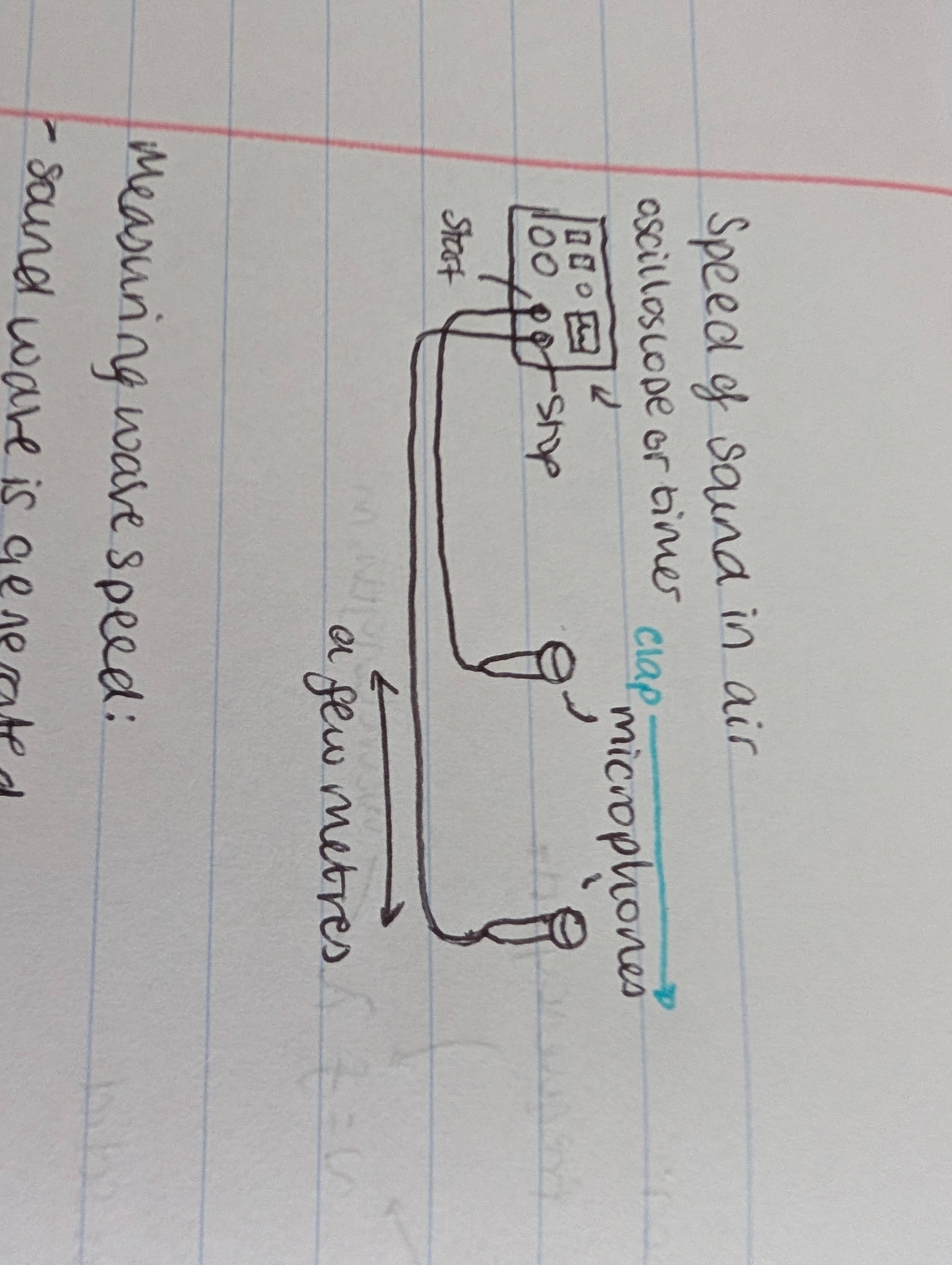
Describe how to measure the speed of sound in air.
Measuring waves speed:
-Sound wave is generated
-Timer starts when sound reaches first microphone
-Timer stops when sound reaches second microphone.
-Use metre ruler to measure distance between microphones.
Speed = distance travelled / time taken.
What is refraction?
Th change in direction of a wave when it passes from one medium to another.
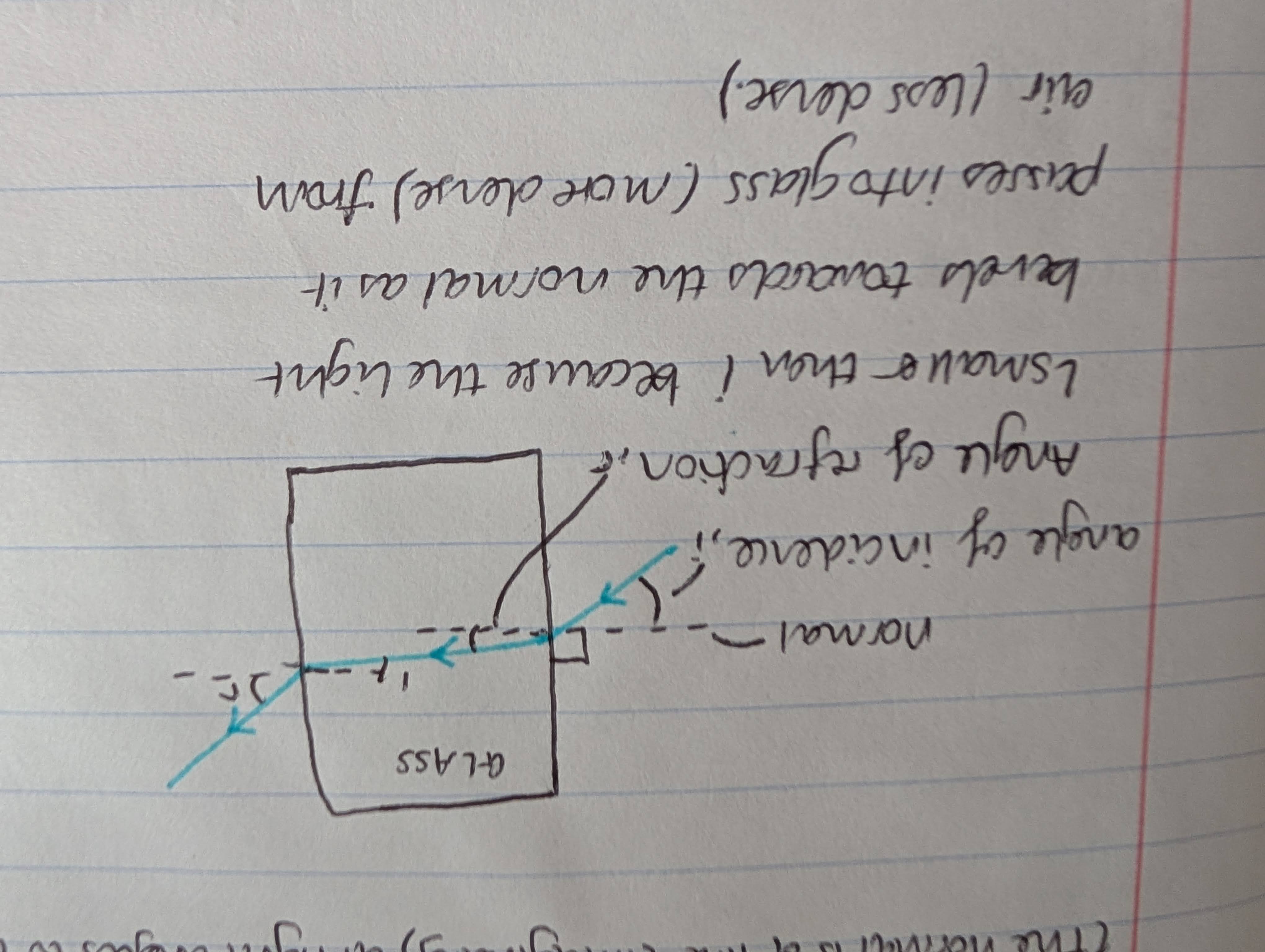
What happens to a wave in more dense material?
It refracts towards the normal.
What is the normal?
An imaginary line at right angles to a surface.
Why is the angle of refraction smaller than the angle of incidence when a wave travels into a denser material?
Because the light bends towards the normal as it passes into eg glass (more dense) from air (less dense).
When light passes through a denser material, it interacts with more molecules, slowing down more than in a less dense material.
What is the angle of incidence?
The angle between light entering a new medium and the normal
What is the angle of refraction?
The angle between the light ray that has refracted and the normal.
Describe the visible spectrum of colours.
Red ← shows the least (least refraction)
Orange
Yellow
Green
Blue
Indigo
Violet ← shows the most (most refraction)
Describe the visible spectrum - wavelength sizes.
Radio waves Rich ← Longer wavelength
Microwaves Men
Infrared In
Visible light Vegas
Ultraviolet Use
X-Rays Expensive
Gamma Rays Gadgets ← Shorter Wavelength
Describe how frequency, wavelength and energy are lower/ higher or longest/shortest in the visile spectrum.
Radio Waves have: longest wavelength, lowest frequency, lowest energy.
This filters down the spectrum so that:
Gamma Rays have: shortest wavelength, highest frequency, highest energy,
Describe the speed at which electromagnetic waves travel.
They travel at the same speed through a vacuum and air.
Electromagnetic waves transfer energy and don't need a medium to travel so can travel through a vacuum.
Electromagnetic waves: describe radio waves.
Produced by oscillations in electrical circuits.
When absorbed, can induce alternating current in a circuit with the same frequency.
Uses: radio and television communications, Bluetooth, remote controls.
Electromagnetic waves: describe microwaves.
Produced by oscillations of electrons.
Uses: satellite television communications, WiFi, heating food in microwaves.
Electromagnetic waves: describe Infrared.
Result of the movement of atoms.
All objects continuously emit and absorb infrared radiation.
We detect this as heat, but infrared cameras can show more detail.
Hotter objects emit infrared radiation at a higher intensity.
Uses: infrared cameras, electrical heaters, cooking food.
Electromagnetic waves: describe visible light.
Results from changes in atoms.
Continuous spectrum.
Different wavelengths are detected as different colours.
Uses: seeing, fibre optic communications.
Electromagnetic waves: describe ultraviolet (UV).
Results from changes in atoms.
Can cause fluorescence (energy from UV absorbed by atom and re-emitted as visible light when electrons changed energy level).
Uses: energy efficient lamps, sun tanning, security.
Risk: ionising, can be harmful, premature skin aging, increased risk of cancer.
Electromagnetic waves: describe X-Rays.
Results from changes in atoms.
Passes through soft tissues in the body but can be absorbed by bone.
Causes damage to cells
Unit for radiation is sievert, Sv.
Uses: medical imaging, radiotherapy.
Risks: ionising, can be harmful, can cause mutation of genes, increased risk of cancer.
Electromagnetic waves: describe waves.
Results from changes in atomic nuclei.
Pass through tissues in the body.
Uses: mecdical imaging, radiotherapy, sterilisation.
Risk: ionising, can be harmful, cause muation of genes, increased risk of cancer.
Waves practical 1 (A): describe the equipment needed.
A ripple tank is used to observe the frequency of water waves.
A ripple tank is a shallow tray of water.
Inside the water is a vibrating bar or rod.
The bar is connected to a power pack or vibration generator to generate ripples with a certain frequency.
When the bar vibrates, it creates waves across the surface of the water.
Above the ripple tank, there is a lamp and below the tank there is a sheet of white card.
When light shines through the water, it produces an image of the waves on the paper.
How is wave speed impacted by the water in waves practical 1?
Wave speed is affected by the depth of the water.
Waves practical 1 (A): describe how wave speed is calculated.
Use a metre ruler to find the length of the tank.
Use a stop clock to measure the time taken for wave to travel the length of the tank.
Calculate the speed using v=s/t
Waves practical 1 (A): describe how wave frequency is calculated.
Read from the vibration generator, or use a stop clock measure the the time for 10 waves to pass a point and calculate frequency with f=10/t
Waves practical 1 (A): describe how wavelength is calculated.
Take a photograph of the screen and use the metre rule to measure 10 wavelengths.
Divide by 10 to give one wavelength.
Waves practical 1 (A): describe how wave frequency, wavelength and speed can be calculated without finding all three separately.
Measure any two and calculate the third using v=fλ
Describe the equipment needed for part B - measuring the frequency, wavelength and speed of waves in a solid.
The vibration generator (oscillator) is used to vibrate the string at a set frequency.
The bridge can be adjusted to change the length of the string to allow a wave form to be observed.
Increasing the hanging weight will increase the tension in the string and increase the wave speed.
Required practical 1 (B) waves in a solid. Describe how to gather measurements for waves in a solid.
Measure wavelength using a metre ruler. The wavelength is the distance across two loops of the waveform on the string.
Read frequency from the vibration generator.
Calculate wave speed using v=fλ
Required practical: How the amount of infrared radiation is absorbed or radiated by a surface depending on its nature. What is the equipment to test the emission of infrared?
A Leslie cube (metal cube with different surfaces colours and textures).
Hot water in the cube is used to make sure the temperature of each surface is the same, so the infrared detecor can measure amount of infrared being emitted from each type of surface.
Required practical: How the amount of infrared radiation is absorbed or radiated by a surface depending on its nature. What is the equipment to test the absorption of infrared?
Identical flasks with different surfaces and filled with cold water are placed the same distance away from an infrared heater.
The change in temperature is measured by a thermometer over a time measured with a stop clock.
Describe the measurements and analysis for infrared radiation practical (emission and absorption).
For emission, when two surfaces are at the same temperature, the infrared detector can be used to show which one is emitting the most infrared radiation.
For absorption of infrared radiation, the flask with the greatest temperature increase in the same time is better absorber of infrared radiation.