PPFB 13- Tablet coatings
 Call Kai
 Learn
Learn Practice Test
 Spaced Repetition
 Match
Match Flashcards
 Knowt Play
1/9

There's no tags or description
Looks like no tags are added yet.
Name | Mastery | Learn | Test | Matching | Spaced | Call with Kai |
|---|
No analytics yet
Send a link to your students to track their progress
10 Terms
Why do we need coatings?
protection, stability ( eg, light, moisture, oxygen)
protect personnel during manufacture
taste masking
improving swallowing
Patient acceptance - mask taste, improve appearance
brand identification and clinical identification ( strengths)
improved handling - coating improves product flow , increases mechanical strength, and reduces the risk of cross-contamination by minimising dusting
modified-release characteristics
isolate different ingredients in the same dosage form
What are the types of coating processes-film coating?
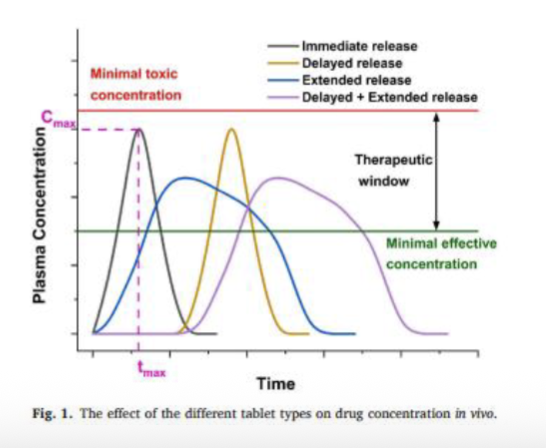
Immediate-release (non-functional)
• Benefits mentioned earlier
• No effect on dissolution/release
• Readily soluble in water
Modified-release (functional)
• Further categorised as delayed-release / gastro-resistant / enteric or extended-release coatings
Gastro-resistant films- enteric • Only soluble in water at pH values > 5–6
• Protect the drug while the dosage form is in the stomach
• Prevent the release of the drug in the stomach
• Used for colonic drug delivery systems
Extended-release/prolonged
• Insoluble in water
• Designed for controlled release over a prolonged period (6-12 hours)
• Reduces tablet burden
What is the process of film coating?
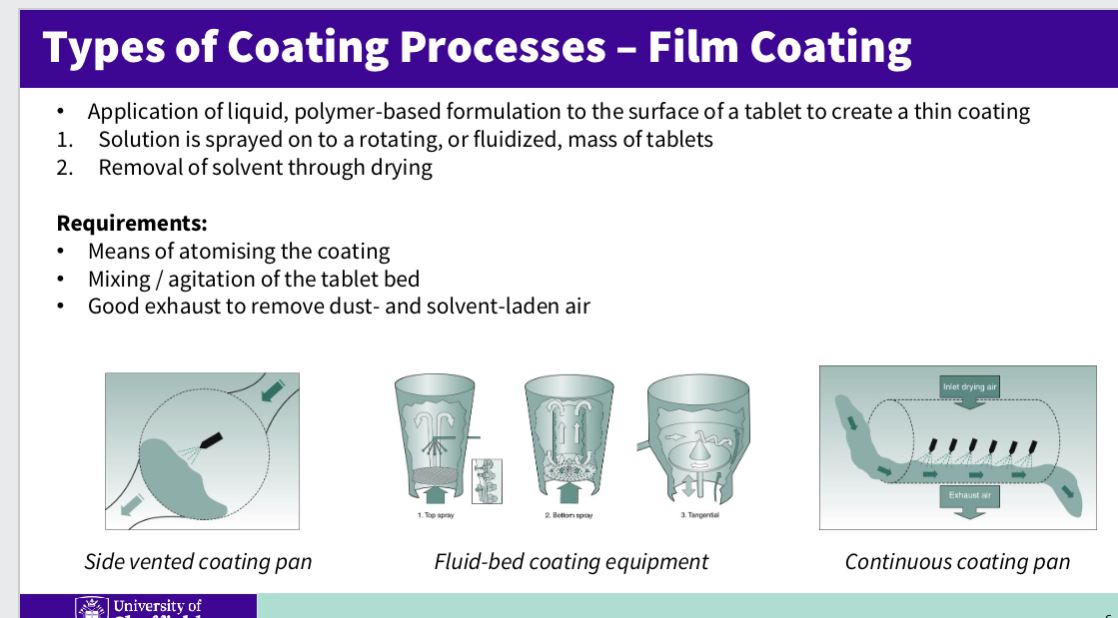
Application of a liquid, polymer-based formulation to the surface of a tablet to create a thin coating
1. Solution is sprayed onto a rotating, or fluidised, mass of tablets
2. Removal of solvent through drying
Requirements:
• Means of atomising the coating
• Mixing/agitation of the tablet bed
• Good exhaust to remove dust- and solvent-laden air
What are some formulation components and considerations for film coating?
Polymer
• Main component
• Solubility dependent on release formulation
• Viscosity can limit spray application capabilities
• Suitable mechanical properties (strength, flexibility, adhesion)
Plasticizer
• Modify physical characteristics
• Plasticiser molecules interpose between the polymer molecules to increase free volume and facilitate increased polymer chain motion within the structure of the coating
• Increased film flexibility and reduces residual stresses as it dries around the tablet
Colourants
• Appearance
• Water-soluble (dyes) or water-insoluble form (pigments)
• Pigments preferred due to their better opacity and better stability against light
Solvent
• Facilitates spray coating and rapid drying
• Organic solvents or aqueous formulations
• Many disadvantages with organic solvents (environmental issues, safety in manufacturing personnel, financial burden due to safety precautions, and solvent residue concerns
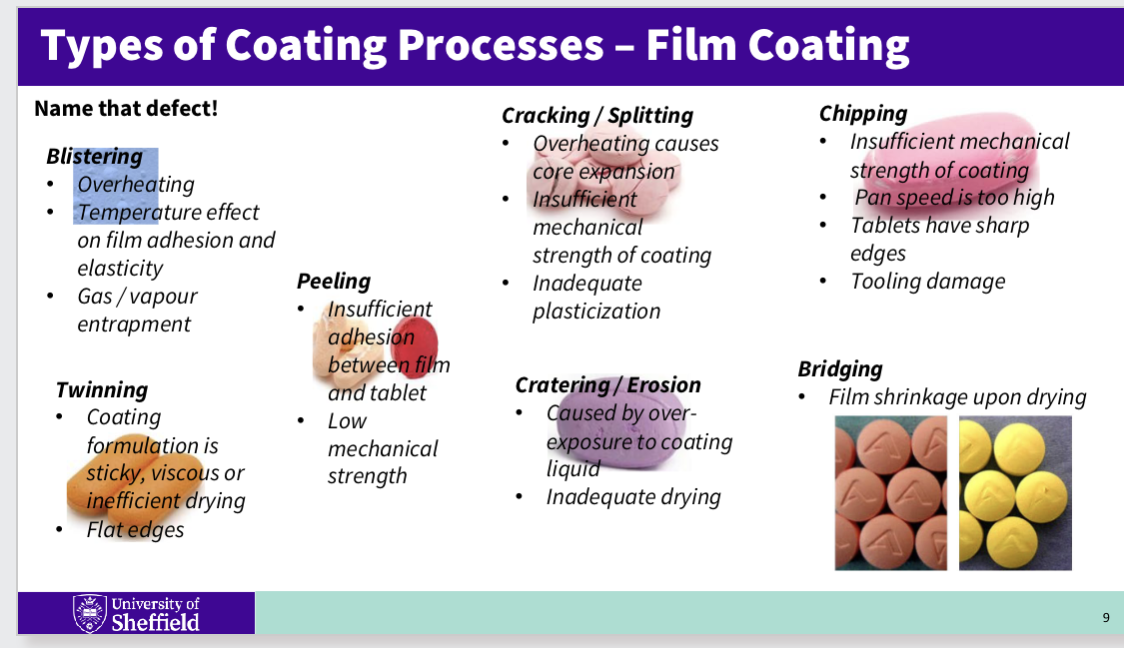
What are the different defects, and how are they caused?
What is sugar coating, and what does it include?
1. Successive application of sucrose-based coatings
2. Water evaporates from the syrup, leaving a thick sugar layer around each tablet
• Shiny and highly coloured
• Typically, an immediate-release profile
• However, a polymer can be used at the sealing step to facilitate delayed or extended-release profiles
What are the advantages and disadvantages of sugar coatings?
✓ Low cost
✓ Attractive glossy finish
✓ Taste masking
Requires specialised and trained personnel
Labour-intensive and long processing time
Can’t embossing
Weight and size increase of the tablet
What is the process of sugar coating?
1. Sealing of the tablet cores
• Initially sealed with a waterproofing or sealing coat to prevent disintegration or stability issues arising from the aqueous content of the sugar coating
2. Subcoating
• Sugar coatings are applied in substantial quantities (increasing weight by up to 50%–100%!)
• Bulking agents (e.g. calcium carbonate) are added to facilitate material build-up
• Anti-adherents (e.g. talc) are added to prevent tablets from sticking
• Binders (e.g. polysaccharide gums) are added to reduce brittleness
3. Smoothing
• Sub Coatings are usually rough; a smoothing sucrose layer is added
• Often coloured with titanium dioxide to achieve the desired level of whiteness
4. Colouring
• Normally, sucrose syrups containing either water-soluble dyes or water-insoluble pigments
5. Polishing
• Tablet surface is now smooth but dull, so wax is used to create a glossy finish
6. Printing
• Provides branding and identification
• Offset gravure (silicone pad transfers ink from a laser-etched plate), ink-jet, or pad-printing
What are the possible sugar coating defects?
Defects include:
roughness, dullness, surface debris, chipping, cracking, poor colour uniformity /marbling, twinning, sweating (excess moisture)
What is compression coating and why is it used ?
• Useful for specialised modified-release coatings or separating incompatible materials
• Compaction of granular material around a preformed tablet
• Uses specialised equipment
• Tablet cores transferred to a slightly larger die that has been partially filled with the coating powder, where the tablet undergoes a second compaction
✓ Segregate two drugs
✓ Formulated for different release times

