8.2 - population models, population momentum and environmental migrants
 Call Kai
 Learn
Learn Practice Test
 Spaced Repetition
 Match
Match Flashcards
 Knowt Play
1/15

There's no tags or description
Looks like no tags are added yet.
Name | Mastery | Learn | Test | Matching | Spaced | Call with Kai |
|---|
No analytics yet
Send a link to your students to track their progress
16 Terms
features of rapid growth age-sex pyramid
poor healthcare
short life expectancies
usually in under developed countries
features of slow/stable growth age-sex pyramid
good healthcare
long life expectancies
stable governments
mostly in developed countries
features of negative/ declining growth age-sex pyramid
good healthcare
long life expectancy
stable governments
lower than replacement rate births
found in developed countries
demographic transition model (DTM)
shows how population transitions from pre-industrial stage to an economical advanced stage
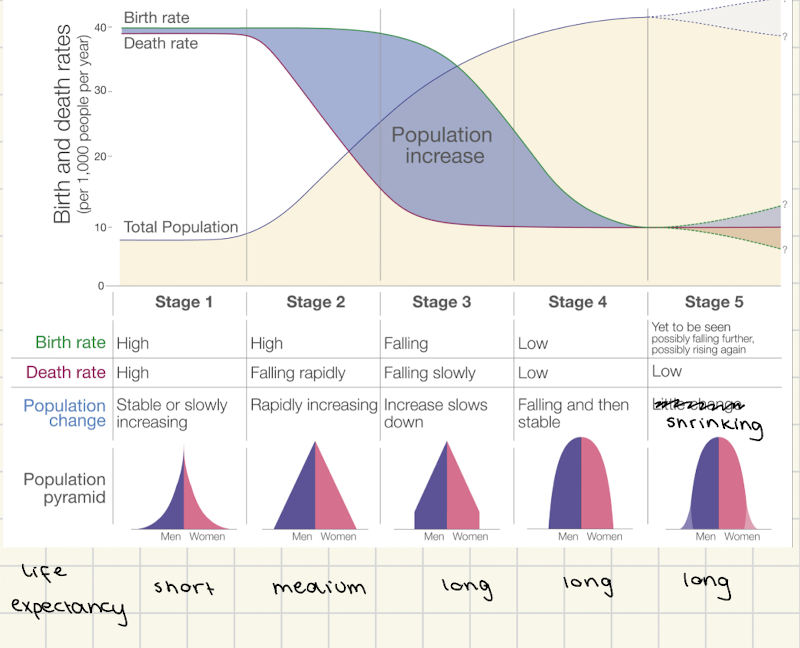
strengths of DTM model
simple framework
broad applicability
helps predict future trends
weaknesses of DTM model
assumes linear progression
overlooks external factors
doesn’t account for migration, policies and global events
stage 5 uncertainty
ignores inequalities
differences urban vs rural
impacts of populations
biocapacity deficit = cnsumption> regeneration
greater greenhouse gas emission
social and economic inequality
increased risk of crossing planetary boundaries
total dependency ratio
ratio of dependents (people typically not in the labor force) to the number of working-age individuals
TDR = (14 > x > 64 population / working age population) x 100
importance of dependancy ratio
allows for future economic, social and health needs prediction
high ratio = high nr. of people dependant on working population
limitations of TDR
many children under 14 work in LEDs
age of retirement is very fluid
population momentum
continued population growth that occurs even after fertility rates decline
due to large base of young people
wide base = high momentum = future growth
environmental migration causes
sudden onset events
slow onset events
environmental migration impacts
on livelihood
on food security
on habitat
environmental emergency migrants
temporary migrants
environmental forced migrants
leave areas due to environmental deterioration or degradation
environmental motivated migrants
avoid expected climate induced threats in the future

