Understanding Cultural Care Framework in Healthcare
 Studied by 0 people
 Call with Kai
 Learn
Learn Practice Test
 Spaced Repetition
 Match
Match Flashcards
 Knowt Play
1/56

There's no tags or description
Looks like no tags are added yet.
Name | Mastery | Learn | Test | Matching | Spaced | Call with Kai |
|---|
No study sessions yet.
57 Terms
Cultural sensitivity
Refers to awareness, understanding, and a respect for culture and its influence on people and processes.
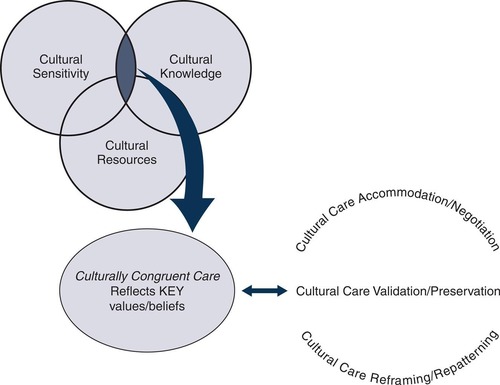
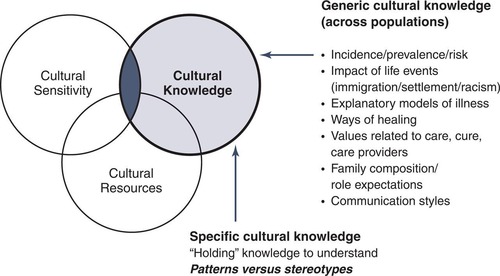
Cultural knowledge
Recognizes that cultural competence is knowledge-based care.
Cultural resources
Recognizes that clinical interactions depend on the cultural competence of the health care provider and the context of care and resources available.
Unlearning
Refers to making a conscious choice to discard an old belief or mental model and adopt a different one.
Culturally congruent, equitable care
Care that incorporates key values and beliefs of the patient and promotes best possible outcomes by recognizing and reducing barriers to access.
Equitable care
Promotes best possible outcomes by recognizing and reducing barriers to access and strengthening opportunities for participation and self-determination.
Diversity
Understanding the concepts of diversity, culture, and difference in terms of their impact on health.
Cultural identity
Understanding one's own culture and identity in terms of patterns and power.
Dynamics of difference
Understanding how to engage with issues of privilege, trust, and equity.
Cultural competence
The ability to understand, communicate with, and effectively interact with people across cultures.
Key elements of CCF
Concept of universality and diversity of culture and care, recognizing culture care values beliefs, and appreciating that cultural groups have their own knowledge and values of health.
Guiding principals and theories of CCF
Leininger's theory defined care as 'assistive, supportive, and enabling experiences or ideas toward others.'
Cultural groups
Groups that have their own knowledge and values of health.
Cultural patterns
Recurring themes and behaviors that characterize a cultural group.
Culture is dynamic
Cultural identity, like culture, is also dynamic and can shift over time and place. Culture is not static but change over time, and through different generations through "ACCULTURATION"
Identification of cultural background
In practice, the identification of the cultural background of an individual can be problematic, because the impact of culture can be conscious or unconscious.
language and culture
Language is one of the instruments through which culture is transmitted and expressed.
race
The term ____ is quite different from culture and has been used to refer to a group of people characterized by certain common physical features.
social construction of race
It is now thought that races are socially and culturally constructed categories that have little to do with actual biological differences.
Ethnicity
Ethnicity refers to social groups that distinguish themselves from other groups by a common historical path, behavioral norms, and their own group identities.
cultural features vs. ethnicity
Culture refers to manifested characteristic behavioral patterns and value systems, while ethnicity refers to a group of people that share a common cultural feature or root culture.
Minority Groups
A minority is a relatively smaller group that is identified in relation to a majority group in society.
social disadvantages of minorities
Strictly speaking, minority groups may not automatically suffer from social disadvantages.
ascribed identities
Identities are often ascribed by others and may have different meanings for others than for the individuals being appraised or labelled.
Challenges of Understanding Culture
Comprehending another person's culture through his or her language can be quite challenging.
Physical features of Race
This aspect of people has been used to refer to a group of people characterized by certain common physical features, such as color of skin, eyes, and hair.
Common Characteristics of Ethnic Groups
Members of an ethnic group may share a common language, religion, culture, racial background, or other characteristics that make them identifiable within their own group.
Behavioral Norms in Ethnicity
Ethnicity involves behavioral norms that distinguish social groups from one another.
cultural transmission
Through language, a person communicates not only semantic meanings, but also underlying conceptions, values, and attitudes.
cultural identity
Influences interpretation of events and interactions with others and is associated with experiences of marginalization or privilege depending on the social power or importance associated with that identity.
cultural sensitivity
- Requires that health care providers become aware of their own assumptions and avoid labelling and judging people. - --Understanding own values, biases, prejudices, and privilege; self-awareness is a critical component of cultural competence.

Privilege
Right or benefit available to specific person(s) or a restricted group that exceeds the advantages available to others.
White Privilege/Whiteness
Unearned power that is grounded in values of the dominant White society and allocated to White people without a specific request by individuals.
Meritocracy
A belief that individual success is solely based on merit, hard work, ability, and accomplishment.
Equity
Focuses on equality of outcomes, contrasting with equality which focuses on equality in the process.
Barriers to Equity
Five barriers which can transform barriers into building blocks: Information, Connections, Experience and expertise, Resources, Decision making.
Cultural identifiers
Categories of identity that reflect class diversity.
social disadvantage
Condition where minorities encounter mistreatment and discrimination by the majority.
marginalization
The process through which certain groups are pushed to the edge of society, limiting their access to resources and opportunities.
Dominant norm
The prevailing standard or expectation in society that influences cultural identity.
trust
A critical component in relationships between health care providers and patients.
social power
The influence and authority that certain identities hold within a society.
experiences of privilege
The benefits and advantages that individuals or groups experience based on their identity.
culturally competent health care providers
Professionals who must navigate their own biases while providing care to diverse populations.
information barrier
A barrier that can be transformed into a building block when its influence is recognized and purposefully used to improve accessibility, credibility, and relevance.
accessibility
The ease with which information is conveyed in the patient's language and appropriate literacy level, assessing understanding and inviting questions.
credibility
The quality of information coming from sources that are deemed credible and trusted, such as community leaders and healers.
relevance
The quality of information that uses and builds on concepts familiar and important to the patient, recognizing patient perspectives and needs.
generic cultural knowledge
Basic knowledge about cultural domains and processes that apply across a wide variety of cultural groups.
specific cultural knowledge
Knowledge that focuses on specific cultural groups or aspects of care influenced by culture.
Monochromatic time (m-time)
A time orientation characterized by schedules, structure, logic, linear thinking, and rationality, typical of low-context cultures like Canada and the United States.
Polychromatic time (p-time)
A time orientation where schedules are less important than relationships, allowing for multiple tasks to be done at once, typical of high-context cultures.
transportation issues
Challenges related to transportation that may affect a patient's ability to meet appointment times.
work issues
challenges related to employment that may affect a patient’s ability to meet appointment times
childcare issues
Challenges related to finding childcare that may affect a patient's ability to meet appointment times.
support system navigation
The need for a friend or family member to accompany a patient for support and assistance in navigating the healthcare system.
explanatory model of illness
A framework that helps understand how individuals perceive and interpret their health conditions.
 Note
Note  Flashcards (58)