IST Midterm
 Studied by 0 people
 Call Kai
 Learn
Learn Practice Test
 Spaced Repetition
 Match
Match Flashcards
 Knowt Play
1/28

Earn XP
Description and Tags
○ = not on study guide; CH1: 1-9, CH2: 10-21, CH3: 22-
Name | Mastery | Learn | Test | Matching | Spaced | Call with Kai |
|---|
No analytics yet
Send a link to your students to track their progress
29 Terms
Data ○
stored representations of meaningful objects and events
structured: numbers, text, dates
unstructured: images, video, documents
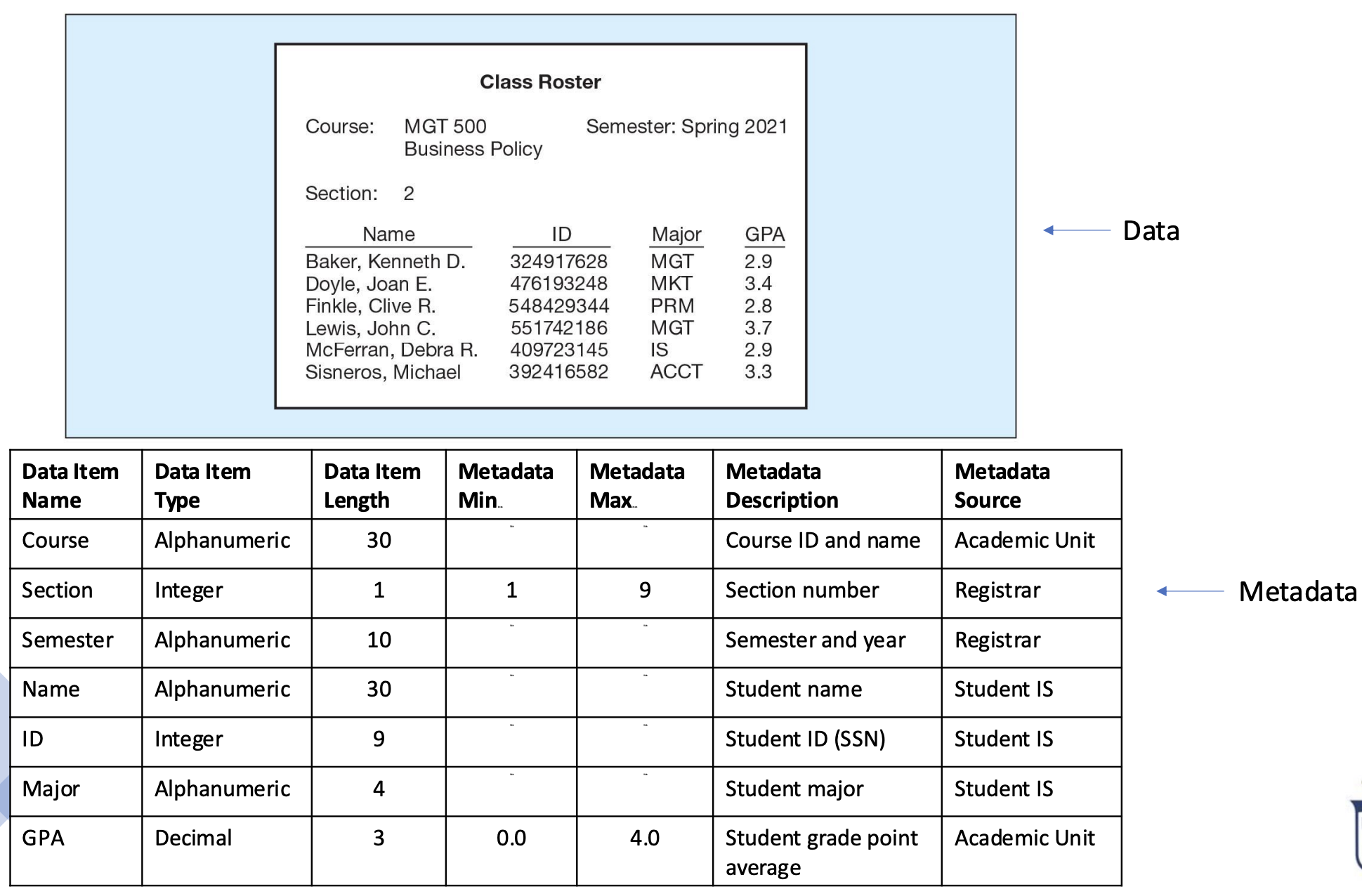
Metadata
data that describes the properties and context of user data
Data & Metadata example
Database
organized collection of logically related data
data stored in one place can be related to data stored in another place
data feeds into programs that manipulate and analyze it
operational: reflects organization dynamic transactions
analytical: reflects the organization's static or historical data
database model ○
architecture that the DMBS uses to store objects within the database and to relate them to one another
The database approach ○
central repository of shared data
data is managed by a controlling agent
stored in a standardized, convenient form
requires a Database Management System
Database management system (DBMS) ○
a software system that is used to create, maintain, and provide controlled access to user databases
Advantages of the Database Approach
Program-data independence
Planned data redundancy
Improved data consistency
Improved data sharing
Increased application development productivity
Enforcement of standards
Improved data quality
Improved data accessibility and responsiveness
Reduced program maintenance
Improved decision support
Costs and Risks of the Database Approach
New, specialized personnel
Installation and management cost and complexity
Conversion costs
Need for explicit backup and recovery
Organizational conflict (e.g., conflicts on data definitions, data formats and coding, rights to update shared data)
Are statements that define or constrain some aspect of the business
Are derived from policies, procedures, events, functions
Assert business structure
Control/influence business behavior
Are expressed in terms familiar to end users
Are automated through DBMS software
example: A student may register for a section of a course only if he or she has successfully completed the prerequisites for that course.
Define how entities interact, what constraints are applied, and how data should be organized and validated.
Ensure the ERD accurately reflects business requirements, supports data integrity, and provides a solid foundation for the database design.
Entity ○
a person, a place, an object, an event, or a concept in the user environment about which the organization wishes to maintain data
categories strong, weak, and associative
Associative Entity ○
A special type of entity that is used to represent and manage many-to-many relationships between two other entities.
Helps in normalizing the database schema by avoiding redundant data and ensuring that relationships are managed efficiently.
Attribute ○
property or characteristic of an entity or relationship type
Required vs. Optional Attributes
Simple vs. Composite Attribute
Single-Valued vs. Multivalued Attribute
Stored vs. Derived Attributes
Identifier Attributes
One-to-Many Relationship Cardinality
Data integrity ○
Mechanisms for implementing business rules that maintain integrity of manipulated data
All relations are in…
1st Normal form
Relation
A _______ is a named, two-dimensional table of data
Consists of rows (records) and columns (attribute or field)
Requirements for a table to qualify as a relation:
It must have a unique name.
Every attribute value must be atomic (not multivalued, not composite).
Every row must be unique (can’t have two rows with exactly the same values for all their fields).
Attributes (columns) in tables must have unique names.
The order of the columns must be irrelevant.
The order of the rows must be irrelevant.
Integrity Constraints
Mechanisms for maintaining the integrity of stored data.
Domain Constraints
Entity Integrity
Referential Integrity
Domain Constraints (Integrity Constraints)
Allowable values for an attribute (includes data types and restrictions on values, e.g., NOT NULL)
Entity Integrity (Integrity Constraints)
No primary key attribute may be null. (All primary key fields MUST contain data values.)
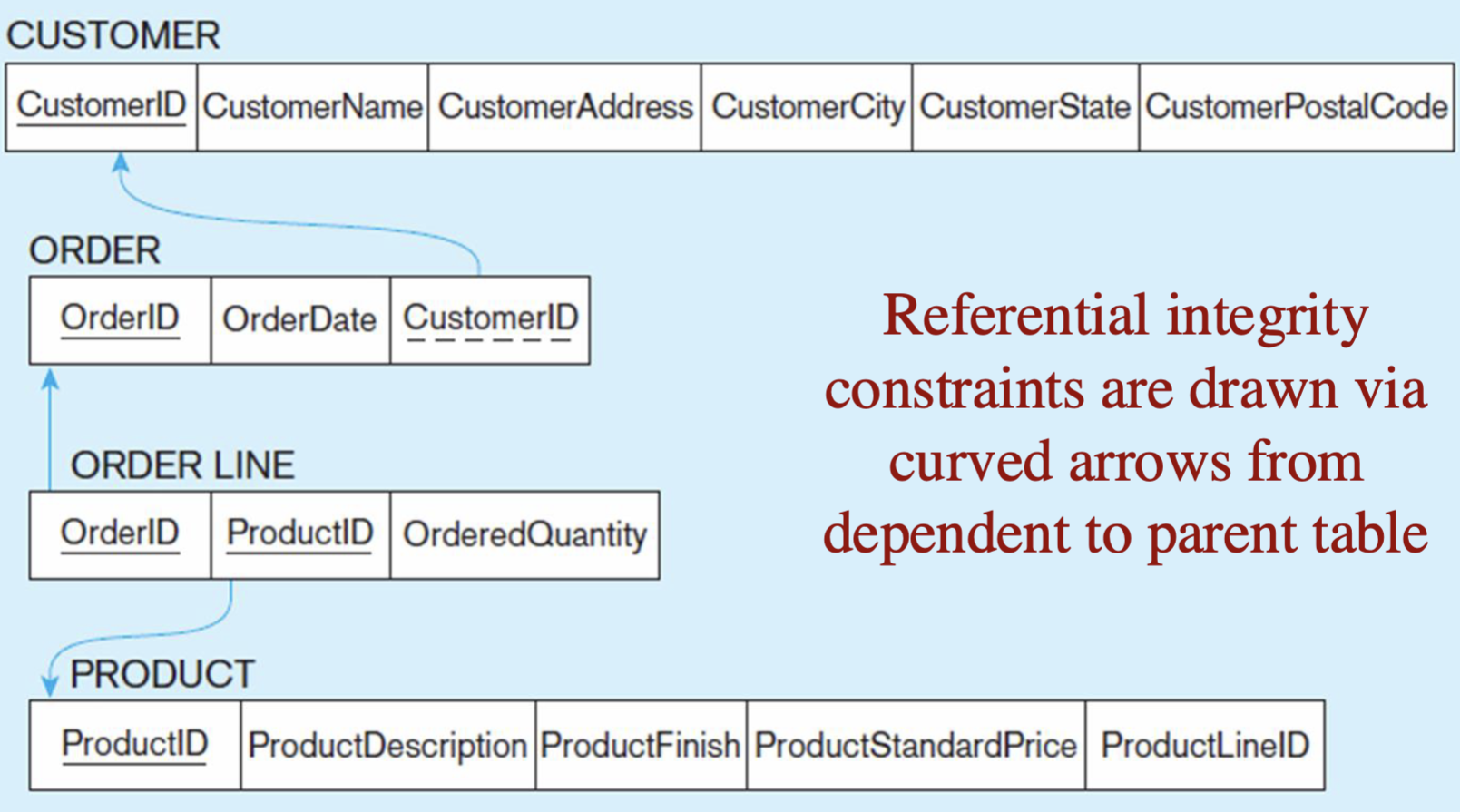
Referential Integrity (Integrity Constraints)
Rules that maintain consistency between the rows of two related tables.
Rule states that any foreign key value (on the relation of the many side)
MUST match a primary key value in the relation of the one side. (Or the foreign key can be null.)
• For example: Delete Rules
• Restrict–don’t allow delete of “parent” side if related rows exist in
“dependent” side
• Cascade–automatically delete “dependent” side rows that correspond with
the “parent” side row to be deleted
• Set-to-Null–set the foreign key in the dependent side to null if deleting from
the parent side (not allowed for weak entities)
Referential Integrity Picture (Integrity Constraints)
 Note
Note  Flashcards (33)