Physics 2 Test 2
 Call Kai
 Learn
Learn Practice Test
 Spaced Repetition
 Match
Match Flashcards
 Knowt Play
1/56

Earn XP
Description and Tags
ananta
Name | Mastery | Learn | Test | Matching | Spaced | Call with Kai |
|---|
No analytics yet
Send a link to your students to track their progress
57 Terms
In the presence of an electric field, electrons in a conductor move with an average velocity known as:
Drift velocity.
If two copper wires of the same thickness have different length at room temperature, then the longer wire has
same resistivity.
For resistors in parallel, voltage across each resistor is what?
The voltage across each resistor is the same.
A wire has a resistance R & resistivity ρ. If its length and diameter are BOTH cut in half, what will be its resistance?
2R
When resistors are connected in series:
Voltage across different resistor is different.
Total resistance is more than that of any individual one.
Current through each resistor is same.
All of the above statements are correct.
All of the above statements are correct.
The resistance (R) of a conductor depends on all of the following EXCEPT:
Length (L) of the conductor.
Cross-sectional area (A) of the conductor.
Material’s resistivity (ρ).
Applied voltage (V).
Applied voltage (V).
Nonohmic materials are characterized by:
A nonlinear relationship between current and voltage.
What does Kirchhoff’s loop rule state?
The sum of potential differences in a closed loop is zero.
To measure the potential difference across a resistor, a voltmeter is connected in series.
False
The drift velocity of electrons in a conductor is zero in the absence of an electric field.
True
The terminal potential difference of a real battery equals its emf when no current is drawn.
True
Ohm’s Law states that the current through a conductor is inversely proportional to the potential difference across it.
False
If current in a conductor flows in the +x direction, how is the magnetic field oriented according to right-hand rule?
circular around the wire, counterclockwise if viewed from the +x direction.
What describes the force on a moving charge in a magnetic field?
always perpendicular to both the velocity and the magnetic field.
Two parallel wires carry currents in the same direction. How do they interact?
they attract each other.
What is the torque on a current loop in a uniform magnetic field if the loop’s plane is parallel to the field?
zero.
What is the total force on a charged particle moving in both electric and magnetic fields called?
lorentz force.
The direction of the magnetic field around a current-carrying wire can be determined using the left-hand rule.
false
A particle moving in a plane perpendicular to the magnetic field undergoes uniform circular motion.
true
Two parallel wires carrying currents in opposite directions will repel each other.
true
A charged particle moving parallel to a magnetic field experiences maximum force.
false
In a velocity selector, particles with any speed can pass through undeflected.
false
what is the magnetic field inside an ideal solenoid?
uniform and parallel to the axis of the solenoid.
which law states that the magnetic flux through a closed surface is always zero?
Gauss's Law for Magnetism.
What does Ampère’s Law mathematically express?
the circulation of the magnetic field around a closed loop.
Inside a wire (r < R), how does the magnetic field vary with distance r?
it increases linearly with r.
At large distances (z >> R), how does the magnetic field of a current loop behave?
like a dipole.
a magnetic monopole (a single north or south pole) does not exist in nature.
true
the magnetic field at the center of a current loop is zero.
false
the magnetic field at a point outside a long solenoid is uniform and equal to the field inside.
false
the magnetic field due to a straight wire is circular around the wire.
true
Ampère’s Law is valid only for symmetrical current distributions.
false
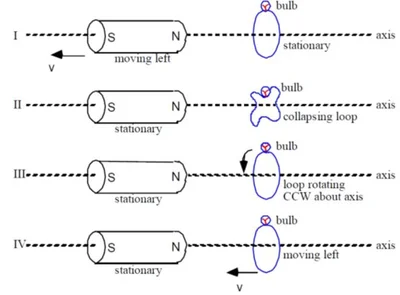
in which of the following figures will the light bulb be glowing?
I, II, IV
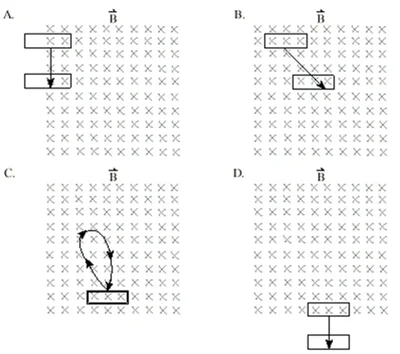
in which of the following situations would an induced emf be produced in a rectangular loop of wire?
Figure D.
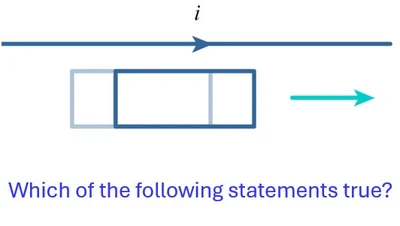
a conducting loop moves at a constant speed parallel to a long, straight, current‑carrying wire, as shown in the figure.
there will be no induced current in the loop.
Which of the following statements is FALSE?
an emf is induced in a loop of wire by moving it near a magnet.
a changing magnetic field can produce an electric current.
an emf is induced in a loop of wire by changing the current in it.
an emf is induced in a loop of wire by keeping a stationary magnet near it
an emf is induced in a loop of wire by keeping a stationary magnet near it
A circular loop of wire lies in the plane of the paper. An increasing magnetic field points out of the paper.
clockwise
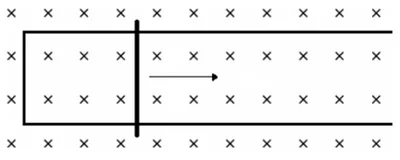
a conducting rod moves horizontally on a set of conducting rails at a constant velocity through a magnetic field below.
the induced current in the circuit is counterclockwise.
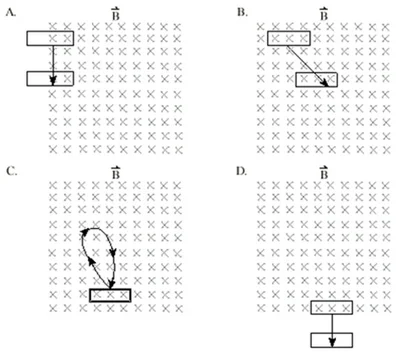
In which of the situations can an emf be induced in a rectangular loop of wire? The loop of wire is moved as indicated.
Figure D
Lenz’s Law states that the direction of the induced current in a loop is such that it:
opposes the change in magnetic flux.
According to Faraday’s Law of Induction, an emf is induced in a conductor when:
the magnetic flux through the conductor changes.
the self-inductance of a solenoid depends on:
the number of turns per unit length, cross-sectional area, and its length.
Lenz’s Law is a consequence of the conservation of energy.
true
the potential difference across an inductor opposes the change in current.
true
an electric current can be induced in a loop by a changing magnetic field through it.
true
the emf is induced in a coil as long as a constant magnetic flux passes through it.
false
Which of the following statements about capacitive reactance is TRUE?
it decreases with increasing capacitance.
it increases with increasing capacitance.
it doesnt change.
it decreases with increasing capacitance.
In an AC circuit with only a resistor, how are the current and voltage related?
current and voltage are in phase.
In a series RLC circuit the total impedance
is never less than R.
The average value of a 12 V peak sine wave over one complete cycle is
0 V
In a capacitor AC circuit, how does the current relate to the voltage?
current leads voltage by π/2.
a pure inductor
does not dissipate energy but only stores it.
At resonance in an RLC circuit, what happens to the impedance?
It is minimized and equal to R.
a transformer works on the principle of:
electromagnetic induction.
In an inductor AC circuit, Current leads voltage by π/2.
false
In a series RLC circuit, the inductor voltage (VL) leads the capacitor voltage (VC) by π.
true
in a step down transfermer, the nuber of turns in primary coil is less than that in seconodary coil.
false

