Forensic Science: Crime Scene Investigation and Evidence Analysis
 Studied by 0 people
 Call Kai
 Learn
Learn Practice Test
 Spaced Repetition
 Match
Match Flashcards
 Knowt Play
1/130

There's no tags or description
Looks like no tags are added yet.
Name | Mastery | Learn | Test | Matching | Spaced | Call with Kai |
|---|
No analytics yet
Send a link to your students to track their progress
131 Terms
Who are the members of the CSI team?
Police Officers, Crime Scene Investigators, Medical Examiners, Detectives, Specialists
What is the role of Police Officers in a CSI team?
Secure the scene, ensure safety, separate witnesses
What is the role of Crime Scene Investigators?
Examine and collect evidence
What is the role of Medical Examiners?
Examine the dead body
What is the role of Detectives?
Develop cases using reports about evidence
What types of crime labs exist?
Federal, State, Regional, Local
Who runs Federal crime labs?
Department of Justice (DOJ)
What is the largest crime lab in the world?
FBI
What are the seven S's of crime scene investigations?
Secure, Separate, Scan, See, Sketch, Search, Scene evidence collection
What does it mean to secure the scene?
Ensure safety and restrict access
What is collusion?
When witnesses discuss a crime and alter their stories
What are the different types of searches?
Point to Point, Line search, Grid Search, Quadrant, Spiral, Arial
What should be documented on a crime scene sketch?
Date, Time, Location, Sketching officer, North, Scale
When is a search warrant needed?
To search private property unless permission is given or in emergencies
What is the difference between a primary and secondary crime scene?
Primary is the initial scene; secondary is connected but not adjacent
What is a point-to-point search?
A preliminary search that requires a more thorough follow-up
What are rectangular coordinates?
Measured using two walls to locate an object
What is a datum point?
A permanent reference point for measurements in a crime scene
What types of lenses do crime scene photographers use?
Telephoto, Wide Angle, Macro, Multipurpose
What is the function of a tripod in crime scene photography?
To steady the camera and prevent blurry pictures
What is the progression of photographs taken at a crime scene?
Long range or overview photographs first
What are the types of photographs taken at a crime scene?
Long range, medium range, close up, and identification quality photographs.
What should a CSI do first before photographing the scene?
Ensure the crime scene is in an unaltered condition.
How can blood evidence be enhanced in photography?
By spraying it with luminol and turning off the lights.
What is Locard's Exchange Principle?
When a person contacts an object or another person, a cross transfer of physical evidence can occur, depending on the duration and intensity of that contact.
What is direct evidence?
Evidence such as an eyewitness account or video/audio recording.
What is circumstantial evidence?
Class evidence found at a scene.
What is the difference between class and individual evidence?
Individual evidence can be traced to a specific individual (like DNA), while class evidence belongs to a group (like tire brand).
How is biological evidence collected?
In a breathable container like a paper bindle or paper evidence bag.
How is liquid or arson evidence collected?
In an airtight, non-breakable container.
What is the process of maintaining a chain of custody?
Evidence is collected, sealed, labeled, and logged, with signatures at each step.
Why are photographs taken at a crime scene?
To document the scene's original condition, assist investigators, and serve as visual evidence in court.
What is the importance of a photo-log in an investigation?
It helps track what pictures were taken and in what order for easy reference.
What is needed for outdoor photography at a crime scene?
An external lighting source and GPS coordinates for the photographs.
What was a key issue in the OJ Simpson case?
The evidence was not handled properly, leading to questions about its integrity.
What are the functions of hair?
Keeps the body warm, protects from pathogens, decreases friction, and protects from sunlight.
What is hair primarily composed of?
Keratin.
What are the three layers of hair?
Cuticle (outer coating), cortex (protein-rich structure), and medulla (central core).
What characteristics of hair are determined by genetics?
Texture, color, thickness, and amount of hair.
What are the differences between animal and human hair?
Animal hair has a thicker medulla and can have banding patterns; human hair has a thinner medulla and no banding.
What are sources of natural fibers?
Plant (cotton, hemp), animal (wool, silk), and minerals (fiberglass, asbestos).
What are some types of synthetic fibers?
Polyester, rayon, celenese, nylon, and acrylic.
What are plant fibers made of?
Cellulose.
Why do investigators need to collect fibers quickly?
Fibers can be gone from a scene within the first 24 hours.
What are patent, latent, and plastic impressions?
Patent impressions are two-dimensional and visible to the eye; latent impressions are not visible and require techniques to lift them; plastic prints are three-dimensional impressions left in a soft surface.
How do you preserve an impression made in soft soil or sand?
Spray it with hair spray to hold the soil/sand in place and then use plaster to make a cast.
What factors make a footprint unique?
Wear pattern on the shoe and size.
What can a shoe impression tell you about the person wearing the shoe?
Weight, height, how they walk, and possible injuries.
What factors can make a tire impression individual evidence?
Individual marks in the tire tread, wear patterns, and any pebbles embedded in the tread.
What is track width?
The measurement between the back wheels or front wheels of a vehicle.
What is wheelbase length?
The measurement from the front axle to the back axle of a vehicle.
How can turning diameter of a vehicle be useful in a forensic investigation?
Different vehicles have specific turning diameters that can help identify the type of vehicle at a crime scene.
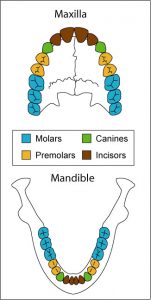
What are the different types of teeth?
Incisors (cutting), canines (cutting), and molars (chewing).
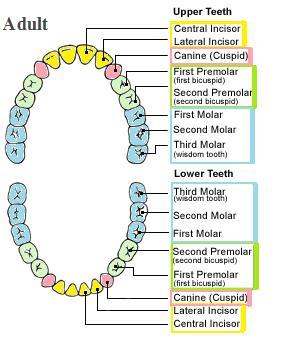
Why are dental impressions considered individual evidence?
Teeth are unique to each individual.
How do you compare dental marks to determine if they belong to a specific individual?
Measure the size and spacing of the teeth.
What can you learn from a person's dental impressions?
Health of teeth, possible nutrition, and age.
What types of crime scenes do forensic investigators collect tool mark evidence?
Burglary scenes.
What are the class characteristics of tool mark evidence?
Make, model, shape, type of impression, and general dimensions of the tool.
What are the individual characteristics of tool mark evidence?
Unique marks and chemical composition of the tool.
What are the two ways that tool marks can be classified?
Class evidence (shape and type of mark) and individual evidence (composition and unique patterns).
What is luminol used for?
To detect blood that has been cleaned up at a crime scene.
How do you preserve an impression or tool mark when you cannot take the material?
Make a cast of the impression.
What are the three categories of tool mark evidence?
Indentation, abrasion, and cutting.
When and how are fingerprints ridges formed?
They are formed during the 10th week of pregnancy from the basal skin layer.
What are the three types of fingerprints?
Arches, whorls, and loops.
Which type of fingerprint is the most common?
Loops.
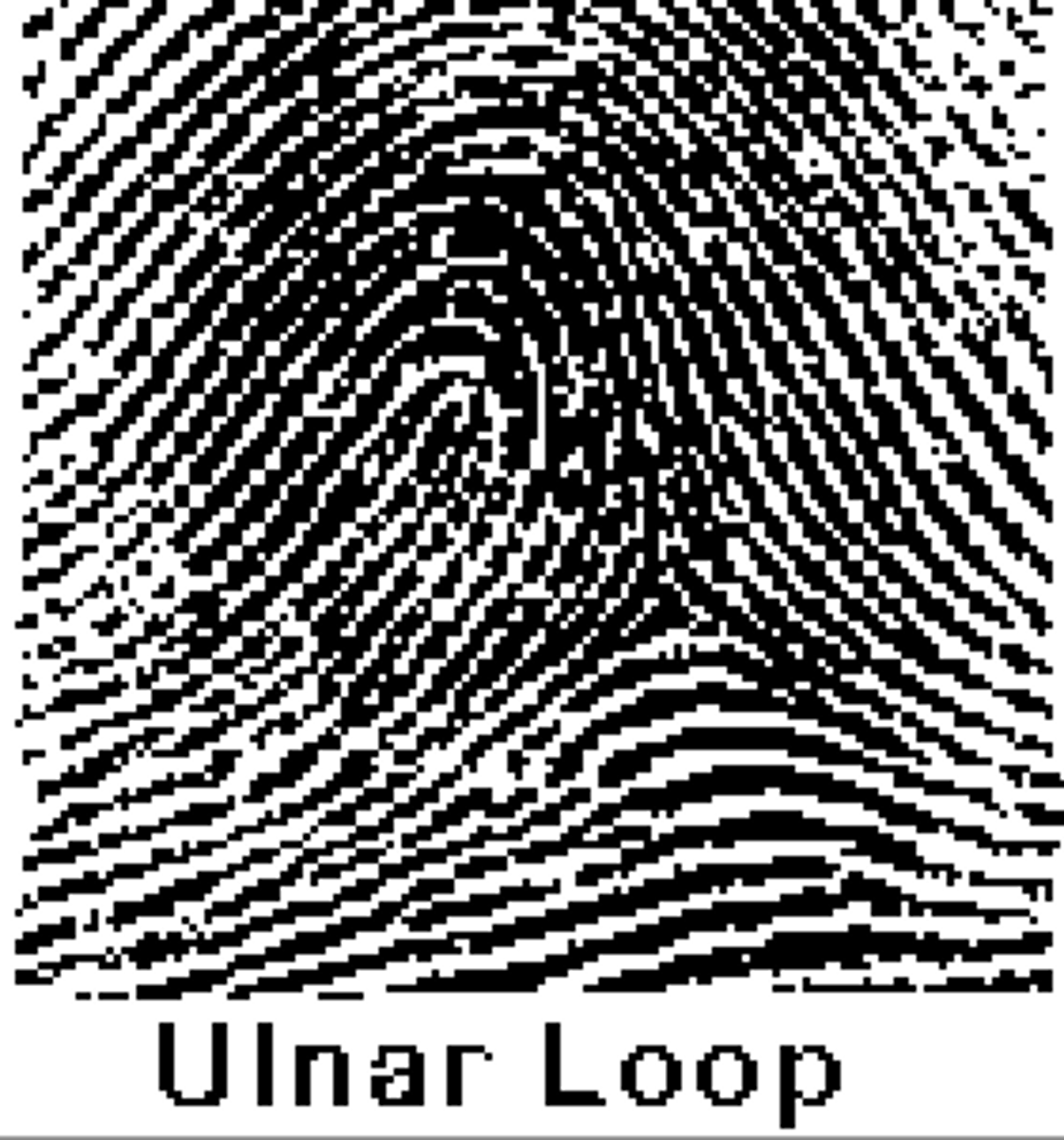
What are patent, latent, and plastic fingerprint impressions?
Latent prints are not easily visible; patent prints are visible and made with substances; plastic prints are 3-D impressions in soft surfaces.
How are fingerprints left behind?
Oils from fingers mix with dirt and dust, leaving a print.
What is the study of the uniqueness of finger ridge structures called?
Dactyloscopy.
What are minutiae in fingerprints?
Small characteristics of ridge patterns.
What is the name of the fingerprint database created by the FBI?
Automated Fingerprint Identification System (AFIS).
What methods are used to visualize latent prints?
Dusting and chemical lifting.
Why do false matches occur in fingerprint analysis?
Human error in reading or entering prints into the database.
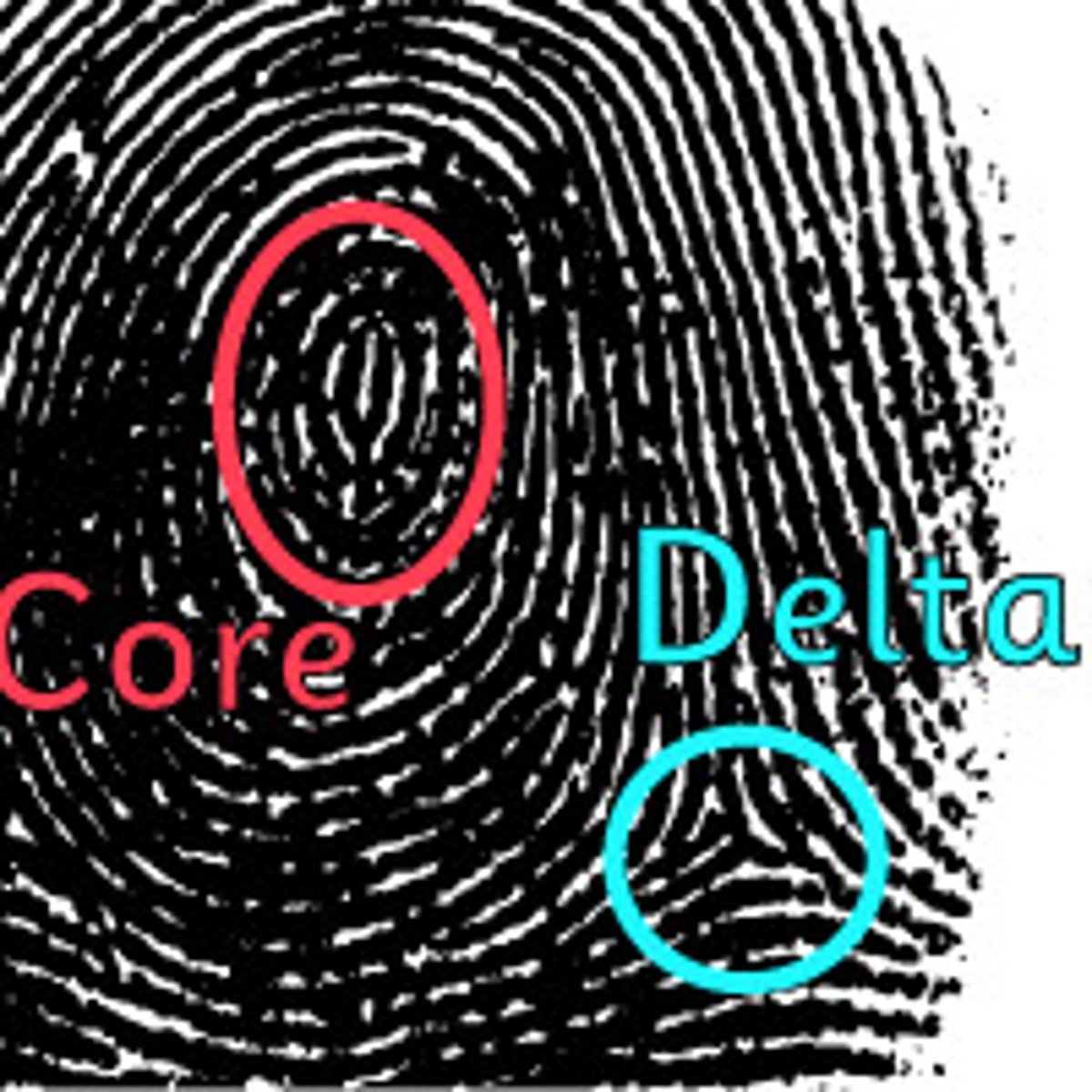
What is a delta in a fingerprint?
A triangle-shaped minutia found on prints except for plain arches.
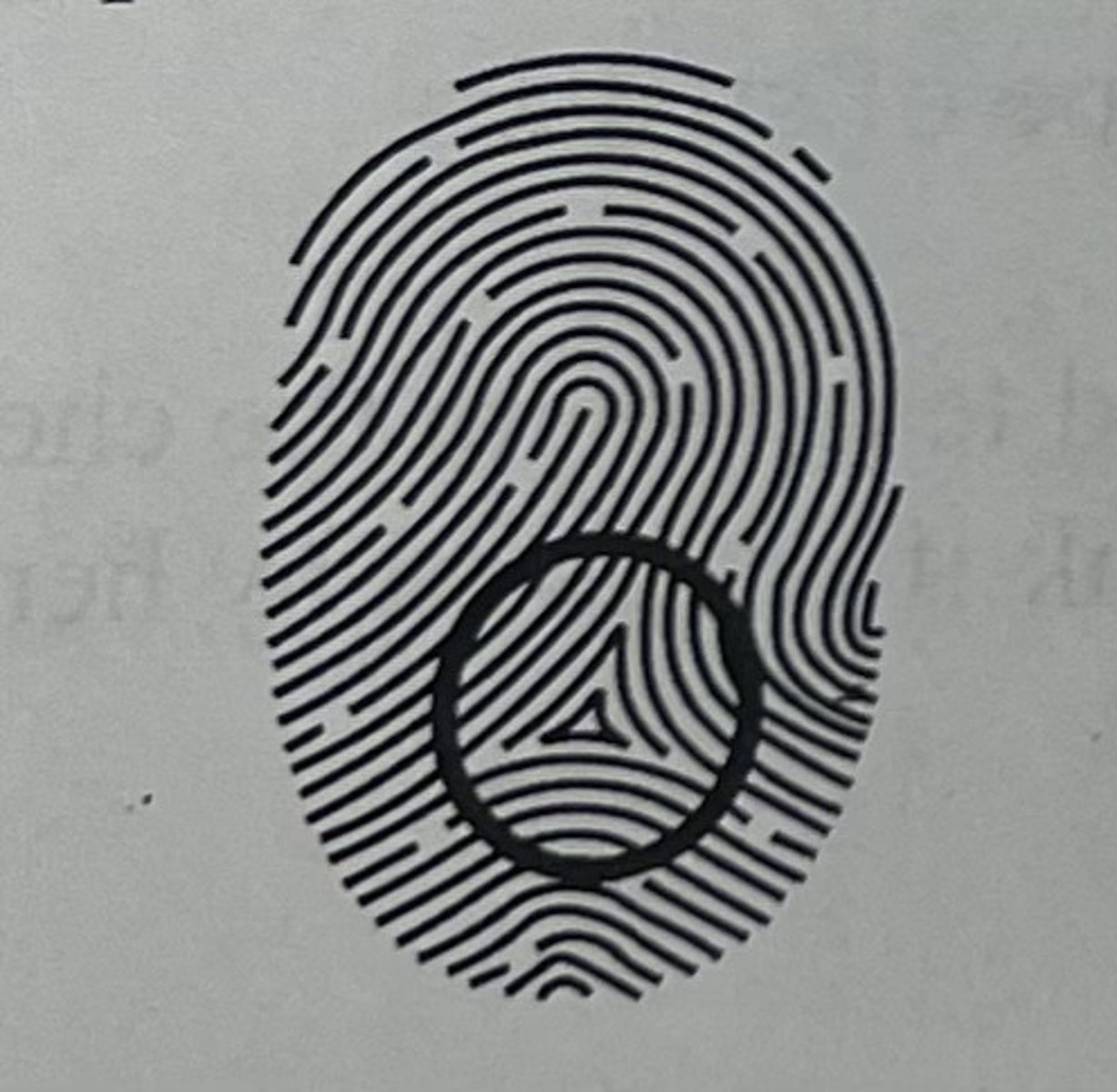
What is the core of a fingerprint?
The center of the circular part of a whorl or loop.
How does superglue fuming work?
Cyanocrylate vapor attaches to moisture in the air and turns fingerprints white.
Federal Crime Lab
Run by the Department of Justice (DOJ), Includes the FBI (largest crime lab in the world), ATF (Alcohol, Tobacco, Firearms and Explosives), DEA (Drug Enforcement Agency), and US Postal Service Investigation Services
State: Crime Lab
Crime Labs run by the state, In Texas the state crime lab is run by TxDPS (Texas Department of Public Safety).
Regional
In Texas, the state crime lab services are broken up into regions for faster services.
Local Crime lab
Harris County Sherriff’s Office and Houston Police Department.
Secure the scene
Make sure everyone is safe and does not need medical attention, then rope off the scene to restrict access.
Separate the witnesses:
Separate the witnesses to avoid COLLUSION
Scan the scene:
Look over the scene to get an idea of what may have happened, the size of the scene and where evidence may be located
See the scene:
Take pictures of everything that may be important to the case
Sketch the scene:
Make a detailed sketch using exact measurements
Search for evidence:
Use the best search method for your scene to locate all evidence
Scene evidence collection:
Collect all evidence an put in correct package using the chain of custody procedures
Point to Point:
Quick scan or overview of the scene
Line search:
Back and forth in a pattern across the room or outside. Works well when you have a large space like an acre to go over
Grid Search :
Line search going in both directions to create a grid. More thorough
Quadrant:
Split a large building or field into smaller units to search, works where you have multiple rooms to look at
Spiral:
Start in the center of the room and walk in a spiral to cover all of the floor space. God for indoor scenes
Arial:
Good for when you have multiple acres of land to look at
Why would you go back and search a crime scene after you have already performed a search?
1. To check and make sure you did not leave any tools behind before leaving the scene 2. You are missing a specific item that you think should be present (like a weapon or piece of evidence)
What is the difference between rectangular and polar coordinates and which one is used more often?
Rectangular coordinates is what you used when you measured the location of an object using two walls. Polar coordinates is measuring from the datum point.
What is datum point? Give some good examples of indoor and outdoor datum points
A permanent point in a crime scene that is used to measure from or to mark direction North from. Indoor datum points can be walls corners, or other permanent features (not a couch, tv, chair etc.). Outdoor datum points can include a telephone pole, corner of a building etc. (not a car or movable object)
What types of lenses do crime scene photographers use? What is the function of each type of lens?
Telephoto: Lense can focus on objects far away Wide Angle: Takes large landscape type photos Macro: Used to see small details close up Multipurpose: Can do multiple of the functions above
Describe the progression of photographs taken at a crime scene.
1. Long range or overview photographs: Includes the entire crime scene and surrounding area 2. Medium Range photographs: Includes evidence and items around the evidence 3. Close Up Photographs: Includes evidence to where you can see what they evidence is 4. Identification quality photographs: allows you to see details of each piece of evidence to be able to identify it or the victim
which step should a CSI always do 1st before photographing the scene?
To make sure the crime scene is in an unaltered condition
What is the difference between class and individual evidence?
Individual evidence is evidence that can be traced to a certain individual like DNA, fingerprints, wear pattern on shoes etc. Class evidence belongs to a class of items like, brand of tire, style of shoe, color of thread
 Note
Note  Flashcards (99)