Combustion
 Studied by 0 people
 Call Kai
 Learn
Learn Practice Test
 Spaced Repetition
 Match
Match Flashcards
 Knowt Play
1/6

There's no tags or description
Looks like no tags are added yet.
Name | Mastery | Learn | Test | Matching | Spaced |
|---|
No study sessions yet.
7 Terms
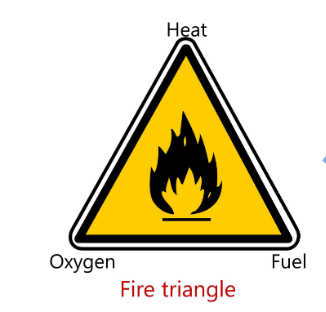
Fire triangle
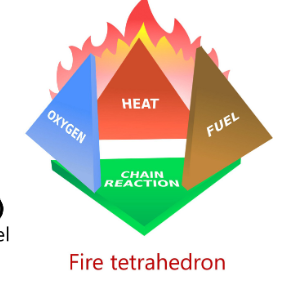
fire tetrahedron
1. Fuel – material that burns
2. oxygen
3. Heat – ignition source
4. Chemical chain reaction – sustains combustion
Open vs closed systems
· Open system:
o Oxygen is freely available from the air.
o Pressure doesn’t build up significantly.
o Common in fires and deflagrations (e.g., burning wood, gasoline fire).
· Closed system:
o Limited oxygen supply.
o Pressure can rise rapidly.
o Common in confined explosions or detonations (e.g., bomb casing).
Deflagration definition:
· Rapid combustion where the flame front moves slower than the speed of sound
detonation definition:
Extremely rapid combustion where the reaction front moves faster than the speed of sound
Analytical scheme for deflagration
- Collect → Extract/Desorb → Analyze → Interpret
o Collect: debris + ACS (activated carbon strips)
o Extract/Desorb: solvent extraction, SPME(solid phase micro extraction), thermal desorption
o Analyze: GC‑MS
o Interpret: match to accelerant patterns
- Note: it is important to understand the background because the polymeric sample may look like an ignitable liquid
Physical evidence from detonation (shrapnel)
pieces of casing, metal, or objects propelled by the blast
 Note
Note  Flashcards (312)