ESS W3 L1 pt 1 climate change
 Call Kai
 Learn
Learn Practice Test
 Spaced Repetition
 Match
Match Flashcards
 Knowt Play
1/33

Earn XP
Description and Tags
atmosphere and oceans: basics of climate change
Name | Mastery | Learn | Test | Matching | Spaced | Call with Kai |
|---|
No analytics yet
Send a link to your students to track their progress
34 Terms
The earth system and climate change fundamentals:
Earth systems interconnectivity and climate feedbacks, tipping points
Earth’s energy budget
Greenhouse effect
Earth’s energy imbalance and radiative forcing
Climate risk assessments: understanding shared socio-economic pathways (SSPs)
Radiative forcings:
Many components of the earth’s system can influence another
Many of these can be disrupted by changes in our climate
Earth: a remarkable planet for life
The climate system refers to the long term mean temperature and conditions of the climate at the surface of the earth and shifts the attention to:
the atmosphere and the oceans
elements like carbon dioxide and methane and their cycling
phosphorus which carry energy and information (ADN)
the ice sheets like the one in Greenland or West Antarctica
rain forests
life cycles anything it needs
emitting green house gases
earth and climate are complex systems:
Feedbacks: something happens and then the system comes back with a response could be:
Damping feedback stability
Or the other way amplify the initial change, not want we like
our life support:
Temperature, the climate, Ozone layer, water cycle, nutrient cycles biodiversity or nature. It pushes too far , beyond planetary boundaries
Climate feedbacks 1:
processes that can either amplify or reduce the effects of climate forcings. A feedback that increases an initial warming is called a "positive feedback." A feedback that reduces an initial warming is a "negative feedback.”
Examples of Climate feedbacks:
Forest greening and browning, clouds, ice albedo, water vapor…
Types of cycles:
Real (material) cycles
Causal cycles
Climate feedbacks 2:
Processes that can either amplify or reduce the effects of climate forcings
A feedback that increases an initial warming is a positive feedback
A feedback that reduces an initial warming if a negative feedback
Types of feedback loops:
Damping feedback (stability)
Amplifying feedback (possible instability)
Feedback:
A sequence of interactions determining the response of the system to an initial change
In the climate system, a feedback is a process that can work as part of a loop to either lessen or add to the effects of a change in one part of the system
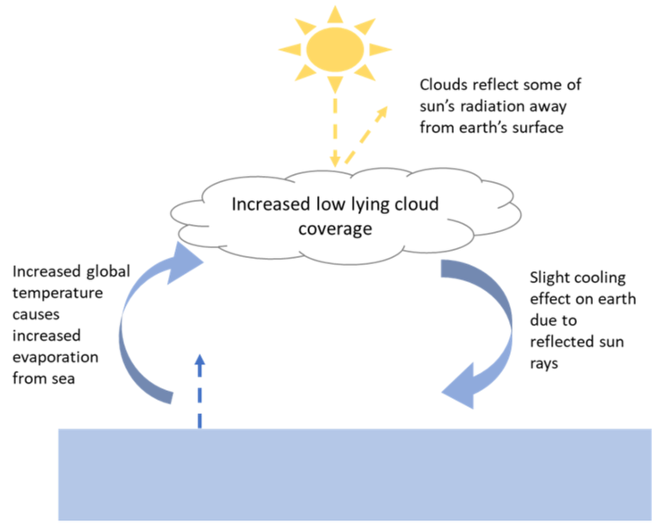
The negative feedback loop between global warming and low lying clouds:
When the Earth's surface temperature increases, more water evaporates from the oceans, which leads to more low level clouds forming in the lower atmosphere.
These clouds reflect some of the sun's radiation back into space, which cools the Earth's surface.
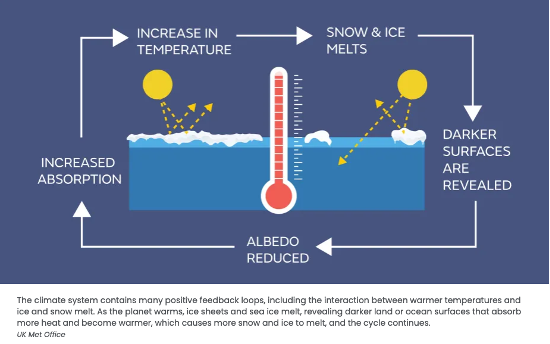
The positive feedback loop between global warming and melting ice:
Ice albedo – ice is white and very reflective, in contrast to the ocean surface, which is dark and absorbs heat faster
As the atmosphere warms and sae ice melts, the darker ocean absorbs more heat, causing more ice to melt, and making earth warmer overall
The ice-albedo feedback is a very strong positive feedback
Negative feedback loops:
Ocean’s ability to store heart – helps keep temperatures in a liveable range across the planet
Ability of plants and soil to absorb carbon dioxide. Removing it from the atmosphere
Positive feedback loops:
Relationship between global warming and increased amounts of water vapour in the atmosphere
A warmer planet causes more water to be evaporated from the surface, resulting in increased heat storing water vapour in the atmosphere, which leads to more warming in an ongoing, continually amplified cycle
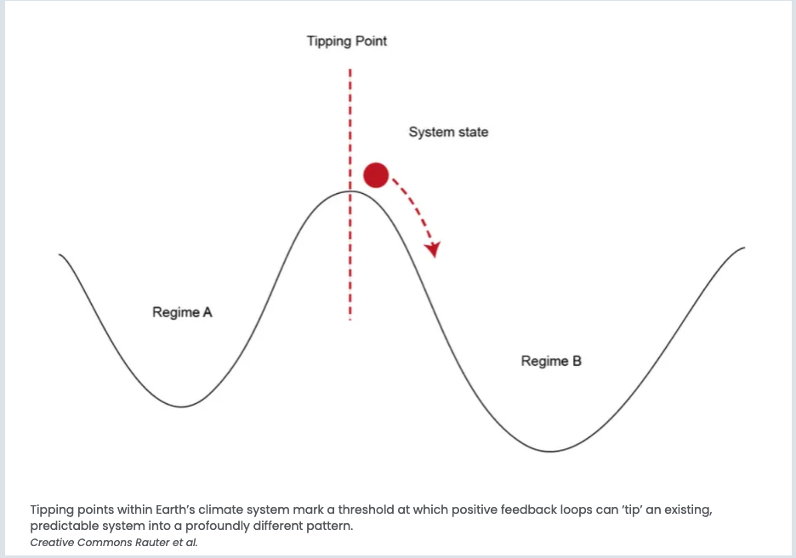
Climate tipping points:
When earth’s climate abruptly moves between periods of relatively stable climates
When a positive feedback loop crosses a threshold that leads to large changes
occur when a positive feedback loop crosses a threshold that leads to large changes that often can’t be turned around or reversed
The positive feedback becomes so strong, or the changes begin happening so quickly, amplifying like that catalyse of the ozone in the 1980s which produced the ozone hole
Example: Ozone hole - Also identified from when earth ‘climate abruptly moved between periods of relative stable climate in the past
tipping points are identified from climate state changes that happened in the past
Ocean circulation, ice loss, rapid release of methane
‘Global map of potential tipping cascades. Arrows show potential interactions among tipping elements based on expert elicitation that could generate cascades’ (Bellamy 2023).
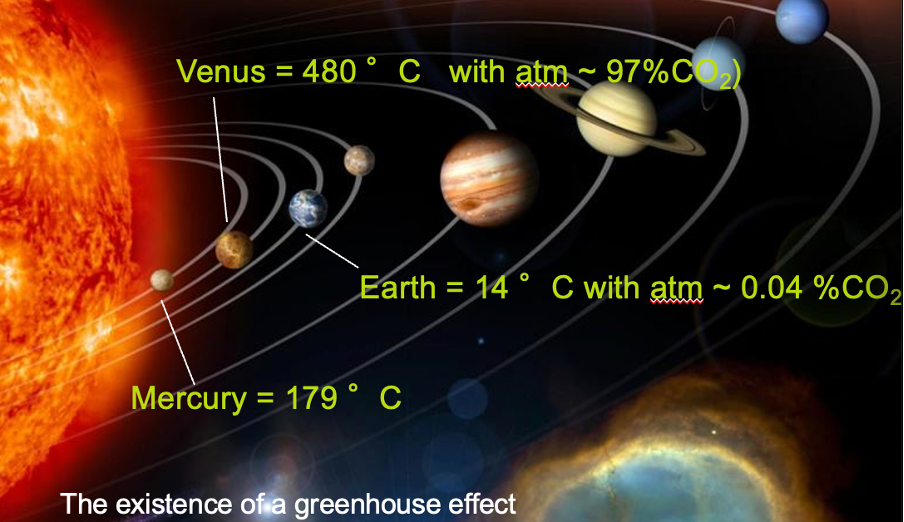
The existence of a greenhouse effect:
It is clear from looking at the different temperatures of planets in our solar system that their temperatures cannot be explained simply by their distance from the sun
Something more complicated is going on, and whatever it is can have a big effect.
The answer is that each planet with an atmosphere has a greenhouse
Venus’ atmosphere is 97% CO2, ours is 0.04% CO2
While this is compelling evidence that a planet’s atmosphere is important in terms of controlling its temperature, it is far from a bullet proof argument.
Venus is warmer as it has a thick atmosphere made of carbon dioxide
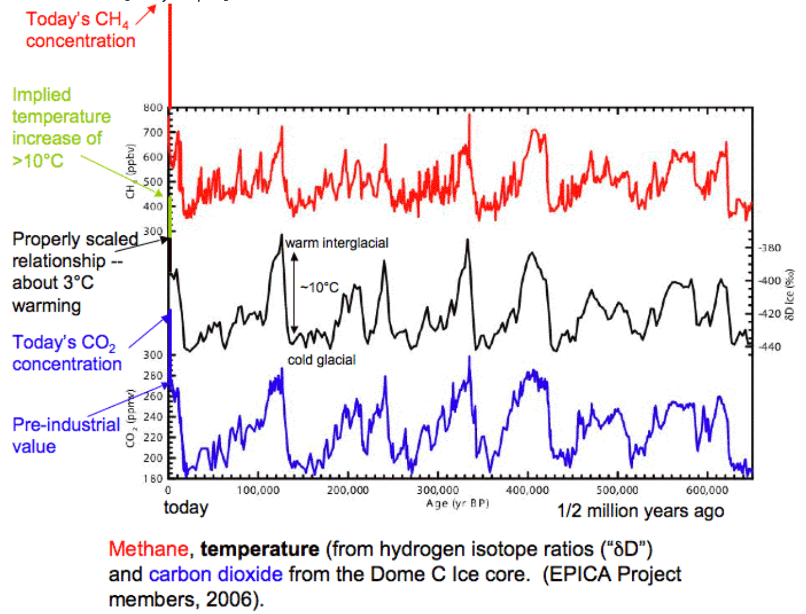
In the past the variation of greenhouse gases in the paleoclimatic records tell us that GHG were coinciding with earth surface temperature change
CO2 and CH4 are higher now than at any time during the last 800,000 years
watts
Measure of energy
342 W is a flow of energy approx. to eating a mars bar every hour continuously
Earth’s energy budget:
Input of energy to our planet:
hits a cross section
energy spreads
some energy reflected
Earth’s energy budget: input
sun’s radiation
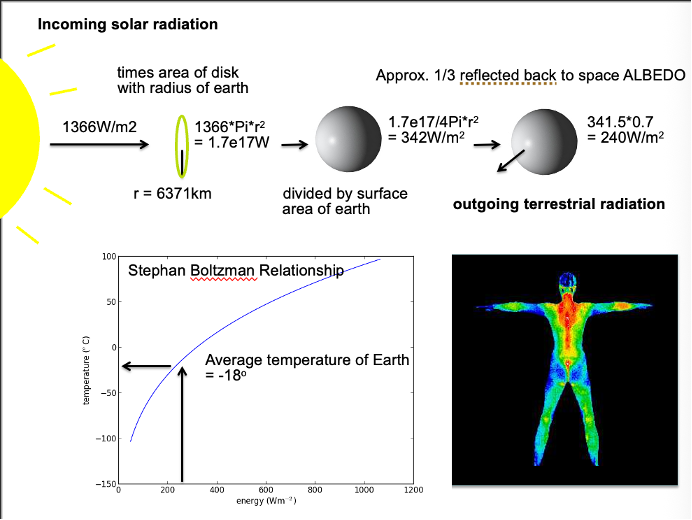
Sun’s radiation at the top of the atmosphere = 1366 W/m2
Earth’s energy budget: cross section
the suns radiation hits a cross section of earth (a disk) which we describe via Pi X radius^2
This gives the total amount of the sun’s energy hitting our planet
Earth’s energy budget: spreads
Over a day this energy is spread over the whole surface of the planet
so we divide that number by the area of a sphere: 4 X Pi X radius^2
This gives us the average energy hitting a square metre of the earth’s surface
Earth’s energy budget: reflection
About 1/3 of that energy is reflected away from the surface
Clouds reflect 1/3 of the total amount of sunlight that hits earth’s atmosphere back into space
Every surface reflects some light
The poles reflect most of the energy due to snow
If all the energy was arriving but not leaving the earth would heat up and very soon would combust and become a ball of molten rock
So the total energy being absorbed by the earth is on average 240 W/ m2
objects emitting radiation
All objects emit radiation and this depends on the temperature of the object
The relationship between temperature and emission of radiation is described by the Stephan Boltzmann constant multiplied by the 4th power of temperature
blackbody radiation
The energy released by earth is a function of temperature
If earth’s temperature increases, it raises the amount of outgoing radiation
So the more energy you add to earth, the more energy it will emit
This concept is the Stefan Boltzmann law which has an overall cooling effect
radiation of earth
can read off the temperature that the earth’s surface would have to be to lose the same amount of energy it absorbs from the sun
This is -18C
But this is incorrect – its actually +14C
radiation calculation
This calculation is missing the greenhouse effect – which naturally warms our planet by around 32C
Heat energy needs to be lost otherwise the planet would just keep heating up
This energy is lost, but from higher up in the atmosphere
The surface temperature is the area elevated by the greenhouse effect

