Homeostasis and Response
 Studied by 2 people
 Call Kai
 Learn
Learn Practice Test
 Spaced Repetition
 Match
Match Flashcards
 Knowt Play
1/66

There's no tags or description
Looks like no tags are added yet.
Name | Mastery | Learn | Test | Matching | Spaced | Call with Kai |
|---|
No analytics yet
Send a link to your students to track their progress
67 Terms
Homeostasis
Why is this important?
regulation of internal conditions for optimum conditions for cells / enzyme activity
cells need the right condition to function properly/ for enzymes
Negative Feedback
Problem
Receptor detects a stimulus
Coordination centre receives and processes the information then organises a response
Effector produces a response which counteracts the change and restores the optimum level.
This may make the level change too much but the receptor detects if the level changes too much and negative feedback starts again.
Body temperature
Pathway
change , receptor, coordination centre, effector
Change in temp
cells in the brain -
thermoregulatory centre acts as a coordination centre and triggers effectors
skin/blood vessels, sweat glands
Water content of body
Pathway
change in water content
cells in the brain
pituitary gland
kidneys
Blood glucose
Pathway
change in blood glucose levels
pancreas
panaceas
liver
Nervous system
Central nervous system- Brain and spinal chord. The CNS is connected to the body by sensory neurones and motor neurones.
Sensory neurons - carry information as electrical impulses from the receptors to the CNS
Motor neurons - carry electrical impulses form CNS to effector
Effector- muscles(contract) and glands(secrete hormones) that respond to nervous impulses.
Synapses
connection between 2 neurones
The nerve signal is transferred by chemicals which diffuse across the gap.
These chemicals set of a new electrical signal in the next neurone.
Reflexes
Rapid, automatic responses to certain stimuli that do not involve the conscious parts of the brain.
Reduce the chance of being injured.
Light in the eye → the pupil gets smaller.
Reflex arc
Neurones in reflex arcs go through the spinal cord or unconscious parts of the brain.
Stimulus is detected by receptors.
Sensory neurones send impulses to a relay neurone in the CNS.
At the synapse between sensory and relay neurones, chemicals are released that trigger the next neurone.
The impulse travels to a motor neurone, which carries it to the effector (muscle).
The muscle contracts in response.
How to investegate reaction time?
caffeine wait 10 minutes then repeat
time it takes to respond to a stimulus.
Person A holds out their hand with a gap between their thumb and first finger.
Person B holds the ruler with the zero at the top of person A's thumb.
Person B drops the ruler without telling Person A and Person A must catch it.
The distance on the ruler level with the top of person A's thumb is recorded in a suitable table.(the further down the ruler the slower the reaction time).
Repeat this ten times.
Swap places, and record another ten attempts.
You can use the conversion table to help convert your ruler measurements into reaction time or just record the catch distance in cm.
Control variables - same person, same hand. ruler dropped form same height.
How reaction time can be measures using a computer?
Click the mouse when they see a stimulus.
More precise because no human error is possible.
Records time in milliseconds for more accurate measurement.
Person can’t predict the stimulus by anticipating body language.
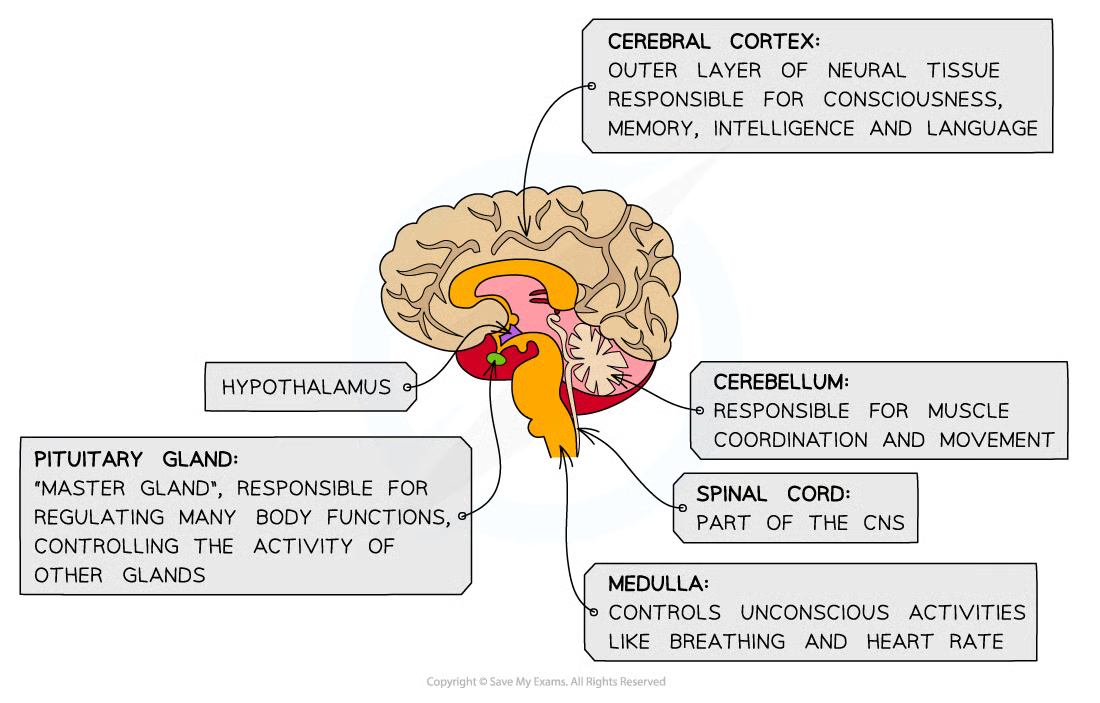
Brain
Part of the CNS.
Made up of interconnected neurones.
Cerebral cortex – responsible for consciousness, intelligence, memory, and language.
Medulla – controls unconscious activities such as breathing and heartbeat.
Cerebellum – responsible for muscle coordination.
How scientists study the brain?
Studying patients with brain damage – If a small part of the brain is damaged, observing the effect on the patient can reveal the function of that part of the brain.
Electrically stimulating the brain – A tiny electrode is inserted into the brain and stimulated with electricity. Observing the responses (e.g., muscle contraction) shows what different parts of the brain do.
MRI scans – A tube-like machine produces detailed images of the brain’s structures and shows which areas are active when people do activities like listening to music or remembering something.
Positives and Problems with messing with the brain
Research has led to treatments for disorders of the nervous system.
Electrical stimulation can reduce muscle tremors caused by disorders.
The brain is complex and delicate – investigating it carries risks of physical damage or increased problems with brain function.
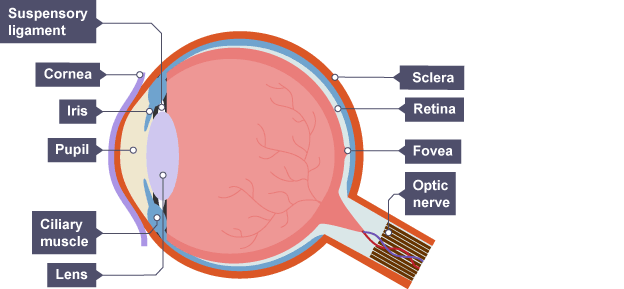
Eye
Silly Cows In London Sleep Outside
Sclera – tough supporting wall of the eye.
Cornea – transparent outer layer at the front of the eye; refracts light into the eye.
Iris – contains muscles that control the diameter of the pupil, regulating how much light enters the eye.
Lens – focuses light onto the retina, which contains receptor cells sensitive to light intensity and colour.
Shape of the lens is controlled by ciliary muscles and suspensory ligaments.
Optic nerve – carries impulses from the retina to the brain.
Rod and cone cells- light receptor cells in the back of the eye
The Iris Reflex
Very bright light can damage the retina.
Reflex that makes the pupil smaller (in bright light):
Circular muscles of the iris contract
Radial muscles of the iris relax
Pupil contracts → less light enters the eye
Reflex in dim light (pupil dilation):
Radial muscles contract
Circular muscles relax
Pupil dilates → more light enters the eye
Focusing on near/distant objects.
Near objects:
Ciliary muscles contract, slackening/ loosening the suspensory ligaments to give a smaller diameter
Lens becomes fat / THICKER (more curved)
Increases the amount light is refracted
Distant objects:
Ciliary muscles relax, suspensory ligaments are pulled tight
Lens becomes thin (less curved)
Light is refracted less
Why old people need glasses more?
eye loses flexibility so it cant easily spring back to a round shape so light cant be focused well for near viewing
The lens becomes less elastic (less flexible) as you age.
The ciliary muscles cannot change its shape as easily.
This means the eye cannot focus properly on near objects.
Long-sightedness (Hyperopia):
Lens cannot refract light enough, or the eyeball is too short.
Unable to focus on near images: Images of near objects/ light rays are focused behind the retina.
Glasses with a convex lens (curves outward) refract light more, so images are focused on the retina.
Short-sightedness (Myopia):
Lens is the wrong shape and refracts too much, or the eyeball is too long.
Unable to focus on distant objects; images/ light rays are focused in front of the retina.
Glasses with a concave lens (curves inward) diverge light rays so they focus on the retina.
Contact lenses
Thin lenses that sit on the surface of the eye, shaped to compensate for the fault in focusing.
Lightweight and invisible.
Hard lenses – more durable, often used for sports.
Soft lenses – more comfortable but higher risk of eye infection.
Laser eye surgery
Vision corrected by reshaping the cornea with a laser.
Changes how strongly the cornea refracts light.
Can improve short-sightedness by making rays less powerful, or long-sightedness by increasing refraction.
Risks include infection, complications, or vision loss.
Replacement lens surgery
The natural lens is removed and replaced with an artificial lens made of glass or plastic.
Can correct severe vision problems.
Higher risk of damage or loss of sight compared to other methods.
Controlling Body temperature
The body balances energy gained and lost to keep core body temperature constant.
Thermoregulatory centre in the brain:
Contains receptors sensitive to the temperature of blood flowing through the brain (core temperature).
Also receives impulses from temperature receptors in the skin about skin temperature.
Temperature receptors detect:
Core temperature too high → triggers responses to cool the body.
Core temperature too low → triggers responses to heat the body.
Effectors:
Sweat glands produce sweat → cools body by evaporation.
Muscles contract (shivering) → generate heat.
Some effectors work antagonistically:
One set heats, the other cools, allowing precise control of temperature.
Responses to alter body temperature
Too hot:
Sweat glands produce sweat, which evaporates from the skin, transferring energy to the environment.
Blood vessels supplying the skin dilate (vasodilation) → more blood flows near the surface, transferring more heat to the environment.
Too cold:
Hair stands up to trap an insulating layer of air.
No sweat is produced.
Blood vessels in the skin constrict (vasoconstriction) → less blood flows near the surface, reducing heat loss.
Shivering (muscle contractions) releases energy to warm the body.
Hormones
Chemical molecules/messenger released directly into the blood.
Carried in the blood to other parts of the body and only affect specific target cells in particular organs (target organs).
Produced by various glands that make up the endocrine system.
Effects are long-lasting.
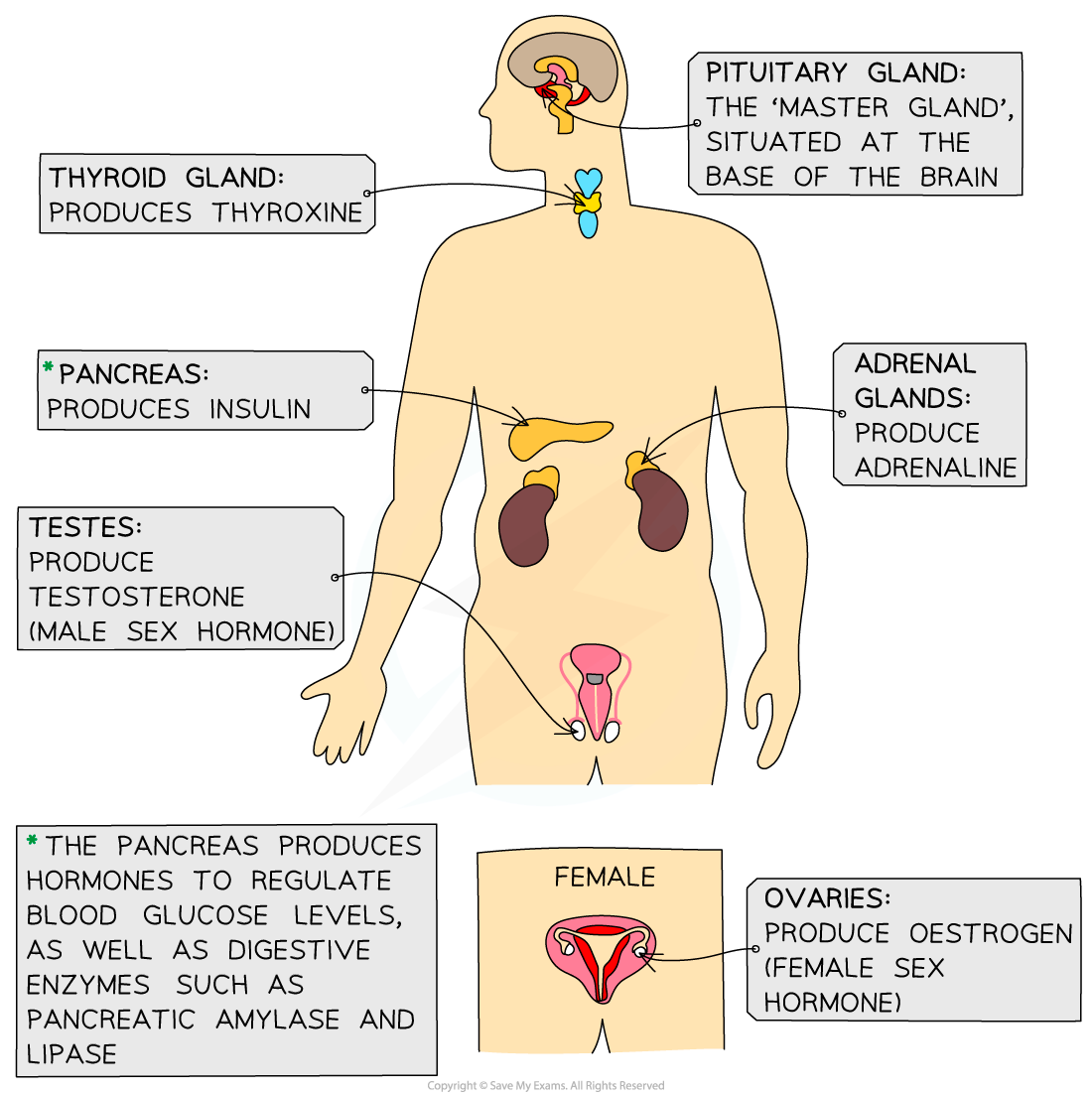
Endocrine system
Pituitary gland – Produces many hormones that regulate body conditions; known as the master gland because its hormones direct other glands to release their hormones.
Thyroid – Produces thyroxine, which regulates the rate of metabolism, heart rate, and body temperature.
Adrenal glands – Produce adrenaline during stress to prepare the body for fight or flight.
Pancreas – Produces insulin to regulate blood glucose levels - increased heart rate, breathing rate
Testes – Produce testosterone, which controls puberty and sperm production.
Ovaries – Produce oestrogen, involved in the menstrual cycle.
Nerves vs hormones
N- Verry fast, act for a short time, act on a precise area
Hormones - Slower action, act for a long time, act in a more general way
How does the eye refract more light?
Becomes thicker(fat)
How does glucose enter blood?
How is glucose removed?
Food containing carbohydrate puts glucose into the blood from the gut
Normal metabolism removes glucose
Vigorous exercise removes more glucose form blood
How is excess glucose stored?
Stored as glycogen in the liver and in the muscles.
Controlling Blood glucose levels
3 step cycle
Changes are monitored by the pancreas
Controlled by the hormones insulin ( liver turns glucose into glycogen) and glucagon (makes liver turn glycogen into glucose)
If too high —> insulin secreted by pancreas —> glucose moves from blood into liver and muscle cells.
If too low —> Glucagon is secreted by pancreas —> glucose released into blood by river
Function of insulin
Makes glucose move from blood into liver and muscle cells
In the liver (and muscles), glucose is converted into glycogen - GLYCOGENISIS
Function of Glucagon
The liver converts glycogen back into glucose - GLYCOGENOLYSIS
The glucose leaves the liver and enters/is released into the blood
Diabetes Type 1
Pancreas produces little or no insulin → blood glucose can rise to dangerous levels that can kill
Insulin therapy: insulin injected, usually at mealtimes → glucose removed from blood quickly
Limit foods high in carbohydrates
Do regular exercise
Diabetes type 2
Body is resistant to its own insulin → cells do not respond properly
Blood glucose rises to dangerous levels
Being overweight increases risk of developing Type 2 diabetes
Controlled by eating a carbohydrate-controlled diet and doing regular exercise
Kidneys
Kidneys make urine by removing waste products from blood
→ Selective reabsorption: Useful substances like glucose, ions, and the right amount of water are reabsorbed into the blood
→ Filtration: Substances are filtered out of blood as it passes through the kidneys
Substances excreted(removed) in urine: urea, excess ions, and water
Urea
Kidneys
Proteins are broken down into amino acids, which cannot be stored by the body
MUST KEEP AMINO ACIDS IN LOW AMOUNT
SO TOXIC SUSBTANCES DO NOT BUILD UP IN BODY AND CAUSE DAMAGE TO CELLS/TISSUES
→ Deamination: Excess amino acids are converted into fats and carbohydrates in the liver for storage
→ Ammonia production: Ammonia is produced as a waste product and is toxic
→ Urea formation: Ammonia is converted into urea in the liver
→ Excretion: Urea is transported to the kidneys, filtered out of the blood, and removed from the body in urine
Ions
Kidneys
Ions (e.g. sodium) are taken in through food and absorbed into the blood
If ion or water content is wrong, it upsets the balance between ions and water
This affects osmosis → too much or too little water moves into cells
Cells can shrivel (lose water) or swell (gain too much water)
Some ions are lost in sweat (not regulated)
Kidneys maintain the correct ion balance
→ After filtration, the right amount of ions is reabsorbed into the blood
Excess ions are removed from the body in urine
Water kidneys
Water content of the body must be balanced
Water is lost from the skin in sweat and from the lungs when breathing out
Water balance depends on the amount we consume
Kidneys control water balance by adjusting how much is reabsorbed into the blood
Excess water is removed from the body in urine
How is the concentration of urine controlled?
Hormone - water
ADH (anti-diuretic hormone) is released by the pituitary gland into the bloodstream
The brain monitors the water content of the blood
This works by negative feedback
If water concentration is too high:
Receptors in the brain detect this
The coordination centre signals the pituitary gland
Less ADH is released
Less water is reabsorbed from kidney tubules
More water is lost in urine
If water concentration is too low:
Receptors in the brain detect this
The coordination centre signals the pituitary gland
More ADH is released
More water is reabsorbed from kidney tubules
Less water is lost in urine
ADH increases water reabsorption MAKES TUBICLES MORE PERMEABLE TO WATER
from kidney tubules
(so) ADH increases the concentration of dissolved substances (of urine)
(so) ADH decreases the volume (of urine)
What occurs if kidneys don’t work properly
Waste substances build up in the blood
The body cannot control ion and water levels properly
This can lead to death if untreated
Dialysis Machine
Dialysis keeps concentrations of dissolved substances in the blood at normal levels
Blood passes through partially permeable membranes in dialysis fluid
Small waste substances (urea), excess ions, and water diffuse out; large proteins stay in the blood
Dialysis fluid has normal levels of glucose and useful ions so they are not lost
Done about 3 times a week for 3–4 hours
Risks: blood clots, infection; expensive
Keeps patient alive until a donor kidney is available
Cure for kidney failure: kidney transplant
A healthy kidney from a donor is transplanted into the patient
Donor can be someone who died suddenly (on the organ donor register / donor card) or a living person
There is a small risk to a living donor
Risk that the donor kidney is rejected by the patient’s immune system
Patients are treated with drugs to reduce rejection, but rejection can still happen
Cheaper in the long term than dialysis
Frees patients from spending hours on dialysis
However, there are long waiting lists
Puberty
Sex hormones released at puberty cause physical changes and sperm production
Testosterone (testes) → sperm production and male characteristics (facial hair)
Oestrogen (ovaries) → female characteristics and control of menstrual cycle
4 Stages of menstrual cycle
Day 1–4: Menstruation – Uterus lining breaks down and is shed
Day 4–14: Uterus lining rebuilds – Becomes thick and spongy with/full of blood vessels, ready for a fertilized egg
Day 14: Ovulation – Egg develops and is released from the ovary
Day 14–28: If no fertilized egg – Uterus lining is not needed, starts to break down, and the cycle restarts
FSH
FSH (follicle-stimulating hormone) is produced in the pituitary gland
Causes an egg to mature in one of the ovaries
Stimulates the ovaries to produce oestrogen
Oestrogen
Oestrogen is produced in the ovaries
Causes the lining of the uterus to grow
Stimulates the release of LH, which causes egg to be released
Inhibits the release of FSH
LH
LH (luteinising hormone) is produced by the pituitary gland
Stimulates the release of an egg at day 14 → ovulation
Progesterone
Progesterone is produced by the ovaries from the remains of the follicle after ovulation
Maintains the lining of the uterus during the second half of the cycle
When progesterone levels fall, the lining breaks down
Inhibits the release of LH and FSH
How can hormones/the pill be used to reduce fertility?
Oestrogen can be used as contraception: taken every day to keep levels high → inhibits FSH → egg development stops → menstruation stops
Progesterone reduces fertility by STIMULATING A THICK MUCUS IN THE CERVIX→ sperm cannot reach the egg
PROGESTERONE ALSO INHIBITS LH SO NO OVULAITON OCCURS SO NO EGG TO FERTILISE
Combined pill (oestrogen + progesterone) is about 99% effective
Side effects: headaches, nausea
Does not protect against STDs
Progesterone-only pill has fewer side effects and is just as effective
Other hormonal methods to reduce fertility
I pick important iguanas
Contraceptive patch – contains oestrogen and progesterone, stuck on the skin, lasts 1 week
Contraceptive implant – inserted under the skin of the arm, releases progesterone continuously → stops ovary release, thickens mucus, prevents sperm reaching egg; lasts up to 3 years 99%
Contraceptive injection – progesterone, lasts 2–3 months 99%
IUD (intrauterine device) – T-shaped device inserted into uterus → kills sperm and prevents implantation of a fertilised egg
Plastic IUS – releases progesterone
Copper IUD – prevents sperm surviving inside uterus
Barrier methods
condom
diagrapham
spermicide
Condoms – worn over the penis during intercourse to prevent sperm entering the vagina
Female condoms – worn inside the vagina to prevent sperm reaching the egg
Only form of contraception that protects against STDs
Diaphragm – small plastic cup placed over the cervix to form a barrier, used with spermicide to kill sperm
Spermicide alone – also a form of contraception but less effective (about 70–80% effective)
Drastic ways to avoid pregnancy
Sterilisation – permanent procedure
Female: cutting or tying the fallopian tubes (ovaries → uterus)
Male: cutting or tying the sperm ducts (testes → penis); tubes can sometimes be rejoined
Natural methods – avoid pregnancy by tracking when a woman is most fertile and avoiding sex on those days; less effective, popular for those avoiding hormonal or barrier methods
Abstinence – the only method that completely prevents sperm meeting egg
How can hormones increase fertility?
Some women have low FSH levels → eggs do not mature → no eggs released → cannot get pregnant
FSH and LH can be given as fertility drugs to stimulate ovulation
Progesterone given to maintain uterus lining
FSH matures the egg so more eggs mature
LH stimulates ovulation so more eggs can be collected so through IVF there is increased chance of fertilsing egg and inserting embryo
Pros: helps women get pregnant
Cons: not always successful, expensive, may overstimulate ovaries → multiple eggs released → risk of multiple pregnancies (twins, triplets)
IVF
VF (in vitro fertilisation) – eggs collected from woman’s ovaries and fertilised in a lab with sperm
ICSI (intracytoplasmic sperm injection) – sperm injected directly into egg; used if man has low sperm count
Fertilised eggs grown in incubator into embryos
Once embryos are a ball of cells, 1–2 are transferred to woman’s uterus to increase chance of pregnancy
FSH and LH given before egg collection to stimulate multiple eggs to mature
Pros: helps couples have a child
Cons: risk of multiple births, low success rate, stressful, possible side effects from drugs
How IVF has improved?
Why are some against IVF?
Microtools are used on eggs and sperm to improve IVF
Time-lapse imaging with microscope and camera allows embryos to be monitored
Helps identify embryos most likely to be successful for implantation
Unused embryos are destroyed → considered unethical by some, as they are potential human life
Genetic testing of embryos before implantation raises ethical issues → could lead to selection for preferred characteristics (e.g. gender, eye colour)
Adrenaline
Hormone released by adrenal glands in response to stress or fear detected by the brain → adrenaline
Prepares the body for fight or flight
Increases oxygen and glucose supply to cells in the brain and muscles
Increases heart rate to deliver oxygen and energy faster and breath rate
How does Thyroxine regulate metabolism?
Hormone released by thyroid gland in the neck → thyroxine
THROXINE INCREASES basal metabolic rate (BMR) – the rate at which chemical reactions occur in the body at rest
Stimulates protein synthesis for growth and development
Released in response to TSH (thyroid-stimulating hormone) from the pituitary gland
Negative feedback keeps thyroxine levels in the blood at the right amount
If levels are too high → TSH secretion is inhibited → less thyroxine released → levels fall back to normal
Auxin
Auxin – plant hormone that controls growth near tips of shoots and roots
Controls growth in response to light (phototropism) and gravity (gravitropism/geotropism)
Produced in tips and moves backward to stimulate cell elongation just behind the tip
If tip is removed → no auxin available → shoot may stop growing
Extra auxin promotes growth in shoots but inhibits growth in roots → can be used to produce desired results
When shoot grows towards light?
When the shoot tip is exposed to light, more auxin accumulates on the side that is in the shade than on the side in the light.
This makes the cells elongate faster on the shaded side, so the shoot bends towards the light.
positive tropisms – the plant grows towards the stimulus
negative tropisms – the plant grows away from the stimulus
The plant stem, responses to light are known as a positive phototropism, which means the stem grows towards the light
In the plant root, responses to light are known as a negative phototropism, which means the root grows away from the light
When shoots grow away from gravity and roots grow towards gravity?
Shoot growing sideways: gravity causes unequal distribution of auxin → more auxin on the lower side
In shoots, extra auxin promotes growth → lower side grows faster → shoot bends upwards
Root growing sideways: more auxin on the lower side
In roots, extra auxin inhibits growth → upper side elongates faster → root bends downwards
Investigating Plant Growth responses
Effect of light
Observation: Growth response should show phototropism – seedlings bending towards the light.
GROWTH OCCURS AT TIP / MORE GROWTH ON SIDE AWAY FROM LIGHT /BENDING OCCURS BEHIND TIP
Step 1: Put 10 cress seeds into each of three petri dishes lined with moist filter paper.
Step 2: Label the dishes clearly.
Step 3: Shine a light onto:
Dish 1 → from above
Dish 2 → from one side
Dish 3 → from opposite side
Step 4: Leave the seeds for one week until seedlings have grown enough to observe responses.
Step 5: Observe which seedlings grow towards the light.
Controlling variables:
Use the same number of seeds in each dish
Use seeds from the same source
Keep petri dish size and moisture the same
Keep distance from the light source the same
Keep light intensity the same
SAME TEMP
SAME TYPE OF PLANT
SAME VOLUME OF WATER
Auxin uses
Killing weeds – most weeds in crop fields are broad-leaved, crops have narrow leaves; selective weedkillers using auxins disrupt weed growth pattern, killing weeds while crops stay unharmed
Growing from cuttings – a piece of plant (e.g. branch tip) won’t grow roots in soil alone; adding rooting powder with auxins stimulates rapid root growth which means growers can produce lots of clones of good plant.
Tissue culture – grows clones of plants from a few cells; hormones like auxins in the growth medium stimulate cells to divide, forming roots and shoots
Weed killers
Rooting power
Promote growth in tissue cultures
Uses of Gibberellin
Seed germination – when a seed starts to grow
Overcoming dormancy – some seeds won’t germinate until they experience certain conditions (e.g., cold stratification)
Treating seeds with gibberellin can alter dormancy, making all seeds in a batch germinate at the same time
Inducing flowering – some plants require specific conditions (e.g., long days, low temperatures) to flower
Treating with gibberellin allows them to flower without changing environmental conditions, producing bigger flowers
Growing larger fruit – seedless varieties often don’t grow as large as seeded fruit
Applying gibberellin makes fruit grow larger to match normal sizes
Promote flowering
Bigger fruit
More fruit
Ethene
Ethene (ethylene) – gas produced by aging parts of a plant that influences growth by controlling cell division and stimulating enzymes that cause fruit to ripen
Commercially, ethene is used to speed up ripening of fruits on the plant or during transport
Fruits are often picked unripe → firmer and less easily damaged
Ethene is added in supermarkets so fruit ripens on shelves to be perfect when sold
Ripening can be delayed during storage by adding chemicals that block ethene or removing ethene from the air
Remember
For kidneys ALWAYS SAY REABSORBED
GLANDS RELEASE HORMONES NOT PRODUCE

