Synaptic Plasticity and Memory - LEARNING
 Call Kai
 Learn
Learn Practice Test
 Spaced Repetition
 Match
Match Flashcards
 Knowt Play
1/138

There's no tags or description
Looks like no tags are added yet.
Name | Mastery | Learn | Test | Matching | Spaced | Call with Kai |
|---|
No analytics yet
Send a link to your students to track their progress
139 Terms
why is memory important?
it underpins the organisation and functioning of the self by forming a network of autobiographical memories about personal experiences
what are the two key characteristics of autobiographical memory?
specificity and coherence
what is memory specificity?
the ability to recall particular events that happened on specific days, crucial for effective self-functioning and is linked to mental health conditions like depression and PTSD
what is memory coherence?
the narrative structure of autobiographical memories, which relates to psychological well-being and the presence or absence of psychopathology
give a brief description of the history of memory.
hippocrates rejects the idea that the psyche is independent of the body, belives the brain is repository of all mental processes, including memory.
this influences descartes, to locate memory and emotion within specific brain structures.
james believed that memory may be influenced by beliefs.
what are the types of associative learning?
classical conditioning and operant conditioning
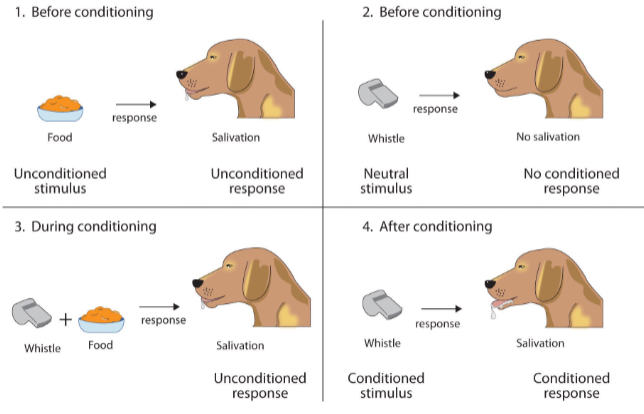
what is classical conditioning?
neutral signal before the unconditioned stimulus, a reflex, e.g. Pavlovian theory
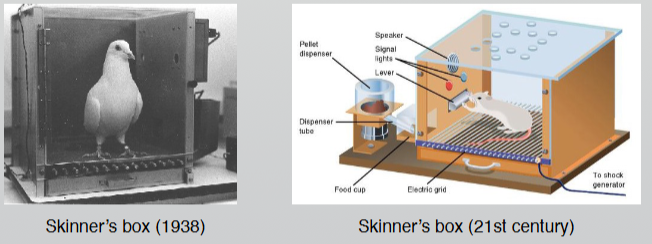
what is operant conditioning?
positive or negative reinforcement following behaviour, creating a voluntary change in behaviour, e.g. skinner’s box
what are the types of non-associative learning?
habituation and sensitisation
what is habituation?
decreased behavioural response to a sensory stimulus
what is sensitisation?
increased response to a sensory stimulus
what is the difference between associative and non-associative learning?
associative involves a paired stimulus, but non-associative does not
explain plasticity as a mechanism for learning and memory?
james believed that the brain’s capacity for changes in nervous pathways was associated with the establishment of habits, and this was fundamental for learning and memory
explain plasticity through morphological changes.
Cajal explicitly argued that neural plasticity occurs through activity-dependent morphological changes in neurones, especially at their dendrites and synaptic contacts. that learning leads to the growth, branching, and multiplication of neuronal processes, increasing the number and complexity of inter-neuronal connections
what is an engram?
the enduring after effect of the brain stimulation, a physical and lasting modification in excitable tissue, left behind by every experience
explain plasticity through functional changes?
Knorski framed plasticity primarily as a change in the functional efficacy of synaptic connections, repeated, contigent co-activation of neurones produces lasting changes in how strongly specific synapses influence postsynaptic firing, these modification underlie learning.
what is Hebb’s postulate?
the idea that synapses are strengthened when a presynaptic neurone repeatedly and casually helps a postsynaptic neurone to fire.
what are Lashley’s core principles of engrams?
equipotentiality and mass action
explain equipotentiality?
any part of a functional area of the cortex can take over the role of another part, as long as enough cortex remains. memories are not localised, when one part is damaged other parts can compensate
expalin mass action?
the efficacy of brain function decreases as the amount of cortex removed increases, but is not dependent on removing any specific spot. the more tissue that is damaged, the worse the deficit, regardless of which part is taken out.
describe the case study of patient HM
history of epilepsy, lacked short-term memory, but retained ability in long-term memory and ability to learn
discuss Milner’s theories about the hippocampus and long-term memory.
Milner showed that damage to the hippocampus causes a profound inability to form most new long-term memories, H.M. after surgical removal of this brain area to treat epilepsy, could not create lasting memories for events after his surgery, even though older memories remained largely intact.
Milner found that not all memory was lost following H.M.’s surgery, he could still learn new motor skills, despite having no memory of practising them, revealing declarative memory relies on the hippocampus, and procedural memory uses different brain regions.
what was the conclusion of Milner’s work?
the hippocampus is crucial for turning short-term memories into long-term ones.
what is fractionation of long-term memory systems?
long-term and short-term memory are separate systems, the memory system is fractioned into different subsystems based on what they store and how they work.
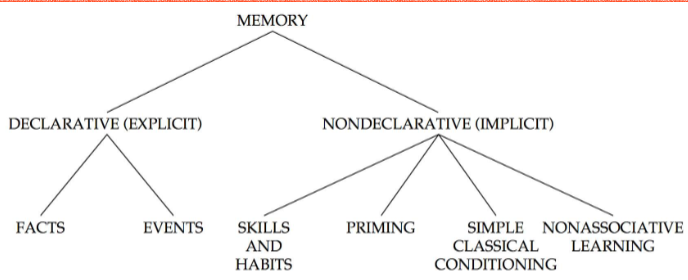
what are the main types of long-term memory storage?
declarative memory and non-declarative memory
what is declarative memory?
storage of facts and events you can consciously recall and describe
what are the subtypes of declarative memory?
episodic memory and semantic memory
what is episodic memory?
memory for personal experiences
what is semantic memory?
general facts and knowledge
what is non-declarative memory?
skills, habits, and unconscious associations
what are the subtypes of non-declarative memory?
procedural memory, priming, classical conditioning, and non-associative learning
what is procedural memory?
how to do things
what is priming?
faster recognition or response due to previous exposure
what is the location of episodic memory areas?
hippocampus, medial temporal lobe, and neocortex
what is the location of semantic memory areas?
lateral and anterior temporal cortex, and prefrontal cortex
what is the location of procedural memory areas?
striatum, cerebellum and motor cortex
what is the location of priming and perceptual learning areas?
neocortex
what is the location of simple classical conditioning areas?
amygdala and cerebellum
what is the location of non-associative learning areas?
reflex pathways
describe the linear system for encoding of memory.
environmental input → sensory registers (visual, auditory, and haptic) → short-term store (rehearsal, coding, decision, retrieval strategies) → response output/long-term store
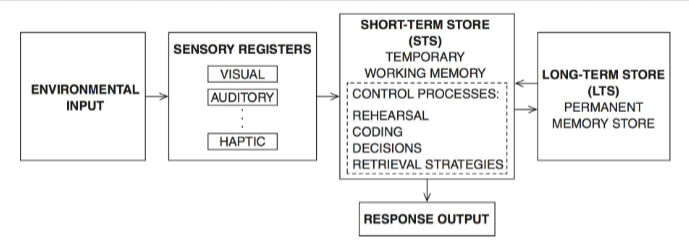
what is an environmental input?
anything you can see, hear, touch, etc, starts as environmental information
what are sensory registers?
visual, auditory, and haptic registers hold raw sensory data for a brief moment, quickly filtering information, most is lost, but some is sent onwards.
what is short-term store/working memory?
temporary memory storage, here information is held briefly, actively processed by control processes.
what is long-term store?
only some information is encoded and transferred from STS to LTS. LTS is where permanent memory is stored
explain the effects of frontal and temporal lobe lesions on memory.
patients with frontal vs temporal lobe lesions provide evidence for existence of independent short- and long-term memory stores, such stores can be dissociated on the basis of the temporal aspects of memory and brain regions involved.
what is the working memory structurally?
a network of neurones, which temporarily holds the incoming information for seconds. sustained neural circuit activity means the neurones keep firing together to maintain information in mind.
describe the consolidation → long-term memory path?
consolidation is the process by which temporary working memory gets transformed into a durable long-term memory. engrams are the lasting physical changes in the brain that store long-term memories.
describe the forgetting or loss of engram path.
information can disappear from the working memory if it isn’t encoded, or if the neural activity stops, so it’s replaced by new information or simply lost.
what is a structural trace?
temporary physical or physiological change in neural circuits that supports holding information for seconds to minutes.
what are the two methods for holding short-term memories?
persistent neural activity and temporary synaptic changes
explain the persistent neural activity model?
when you’re holding something in short-term memory, specific groups of neurones keep firing in the brain even after the original stimulus is gone. this kind of activity is seen in the prefrontal cortex, which acts as a workspace for information. the persistence is maintained by reverberatory circuits, which allow the memory trace to echo briefly in the brain.
explain the temporary synaptic changes model.
at the cellular level, short-term synaptic plasticity helps maintain information via post-tetanic potentiation and short-term potentiation where synapses become temporarily more effective after recent activity. these synaptic changes involve increased release of neurotransmitter vesicles at certain connections, but dont involve the creation of new synapses or major growth.
what happen if a short term memory is sustained in the brain?
it can be consolidated into a long-term memory, where permanent structural changes occur.
what is immediate memory?
briefly holds sensory impressions
what is the role of working memory?
actively holds and manipulates information for ongoing tasks, sometimes overlaps conceptually with short-term memory
what causes forgetting?
if information isn’t attended to, rehearsed, or consolidated
what is anterograde amnesia?
where new events are not transferred to long-term memory, it is a deficit in learning subsequent to the onset of the disorder
what is retrograde amnesia?
where someone will be unable to recall events that occurred before the onset of amnesia
what is dissociative amnesia?
blocking out of critical personal information, usually of traumatic or stressful nature
what are the causes of amnesia?
usually traceable to brain injury related physical trauma, infections, drugs, and alcohol abuse, or reduced blood flow to the brain.
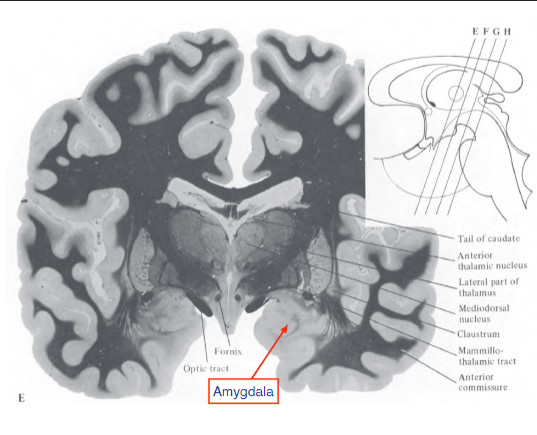
describe the amygdala?
found anteriorly, has a role in conditioning, and has an almond shaped structure
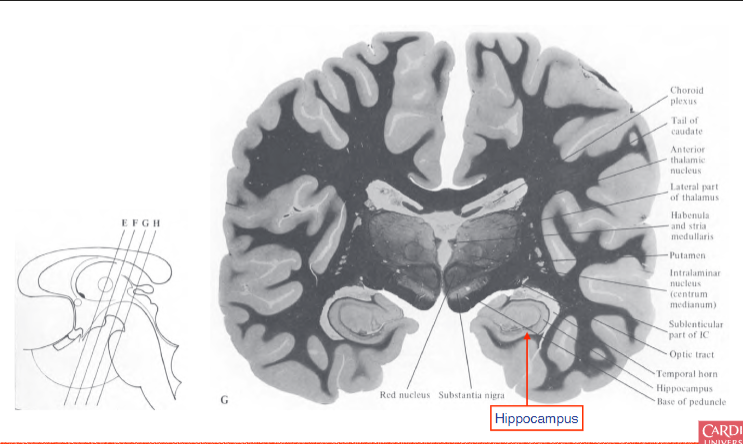
describe the hippocampus?
found posteriorly to the amygdala, involved in encoding declarative memories
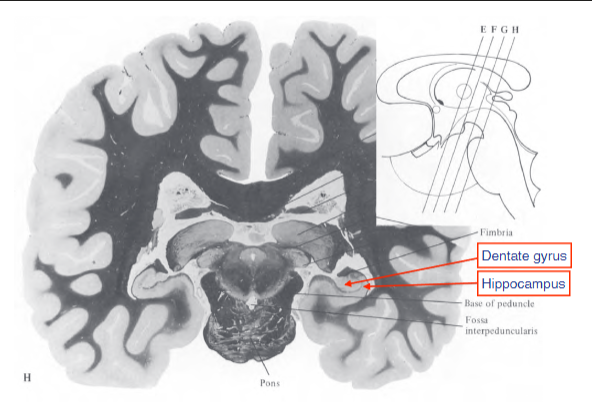
describe the location of the dentate gyrus.
connected to hippocampal formation
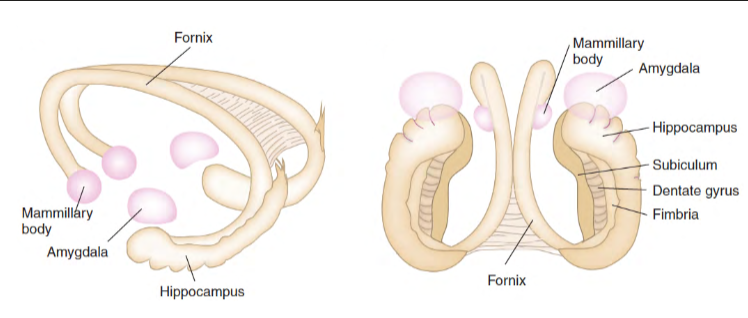
what is the fornix?
fibre connection between hippocampus and hypothalamus
what are the afferent inputs of the mammillary nucleus?
hippocampal formation via post commissural fornix, providing a principal excitatory input to the mammillary bodies, carrying information from the hippocampal memory system.
what are the efferent inputs of the mammillary nucleus?
mammillothalamic tract and mammillotegmental tract
what is the mammillothalamic tract?
projects from the mammillary nuclei to the anterior thalamic nuclei, forming part of Papez’ circuit and influencing cingulate cortex via the anterior thalamus
what is the mammillotegmental tract?
sends projections back to the tegmental nuclei of Gudden in the midbrain
what is the medial mammillary nucleus’ role?
receives input predominantly from the subiculum and ventral tegmental nucleus of Gudden, and projects via the mammillothalamic fibres to anteromedial/anteroventral thalamic nuclei and reciprocally to the ventral tegmental nucleus
what is the role of the lateral mammillary nucleus?
receives inputs from pre/parasubiculum and the dorsal tegmental nucleus of Gudden, and projects bilaterally to the anterodorsal thalamic nucleus and reciprocally to the dorsal tegmental nucleus, contributing critically to the head-direction system.
what are the limbic structures?
cingulate gyrus, fornix, parahippocampal gyrus, hippocampus, uncus, amygdala, entorhinal area, and septal nuclei
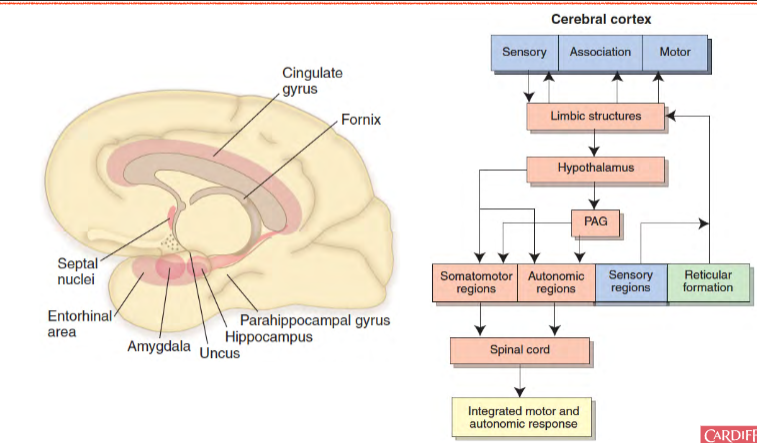
describe the hippocampal involvement in spatial memory.
the hippocampus is critical for spatial memory, forming a cognitive map of environments that allows for flexible navigation and remembering the locations of objects.
what is stored in the anterior hippocampal regions?
encoded novelty
what is stored in the posterior hippocampal regions?
spatial representations
what are hippocampal place-cells?
special type of neurone (pyramidal cell) found in the hippocampus, become highly active when the animals is in a particular area of its environment, creating a cognitive map representing spatial layout.
what is the role of place cells in episodic memory formation?
they can reactivate to replay sequences from experiences, which aids memory consolidation.
what is long-term potentiation?
a persistent strengthening of synapses based on recent patterns of activity, leading to a long-lasting increase in signal transmission between neurones.
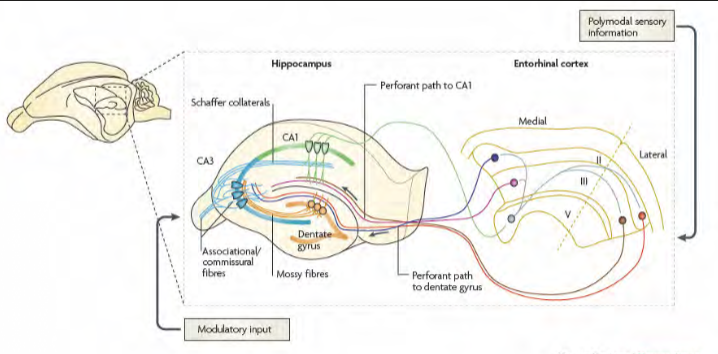
describe the tri-synaptic circuit of the hippocampus.
entorhinal cortex activates the granular cells in the dentate gyrus via the perforant pathway.
the granular cells give rise to mossy fibre axons that innervate the CA3 pyramidal cells via giant mossy fibre boutons.
the CA3 pyramidal cells send their axon via schaffer collateral pathway to the CA1 area where they activate CA1 pyramidal cells via en passant boutons.
what is the main excitatory neurotransmitter of the hippocampus?
glutamate
what kind of neurotransmission occurs in the neuromuscular junction?
multi-vesicular release of acetylcholine
what kind of neurotransmitters are involved in inhibitory neurotransmission?
GABA in the brain and glycine in the spinal cord
what kind of neurotransmission occurs in the central synapse?
single release of glutamate
describe the discovery of glutamate.
Glutamate was noticed to excite cells, but researchers initially thought it was too nonspecific to be a neurotransmitter. They later realized it was a major excitatory transmitter in the brain.
what are the two major classes of receptors?
ionotropic and metabotropic/GPCR
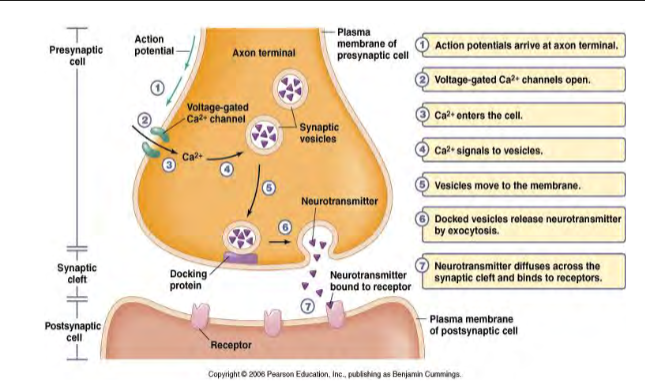
describe synaptic transmission.
action potentials arrive at axon terminal.
voltage-gated Ca2+ channels open.
Ca2+ enters the cell.
Vesicles move to the membrane.
docked vesicles release neurotransmitter by exocytosis.
neurotransmitter diffuses across the synaptic cleft and binds to receptors.
describe stratum radiatum responses?
comprised of a negative going presynaptic fibre volley that reflects synchronised action potential discharges in the schaffer collateral fibre bundle travelling past the recording electrode
describe the stratum pyramidale response.
composed of a positive f-EPSP that is followed by a negative going synchronised action potential discharge in the CA1 pyramidal neurone bodies.
how do NMDARs mediate induction of LTP?
glutamate is released and binds to AMPAR and NMDAR, AMPAR responds by opening, allowing sodium ions in, depolarising the postsynaptic membrane. the NMDAR channel is blocked by Mg2+, but is opened by glutamate and depolarisation, pushing the Mg2+ out. this allows Ca2+ to enter, activating signalling pathways leading to insertion of more AMPAR, strengthening of synaptic transmission and additional proteins are made to help maintain LTP.
what is the role of NMDARs in memory?
control synaptic plasticity, crucial for encoding and consolidating new memories.
describe the historical foundations of NMDAR-dependece.
Bliss, Lomo, Collingridge, and Morris performed experiments that described LTP in the dentate gyrus in vivo and later in CA1, and demonstrated that LTP in CA1 is blocked by NMDAR antagonists like D-AP5, establishing NMDAR-dependent LTP as the main experimental model for synaptic memory mechanisms
what kinds of potentiation are present in NMDAR-dependent synaptic plasticity?
short term potentiation, long term potentiation 1, 2, and 3, E-S potentiation, and non-Hebbian LTP
what kinds of potentiation are present in NMDAR-independent synaptic plasticity?
paired pulse facilitation, post-tetanic potentiation, and mossy fibre LTP
what are the kinds of activity dependent depression of synaptic efficiency?
NMDAR-LTD and mGluR-LTD
what kinds of stimulation are used to induce LTP?
high frequency stimulation, theta-burst stimulation
what is high frequency stimulation?
100Hz tetanus for 1 second
what is theta-burst stimulation?
bursts of 4 pulses at 100Hz repeated at theta frequency
what does high-frequency train or TBS trigger?
lasting increases in synaptic strength
how can you experimentally distinguish STP and LTP?
both are induced by strong trains, but STP decays over tens of minutes, while LTP persists for hours or longer. weak stimulation can give mainly STP, stronger or repeated trains produce both a fast-decaying STP and a slower stable LTP.
delay vs no delay protocols can separate transient from sustained LTP.
describe the temporal separation and stability of STP vs LTP.
if stimulation is paused shortly after induction, STP can decay while LTP remains, supporting the idea of distinct processes with different time constants
what are the functional differences between STP and LTP?
during early post-tetanus times, responses to repeated stimuli show strong facilitation or dynamic gain control. later when only LTP remains, the same trains are transmitted more linearly and stably, supporting distinct computational roles.

