WEEK 6 - CONFORMITY AND OBEDIENCE
 Studied by 0 people
 Call Kai
 Learn
Learn Practice Test
 Spaced Repetition
 Match
Match Flashcards
 Knowt Play
1/24

There's no tags or description
Looks like no tags are added yet.
Name | Mastery | Learn | Test | Matching | Spaced | Call with Kai |
|---|
No analytics yet
Send a link to your students to track their progress
25 Terms
Conformity
change in behaviour due to the real or imagined influence of others.
ISI - Sherif Dot experiment
Autokinetic effect - non controlled eye movements. In a dark room, a dot of light projected on wall. No point of reference to judge movement of dot. Dot didnt actually move but due to uncontrolled eye movement ppts believed it did. Ppts asked how much the dot moved. Trials done alone and in groups.
Looked into how norms are established in a group
Controlled env in lab.
When ppts did experiment alone, estimations varied a lot. From high movement to low movement. When done in a group, difference between estimations was reduced. Group arrived at consensus and group norm identified.
Ppts stuck to group response when they were called back to the lab weeks later. Even if alone.
New group members carry on the norm even if they were not there when original norm established.
Private acceptance
conforming to other people’s behaviour out of a genuine belief that what they are doing or saying is right. Informational social influence can often result in private acceptance.
When do people conform to informational social influence?
ambiguous situation
crisis situation
other people are experts
Eyewitness identification study – Baron et al. (1996) - ISI
Saw image of perpetrator. Then had to select individual from line of 4 men. Quick task therefore difficult and ambiguous.
Groups of 4 - ppt and 3 confeds.
Confed gave wrong answer.
Ppts split into ‘important’ condition and ‘non important condition’.
Important: paid $20 and told its an experiment to test eyewitness testimony in the police. Conformity= 51%
Non important: first test to construct a task that still being developed. Conformity = 35%
Important = thought majority must be right. Close to a crisis situation.
Asch - 1951
Asch - 1951
1951 - conformist time in America due to war.
Conformity - 37%
Conformed for multiple reasons: ‘they must be right’ ‘I know they are wrong but why should I be different - discomfort of disagreement with group’
Partner confed conformity = 5%.
Unanimity = group power.
When ppt had to write answer - anonymous - conformity = drops by 2/3rds. 12.5%
On average people conformed on 1/3rd of the trials.
Public compliance
conforming to other people’s behaviour publicly, without necessarily believing in what they are doing or saying. Normative social influence leads to public compliance, but not always private acceptance.
Johnny Rocco - Schachter 1951
Students asked to evaluate case of juvenile delinquent.
Most students thought Johnny should receive a mid level punishment.
Confed argued Johnny should receive highest level punishment
Students tried to change confeds mind. Then when they couldn’t they ignored him.
Survey completed about future meetings of people within the group. Asked who should be excluded when the group meets again. Students nominated the deviant individual
Asked how they would assign future tasks. Assigned unimportant jobs or boring jobs to the deviant.
Social impact theory.
Conforming to normative social influence depends on:
the group’s importance - How important the group is to you
immediacy (closeness in space and time) - more likely to conform if the group is physically close to you or will see them soon
the number of people in the group. Normative pressure increases with group size.
cultural values - collectivistic cultures = higher conformity
Minority influence
Minority needs consistent view over time. The minority is unanimous - if there are 2 or more minority views, majority will dismiss them.
New and unexpected information is introduced. Causes deeper thinking.
2 types of group norms people conform to in everyday life.
Injunctive norms
Descriptive norms
Injunctive norms
perceptions of what behaviours are approved or disapproved by others.
Descriptive norms
perceptions of how people actually behave in given situations, regardless of whether the behaviour is approved or disapproved by others.
Using norms to change behaviour - Reno et al 1993.
Ppts walked to dirty or clean parking lot. Researcher manipulated both descriptive and injective norms.
Control - confed walks by and nothing happens. 1/3rd of ppts littered a flyer they were given.
Descriptive - cofed walks by and litters a bag. Ppts interpreted it as norm to litter in dirty parking lot so increased littering from ppts. Clean parking lot - ppts saw behaviour as breaking norm so didnt litter.
Injunctive norm - confer picks up bag - reminded of norm that littering is wrong so dont put flyer on ground.
Using norms to change behaviour - boomerang effect
Conserving electricity experiment - Shultz et al 2007
2 groups - 1) household received leaflet on how much energy their house used and how much the avg in the neighbourhood was. - Descriptive norm condition. 2) also got information but smiley face if energy consumption was below average and sad face if it was above avg - Descriptive and injunctive. Received approval or disapproval .
Later energy measured again - in descriptive condition - those who used above norm had cut down on use. Those who below norm increased consumption. - in descriptive and injunctive - those with high consumption decreased and those with low stayed the same.
Freedman & Fraser, 1966 - Foot-in-the-Door Technique
getting people to agree first to a small request makes them more likely to agree later to a second, larger request
Works as we form self image of someone who is helpful. We dont want the people who asked us before to stop liking them because we refused their request. Unreliable
Cialdini et al., 1975 - Door-in-the-Face
first asking people for a large request that they will probably refuse makes them more likely to agree later to a second, smaller request
Dont want to seem unreasonable as person already made compromise for us.
Milgram results
Instead, 62% of participants delivered the maximum 450V.
The average maximum delivered was 360V.
80% kept administering shocks even after the learner said that his heart was bothering him.
People estimate that only 1% of the population would apply the maximum shock.
participants didn’t want to disappoint the experimenter - Milgram
participants didn’t want to disappoint the experimenter
There were 4 different commands, used every time the participant was reluctant to continue, and always given in the same order: 1 – “Please continue”, 2 – “The experiment requires that you continue”, 3 - “It is absolutely essential that you continue”, and 4 “You have no other choice, you must go on”. The experiment was terminated only if the participants refused to obey command 4.
situation was ambiguous - Milgram
situation was ambiguous
Participants trusted the expert dressed in a white lab coat, who said the shocks will not harm the participant in the long term.
Lack of responsibility - Milgram
Lack of responsibility
we obey authority as long as they will take responsibility. Eichmann defence
just following orders without questioning them, so he wasn’t responsible.
Milgram - variantions
Ally
3 teachers, 2 of which were confederates. Confederates refuse to continue – only 10% of participants apply the maximum 450V shock.
unanominity
Two experimenters start to disagree about continuing to apply the shocks – the authority’s view is unclear, so the “teacher” stops applying the shocks.
The authority’s view on the situation became unclear, they were no longer an expert, so participants stopped listening.
Other variations - milgrm
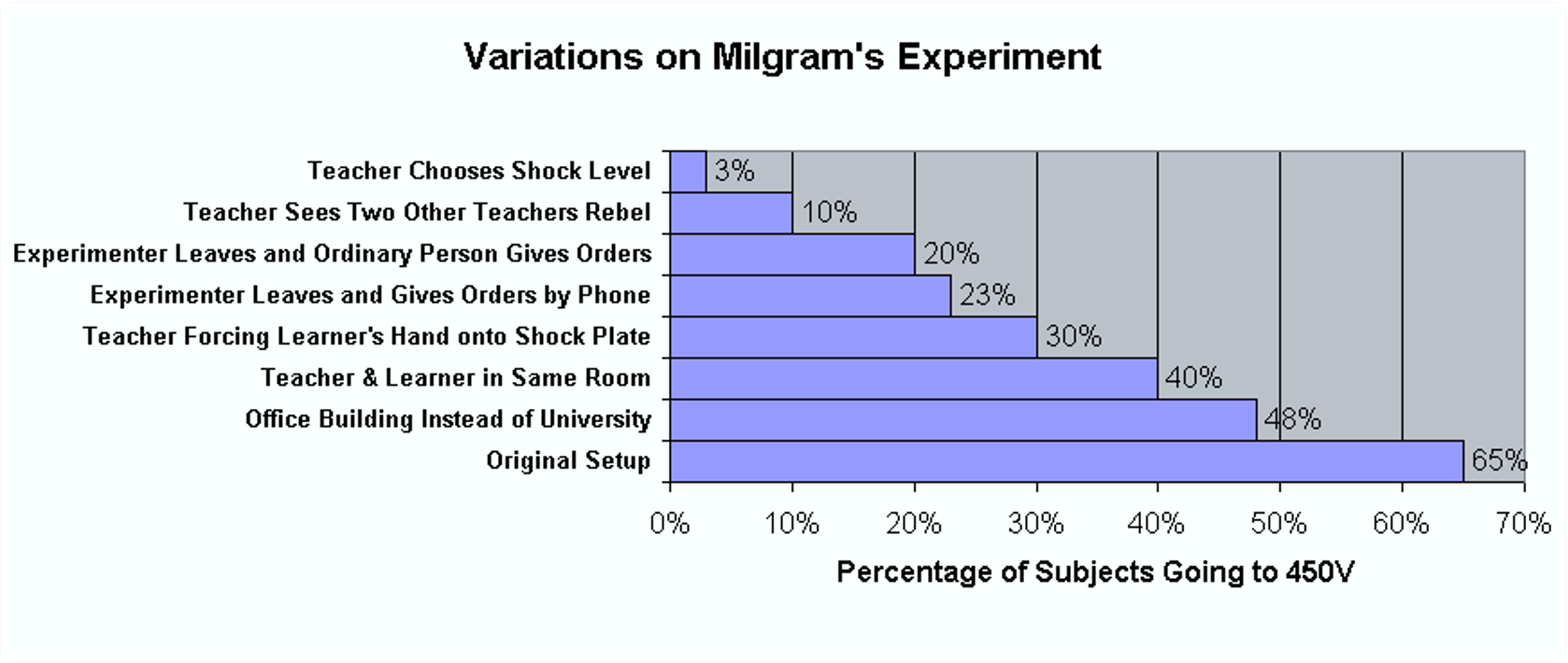
Reasons for obedience
Following the wrong norm: Once people follow a norm, it is difficult to recognize it is no longer appropriate. Probably not many would have agreed to the experiment if they were told from the beginning that they would be applying lethal shocks to others. -if they had time to take a break and think, they likely would have realised the gravity of the situation.
Self-justifications: -After justifying one of the levels, it was difficult to decide where to draw a line and not justify the next level.
The loss of personal responsibility: “easier” for them to do horrible things when they didn’t have to take responsibility
Study replications of milgram – Burger (2009); Doliński (2017)
Burger 2009
Participants were pre-screened, and those who were identified as having a predisposition for experiencing distress were excluded
Those taking part were told explicitly that both them and the learner can leave the study at any time.
the study stopped at 150 Volts; apparently, participants who passed the 150 Volts level in Milgram’s study were those who were more likely to go all the way to the maximum voltage, so it was assumed that those who reach 150 Volts in Burger’s study would be likely to go even further.
70% of the participants delivered the 150 Volts and were ready to continue
Dolinski - another replication done in Poland in 2017 found that 90% of participants were obedient to the 150 Volts level.
 Note
Note  Flashcards (23)