ess topic 8
 Call Kai
 Learn
Learn Practice Test
 Spaced Repetition
 Match
Match Flashcards
 Knowt Play
1/37

There's no tags or description
Looks like no tags are added yet.
Name | Mastery | Learn | Test | Matching | Spaced | Call with Kai |
|---|
No analytics yet
Send a link to your students to track their progress
38 Terms
crude birth rate (CBR) formula
No. Of Births/total population X 1000
Crude Death Rate (CDR) formula
No. Deaths/total population X 1000
total fertility rate
the average number of children a woman is expected to have during her lifetime, based oncurrent age-specic fertility rates
life expectancy
This is the average number of years a person is expected to live from birth, assuming currentdemographic factors (such as healthcare) remain the same
doubling time + formula (must know)
This is the number of years it would take a population to double in size, based on its current growth rate.
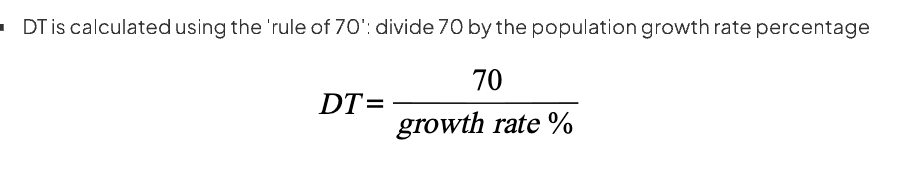
natural increase rate + formula (must know)
This is the dierence between the crude birth rate and crude death rate, usually expressed as apercentage or a number per 1 000.
If the birth rate is higher than the death rate, natural increase occurs

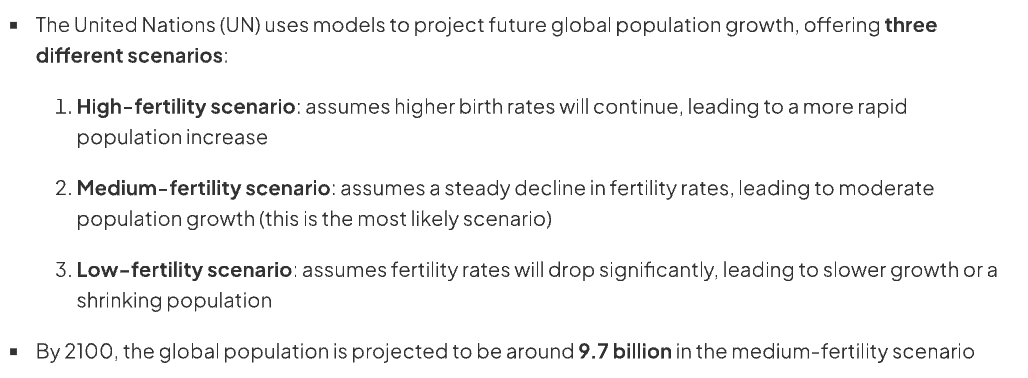
UN projection models (3)
direct management of population growth (3)
anti-natalist: reduce birth rates in countries with high population growth. These policies are common in countries facing overpopulation, where resources are strained. ex: China’s one child policy.
pro-natalist: encourage an increase in birth rates in countries with low or negative populationgrowth. These policies are used in countries facing ageing populations or labour shortages, ex: Sweden provides parental leave to support family growth.
migration policies: manage immigration and emigration to influence population size and labour markets. ex: Germany encourages immigration to offset declining population.
indirect management of population growth (3)
economic policies: improving living standards + changing family planning decisions. ex: improved employment opp can reduce poverty —> less children + higher living standards.
social and gender equality policies: reduce birth rates by empowering women and girls. ex: education for girls and women —> delayed marriages and childbirth —> improved gender equality
public health and welfare policies: lowering death rates and improving overall well-being. ex: improving healthcare —> reduce infant mortality —> smaller family size + stable populaiton growth.
age-sx pyramids.
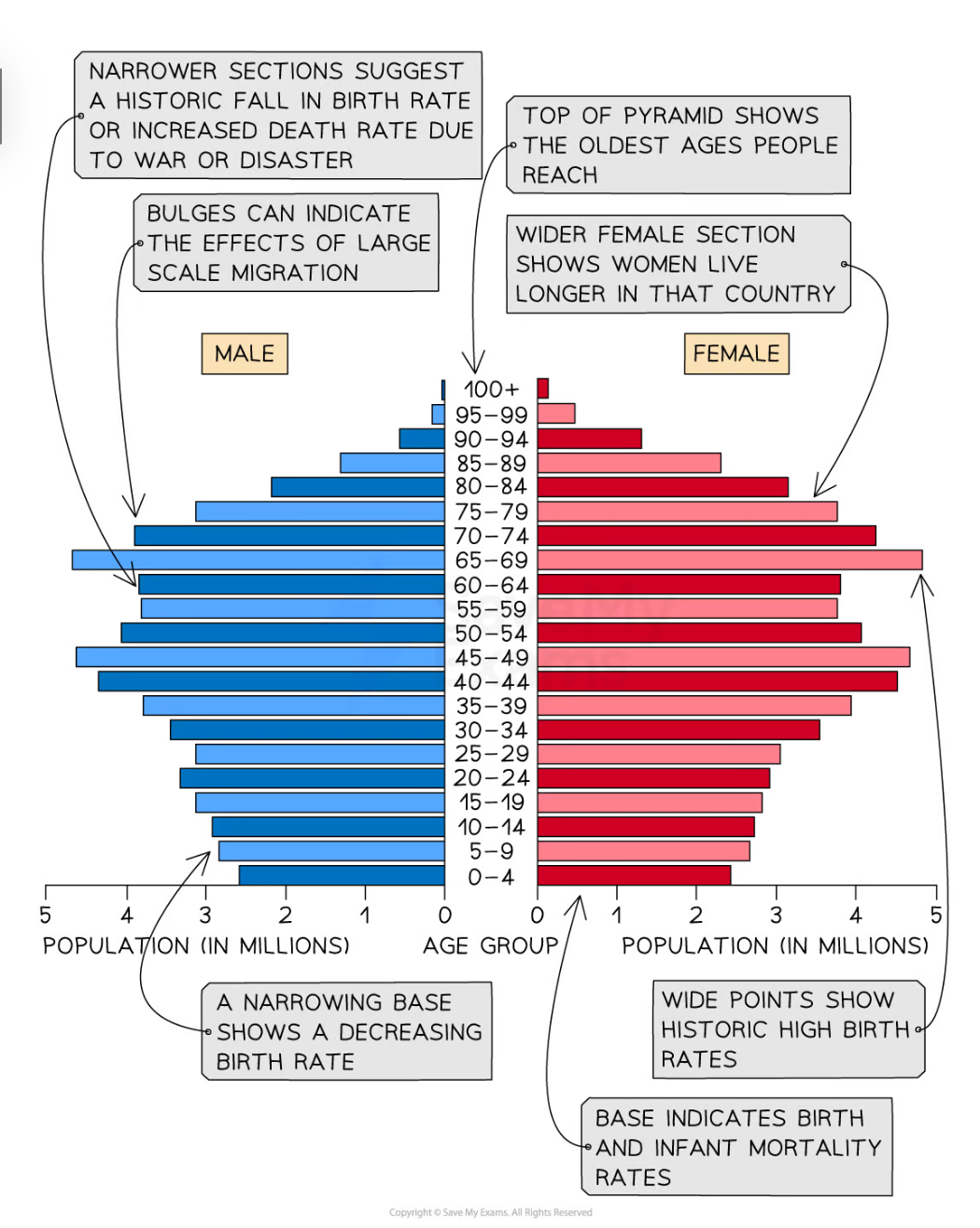
different types of age-sx pyramids
low-income countries (LICs)
more developed LICs
high-income countries
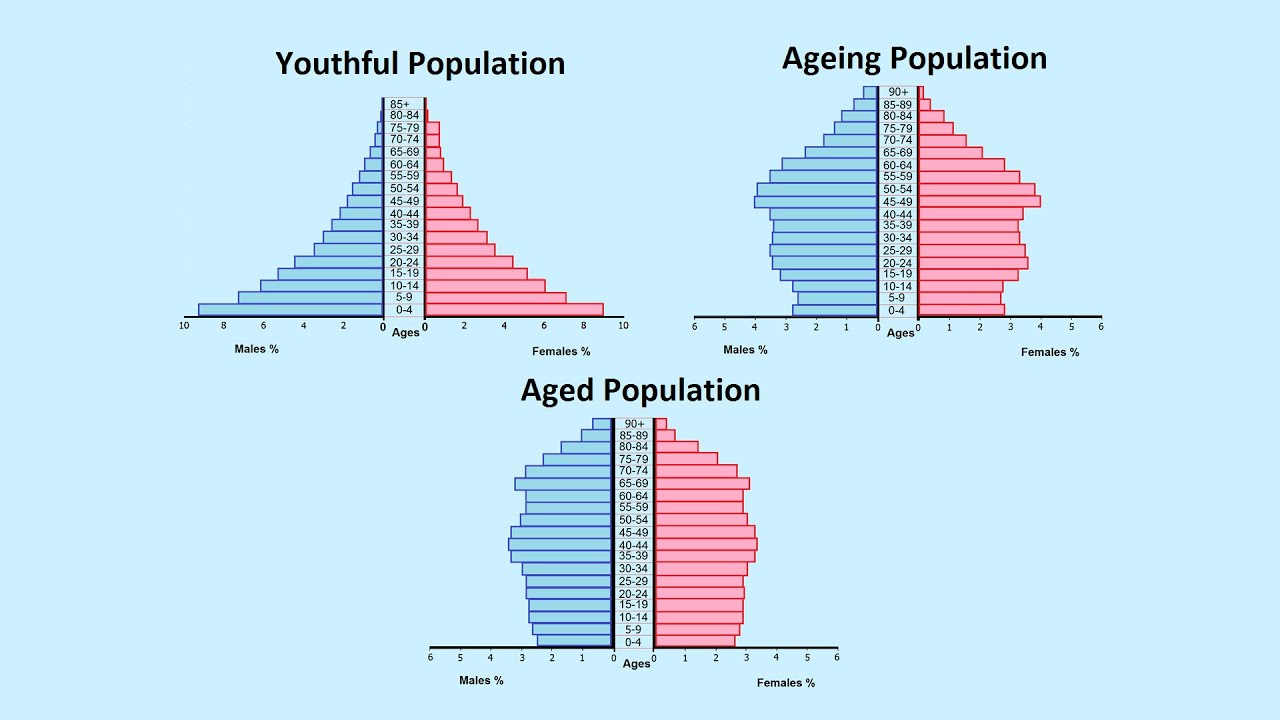
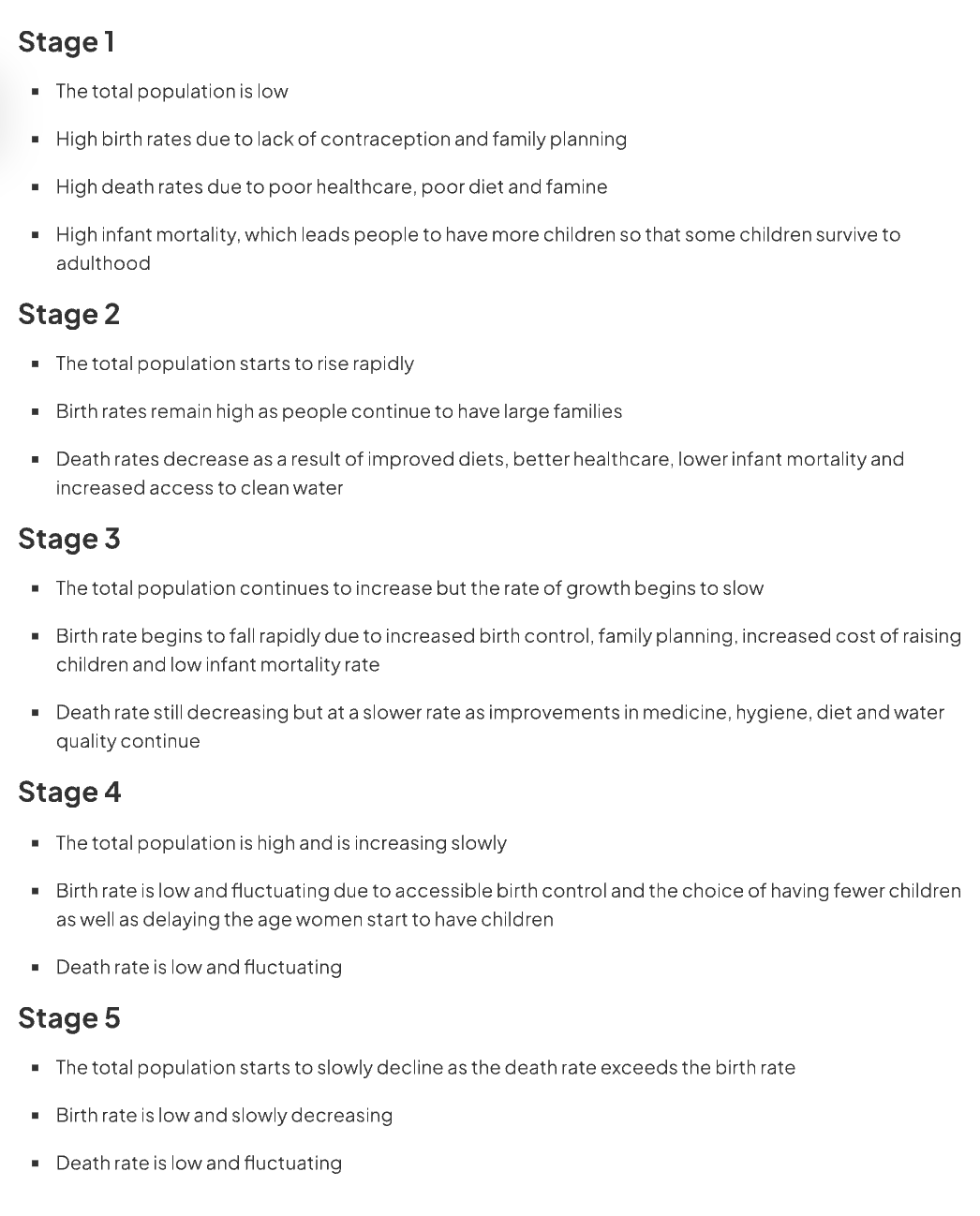
demographic transition model + relationship with age-sx pyramids
urban ecosystem’s components
ecosystems have both biotic components (living organisms like plants, animals and humans)and abiotic components (non-living parts like soil, water, air and urban infrastructure).
urban areas + its types
An urban area is a built-up area with a high population density, buildings and infrastructure. Cities, towns and suburbs are classified as urban areas.
difference between urban and rural areas (in terms of population density, infrastructure, and ecosystem types)
Urban areas have a dense assemblage of buildings and people located close together for residential, cultural, productive, trade and social purposes;
rural areas have relatively low population density and dispersed settlements.
what is an urban system
it is a network of interconnected elements that work together to support life in a city or town
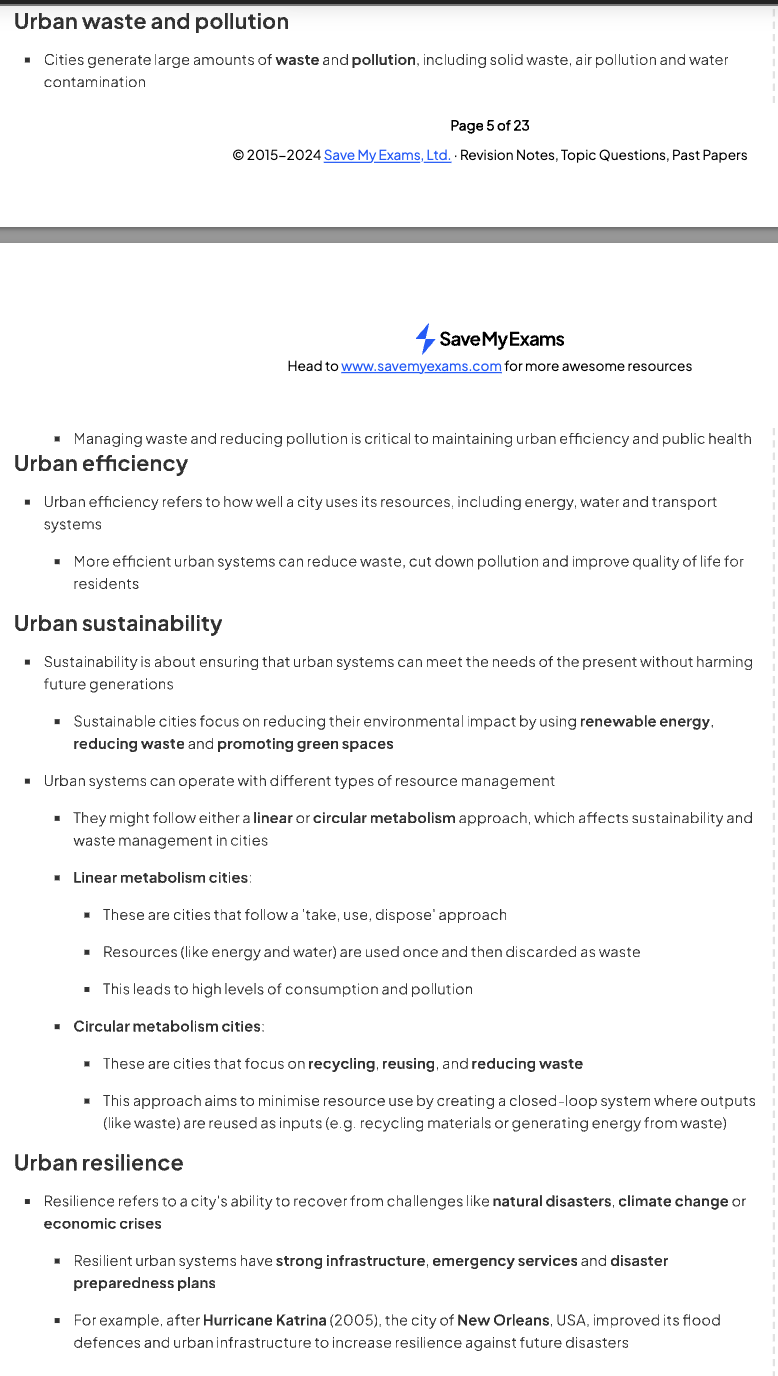
urban waste/pollution, urban efficiency, urban sustainability, urban resilience
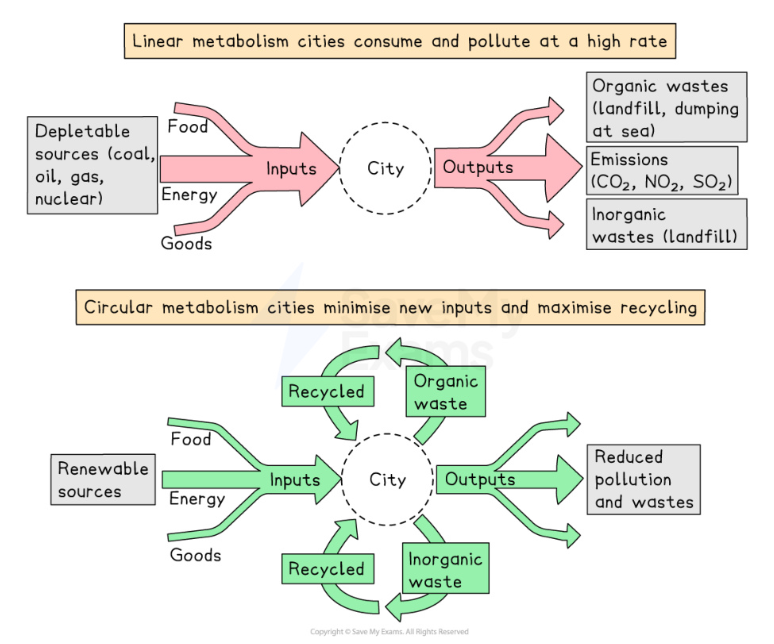
urban system flow diagram (linear and circular metabolism)
urbanisation
the process where a growing proportion of a country's population moves from ruralareas (countryside) to urban areas (cities and towns)
rural-urban migration, push-pull factors
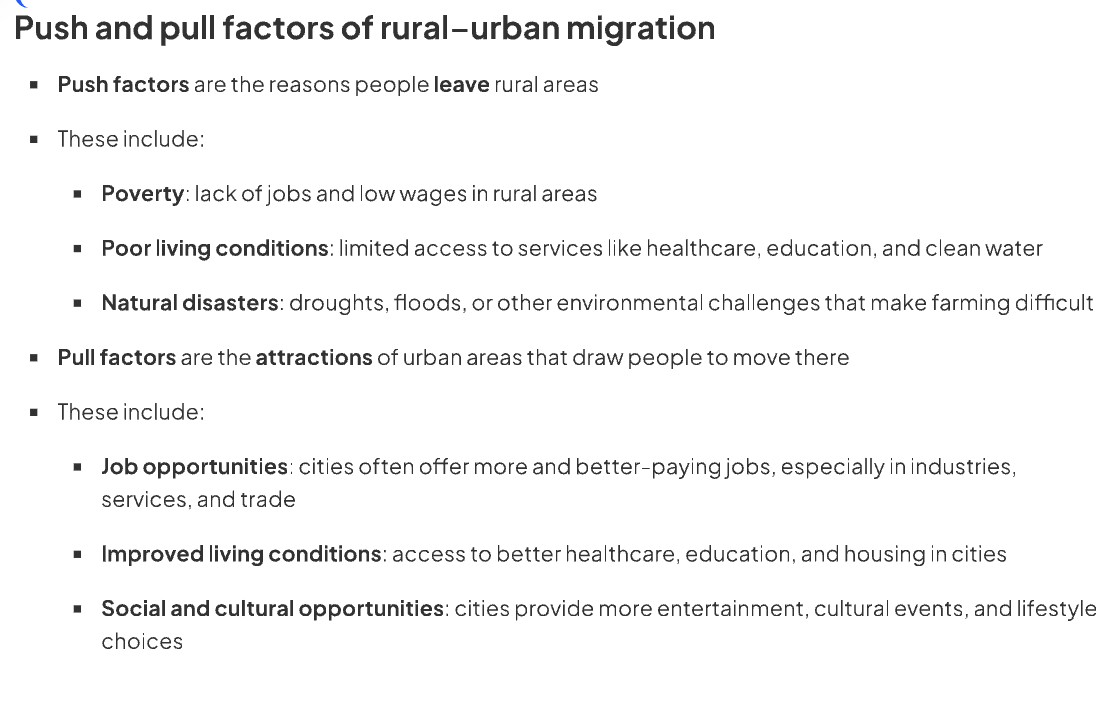
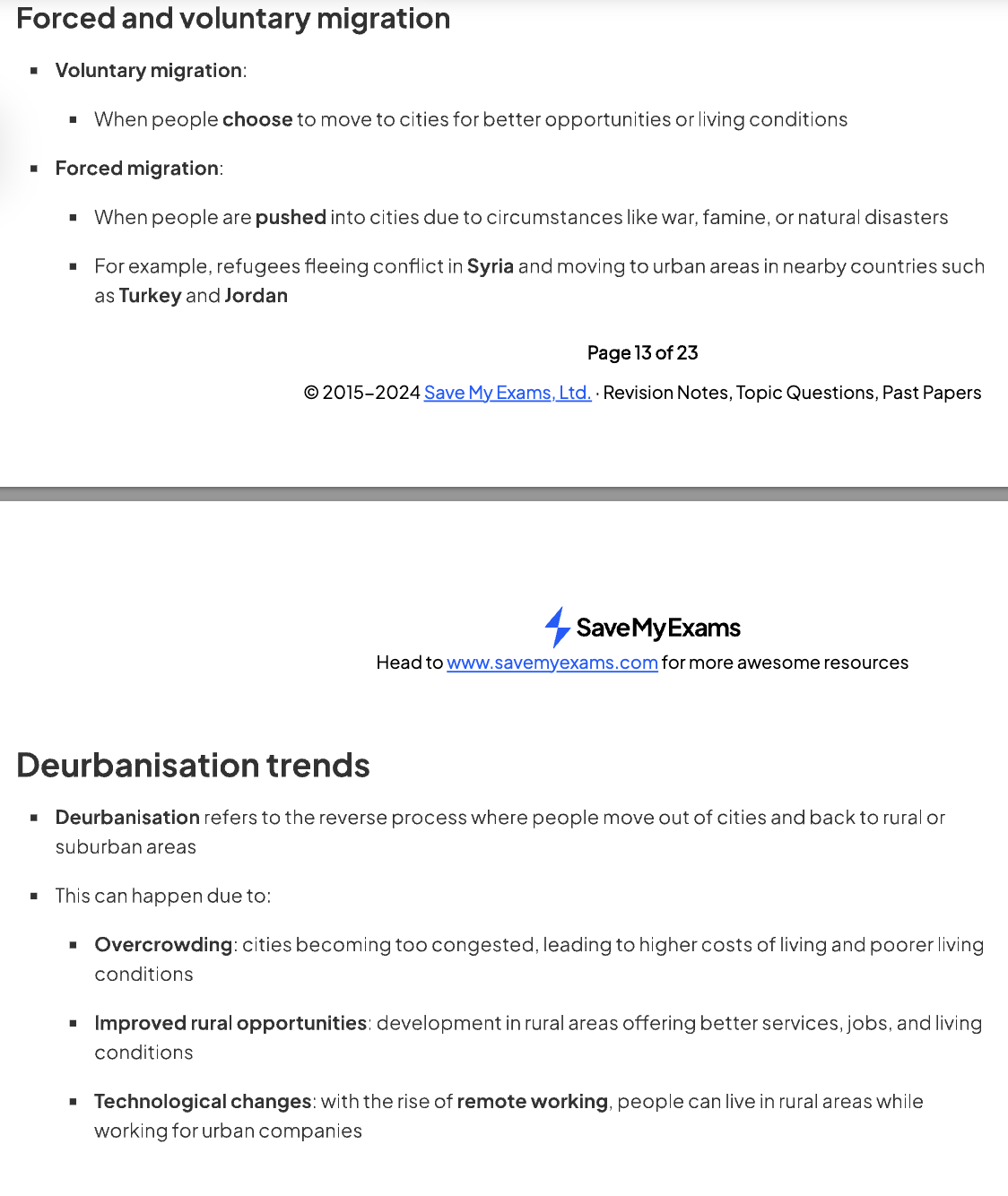
rural-urban migration, forced and voluntary migration + deurbanisation trends
suburbanization
Suburbanisation is the process where people move from the dense central parts of cities (urbanareas) to the less dense, peripheral areas (suburbs).
It involves the expansion of cities into nearby rural or undeveloped areas, creating lower-densityresidential areas
urban sprawl
Urban sprawl refers to the uncontrolled expansion of urban areas into surrounding rural land, creatingspread-out developments.
Urban sprawl is closely related to suburbanisation, as lower-density housing and commercial developments require more land, stretching the boundaries of the city
environmental impacts of urban expansion → agriculture
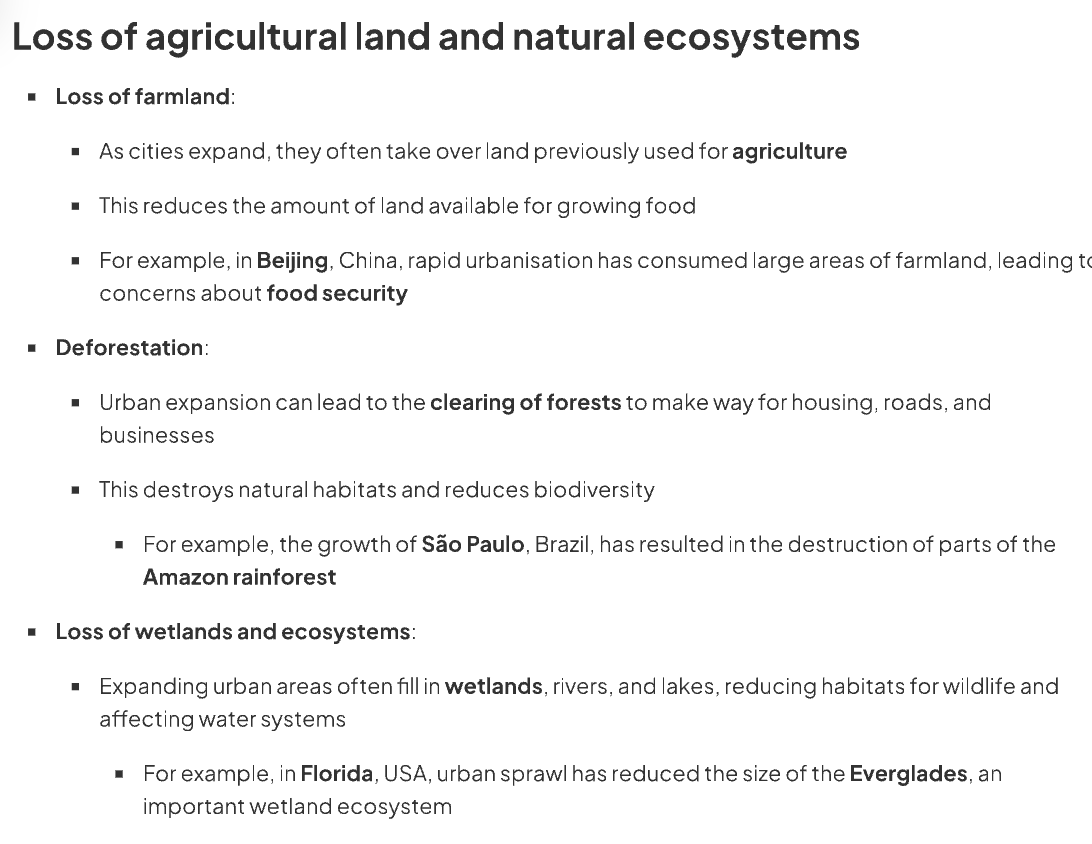
environmental impacts of urban expansion → water
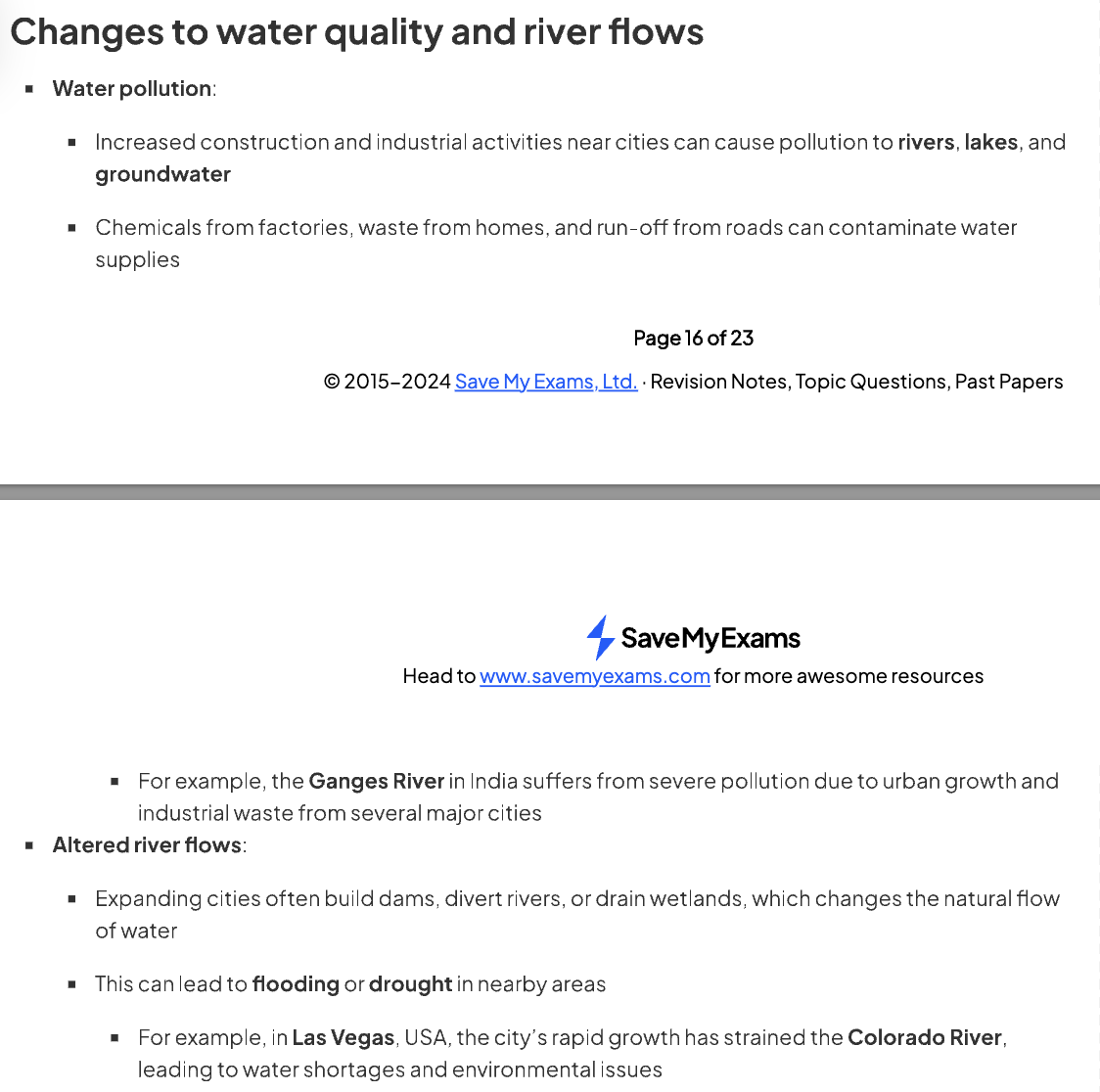
environmental impacts of urban expansion → air
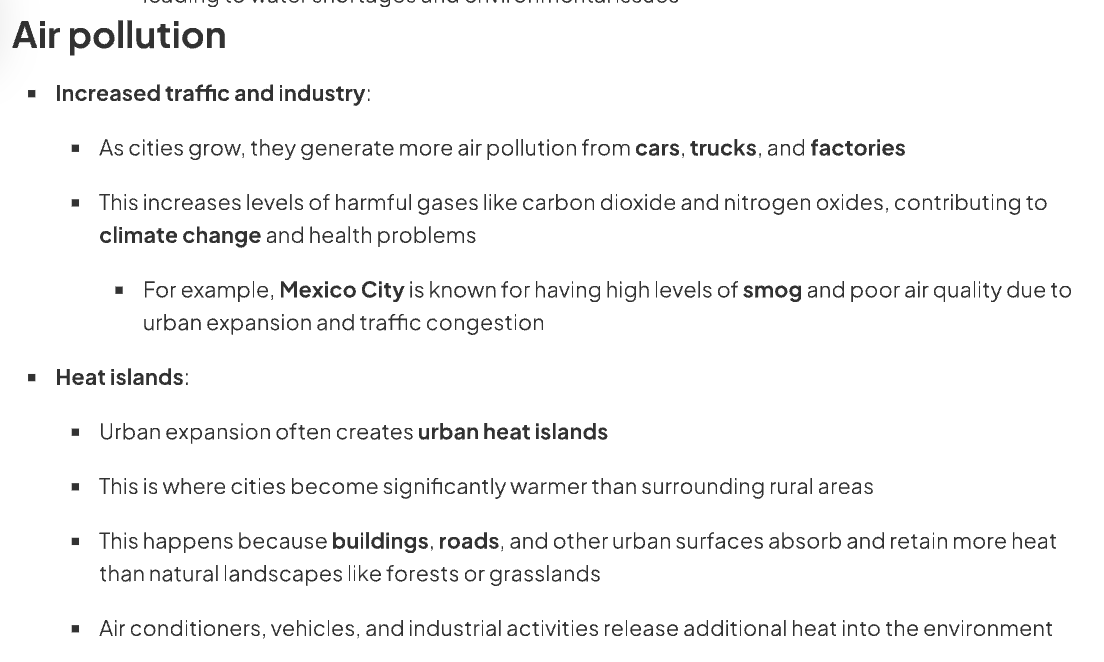
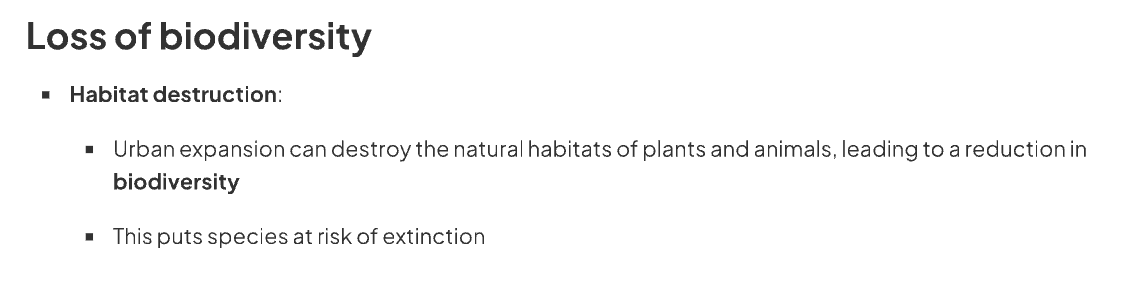
environmental impacts of urban expnasion → biodiversity
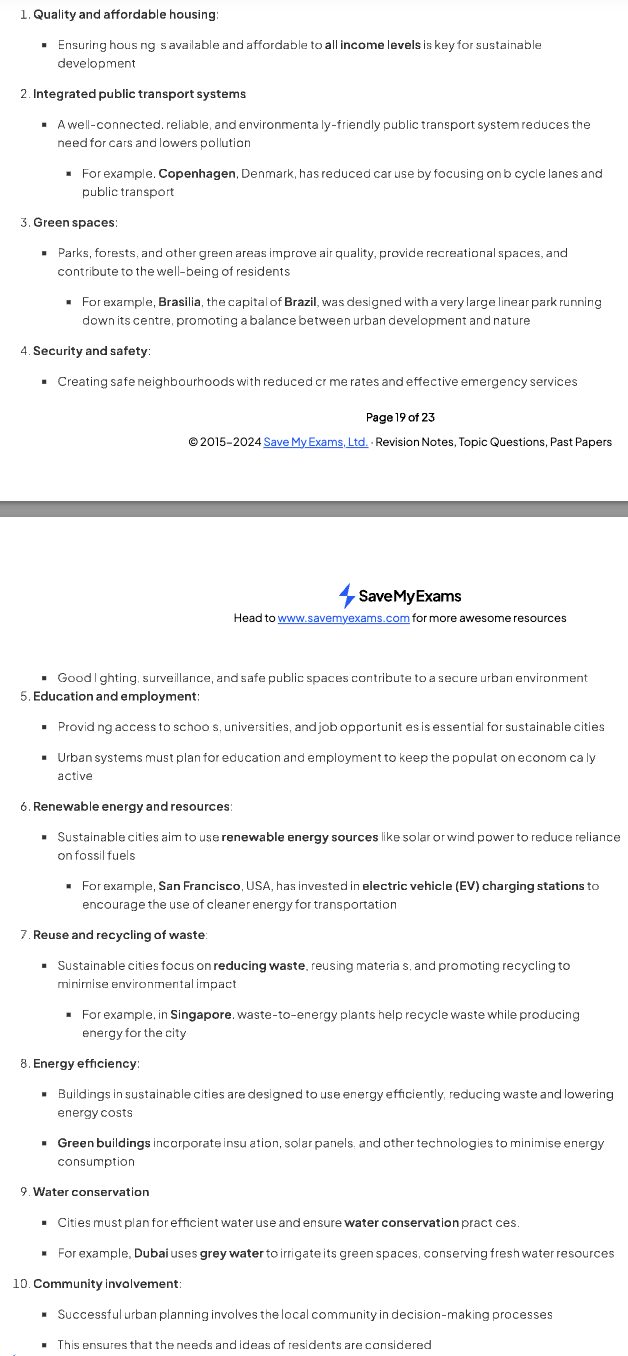
urban planning + factors in sustainable urban planning
Urban planning is the process of designing how land and buildings in a city are used to meet the needsof the population
It focuses on the best way to organise urban space to meet the physical, environmental,commercial, industrial, and social needs of all residents
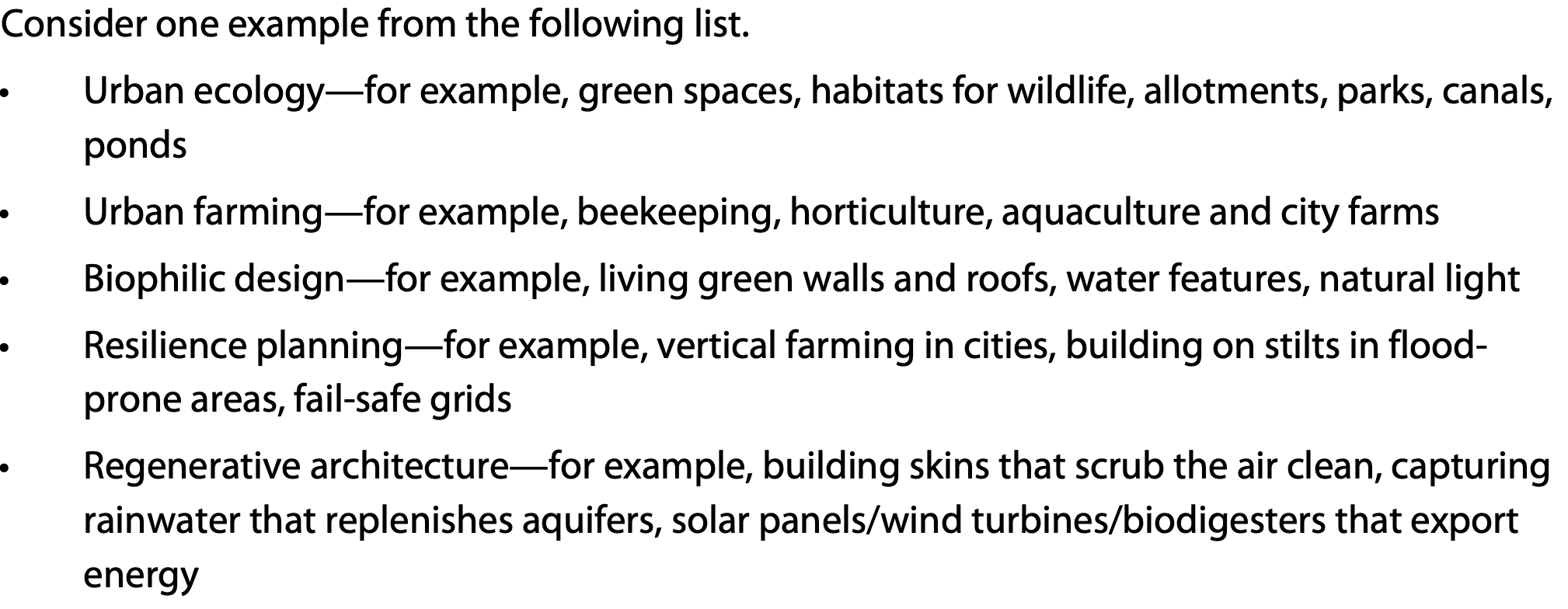
ecological urban planning components:
urban ecology: green spaces and natural habitats into city design
urban farming: growing food withinc ities
biophilic design: brings nature into the built environment (natural elements into architecture)
resilience planning: designing cities to withstand and adapt to env changes
regenerative architecture: reduce env harm but actively improve the env
what causes urban air pollution
it is caused by inputs from human activities to atmospheric systems, including nitrogen oxides (NOx), sulfur dioxide, carbon monoxide and particulate matter.
PM2.5: ne particles with a diameter of 2.5 micrometres or smaller; PM10: larger particles with a diameter of 10 micrometres or smaller
primary pollutants + their sources
primary pollutants are directly emitted from a source + immediately active in the atmosphere.
natural sources: come from natural events (eg forest fire, volcanic eruptions, dust storms)
anthropogenic sources: human activities (eg burning fossil fuel, agricultural burning, industrial processes)
secondary pollutants
Secondary pollutants are not emitted directly but form in the atmosphere when primary pollutantsreact with other chemicals
eg tropospheric ozone
air pollution management strategies
reducing the use of fossil fuels → promote renewable energy sources; improve public transport; cycling
emission zones and car restrictions → Low Emission Zones (LEZs) restrict high-polluting vehicles, reducing air pollution in the city centre
catalytic converted → fitted to car exhaust systems to reduce harmful emissions
growing trees and natural screens → trees absorb co2 and trap particulate matter; natural screens like hedges reduce pollutants near roads and buildings
green walls and green roofs → covered w vegetation to improve air quality and regulate temperature (reducing urban heat island effect)
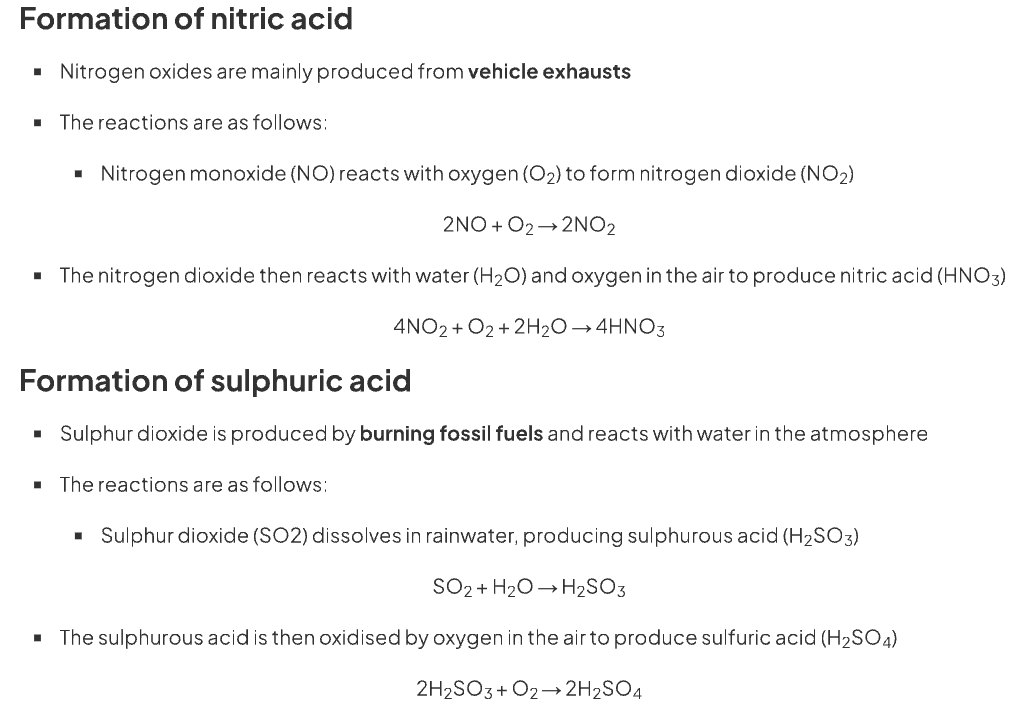
acid rain formation + chemical formula to form acid rain
occurs when NOx and sulfur dioxide react with water and oxygen in the air to produce nitric and sulfuric acid, resulting in acid rain.
impacts of acid rain on ecology
terrestrial habitats:
accelerates leaching of essential nutrients from soil, leading to nutrient deficiencies
increase soil toxicity
direct damage to foliage (weaken trees)
coniferous forests are sensitive to acid rain, inhibits nutrient absorption
freshwater habitats:
water bodies become more acidic because of solubilisation of aluminium
aluminium is toxic to aquatic life (make fish harder to breath, or exoskeleton inidviduals have difficulty in maintaining their shell)
impacts of acid rain on buildings and infrastructure
corrosion of construction materials:
acid rain erodes materials like marble, limestone causing it to corrode and weaken
impact of acid rain on human health
respiratory issues:
nitrate and sulphate particles can cause respiratory problems
particulate matter can enter lungs and increase risk of asthma, lung inflammation, etc
acid rain management strategies
altering human activity: using alternative energy sources
controlling at the point of release: scrubbers and catalytic converters
restoring the damaged systems: healthcare and adding limestone/fertilizer to lakes

