ART 149 FINAL EXAM STUDY GUIDE
 Call Kai
 Learn
Learn Practice Test
 Spaced Repetition
 Match
Match Flashcards
 Knowt Play
1/144

There's no tags or description
Looks like no tags are added yet.
Name | Mastery | Learn | Test | Matching | Spaced | Call with Kai | Chat |
|---|
No analytics yet
Send a link to your students to track their progress
145 Terms
Author Page
A page for the author
Canon Table
A table of concordance for two or more parallel texts of the Gospels, usually the one compiled by Eusebius of Caesarea in the fourth century.
Carpet Page
a characteristic feature of Insular illuminated manuscripts. They are pages of mainly geometrical ornamentation, which may include repeated animal forms, typically placed at the beginning of each of the four Gospels in Gospel Books.
Codex
A book, or a group of manuscript pages (folios), held together by stitching or other binding along one edge.
Colophon
The data placed at the end of a book listing the book's author, publisher, illuminator, and other information related to its production. In East Asian handscrolls, the inscriptions which follow the painting are also called this.
Evangelist Symbols
And the first beast was like a lion, and the second beast was like a calf, and the third beast had a face as a man, and the fourth beast was like a flying eagle. Over time, these four beasts sitting beneath the throne of God, were interpreted as symbols of the four Evangelists – Matthew, Mark, Luke and John.These symbols are often depicted in illuminated manuscripts and represent the attributes of each Evangelist.
Folio
An individual leaf of paper or parchment, numbered on the recto or front side only, occurring either loose as one of a series or forming part of a bound volume.
Gospels
The Gospels are the first four books of the New Testament, detailing the life and teachings of Jesus Christ, often illustrated in ornate manuscripts.
Illuminated Manuscript
A painting on paper or parchment used as an illustration and/or decoration in a manuscript or album. Usually richly colored, often supplemented by gold and other precious materials.
Initial Page
first page, embellished words
Parchment
A writing surface made from treated skins of animals. Very fine is known as vellum.
Psalter
In Jewish and Christian scripture, a book of the Psalms attributed to King David.
Scriptoria/Scriptorium
A room in a monastery for writing or copying manuscripts
Vellum
A fine animal skin prepared for writing and painting
Verso/Recto
Left/Right
Cabochon
a gem polished not faceted.
Cames
A lead strip used in the making of leaded or stained-glass windows. They have an indented groove on the sides into which individual pieces of glass are fitted to make the overall design.
Cloisonne
an enameling technique in which artists affix wires or strips to a metal surface to delineate designs and create compartments (cloisons) that they subsequently fill with enamel.
Embroidery
the art of using a needle and thread or yarn to decorate fabric or other materials with a design or pattern
Enamel
Powdered, then molten, glass applied to a metal surface, and used by artists to create designs. After firing, the glass forms an opaque or transparent substance that fuses to the metal background.
Gadrooning
The ornamental notching or carving of a rounded molding
Grisaille
a method of painting in gray monochrome, typically to imitate sculpture
Heraldic motif
hereditary symbols employed to distinguish individuals, armies, institutions, and corporations.
Hierarchy of Scale
used to evoke a sense of balance, harmony, equilibrium, and proportion in a work. Artists may choose to make important figures larger in order to draw attention to meaningful elements of the composition.
High Cross
A monumental crucifix carved of stone and decorated with patterns or figures in relief. A circle, possibly representing a halo or the desk of the sun appears behind the arms of the cross. Typical of early Medieval Ireland.
Lancet Window
A tall, narrow window crowned by a sharply pointed arch, typically found in Gothic architecture.
Repousse
A technique of pushing or hammering metal from the back to create a protruding image. Elaborate reliefs are created by pressing or hammering metal sheets against carved wooden forms.
Relics
Venerated object or body part associated with a holy figure, such as a saint, and usually housed in a reliquary.
Reliquary
A container, often elaborate and made of precious materials, used as a repository for sacred relics.
Rose window
A round window, often filled with stained glass set into tracery patterns in the form of wheel spokes, found in the facades of the naves and transepts of large Gothic churches.
Stained glass
Glass stained with color while molten, using metallic oxides, Stained glass is most often used in windows, for which small pieces of different colors are precisely cut and assembled into a design, held together by lead cames. Additional details may be added with vitreous paint.
Tapestry
a piece of thick textile fabric with pictures or designs formed by weaving colored weft threads or by embroidering on canvas, used as a wall hanging or furniture covering.
Tracery
Stonework or woodwork forming a pattern in the open space of windows or applied to wall surfaces. Plate: a series of openings are cut through the wall. Bar: Mullions divide the space into segments to form decorative patterns
Carolingian
a Frankish noble family with origins in the Arnulfing and Pippinid clans of the 7th century AD.; collapsed under viking raids
Celtic
The art of the Celts is generally associated with ornamental artistry that is comprised of repetitive patterns, spirals, knots, foliage, and animal forms.
Gothic
stain glass (light is important), gargoyles, flying buttress, pointed domes, ex: St. Denis by Abbott Suger
hiberno/hiberno Saxon
is the style of art produced in the post-Roman history of the British Isles. The term derives from insula, the Latin term for "island"; in this period Great Britain and Ireland shared a largely common style different from that of the rest of Europe.
Insular
Also known as Hiberno-Saxon art, is the style of art produced in the post-Roman history of the British Isles; the term derives from "insula" the Latin term for island; in this period Great Britain and Ireland shared a largely common style different from that of the rest of Europe.
Merovingian
relating to the Frankish dynasty founded by Clovis and reigning in Gaul and Germany c. 500–750.
Mozarabic
Of an eclectic style practiced in Christian medieval Spain when much of the Iberian peninsula was ruled by Islamic dynasties.
Ottonian
stylistic term referring to Medieval art and architecture in the 900s A.D. and the early 1000s A.D. in the Holy Roman Empire; its name comes from a dynasty of emperors, all named Otto -- Otto (I) the First, the Second, and the Third
Romanesque
refers to the time period of the 11th and 12th century and means "Roman-like"
Viking/Norseman
The Viking art, also known commonly as Norse art, is a term widely accepted for the art of Scandinavian Norsemen and Viking settlements further afield—particularly in the British Isles and Iceland—during the Viking Age of the 8th-11th centuries CE.
Rayonnant
French building style (13th century) that represents the height of Gothic architecture. During this period architects became less interested in achieving great size than in decoration, which took such forms as pinnacles, moldings, and especially window tracery
Flamboyant
a lavishly-decorated style of Gothic architecture that appeared in France and Spain in the 15th century, and lasted until the mid-sixteenth century and the beginning of the Renaissance.
The Crusades
a medieval military expedition, one of a series made by Europeans to recover the Holy Land from the Muslims in the 11th, 12th, and 13th centuries.
Feudalism
the economic and political system of Medieval Europe. It was land-based and built upon the system of loaning a loyal person land in return for military service and taxes. It depended upon loyalty and the use of land as wealth.
Pilgrimage
A devotion in motion. Traveling, often on foot, to a sacred or holy site to reach enlightenment, prove devotion, and/or experience a miracle.
Monasticism (Benedictines and Cistercians)
a religious way of life in which one renounces worldly pursuits to devote oneself fully to spiritual work.
The Cistercians soon came to distinguish themselves from Benedictines by wearing white or grey tunics instead of black; white habits are common for reform movements.
Much of Cistercian reform took place against the rivalry with the famous Benedictine abbey of Cluny, where wealth and excess were said to have set in.
Ambulatory
the passage (walkway) around the apse in a church, especially a basilica, or around the central space in a central-plan building
Archivolt
a band of molding framing an arch, or a series of stone blocks that form an arch resting directly on flanking columns or piers
Apse
a large semicircular or polygnal (and usually vaulted) recess on an end wall of a building. in a christian church, it often contains the altar. "apsidal" is the adjective describing the condition of having such a space.
Bay
a unit of space defined by architectural elements such as columns, piers, and walls
Buttress
A projecting support built against an external wall, usually to counteract the lateral thrust of a vault or arch within.
Cathedral
The principal Christian church in a diocese, the bishop's administrative center and housing his throne.
Chapter House
a building used for the meetings of the canons of a cathedral or other religious community.
Choir
The part of a church reserved for the clergy, monks, or nuns, either between the transept crossing and the apse or extending farther into the nave; separated from the rest of the church by screens or walls and fitted with stalls (seats).
Clerestory
In a basilica, the topmost zone of a wall with windows, extending above the aisle roofs. Provides direct light into the nave.
Cloister
A covered walkway, usually in an abbey, convent, or other religious institution. A cloister typically has a wall on one side and an arcade opening onto an unroofed quadrangle on the other.
Compound pier
feature of a nave arcade designed for the support of arches and to bring arch and pier into harmony. Characteristic of gothic architecture
Crossing
The place in a cruciform church where the transept crosses the nave
Crossing tower
Rises from intersection of nave and transept of Romanesque cathedral.
Cruciform
Of anything that is cross-shaped, as in the cruciform plan of a church.
Elevation
The arrangement, proportions, and details of any vertical side or face of a building. Also: an architectural drawing showing an exterior or interior wall of a building.
Finials
A knoblike architectural decoration usually found at the top point of a spire, pinnacle, canopy, or gable. Also found on furniture. Also the ornamental top of a staff.
Flying buttress
In Gothic architecture, it is an arched bridge above the aisle roof that extends from the upper nave wall, where the lateral thrust of the main vault is greatest, down to a solid pier.
Gable
The generally triangular portion of a wall between the edges of a dual-pitched roof.
Historiated Capital
A capital which is decorated with figures of animals, birds, or humans, used either alone or combined with foliage. The figures need not have any meaning, although they may be symbolic or part of a narrative sequence.
Jambs
In architecture, the vertical element found on both sides of an opening in a wall , and supporting an arch or lintel.
Lintel
A horizontal element of any material carried by two or more vertical supports to form an opening.
Narthex
an architectural element typical of early Christian and Byzantine basilicas and churches consisting of the entrance or vestibule, located at the west end of the nave, opposite the church's main altar.
Nave
The central space of a church, two or three stories high and usually flanked by aisles.
Nave arcade
in basilica architecture, the series of arches suppoted by piers or columns separating the nave from the aisles
Pier
A masonry support made up of many stones, or rubble and concrete (in contrast to a column shaft which is formed from a single stone or a series of drums), often square or rectangular in plan, and capable of carrying very heavy architectural loads.
Pinnacles
In Gothic architecture, a steep pyramid decorating the top of another element such as a buttress; the highest point.
Portal
A grand entrance, door, or gate, usually to an important public building, and often decorated with sculpture.
Radiating chapel
Series of chapels arranged around an ambulatory in the apse of a cathedral EX: St. James Cathedral, Santiago de Compostela
Refectory
The dining room in a monastery or convent.
Ribs
transverse and diagonal structural support; an arch separating one vaulted bay from the next; rib crossing a bay diagonally from pier impost to pier impost
Springer
The point at which the curve of an arch or vault meets with and rises from its support.
Transept
The arm of a cruciform church perpendicular to the nave. The point where the nave and this intersect is called the crossing. Beyond the crossing lies the sanctuary, whether apse, choir, or chevet.
Triforium
The element of the interior elevation of a church found directly below the clerestory and consisting of a series of arched openings in front of a passageway within the thickness of the wall.
Trumeau
A column, pier, or post found at the center of a large portal or doorway, supporting the lintel.
Tympanum
In medieval and later architecture, the area over a door enclosed by an arch and a lintel, often decorated with sculpture or mosaic.
Vault
An arched masonry structure that spans an interior space.
Barrel Vault
an elongated or continuous semicircular one, shaped like a half-cylinder
Groin Vault
created by the intersection of two barrel ones of equal size which creates four side compartments of identical size and shape
Rib Vault
Groin one with extra masonry demarcating the junction
Voussoirs
bricks that were wedge shaped so they would fit together to build an arch
Webbing of a vault
the vault surface between the ribs of a rib vault
Four Evangelists
the Angel for Saint Matthew
the Lion for Saint Mark
the Ox for Saint Luke
the Eagle for Saint John
St. Cuthbert
An influential churchman who was Prior of Melrose and then of Lindisfarne. He was a venerated religious figure, and a successful preacher who was responsible for the spread of Christianity in the North of England.
St. Columba
An Irish abbot and missionary credited with spreading Christianity in present-day Scotland. He founded the important abbey on Iona, which became a dominant religious and political institution in the region for centuries. He is the Patron Saint of Derry.
St. Jerome
The second-most voluminous writer – after Augustine of Hippo (354–430) – in ancient Latin Christianity. The Catholic Church recognizes him as the patron saint of translators, librarians, and encyclopedists. They translated many biblical texts into Latin from Hebrew, Aramaic, and Greek.
Eusebius
Wrote the first surviving history of the Christian Church as a chronologically ordered account, based on earlier sources, complete from the period of the Apostles to his own epoch.
Bishop Bernward
He was bishop of Hildesheim in Saxony from 993 until his death, and during this time it became an important centre for the arts. In 1010 he laid the foundation stone of the church of St Michael, for which he commissioned several works, notably the famous bronze doors (cast 1015) and a great bronze column.
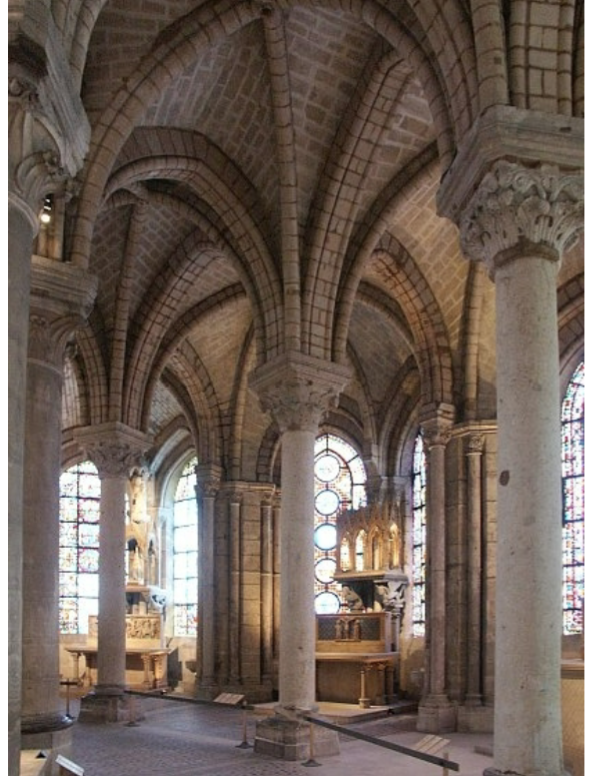
Ambulatory and Radiating Chapels of the Abbey Church (Gothic)
(ca. 1140-1144) from St. Denis in Paris, France
Plan of the east end
Shows Choir, Ambulatory, Apsidal Chapels, Apse
Burial Site of Monarchy (St. Denis and Kings of France)
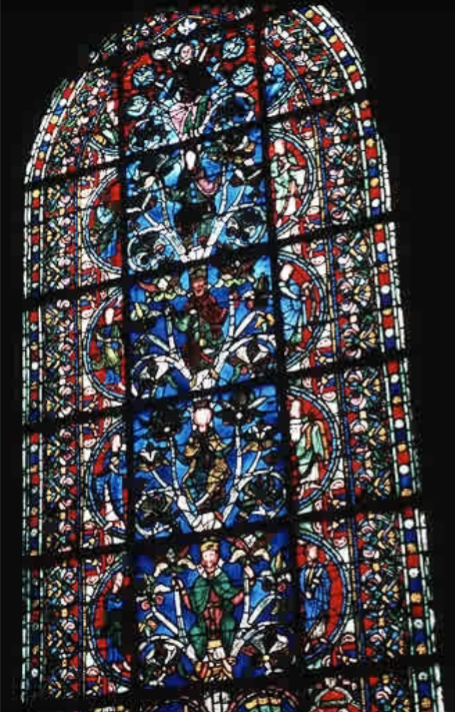
Tree of Jesse (Gothic)
(ca. 1140-1850) from St. Denis in Paris, France
Stained Glass in Chancel and Rose Window
Symbolic Rep of Jesus’ family tree from birth
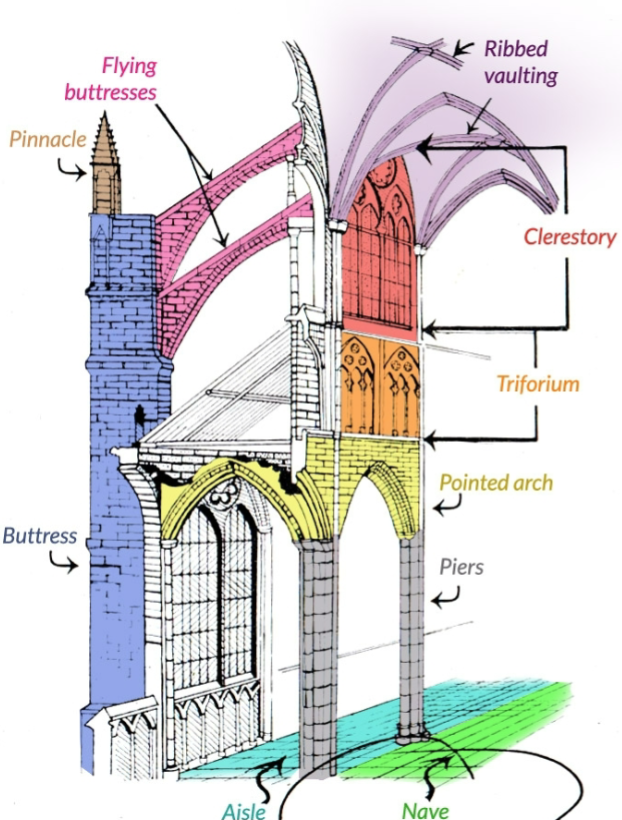
Gothic Cathedral Diagram (Gothic)
Nave, Aisle, Supportive Buttress, Pointed Arch, Compounded Piers, Triforium, Clerestory Window, Strong Ribbed Vaulting, Flying Buttresses Supporting, Pinnacle of Decor
Arches went up and out
Opened Wall for Cathedral
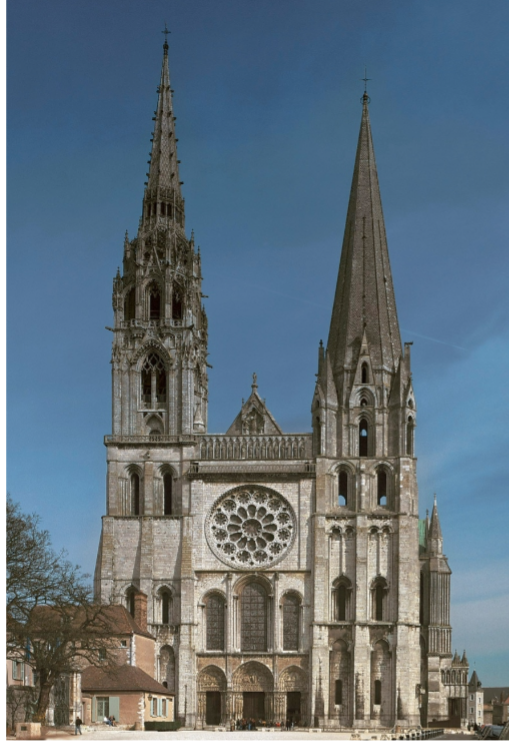
Cathedral of Notre Dame (West Facade) (Gothic)
(ca. 1150-1250) in Chartes France
Shorter is 349 ft. and Larger 377 ft.
176 Stained Windows
Gothic Style
Destroyed Multiple Times
Lightning