BREASTS AND LYMPHATIC SYSTEM ASSESSMENT
 Studied by 0 people
 Call Kai
 Learn
Learn Practice Test
 Spaced Repetition
 Match
Match Flashcards
 Knowt Play
1/46

There's no tags or description
Looks like no tags are added yet.
Name | Mastery | Learn | Test | Matching | Spaced | Call with Kai |
|---|
No analytics yet
Send a link to your students to track their progress
47 Terms
BREASTS
paired mammary glands that lie over the muscles of the anterior chest wall, anterior to the pectoralis major and serratus anterior muscles
FEMALE BREAST
accessory reproductive organ with two functions; to produce and store milk that provides nourishment for newborns and to aid in sexual stimulation
TAIL OF SPENCE
upper outer quadrant, which extends into axillary area;
where most breast tumors occur
LYMPH NODES OF BREAST
drain lymph from breasts to filter out microorganisms and return water and protein to the blood
INFLAMMATION OR ABNORMAL GROWTH OF BREAST
recent increase in the size of one breast
REDNESS
breast inflammation
PIGSKIN-LIKE OR ORANGE-PEEL (PEAU D'ORANGE)
edema; seen in metastatic breast disease
EDEMA
caused by blocked lymphatic drainage
PAGET'S DISEASE
early signs: redness, mild scaling, and flaking of the nipple
late signs: tingling, itching, increased sensitivity, burning, discharge and pain in the nipple
RETRACTED NIPPLE, DIMPLING, RETRACTED BREAST TISSUE
malignancy
DIMPLING OR RETRACTION
usually caused by a malignant tumor that has fibrous strands attached to the breast tissue and the fascia of the muscles.
ASSESSMENT FOR DIMPLING OR RETRACTION
a. raise arm
b. lower and press
c. press together
FIBROSIS OR FIXATION OF THE UNDERLYING TISSUES
restricted movement of breast or retraction of the skin or nipple
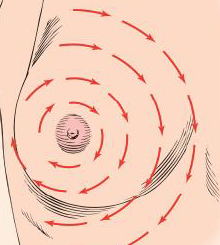
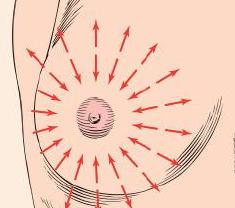
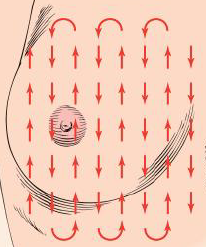
PATTERNS OF PALPATING THE BREASTS
circular or clockwise, wedged, vertical strip, flat pads of three fingers, bimanual palpation
FIBROCYSTIC BREASTS
painful, tender breasts; right before menstruation
INFLAMMATION
heat in the breasts of women who have not just given birth or who are not lactating
MALIGNANT TUMORS
upper outer quadrant of breasts; unilateral, with irregular, poorly delineated borders; hard and nontender and fixed to underlying tissues
FIBROCYSTIC BREAST TISSUE
feel ropy, lumpy or bumpy; nodular, glandular
BENIGN BREAST DISEASE
also called fibrocystic breast disease
bilateral, multiple, firm, regular, rubbery, mobile nodules with well-demarcated borders;
marked by round, elastic, defined, tender, and mobile cysts; most common from age 30 to menopause
FIBROADENOMAS
usually 1-5 cm, round or oval, mobile, firm, solid, elastic, nontender, single or multiple benign masses found in one or both breasts; lobular, ovoid or round, firm, well defined, seldom tender, usually singular and mobile; common between puberty and menopause
MILK CYSTS
(sacs filled with milk) and infections (mastitis), may turn into an abscess and occur if breastfeeding or recently given birth.
LIPOMAS
collection of fatty tissue that may also appear as a lump
INTRADUCTAL PAPILLOMA
a small growth inside a milk duct of the breast, often near the areola. It is harmless and occurs in women ages 35-50
CANCEROUS TUMORS
irregular, firm, hard, not defined masses; may be fixed or mobile; not usually tender and usually occur after age 50
DISCHARGE
seen in endocrine disorders; may indicate benign intraductal papilloma, fibrocystic disease, cancer of the breast
ACANTHOSIS NIGRCANS
dark, velvety pigmentation of the axillae
ENLARGED LYMPH NODES
infection of the hand or arm
OBESITY
soft, fatty enlargement of breast tissue
GYNECOMASTIA
smooth, firm, movable disc of glandular tissue, may be seen in one breast in males during puberty (temporary)
ANTERIOR CHEST WALL
anterior to the pectoralis major and serratus anterior muscles
breasts extend vertically
sixth rib and horizontally from the sternum to the mid-axillary line
prominent venous pattern
may occur as a result of increased circulation due to a malignancy
Areolas
vary from dark pink to dark brown
Nipples
nearly equal bilaterally in size and are in the same location on each breasT
everted, but they may be inverted or flat.
Supernumerary nipples
may appear along the embryonic “milk line.”
No discharge should be present.
Dimpling or retraction
usually caused by a malignant tumor that has fibrous strands attached to the breast tissue and the fascia of the muscles
Freely and symmetrically
Breasts should hang
Thickening of the tissues
may with an underlying malignant tumor
Circular or Clockwise
wedge
vertical strip
Discharge from one breast
may indicate benign intraductal papilloma, fibrocystic disease, or cancer of the breast
Redness and inflammation
may be seen with infection of the sweat gland
Large nodes
hard and fixed to the skin may indicate an underlying malignancy
 Note
Note  Flashcards (33)