CLEP Flashcards
 Studied by 0 people
 Call Kai
 Learn
Learn Practice Test
 Spaced Repetition
 Match
Match Flashcards
 Knowt Play
1/69

There's no tags or description
Looks like no tags are added yet.
Name | Mastery | Learn | Test | Matching | Spaced | Call with Kai |
|---|
No analytics yet
Send a link to your students to track their progress
70 Terms
Tone
The attitude and feeling conveyed within a poem through words, syntax, & punctuation
Verse
A line in a poem
Stanza
A grouped set of verses (lines) within a poem (similar to a paragraph), often with a repeated pattern of meter or rhyme
Rhyme
Repetition of similar sounds, typically at the end of words and lines
Rhyme scheme
A pattern that rhymes in a poem (e.g., ABAB, ABBA)
What rhyme scheme is demonstrated in the following excerpt?
The people along the sand
All turn and look one way.
They turn their back on the land.
They look at the sea all day.
ABAB rhyme scheme
What rhyme scheme is demonstrates in the following excerpt?
Perhaps my semblance might deceive the truth,
That I to manhood am arrived so near,
And inward ripeness doth much less appear,
That some more timely-happy spirits indu’th.
ABBA rhyme scheme
Internal rhyme
A rhyme that occurs inside the verse, for instance…
Once upon a midnight dreary, while I pondered, weak and weary,
End rhyme
A rhyme that occurs at the ends of the verse, for instance…
I dreamt a dream! What can it mean?
And that I was a maiden Queen
Guarded by an Angel mild:
Witless woe was ne'er beguiled!
Slant rhyme
Rhyme scheme in which the stressed syllables of the consonants match, but the proceeding vowels do not, for instance…
"Hope" is the thing with feathers
That perches in the soul
And sings the tune without the words
And never stops at all,
Feminine (double) rhyme
A rhyme that matches two or more syllables; the final syllable(s) is/are unstressed, and it is usually at the end of the line, for instance…
Milton! thou shouldst be living at this hour:
England hath need of thee: she is a fen
Of stagnant waters: altar, sword, and pen,
Fireside, the heroic wealth of hall and bower,
Have forfeited their ancient English dower
Masculine rhyme
A rhyme that matches only one syllable; usually, the final syllable is stressed and at the end of the line, for instance…
Death, be not proud, though some have called thee
Mighty and dreadful, for thou art not so;
For those whom thou think'st thou dost overthrow
Die not, poor Death, nor yet canst thou kill me.
From rest and sleep, which but thy pictures be,
Free verse
A poem does not follow a regular meter or rhythm; it is the closest form for imitating conversation, for instance…
A noiseless, patient spider,
I mark’d, where, on a little promontory, it stood, isolated;
Mark’d how, to explore the vacant, vast surrounding, It launch’d forth filament, filament, filament, out of itself;
Ever unreeling them—ever tirelessly speeding them.
Blank verse
A verse that does not rhyme, written in iambic pentameter (10 syllables); used in poems/dramas and often in character monologues, for instance…
Tomorrow, and tomorrow, and tomorrow,
Creeps in this petty pace from day to day,
To the last syllable of recorded time;
And all our yesterdays have lighted fools
Meter
The pattern of stressed words in a verse (refers to the rhythmic structure of lines in poetry based on stressed/unstressed syllables); natural speech usually falls on the stress points, for instance…
Shall I compare thee to a summer’s day?
Iambic rhythm
Meter in which the pattern is unstressed then stressed in sequence
Iambic meter
Meter in which a whole verse follows iambic rhythm (unstressed then stressed in sequence)
Iambic pentameter
The most common iambic meter with five stresses & ten syllables total, for instance…
Invoke thy aid to my adventurous song,
That with no middle flight intends to soar.
Anapest
Type of meter — unstressed, unstressed, stressed, for example…
Twas the night before Christmas
when all through the house.
Trochee
Type of meter — stressed, unstressed, for example
Form
The design of a poem
Closed form
Form (design) that follows a set design in meter and verse; poets must follow the pattern & structures with this form (e.g., sonnet)
Open form
Form (design) that does not follow rules of established poetic structres of meter & verse
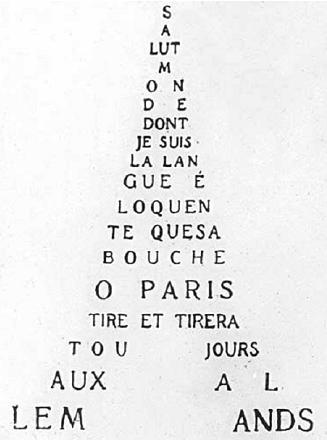
Concrete (shape) poetry
When the poem itself takes on a physical form
Sonnet
Form of poem consisting of 14 lines, usually in iambic pentameter
Petrarchan sonnet
Type of sonnet with 2 majors sections: a major group of 8 lines (the octave) and a minor group of 6 lines (the sestet)
Rhyme scheme is usually abba abba cde cde
Shakespearean sonnet
Type of sonnet with three quatrains (verse of four lines) and a couplet (verse of two lines)
Rhyme scheme is usually abab cdcd efef gg
Octave
8 lines of iambic pentameters
Most common rhyme scheme is abba abba
First part of a Petrarchan sonnet
Sestet
6 lines, generally the second part of a Petrarchan sonnet
Quatrain
Stanza or type of poem consisting of 4 lines
Couplet
2 lines usually with the same rhyme and meter
Heroic couplet
2 lines — a traditional form of English poetry used in narrative & epic poetry
Epic poem
A long narrative poem, usually about the heroic deeds of a person or nation and in the form of a couplet with the same rhyme structure
Told orally, historically used for entertainment
Mock epic
Written in heroic couplets; a modern work using the style of classical epic poetry
Ballad
Narrative poems utilizing a straightforward style and regular rhythm & rhyme; tells a story in simple language and repeating structure
Often intended to be sung
Ballad stanza
Acbc rhyme of 4 lines; 1 & 3 have 8 syllables, and 2 & 4 have 6 syllables
Lyrical poetry
Characterized by focus on personal feelings, moods, emotions, or reflections; often uses musical rhythm & language to create emotional effect
Often in 1st person
Elegy
Type of lyrical poem; a sad poem usually written to praise or weep for someone who has passed and can also be about a lost love/lost time
Ode
Type of lyrical poem; usually to praise something, can have complex form
Villanelle
Type of lyrical poem; 19 lines of 5 tercets, followed by a quatrain; there are two refrains and two repeating lines
Fixed verse form
Tercet
A stanza of 3 lines
Refrain
A line repeated in verse
Sestina
Closed form of 6 stanza of 6 lines each; the end words of each verse of the first stanza are then used to end subsequent stanzas, rotated in pattern
Concludes with a 3 line stanza (envoi) that includes all 6 words again
Epigram
A short, witty saying in verse with a satirical twist at the end
Doggerel
Poem that has irregular rhythm and rhyme; sometimes on purpose and sometimes not
Limerick
A doggerel written on purpose; a stanza of 5 lines with the 1st, 2nd, and 5th lines rhyming
Aubade
A morning love song/poem (or one about lovers in separation at that hour)
Serenade
An evening love song/poem
Denotation
The direct meaning of a word or expression; the explicit & literal meaning of that word
Connotation
The indirect meaning of the word (what is implied)
Symbol
When the words represent a concept, relationship, or object
Some stock symbols are easily recognizable (rose, flag, skull, white, etc.)
Diction
Refers to word choice
Syntax
Refers to grammar
Assonance
The repetition of vowel sounds so that there is internal rhyming in verses
Ex: On a proud round cloud in white high night
Consonance
The repetition of identical or similar consonants
Ex: So your chimneys I sweep & in soot I sleep
Metaphor
A figure of speech that refers to one thing by mentioning another
Ex: “All the world’s a stage”
Simile
A comparison using “like” or “as”
Ex: “Your teeth are like pearls”
Allusion
A figure of speech that makes a reference to an event, a place, or a person
Ex: “That is her Achille’s heel.”
Personification
Giving human characteristics to a thing or an abstraction
Ex: “The wind carried me home”
Alliteration
The repetition of similar sounds (like in consonance & assonance)
Ex: “She sells sea shells by the seashore”
Apostrophe
When a writer detaches themself from reality and talks to an imaginary character
Hyperbole
An exaggeration (overstatement)
Ex: “I’m starving”
Irony
When intended meaning is different from actual meaning
Metonymy
When a thing or concept is not called by its name by rather by a metonym (a closely associated word or concept)
Ex: “The Crown” for the British Monarchy
Onomatopoeia
The formation of words that sound like the object to which they refer
Ex: “Buzz” or “Cuckoo”
Oxymoron
When a seemingly self-contradictory effect is produced
Ex: “Pretty ugly”
Paradox
A self-contradictory statement, but one that might express a truth
Ex: “All animals are equal, but some are more equal than others”
Sarcasm
The use of words that mean the opposite of what you want to say, usually to show irritation or to be funny
Ex: “I work around the clock so I can be poor”
Synecdoche
When the part is taken for the whole, or vice versa
Ex: “Ask for her hand in marriage”
Motifs
Details that repeat themselves (subject, idea, etc.), can have symbolic effect, and add to the depth of the theme.
Can be sounds, ideas, actions, words, etc.,
Ex: a moon, the creak of a door, a sigh, etc.
 Note
Note  Flashcards (33)