Immobilised Enzymes and Biosensors
 Call Kai
 Learn
Learn Practice Test
 Spaced Repetition
 Match
Match Flashcards
 Knowt Play
1/9

There's no tags or description
Looks like no tags are added yet.
Name | Mastery | Learn | Test | Matching | Spaced | Call with Kai |
|---|
No analytics yet
Send a link to your students to track their progress
10 Terms
What are immobilised enzymes?
Enzymes which are attached to an inert matrix such as sodium alignate.
Immobilised enzymes cannot move.
What are the advantages of using immobilised enzymes?
Products are uncontaminated with enzyme.
Increased stability so will denature at higher temperature and can be used efficiently over a wider range of pH.
Enzymes easily added and removed, therefore giving control over reactions.
Can be recovered for re-use.
Why can immobilised enzymes be used efficiently over a wide range of pHs as compared to free enzymes?
Sodium alignate bead “protects” the enzyme.
The enzyme is, therefore, less exposed to the external solution.
Less H+ or OH- ions penetrate the beads.
Shape of the immobilised enzyme’s active site is less disrupted.
Why do immobilised enzymes have a greater tolerance of higher temperatures as compared to free enzymes?
The 3D structure of the enzyme is stabilised.
Therefore, the hydrogen bonds vibrate less at higher temperatures.
Fewer bonds within the immobilised enzyme break.
Active site is less likely to change to shape; enzyme is less likely to become denatured.
Suggest another way in which enzymes can be immobilised.
On a membrane.
Explain why a reaction using an enzyme immobilised on a membrane will occur quicker than an enzyme immobilised inside beads.
Enzyme immobilised on a membrane can make direct contact with the substrate allowing the reaction to take place more quickly.
Substrate molecules must diffuse into the jelly matrix of alginate beads (the product also needs time to diffuse out), so the reaction takes longer.
Intrepret the graph showing the activity of free enzymes, enzymes bound to a gel membrane surface and enzymes immoblised within beads.
Free enzyme - Between 20 – 40 o C the free enzyme has the greatest activity. Both enzyme and substrate are free to move and are therefore more likely to collide. As the temperature increases the kinetic energy of the molecules increases, allowing more successful collisions between enzyme and substrate and the product is produced quickly. Between 40 – 60 o C the volume of fruit juice decreases sharply as increased vibrations break hydrogen bonds in the active site, this changes the shape of the active site and the enzymes become denatured.
Enzyme immobilised in alginate beads – Enzyme activity continues to increase beyond the natural optimum (up to 60 o C). The alginate gel fills and supports the enzyme’s active site, maintaining the shape of the active site, allowing enzyme-substrate complexes to continue to form.
Enzymes bound to a membrane – Membrane bound enzymes are in direct contact with the substrate and therefore the product is formed faster than with enzymes immobilised in alginate.
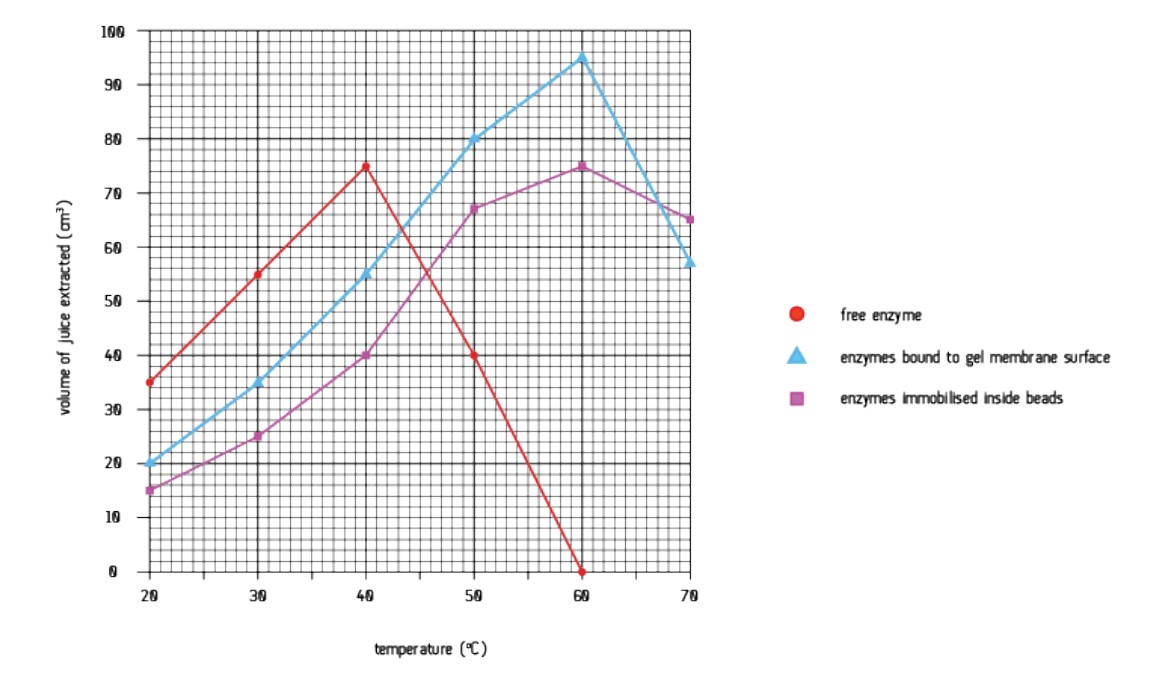
Explain why free enzymes will always have greater activity than immobilised enzymes.
Immobilised enzymes cannot move.
This reduces the frequency of successful collision as the substrate is the only molecule moving.
Free enzymes will therefore always have greater activity provided the temperature is not greater than the optimum.
How do biosensors work?
Biosensors use immobilised enzymes on a gel membrane.
The biosensor detects a chemical change, as substrate is converted to product, and a transducer converts this chemical change into an electrical signal.
This can be amplified and viewed on a display.
Give an example of a use of biosensors.
Biosensors can be used to measure blood glucose concentration in individuals suffering from diabetes.