history of our planet week 9 A
 Studied by 0 people
 Call Kai
 Learn
Learn Practice Test
 Spaced Repetition
 Match
Match Flashcards
 Knowt Play
1/33

Earn XP
Description and Tags
Quaternary interglacials and rapid climate change
Name | Mastery | Learn | Test | Matching | Spaced | Call with Kai |
|---|
No analytics yet
Send a link to your students to track their progress
34 Terms
Rapid quaternary climate change:
Defined as: “occurring when the climate change system is forced to transition to a new climate state at a rate that is more rapid than the rate of change of the external forcing”: Committee on abrupt climate change – national research council 2002
Glacial interglacial cycle driven by orbital (i.e. external) forcing c. 100 ka, Milankovitch cycles
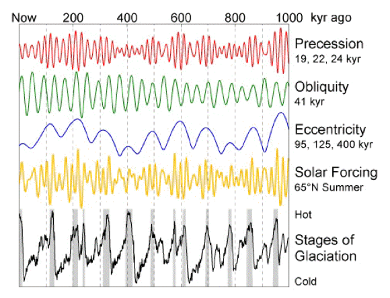
Glacials and interglacials punctuated by sub-Milankovitch millennial scale events interstadials (and stadials)
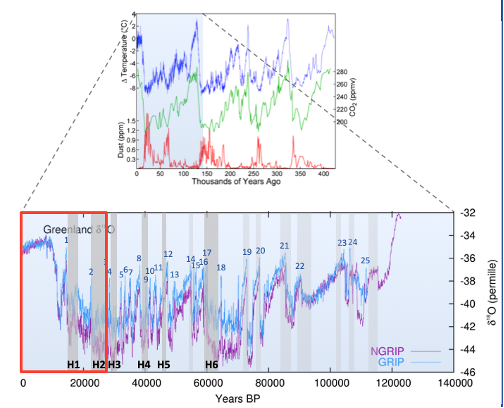
Last glacial interglacial transition (LGIT) – not a smooth transition
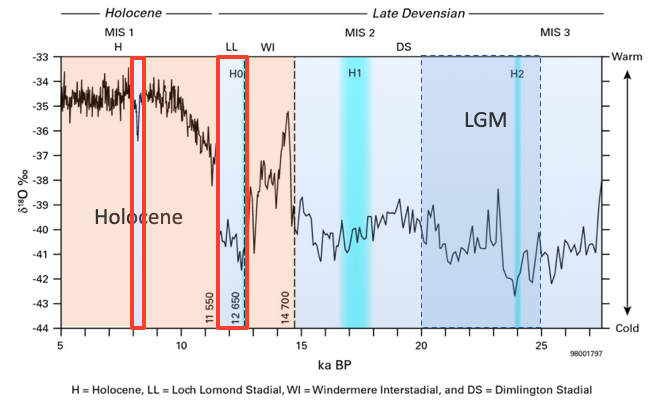
Cold snap – about 1000 years cooler
The Younger Dryas:
Abrupt climate change event
Named after dryas octapelia – alpine/ tundra wildflower
Found in Scandinavian lake sediments
Indicates shift to very cold conditions
Shift occurred in c. 40 years or less
Duration c. 1100 years
Temperature decrease: Greenland = - > 15*C, British isles = - c. 5*C
Enough for remnant parts of ice sheets to start regrowing
Glacial readvance (e.g. loch Lomond stadial) – till, moraines, erratics etc.
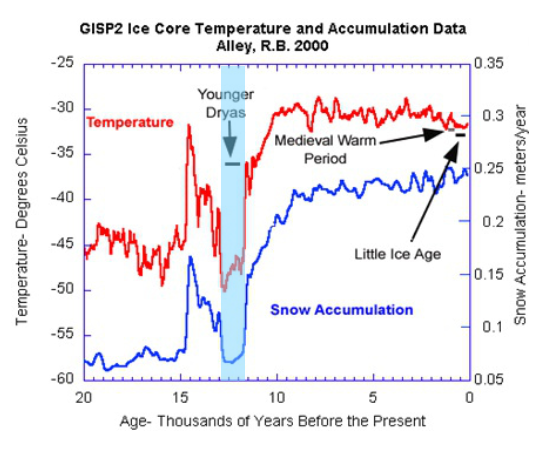
younger dryas recording
First recorded in north Atlantic
Other records: ‘global event’
‘glacial like’ conditions: Strong winter monsoon, Weak summer monsoon, Southwards ITCZ migration
Sub-Milankovitch timescales
May be internal forcing
Deglaciation and the younger dryas:
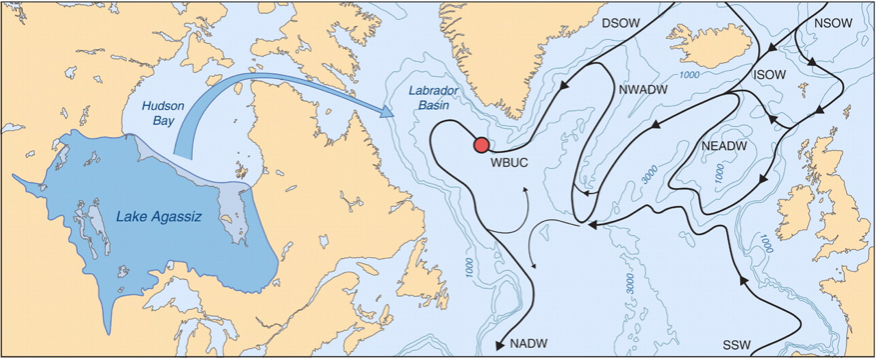
Proglacial lakes formed along margin of Laurentide and cordilleran ice sheets (from the meltwater)
Staged collapse of north American pro-glacial lake Agassiz. YD – at least 4 outburst events
Freshwater influx, reduces north Atlantic deep water (NADW) production, reduces meridional (AMOC) heat transfer
Cooling in high altitudes
the influx of water went into Hudson bay etc.
the salinity of the water is important – it disrupted the salinity levels of the north Atlantic
the younger dryas: an alternative hypothesis:
Kinzie et al (2014, journal of geology)
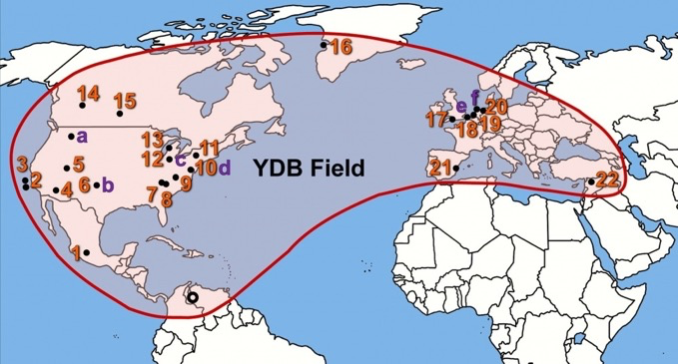
25 sites containing metal spheres, shocked quartz, iridium and black mates of carbon – impact evidence?
Coincided with onset of younger dryas
Air burst or impact from one (or more) comets caused younger dryas
Very controversial – misinterpretation, not reproducible (Pinter et al, 2011, ESR)
Demise of Clovis culture (a group of people) – sudden disappearance from archaeological record ( 13,000-11,000 yr BP) – coincides with younger dryas
Large scale megafaunal (typically mammals over 40 kilos) extinction
Overkill? (by the clovis people – so ran out of food – but problematic and unscientific)
Climate change?
Links with younger dryas?
Something else e.g. meteor
Rapid quaternary climate change: summary:
Glacial interglacial cycle (orbital forcing, external) punctuated by rapid/ abrupt climate changes (suborbital forcing, internal?)
Rapid reorganisation of ocean and atmospheric processes
LGIT- centennial/ millennial scale changes driven by meltwater pulses (e.g. younger dryas)
Societal timescale
Holocene:
The current interglacial c. 11,5000 to present
Why study the Holocene:
We are in it
Period of relative stability
Punctuated by series of climatic events
Context for recent anthropogenic change
Evolution of modern civilisation
Palaeolithic, 2.6 ma – 10 ka
components of holocene
Neolithic revolution
Dawn of agriculture
Explosion of culture, technology, art
Dramatic population increase
Dawn of Anthropocene?
Range of potential forcing mechanisms:
Orbital – Milankovitch: Insolation – amount of solar activity reaching a point of earth due to changes in Milankovitch cycles
Suborbital (sub-Milankovitch): Solar activity, Volcanic activity, GHGs (natural vs anthropogenic), Comets
Characterising the Holocene: 1
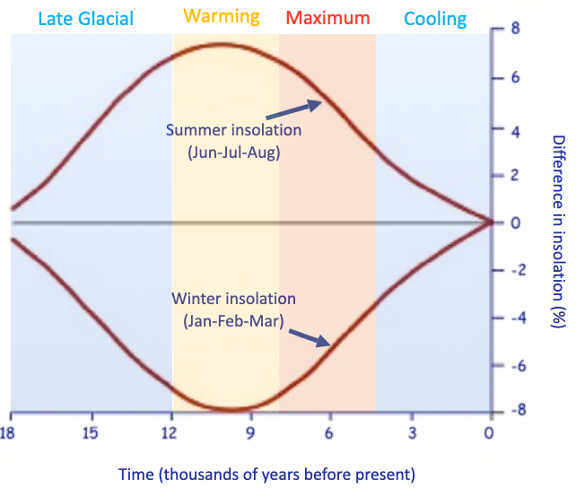
LGIT: increased summer insolation at northern latitudes
Rapid warming – warm summers, cold winters
Thermal maximum – warm summers, cool winters
Cooling – cooling summers, warming winters
System is very simplistic but this broad pattern is seen in climate records globally (wanner et al, 2008)
Characterising the Holocene: 2
Milankovitch forcing – smooth
What drives rapid, abrupt climate change beyond the YD?
Sub-milankovitch timescales
Internal forcing? Atmosphere-ocean circulation
External forcing? Solar activity, meteors
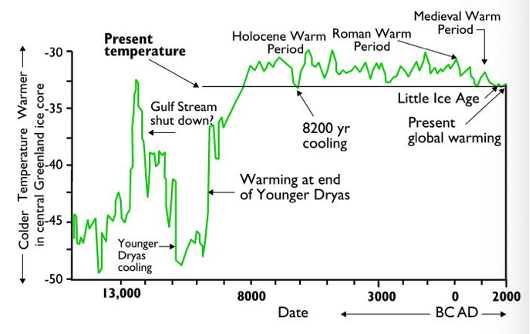
The 8.2Kyr event:
Post younger dryas: absupt climate change event - one final glacial meltwater pulse
Within Holocene – established interglacial
Significant cold snap in Greenland ice cores
Daley et al (2011, Glob, Plan. Change)
Evidence across north Atlantic region
Consistent with meltwater event
Greenland = - 6+- 2*C
Duration of 150 +- 30 years
15% reduction in CH4
Abrupt Holocene climate change:
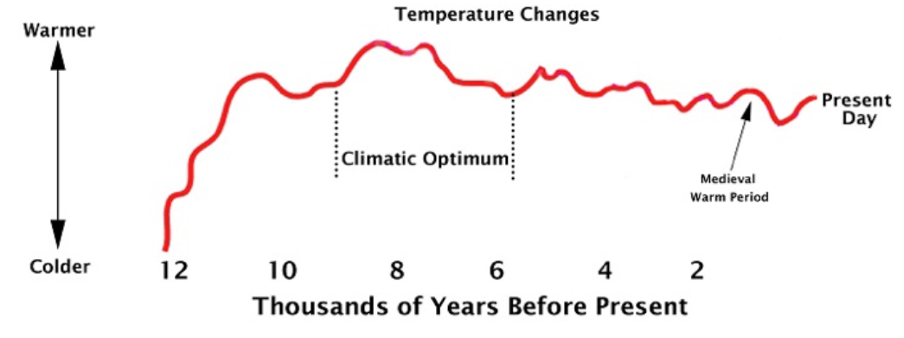
Holocene – a period of relative stability? Considerable climatic variability
Absence od orbital forcing changes? Absence of deglaciation?
What drove changes/ events
In Pleistocene:
Dansgaard-oeschger warming events
Heinrich cooling events
In Holocene:
Glacial meltwater pulse events (e.g. younger dryas, 8.2kyr event)
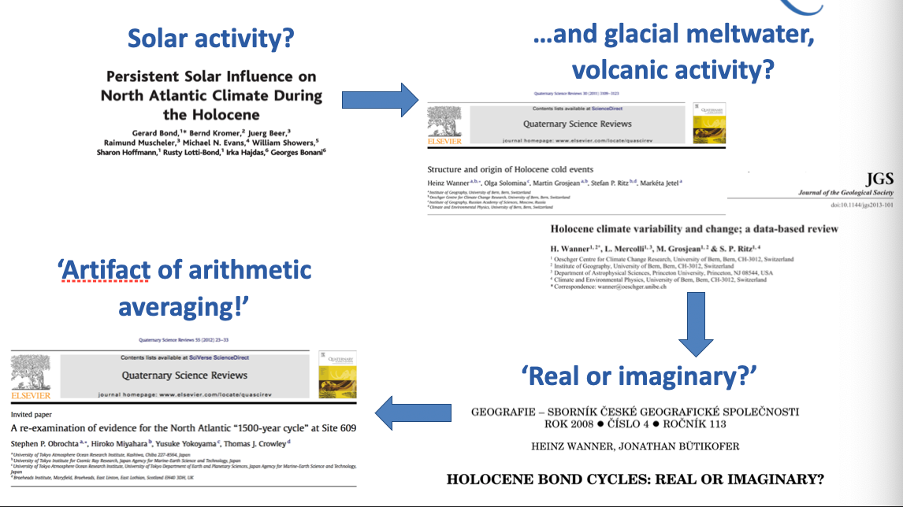
Ice rafted debris events, known as ‘bond’ events, after Gerard bond
Bond events:
Periodicity? 1470 +- 500 years (like D-O events)
Associated with colder prevailing conditions in north Atlantic region
Linked with several Holocene climate events (e.g. 4.2kyr event)
The 4.2 kyr event:
Pronounced ‘dry’ event across mid to low latitudes of Europe, chine, Africa. North America (Weiss and Bradley 2001, science); wetter in tropical south America and Asia? North Europe?
Associated with societal disruption and collapse of ancient civilisations
Timing coincides with Bond (IRD) event 3?
Holocene climate drivers:
The last 1000 years:
the hockey stick
Growing influence of humans over the last 100 years (or more)
The Holocene summary:
Appears relatively. Climatically stable
Complex regional patterns of climatic change
Large number of records (proxy, instrumental) enable comprehensive study
Range of orbital (Milankovitch) and sub orbital drivers
Large, short term variation – possibly cyclical – solar?
Notable climatic events – effects on early civilisations
Last 1000 years – growth of anthropogenic climate forcing
Quaternary interglacials:
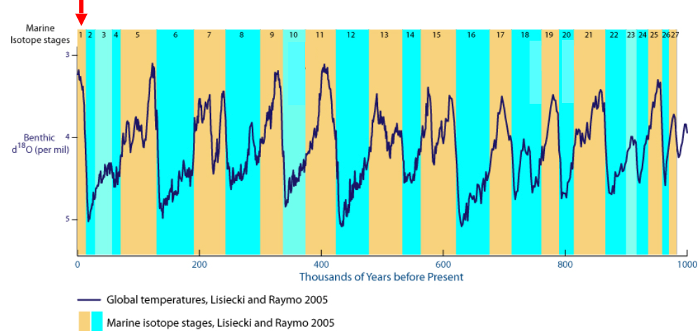
Glacial interglacial cycle initially dominated by obliquity (tilt, 41ka cycle)
Last c. 1 million years dominated by eccentricity (shape, 100ka cycle)
Last c. 1 million years – glacial interglacial cycle became more pronounced, more cyclical, particularly in last 600,000 years
Most recent = most evidence; reflected in quaternary stratigraphy
MIS 5E – the last interglacial:
MIS 5 – subdivided into 5 substages
MIS 5e – ‘ipswichian’/ ‘eemian’ (130-115ka)
Evidence for past interglacials:
MIS 5e – ‘ipswichian’ interglacial
Lake and peat records etc. are rare
Archaeology and sedimentology evidence
Distribution across southern Britain
Generally beyond maximum ice extent at LGM
River terraces: Rivers respond to interglacial-glacial cycle: i) inclusion, ii) aggradation, Law of superposition, Contain archaeology, pollen, Trafalgar square, London: classic last interglacial (ipswichian) site (thames terrace deposits, hippos and hyenas)
Ipswichian flora:
Pollen preserved in variety of sediments (including river terraces)
‘indicator’ species provide evidence of warm continental climate (pollen and plant macrofossils)
Najas minor (brittle waternymph)
Trapa natans (water chestnut)
Acer monspessulanum (Montpellier maple) – mediterranean species
Humans in MIS 5E: Hominin evidence:
Hominin fossils
Archaeological industries
Evidence of butcheries
Humans in MIS 5E: So where were the humans?
Homo sapiens
Homo neanderthalensis
(homo sp. Altai/ homo sapiens ssp. Denisova)
MIS 5E: a good analogue?
Compilation of global temperature records, 130-116kyr
Average 1.5*C warmer than today; regional patterns
Potential analogue for future 2*C climate stabilisation scenario
MIS 5E was: Warmer, Wetter, Higher sea levels, Smaller ice sheets, Lower atmospheric CO2
Why?: Greater axial tilt (obliquity), Perihelion in NH summer (today- NH winter)
Laster c. 1.5ka, Holocene: 11.5 ka
MIS 11: a better analogue?
Eccentricity: 400ka cycle
Orbitally, MIS11is a better analogue than MIS 5e
Low eccentricity: ‘rounder’ orbit; coupled with reduced processional amplitude: Fewer cold stages within the interglacial, Resulting in prolonged warm period
MIS 11: 428-397kyr ago – 31,000 year interglacial
No anthropogenic influence, so can only tell us what ‘should happen’
Would the Holocene have been a ‘long’ interglacial regardless of humans?
Less evidence from MIS 11 (i.e. older)
Summary; MIS 5e
partial analogue for a “2*C world”
Higher temperatures, especially in the arctic
Higher sea levels – 8m higher
Significant impact on biodiversity/ biogeographic boundaries
but: Different orbital forcing conditions
summary: MIS 11:
a better analogue?
Closer to Holocene orbital forcing conditions
Long interglacial?
 Note
Note  Flashcards (30)