Legal Studies Proving Guilt
 Call Kai
 Learn
Learn Practice Test
 Spaced Repetition
 Match
Match Flashcards
 Knowt Play
1/50

There's no tags or description
Looks like no tags are added yet.
Name | Mastery | Learn | Test | Matching | Spaced | Call with Kai |
|---|
No analytics yet
Send a link to your students to track their progress
51 Terms
Criminal Law
An area of law that defines behaviours and conduct that are prohibited and outlines sanctions for people who commit them.
The purposes of criminal law (IPSJ)
Protecting Individuals
Protecting Property
Protecting Society
Protecting Justice
Protecting Individuals
Criminal law aims to protect individuals by establishing crimes and processes to deal with people who commit these crimes.
Protecting Property
Criminal aims to protect privately owned and public property. This includes protecting land and the environment, and personal goods.
Protecting Society
Criminal law aims to protect the community as a whole by setting standards and making it clear what behaviour is not tolerated by the community and the legal system. This helps maintain public order and community safety.
Protecting Justice
Criminal law aims to promote justice by providing processes to deal with offenders and enforce the law. Having the state enforce criminal law helps prevent victims of a crime, and their family and friends, from taking the law into their own hands and imposing their own punishment on an offender.
Presumption of innocence
The right of a person accused of a crime to be presumed not guilty unless proven otherwise.
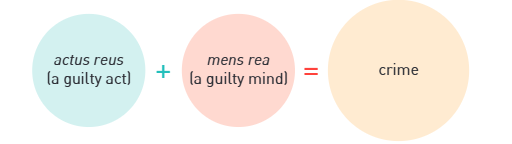
Actus Reus
A Latin term meaning ‘a guilty act’: the physical element of a crime. For a person to be found guilty of a crime, the prosecution must prove that the accused did the wrongful action (or inaction)
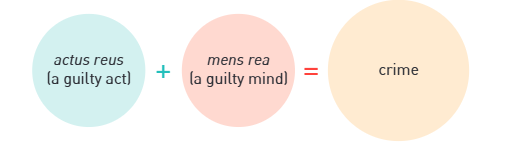
Mens Rea
A Latin term meaning ‘guilty mind’: the mental element of a crime. The prosecution must also prove that the person knowingly or intentionally committed the wrongful action (or inaction).
Strict Liability
Where culpabiltiy or responsibility for committing a crime can be established without having to prove there was mens rea. Many of these crimes are summary offences.
Strict Liability Crimes Examples
Consuming intoxicating liquor (alcohol) while driving and failing to display P plates when driving on a probationary driver licence.
Doli incapax
A Latin term meaning ‘incapable of evil’. Refers to the principle in Victoria that a child aged between 10 and 14 years is presumed to be incapable of forming mens rea because they do not have the intellectual or moral capacity to know the difference between right and wrong.
The burden of proof
Also known as the onus of proof is the responsibility to prove the allegations made in a case. In general the burden of proof is held by the prosecution, that is that the prosecution must present sufficient evidence to prove the guilt of the accused beyond reasonable doubt.
The standard of proof
The standard of proof is the strength of the evidence needed to prove a legal case. In criminal law, the prosecution must prove that the case is beyond reasonable doubt, a reasonable doubt must be sensible and realistic and not imaginary and unrealistic.
Examples of types of offenders or victims
Cyber-crime
White collar crime
Juvenile crime
Organised Crime
Summary offences
Minor criminal offences generally heard in the Magistrates’ Court. They are less serious types of crime. To hear a case summarily means to hear it without a jury. They are determined by a magistrate.
Summary offences examples
Drink-driving and disorderly conduct
Indictable offences
Indictable offences are serious criminal offence generally heard by a judge (and a jury if the accused pleads not guilty) in the County Court or Supreme Court of Victoria.
Indictable offences examples
Homicide offences, culpable driving causing death and rape.
Summary vs Indictable offences
Summary offences in Australia are less serious crimes (e.g., minor theft, disorderly conduct) that are usually heard and decided by a magistrate in the Magistrates’ Court without a jury.
Indictable offences are more serious crimes (e.g., robbery, serious assault, murder) that typically go to a higher court and may be decided by a judge and jury, often involving more complex procedures and heavier penalties.
Indictable offences heard summarily
Serious crimes may be heard summarily, heard in the Magistrate’s court if the court determines it is appropriate and the accused consents, a magistrate determines whether a person charged with a crime is guilty.
Principal Offender
A principal offender is a person who commits an offence and has carried out the actus reus. Any person who is involved in a crime is a principal offender, this includes any person who intentionally assists, encourages or directs another person to commit a crime.
Accessory
An accessory is a person who, without lawful excuse, assists a principal offender after a crime has been committed. This assistance includes helping the principal offender after a crime has been committed. This assistance includes helping the principal offender avoid being arrested, prosecuted, convicted or punished for the crime. An accessory can be found guilty regardless of whether the principal offender has been found guilty.
Murder
The unlawful and intentional killing of a human being by a person who acted voluntarily and without any lawful justification.. It is a part of a group of crimes known as homicide, which are crimes that involve the killing of another person without legal justification.
Manslaughter
The unintentional killing of a person due to a reckless, dangerous act or negligent behaviour
Infanticide
The killing by a mother of a child under two years while suffering a mental condition caused by the effects of the child’s birth
Child homicide
The killing of child under the age of six in circumstances that would normally be manslaughter
Culpable driving causing death
The act of causing the death of another person while driving a motor vehicle in a negligent or reckless manner or under the influence fo drugs or alcohol, this is the most serious driving offence
Homicide by firearm
The killing of a person by discharging a firearm in circumstances that would normally be manslaughter
Elements of murder
The killing was unlawful
The accused’s acts were voluntary
The accused committed acts that caused the victim’s death
The accused acted with intent to kill or cause serious harm
The killing was unlawful
The prosecution must prove the accused did not have a legal justification (or lawful reason) for causing the other person’s death.
The accused’s acts were voluntary
The prosecution must prove the accused committed the acts when they were awake, aware and in control of their bodily actions
The accused committed acts that caused the victim’s death
The prosecution must prove the accused committed acts that contributed significantly and substantially to the victim’s death. That is, the prosecution must prove that the acts were committed, and must also prove causation, meaning it must be proven that there was a direct and unbroken causal link between the accused’s actions and the death of the victim.
The accused acted with intent to kill or cause serious harm
The prosecution must prove they had mens rea:
-intended to kill someone or cause them serious injury or
-knew that it was probable that death or really serious injury would be the result of their actions
Specific defences to murder
They did not intend to kill or seriously harm the person
There was a break in the causation, and their actions did not significantly and substantially cause the victim’s death
Their actions were not unlawful
General Defences to a crime
Self defence
Mental impairment
Duress, often used in family violence
Sudden or extraordinary emergency
Automatism eg. sleepwalking
Intoxication
Accident
Possible sanctions to murder
The maximum penalty for murder is life imprisonment, this doesn’t necessarily mean the person is in jail for the rest of their life as there is a non-parole period and when if finishes, they can apply to be released into the community to complete community service. The standard sentence for murder is 25 years or 30 years if the victim was an emergency worker. The judge must decide according to the seriousness of the offence.
Factors to consider when deciding murder and assault sanctions
-The nature and gravity of the offence, depending on the weapon and where the crime was acted
-The vulnerability of the victim
-The offenders conduct after committing the offence
-The offender’s personal circumstances eg. mental health, character
-Whether the murder was planned or premeditated
-Gulity Plea
One impact of the victim and their family of a murder
Loss of life
One impact of the community of the murder
Increased need for police, fire and emergency services
One impact of the offender of the murder
Guilt of shame of causing a death
Assault
The intentional or reckless use of direct or indirect force or the threat of force used against another person without a lawful excuse, depending of the severity of the offence, it is either a summary or indictable offence.
Elements of assault
The accused applied force or threatened to apply force
The application or threat of force was intentional or reckless
There was no lawful justification or excuse
The accused applied force or threatened to apply force
The prosecution must prove that there was either a threat of force against another person, or actual physical force against another person, the force doesn’t have to be violent, even a slight touch can be considered assault.
The application or threat of force was intentional or reckless
The prosecution must prove that, at the time of assault, the accused intended to apple force or threatened to do so, or was reckless as to the fact.
There was no lawful justification or excuse
The prosecution must prove that there was no lawful justification or excuse to committing a crime.
Specific defences to assault
Consent eg. game, surgery
Lawful arrest
Lawful correction of a child
Possible sanctions to assault
The maximum fine for assault is 15 penalty units or imprisonment for up to 3 years in jail.
Impacts of assault on the victim and their family
Disruption to family life
Impacts of assault on the community
Loss of workplace productivity
Impacts of assault on the offender
Lost income, especially if imprisoned

