8.3 Photosynthesis
0.0(0)
 Studied by 1 person
 Call Kai
 Learn
Learn Practice Test
 Spaced Repetition
 Match
Match Flashcards
 Knowt Play
Card Sorting
1/15

Last updated 6:54 PM on 12/10/25
Name | Mastery | Learn | Test | Matching | Spaced | Call with Kai |
|---|
No analytics yet
Send a link to your students to track their progress
16 Terms
1
New cards
Light dependent reaction steps
Step 1: Excitation of Photosystems by Light Energy
Step 2: Production of ATP via an Electron Transport Chain
Step 3: Reduction of NADP+ and the Photolysis of water
Step 2: Production of ATP via an Electron Transport Chain
Step 3: Reduction of NADP+ and the Photolysis of water
2
New cards
Step 1: Excitation of Photosystems by Light Energy (Light dependent reaction)
Photosystems are groups of photosynthetic pigments (including chlorophyll) embedded within the thylakoid membrane.
Photosystems are classed according to their maximal absorption wavelengths (PS I = 700 nm ; PS II = 680 nm)
When a photosystem absorbs light energy, delocalized electrons within the pigments become energized or 'excited'
These excited electrons are transferred to carrier molecules within the thylakoid membrane.
Photosystems are classed according to their maximal absorption wavelengths (PS I = 700 nm ; PS II = 680 nm)
When a photosystem absorbs light energy, delocalized electrons within the pigments become energized or 'excited'
These excited electrons are transferred to carrier molecules within the thylakoid membrane.
3
New cards
Step 2: Production of ATP via an Electron Transport Chain (Light dependent reaction)
Excited electrons from Photosystem II are transferred to an electron transport chain within the thylakoid membrane.
As the electrons are passed through the chain, they lose energy, this energy is used to translocate H+ ions into the thylakoid.
This build up creates an electrochemical gradient (proton motive force)
Because of this, the H+ diffuses back to the stoma via ATP synthase (chemiosmosis)
This produces ATP (photophosphorylation)
The de-energized electrons from Photosystem II are taken up by Photosystem I
As the electrons are passed through the chain, they lose energy, this energy is used to translocate H+ ions into the thylakoid.
This build up creates an electrochemical gradient (proton motive force)
Because of this, the H+ diffuses back to the stoma via ATP synthase (chemiosmosis)
This produces ATP (photophosphorylation)
The de-energized electrons from Photosystem II are taken up by Photosystem I
4
New cards
Step 3: Reduction of NADP+ and the Photolysis of Water (Light dependent reaction)
The excited electrons (produced in step 1) from Photosystem I may be transferred to a carrier molecule and used to reduce NADP+
NADP+ → NADPH, needed for light independent reactions
The electrons lost from PS I are replaced by de-energized electrons from PS II
Electrons lost from PS II are replaced by electrons released from water via photolysis
Photolysis: Water is split by light energy into H+ ions and oxygen
NADP+ → NADPH, needed for light independent reactions
The electrons lost from PS I are replaced by de-energized electrons from PS II
Electrons lost from PS II are replaced by electrons released from water via photolysis
Photolysis: Water is split by light energy into H+ ions and oxygen
5
New cards
Photophosphorylation
The production of ATP by the light dependent reactions
6
New cards
Cyclic photophosphorylation
Involves the use of PS I and does not involve the reduction of NADP+
When light is absorbed by PS I, the excited electron may enter into an electron transport chain to produce ATP
Following this, the de-energized electron returns to the photosystem, restoring its electron supply (hence: cyclic)
As the electron returns to the photosystem, NADP+ is not reduced and water is not needed to replenish the electron supply
When light is absorbed by PS I, the excited electron may enter into an electron transport chain to produce ATP
Following this, the de-energized electron returns to the photosystem, restoring its electron supply (hence: cyclic)
As the electron returns to the photosystem, NADP+ is not reduced and water is not needed to replenish the electron supply
7
New cards
Non-Cyclic Photophosphorylation
Non-cyclic photophosphorylation involves the two photosystem and does involve the reduction of NADP+
When light is absorbed by Photosystem II, the excited electrons enter into an electron transport chain to produce ATP
Photosystem I results in the release of electrons which reduce NADP+ (forms NADPH)
The photolysis of water releases electrons which replace those lost by Photosystem II
When light is absorbed by Photosystem II, the excited electrons enter into an electron transport chain to produce ATP
Photosystem I results in the release of electrons which reduce NADP+ (forms NADPH)
The photolysis of water releases electrons which replace those lost by Photosystem II
8
New cards
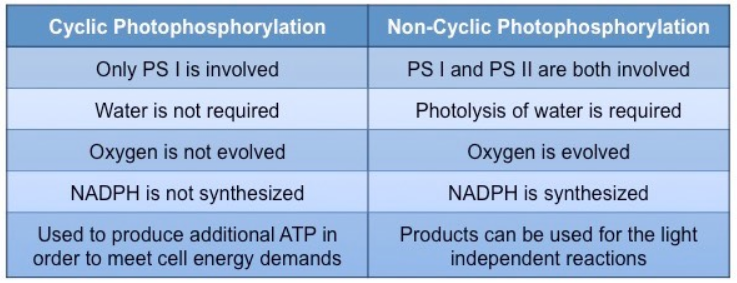
Cyclic vs Non-cyclic photophosphorylation
9
New cards
Light independent reactions
Use chemical energy derived from light dependent reactions to form organic molecules.
10
New cards
Where do light independent reactions occur?
The stroma
11
New cards
Three steps of the Calvin cycle
Carboxylation of ribulose bisphosphate
Reduction of glycerate-3-phosphate
Regeneration of ribulose bisphosphate
Reduction of glycerate-3-phosphate
Regeneration of ribulose bisphosphate
12
New cards
Step 1: Carbon Fixation of light independent reaction
The Calvin cycle begins with a 5C compound called ribulose bisphosphate (or RuBP)
An enzyme, Rubisco, catalyses the attachment of a CO2 molecule to RuBP
The resulting 6C compound is unstable, and breaks down into two 3C compounds - called glycerate-3-phosphate (GP)
A single cycle involves three molecules of RuBP combining with three molecules of CO2 to make six molecules of GP.
An enzyme, Rubisco, catalyses the attachment of a CO2 molecule to RuBP
The resulting 6C compound is unstable, and breaks down into two 3C compounds - called glycerate-3-phosphate (GP)
A single cycle involves three molecules of RuBP combining with three molecules of CO2 to make six molecules of GP.
13
New cards
Step 2: Reduction of Glycerate-3-Phosphate of light independent reaction
Glycerate-3-phosphate (GP) is converted into triose phosphate (TP) using NADPH and ATP
Reduction by NADPH transfers hydrogen atoms to the compound, while the hydrolysis of ATP provides energy.
Each GDP requires one NADPH and one ATP to form a triose phosphate - so a single cycle requires six of each molecule.
Reduction by NADPH transfers hydrogen atoms to the compound, while the hydrolysis of ATP provides energy.
Each GDP requires one NADPH and one ATP to form a triose phosphate - so a single cycle requires six of each molecule.
14
New cards
Step 3: Regeneration of RuBP of light independent reaction
Of the six molecules of TP produced per cycle, one TP molecule may be used to form a half a sugar molecule
Hence, two cycles are required to produce a single glucose monomer, and more to produce polysaccharides like starch
The remaining five TP molecules are recombined to regenerate stock of RuBP
The regeneration of RuBP requires energy derived from the hydrolysis of ATP.
Hence, two cycles are required to produce a single glucose monomer, and more to produce polysaccharides like starch
The remaining five TP molecules are recombined to regenerate stock of RuBP
The regeneration of RuBP requires energy derived from the hydrolysis of ATP.
15
New cards
Lollipop experiment
* Radioactive carbon-14 is added to a ‘lollipop’ apparatus containing green algae
* Light is shone on the apparatus to induce photosynthesis
* After a period of time, the algae is killed by running it into a solution of heated alcohol
* Dead algae samples were analyzed using 2D chromatography, which separates out the different carbon compounds
* Any radioactive carbon compound on the chromatogram were then identified using autoradiography
* By comparing different periods of light exposure, the order by which carbon compounds are generated was determined.
* Calvin used this information to propose a sequence of events known as the Calvin cycle (light independent reactions)
* Light is shone on the apparatus to induce photosynthesis
* After a period of time, the algae is killed by running it into a solution of heated alcohol
* Dead algae samples were analyzed using 2D chromatography, which separates out the different carbon compounds
* Any radioactive carbon compound on the chromatogram were then identified using autoradiography
* By comparing different periods of light exposure, the order by which carbon compounds are generated was determined.
* Calvin used this information to propose a sequence of events known as the Calvin cycle (light independent reactions)
16
New cards
Chloroplast structures
* *Thylakoids –* flattened discs have a small internal volume to maximise hydrogen gradient upon proton accumulation
* *Grana* – thylakoids are arranged into stacks to increase SA:Vol ratio of the thylakoid membrane
* *Photosystems* – pigments organised into photosystems in thylakoid membrane to maximise light absorption
* *Stroma* – central cavity that contains appropriate enzymes and a suitable pH for the Calvin cycle to occur
* *Lamellae* – connects and separates thylakoid stacks (grana), maximising photosynthetic efficiency
* *Grana* – thylakoids are arranged into stacks to increase SA:Vol ratio of the thylakoid membrane
* *Photosystems* – pigments organised into photosystems in thylakoid membrane to maximise light absorption
* *Stroma* – central cavity that contains appropriate enzymes and a suitable pH for the Calvin cycle to occur
* *Lamellae* – connects and separates thylakoid stacks (grana), maximising photosynthetic efficiency
 Note
Note  Flashcards (178)