Cardiovascular Response to Exercise
 Call Kai
 Learn
Learn Practice Test
 Spaced Repetition
 Match
Match Flashcards
 Knowt Play
1/27

Earn XP
Description and Tags
Semester 1, week 2
Name | Mastery | Learn | Test | Matching | Spaced | Call with Kai |
|---|
No analytics yet
Send a link to your students to track their progress
28 Terms
How does the CV system adapt to exercise?
It adapts both acutely (short term) and chronically (long term)
Why does the CV system adapt acutely to exercise?
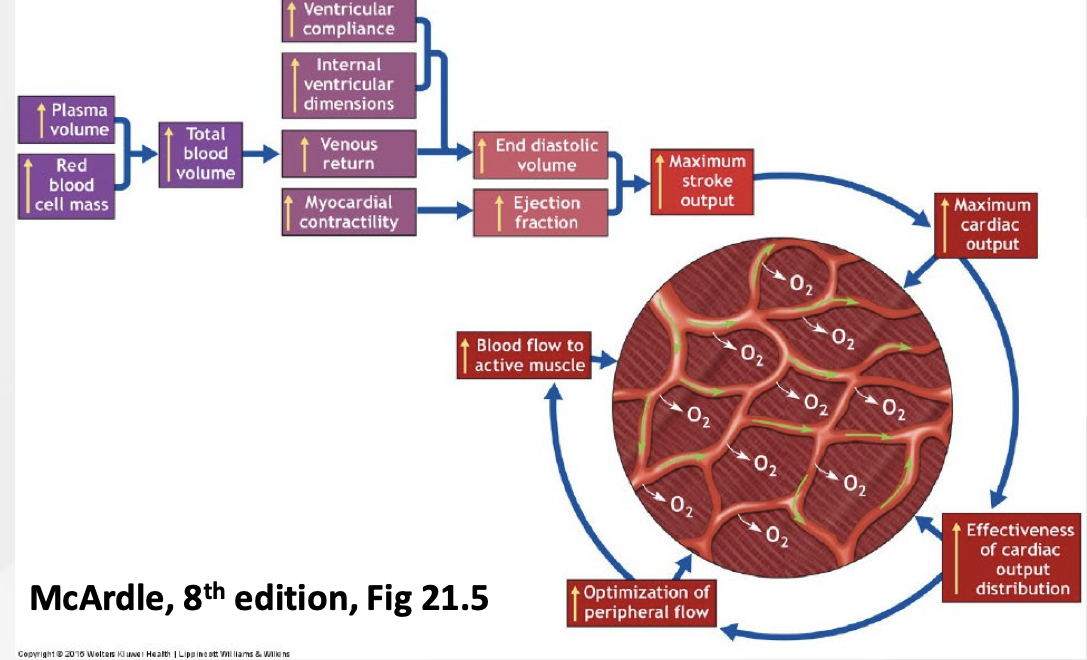
To increase oxygen delivery to working muscles by increasing blood flow to muscles and reducing delivery to low activity tissues
Why does the CV system adapt chronically to exercise?
To deliver more oxygen to active muscle mass: more effective oxygen delivery during sub-maximal exercise and increased maximum oxygen consumption (VO2max)
What are the CV factors influencing oxygen uptake and VO2max?
Cardiac structure and function (big heart delivers more)
Blood (plasma) volume (more widens the heart)
Blood flow and distribution
Oxygen extraction (arteriovenous difference)
What is the Fick Equation?
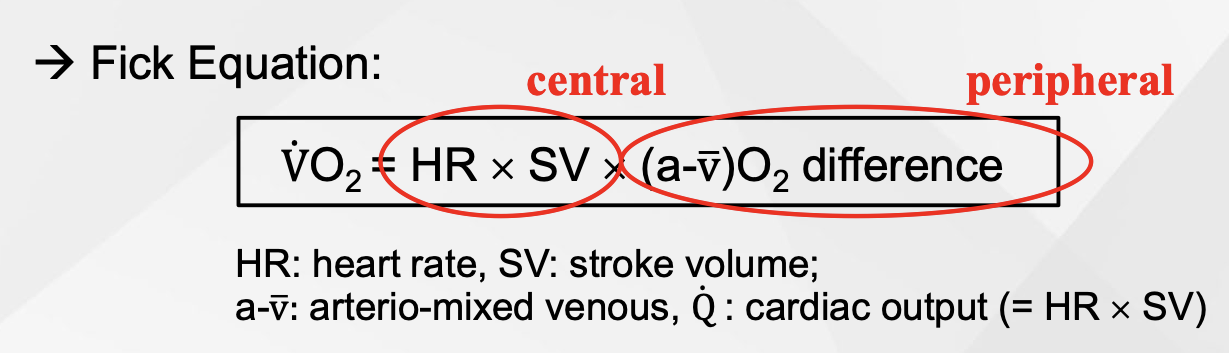
What does oxygen extraction ((a-v)O2 difference) mean?
Training increases sub-maximal and maximal values in muscle. Active muscle can utilise oxygen more efficiently by increasing oxidative capacity (eg. higher oxidative enzyme content)
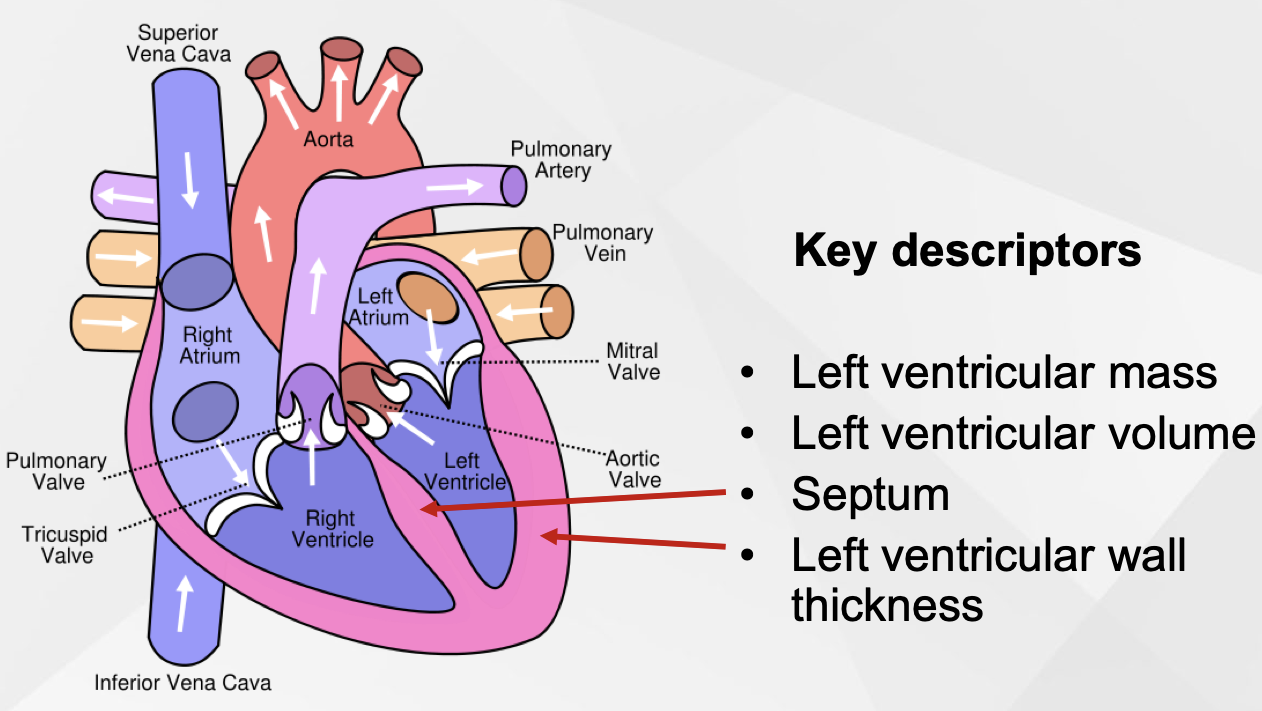
What does the structure of the heart look like?
What is preload?
The amount of blood in the ventricles before contraction (end diastolic volume). This determines cardiac muscle length before contraction. The most important determining factor for preload is venous return
What is afterload?
The pressure against the ventricle must contract (vascular resistance, aortic mean pressure). The higher the afterload, the less blood will be ejected per heartbeat
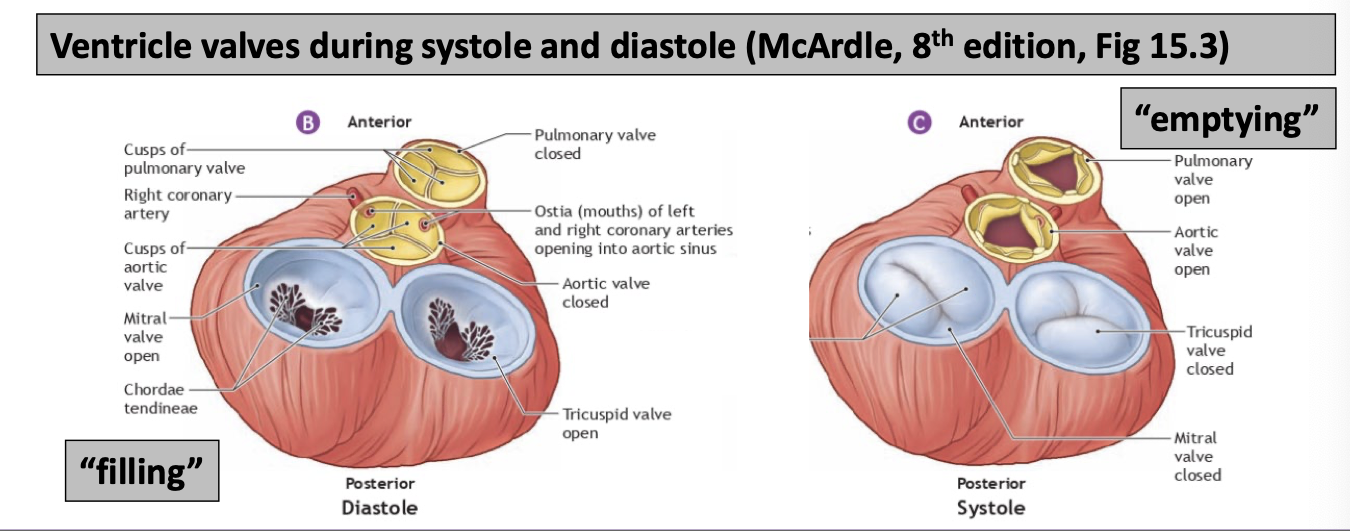
What do the ventricle valves look like during systole and diastole?
What is the Frank-Starling Mechanism?
Contractility. The more the heart fills, the more the heart can contract (can contract more forcefully). It is based on the lengt-tension relationship within the ventricle (the greater the stretch, the greater the contraction). If ventricular end diastolic volume (preload) is increased, the ventricular fibre length is also increased, resulting in an increased tension of the muscle
What are the potential mechanisms of an athlete’s heart?
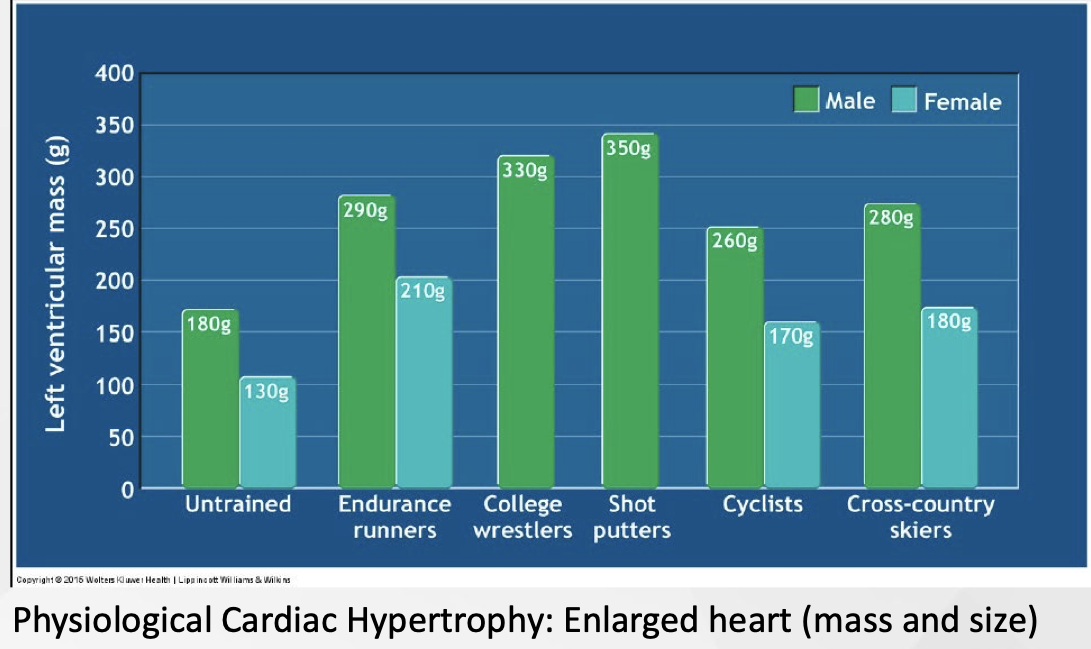
Left ventricular mass is heavier in all athletes
Left ventricular volume is larger in endurance athletes (higher preload = higher stroke volume = eccentric hypertrophy)
Posterior wall thickness and septal thickness is larger in resistance athletes (higher afterload = lower stroke volume = concentric hypertrophy)
This is a hypothesis = The Morganroth Hypothesis (based on cross-sectional data)
What do certain athletes and their heart sizes look like?
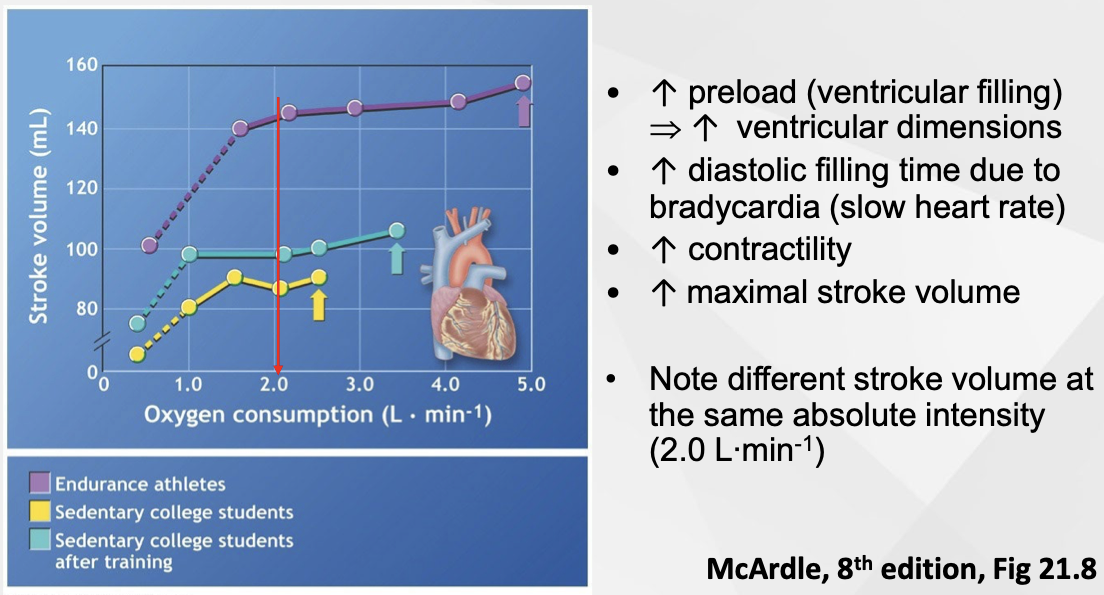
What does an endurance training adaption of stroke volume look like?
Stroke volume = how much blood ejected per beat
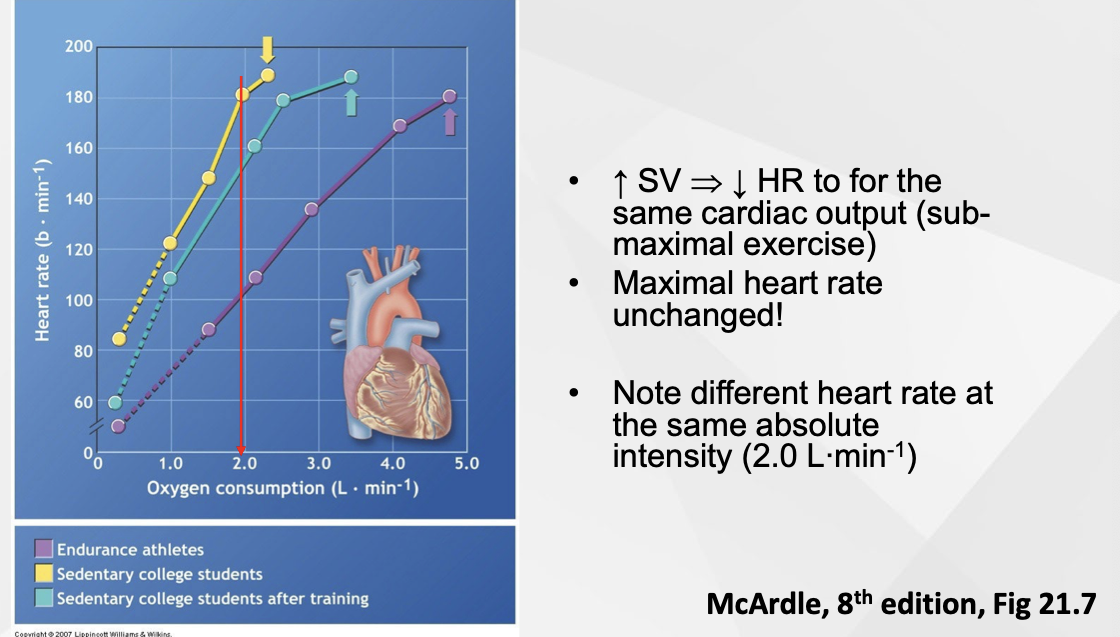
What does an endurance training adaption of heart rate look like?
Heart rate = number of beats per minute
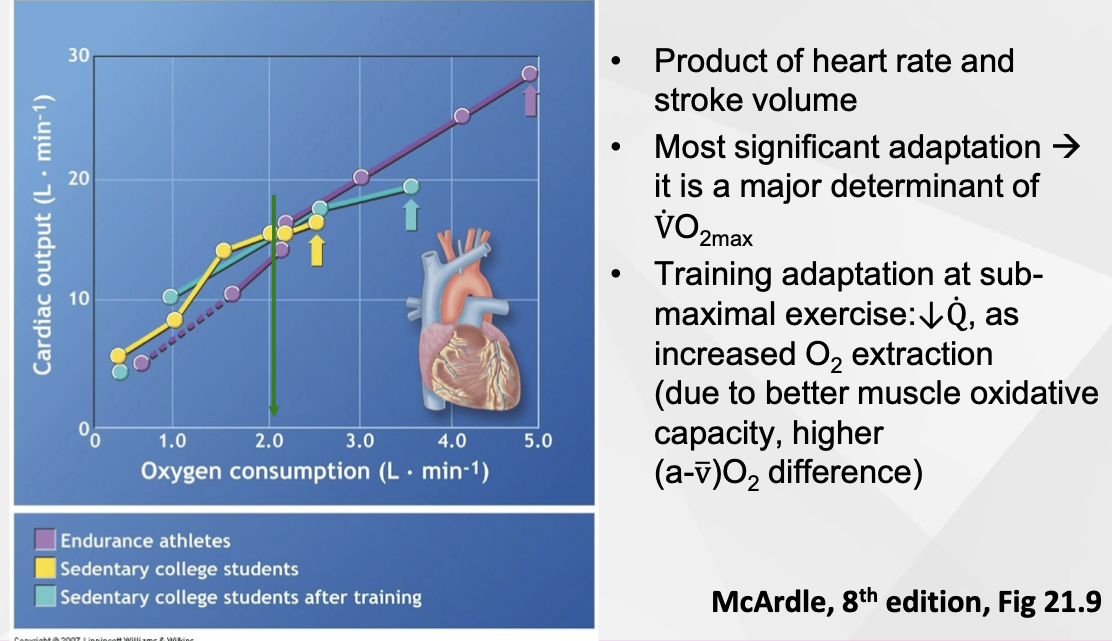
What does an endurance training adaption of cardiac output look like?
Cardiac output = HR x SV = how much blood is ejected per minute
What is acute blood flow redistribution?
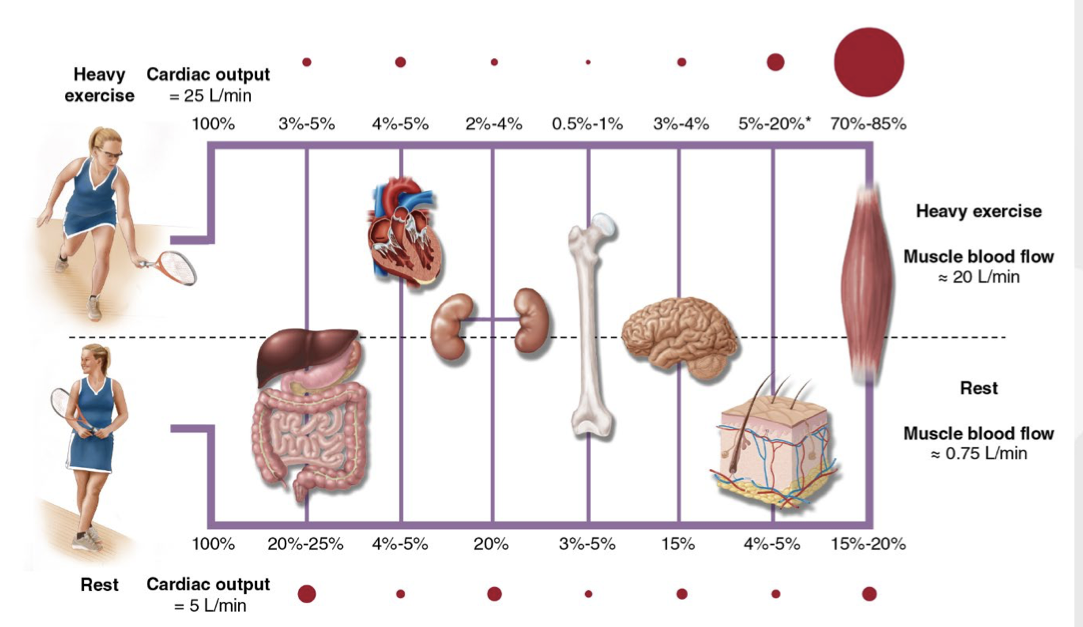
What is acute blood flow regulation?
The dialation and contriction of vessels to increase blood flow to active areas and decrease blood flow to inactive areas
What happens when a muscle is active?
pH drops, protons increase, lactate increases, oxygen consumption decreases, CO2 goes up, temperature goes up. This opens/widens a blood vessel
How are muscle metabolites and temperature involved in acute blood flow regulation?
Metabolic regulation will enhance blood flow to an area with lots of metabolic activity (high temperature areas)
What do dilator substances do?
Dilator substances produced by the endothelium (such as nitric oxide (NO) which is found in beetroot juice) help open/widen blood vessels
What is involved in pressure changes within the vessel?
Low blood pressure, blood vessel constricts, and vise versa
How is sympathetic activity involved in actue blood flow regulation?
Sympathetic activity is the stress response. Adrenaline receptors near active tissues will respond and cause blood vessels to open up. Adrenaline receptors will respond and there will be reduced blood flow to low activity tissues (splanchnic, renal circulations).
Does training the heart increase blood volume?
Yes
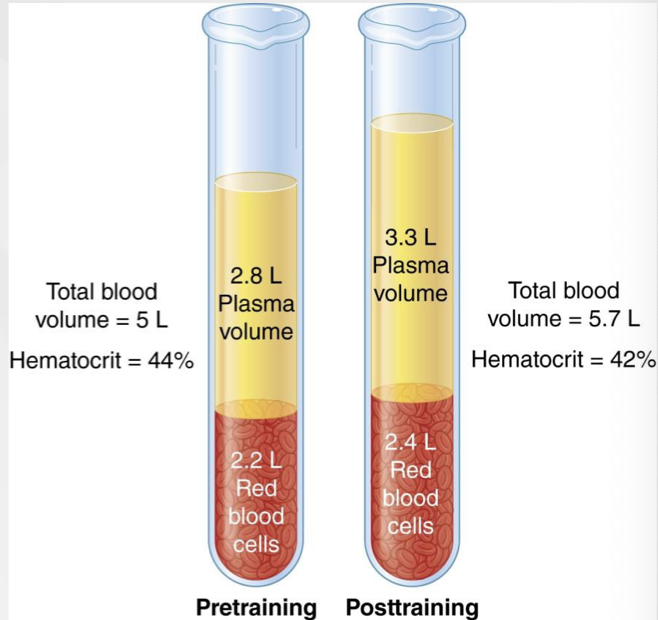
What is the primary mechanism for blood volume increases?
Increase in plasma proteins, mainly albumin (osmotic effect)
Increase in total body water via alterations in kidney function (reduced urine output and increased water retention)
What is evidence for blood volume changes?
Cross-sectional (=comparing different groups) = higher volume in trained athletes
Longitudinal (=following the same people over time) = early changes: plasma volume ↑ (10 days), haemoglobin concentration and the haematocrit remain more or less the same, however, absolute plasma volume and red blood cell number increase
What does blood doping do?
EPO (erythropoietin) induces production of red blood cells
Blood transfusions is blood doping: using a person’s own blood is autologous, using another person’s blood is homologous
What is an overview of aerobic training adaptations?
Increasing oxygen delivery to muscle