Unit 3 - Debt Securities
 Studied by 0 people
 Call Kai
 Learn
Learn Practice Test
 Spaced Repetition
 Match
Match Flashcards
 Knowt Play
1/47

There's no tags or description
Looks like no tags are added yet.
Name | Mastery | Learn | Test | Matching | Spaced | Call with Kai |
|---|
No analytics yet
Send a link to your students to track their progress
48 Terms
Par value
the amount paid to the investor as principal at maturity
most debt securities have a par value of $1,000
principal or face value
Maturities
the date the investor receives the loan principal back
term bonds: principal of the whole issue matures at once
issuers may establish a sinking fund (cash reserve) to accumulate money to retire the bonds at maturity
serial bonds: schedule for portions of the principal to mature at intervals over a period of years until the entire balance has been paid
balloon bonds: hybrid - repays part of the bond’s principal before the final maturity date but pays off the major portion of the bond at final maturity
Coupon rates
the interest rate the bond issuers has agreed to pay the investor
fixed percentage of par value
can be stated yield or nominal yield
Accrued Interest
used to determine the interest earned to date for when the bond trades between coupon payments
the buyer (new owner) must pay the sell (old owner) the amount of interest earned to date at the time of settlement
the new owner get paid the full coupon from the issuer in the next payment cycle
interest is paid on a semiannual basis
Bond Pricing
can trade at par, at a discount to par, or premium to par
bond pricing is measured in points
multiply the quoted price by 10 to get the dollar amount
Market Forces affecting bond prices
the interest rate is the cost of borrowing money (for the issuer) and the reward for lending money (for the investor)
bond prices will rise and fall as interest rates in the market fluctuate
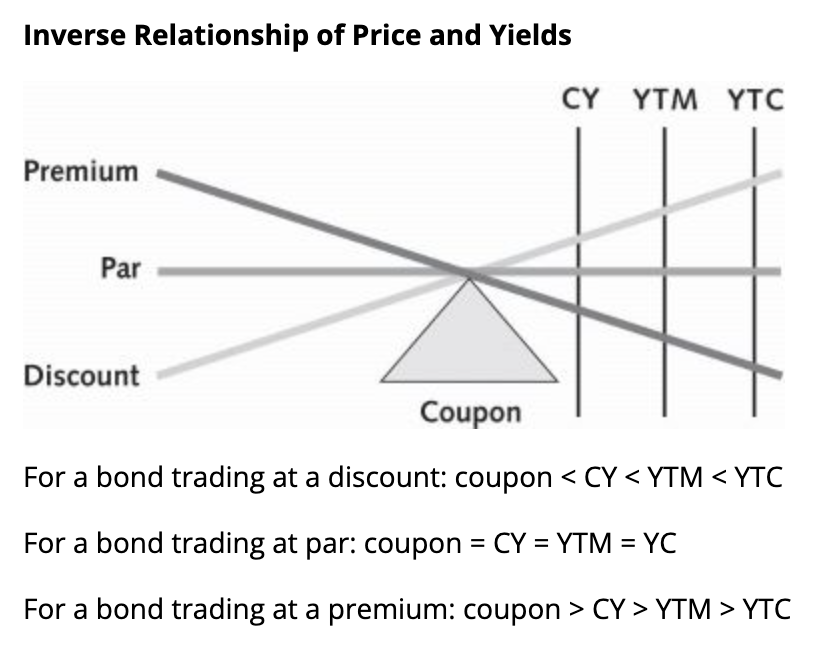
P ↑ r ↓
P ↓ r ↑
inverse relationship
Yields
a measure of a bond’s interest payments in relation to the bond’s value
nominal yield (coupon or stated yield): set at the time of issue and is a fixed percentage of the bond’s par value
current yield = annual coupon payment / market price
Q15 on practice for this chapter
YTM: the annualized return of the bond if held to maturity
takes difference between the price that was paid for a bond and par value received when the bond matures
sometimes called a bond’s basis (“trading on a basis of”)
purchased at discount → investor makes money at maturity
purchased at premium → investor loses money at maturity
YTC: bond w/ a call feature can be redeemed by the issuer before maturity
when a bond is called in by the issuer, the investor receives the principal back sooner than anticipated
reflect the early redemption date and the acceleration of the discount gained or the premium lost
Inverse Relationship of Price and Yields
Call Feature
allows an issuer to redeem a bond before maturity
issuers will exercise the call when interest rates are falling
this feature benefits the issuer
bonds w/ this will need to have a slightly higher coupon rate than a similar bond that doesn’t have this
to make the bond attractive to new investors
assume the call is at par
some have a call set at a premium
Put Feature
allows the investor to force the issuer to pay off the bond before it matures
when interest rates are rising
benefits the bondholder
have a lower coupon rate than similar bonds w/o the feature
feature will compensate for the lower return
Convertible Feature
allows the investor to convert the bond into shares of the issuer’s common stock
gives the investor ownership rights → benefit for the investor
when the value of a convertible bond equals the value of the shares an investor would receive if the conversion feature were exercised → bond is said to be at parity
pay lower coupon rate b/c feature will compensate for the lower return
Zero Coupon Bonds (zeros)
don’t make regular interest payments
issued at a deep discount to their face value and mature at par
the difference between the discounted purchase price and the face value at maturity is the interest the investor receives
b/c coupon rate is 0 → these are more volatile than other bonds w/ similar maturities
owners will pay taxes on the interest annually
“phantom income” → total interest payment / the years remaining to maturity
Bond Ratings
the purchase of a debt security is only as safe as the strength of the borrower
strength can be enhanced if the loan has collateral
investors consult rating services before buying bonds → rate the strength of borrowers
measure the bond’s default risk
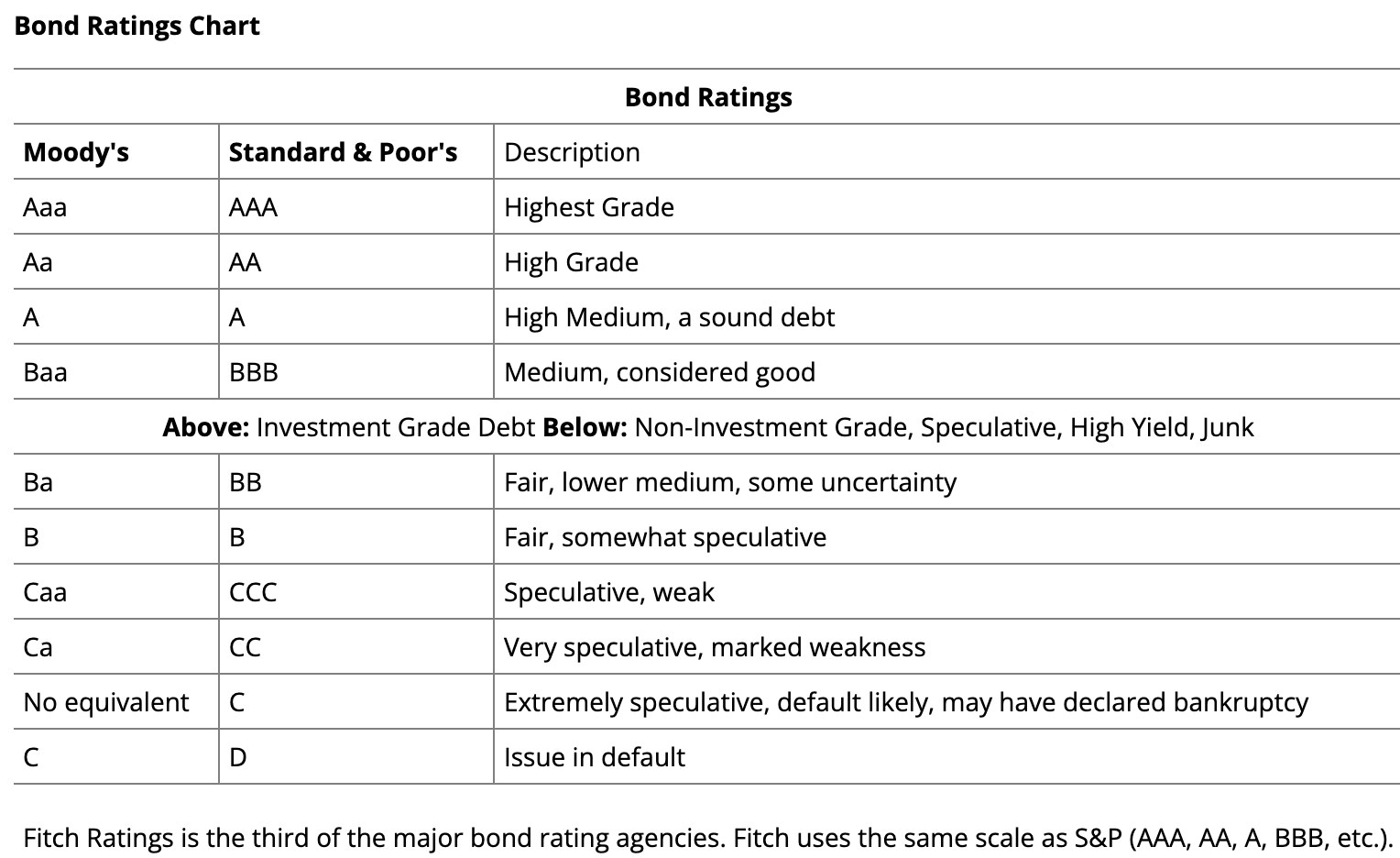
Investment-Grade Debt
bonds rated in the top 4 categories (BBB or Baa and higher)
the only quality eligible for purchase by institutions and fiduciaries
have greater liquidity than lower-grade instruments
the higher the rating, the lower the yield
High-Yield bonds
lower-grade bonds/junk bonds
lower ratings (BB or Ba or lower) and additional risk of default
see large price drops during slow economic times
volatility is usually higher than investment-grade bonds
have higher interest rates b/c the borrower is less creditworthy and there is more risk for the lender
Volatility in bond prices
the more time left to maturity, the more volatile a bond’s price will be given a change in interest rates
the lower a bond’s coupon rate, the more volatile it is
a higher duration → a more volatile price
lower duration → less price volatility
Benefits of debt instruments
bonds are the best way to produce current income for an investor
Q: a customer is seeking income
A: look for income producing debt instruments
if a corporation fails, bonds are higher in priority than equity securities
Risks of debt instruments
DEFAULT: the issuer will fail to pay interest or principal when due
default, financial, or credit risk
treasury-backed securities are the safest for US investors
INTEREST RATE RISK: price of debt securities fluctuate inversely to changes in interest rates
PURCHASING POWER RISK (inflation): as the fixed payment stays the same while prices are rising, the amount of goods the payment will buy decreases
Corporate bonds
trades settle the next business day
accrued interest is calculated using 30 days a month/360 days a year
Secured debt
debt that has collateral → an asset of the corporation is pledged to secure the loan
if the corporation fails the asset can be sold to pay back the bond
the value of the collateral will exceed the face amount of the bond at the time the bond is issued
mortgage bonds: backed by real estate owned by the corporation
equipment trust certificate: secured by equipment the corporation uses in its operations
“rolling stock” for vehicles
collateral trust bonds: backed by a portfolio of securities held in trust to secure the loan
held in a separate account and can’t be touched except for this purpose
securities must be liquid and exceed the loan amount
treasury issues often used as collateral
the securities must have maturities as long as the bond or longer
Unsecured debt
not backed by collateral
based on the financial strength of the issuer
“full faith and credit”
have more risk than a secured bond
debentures: most senior (highest priority) of the unsecured debt obligations
'“senior debt”
guaranteed bonds: are the responsibility of the issuer but are further backed by a third party should the issuer default
most common third party is a parent company
no collateral
income bonds: only make interest payments when the company has enough income and the board authorizes the payments
adjustment bonds
don’t provide reliable income
subordinated debt: carry a higher coupon rate b/c of the additional risk
below debentures - “junior debt”
lowest level of unsecured debt
Order of Liquidation in Corporate Dissolutions
all assets are sold off and those who are owed money line up to be paid
DEBT HAS PRIORITY OVER EQUITY
- administrative claimants help w/ liquidation
Secured debtholders → paid from proceeds of the sale of assets that secured the debt
Unsecured debt (debentures) and general creditors → those the company owes money to as part of its operations (ex. vendors/suppliers)
where wages and taxes are paid out
Subordinated debtholders → higher coupon rate for them b/c of the increased risk for these investors
Preferred stockholders → equity holding and will come after all creditors have been paid out
Common stockholders → extremely rare for them to get anything at liquidation
downside of being the investor that make the most when the company is successful
Treasury securities
only debt issued directly by the US Treasury is backed by the full faith and credit of the US
backed by the govt’s right to impose and collect taxes
US Treasury determines the quantity and types of gov’t securities it must issue to meet federal budget needs
the marketplace determines their interest rates
securities issued by the US gov’t are considered among the highest quality in safety of principal
issued in book-entry form and they have a T+1 settlement cycle
very marketable, liquid, and easy to buy and sell
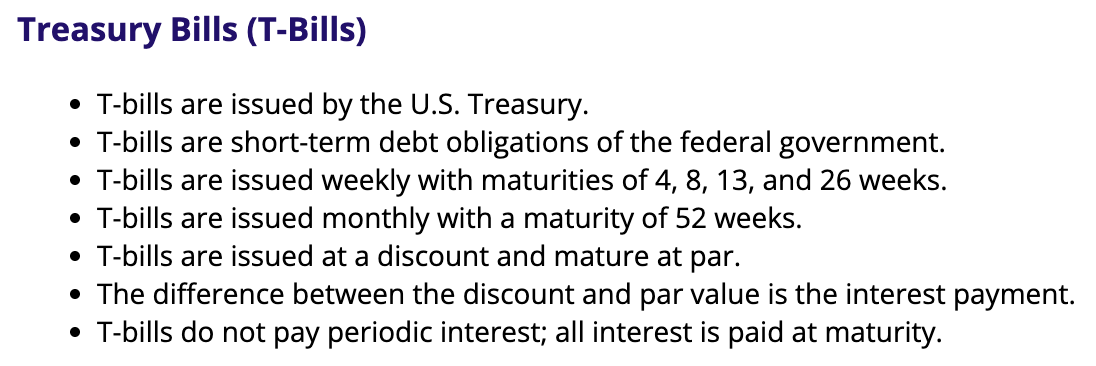
T-Bills
these and STRIPS are the only ones issued at a discount and w/o a stated interest rate
highly liquid
used in market analysis as the standard for a risk free rate of return
also a money market security b/c its short-term
once t-notes and t-bonds have only a year left to maturity, they are considered money market instruments
T-Notes
T-notes are issued by the Treasury,
T-notes have maturities from as short as two years to a maximum of 10 years,
T-notes pay interest every six months (semi-annually), and
at maturity, the investor receives the final semi-annual interest payment and the par value.
intermediate-term
issued at par and pay periodic interest
T-Bonds
long-term
issued at par and pay periodic interest
T-bonds are issued by the Treasury,
T-bonds have maturities greater than 10 years and up to 30 years,
T-bonds pay interest every six months (semi-annually),
at maturity, the investor receives the final semi-annual interest payment and the par value.
Treasury Receipts
broker-dealers (BDs) can create this type of bond from US T-notes and T-bonds
they buy Treasury securities, place them in trust at a bank, and sell separate receipts against the principal and coupon payments
creates new securities and different maturities to choose from
the separating process (stripping) yields more profit for the BD
the receipts themselves aren’t backed by the full faith and credit of the US gov’t
Treasury STRIPS
treasury department’s own version of receipts
banks and BDs perform the actual separation
zero-coupon bonds
issues of the US Treasury and are backed by the full faith and credit of the US gov’t
**not suitable for an investor seeking income
Treasury Inflation-Protected Securities (TIPS)
maturities of 5, 10, or 20 years
fixed coupon rate and pay interest semiannually
the principal value of the bond is adjusted every six months based on the inflation rate
the final principal payment will never be less than $1,000 par
Farm Credit System (FCS)
National network of lending institutions that provides agricultural financing and credit.
Privately owned, government-sponsored enterprise
Raises funds through the sale of Farm Credit Debt Securities to investors.
Funds are made available to farmers through banks and Farm Credit lending institutions.
The FCA, a government agency, oversees the system
Government National Mortgage Association (GNMA or Ginnie Mae)
Government-owned corporation.
Supports the Department of Housing and Urban Development.
GNMA certificates are the only agency securities backed by the full faith and credit of the federal government.
GNMA certificates have a stated 30-year life.
When sold, GNMA maturities are based on an average life expectancy of the mortgages in the portfolio.
GNMAs are based on a portfolio of mortgages.
When mortgages are paid off early, GNMA investors will receive back all outstanding principal of that loan at par.
Creates prepayment risk (covered in the unit on Risk).
GNMA certificates pay a monthly payment that is part principal, part interest (pass-through security).
Federal Home Loan Mortgage Corporation (FHLMC or Freddic Mac)
The FHLMC is a public corporation.
Created to promote the development of a nationwide secondary market in mortgages
Buys residential mortgages from financial institutions
Packages mortgages into mortgage-backed securities for sale to investors.
Freddie Mac certificates pay principal and interest monthly. Note that FHLMC also issues bonds that pay semi-annual interest.
Securities it issues are backed by FHLMC's general credit, not by the U.S. Treasury.
corporation thats owned by investors
their stock trades in the secondary market
Federal National Mortgage Association (FNMA or Fannie Mae)
FNMA is a publicly held corporation that provides mortgage capital.
FNMA purchases conventional and insured mortgages from agencies such as the Federal Housing Administration (FHA) and the Veterans Administration (VA).
FNMA packages them into mortgage-backed securities for sale to investors.
Fannie Mae certificates pay principal and interest monthly. Note that Fannie Mae also issues bonds that pay semi-annual interest.
Securities it issues are backed by FNMA's general credit, not by the U.S. treasury.
corporation thats owned by investors
their stock trades in the secondary market
Municipal Bonds (munis)
issued by state or local govt’s, US territories, or other local authorites
investors are lending money to the issuers to raise funds for public works and construction projects
second in safety after US gov’t securities
safety is based on the issuer’s financial strength and taxing authority
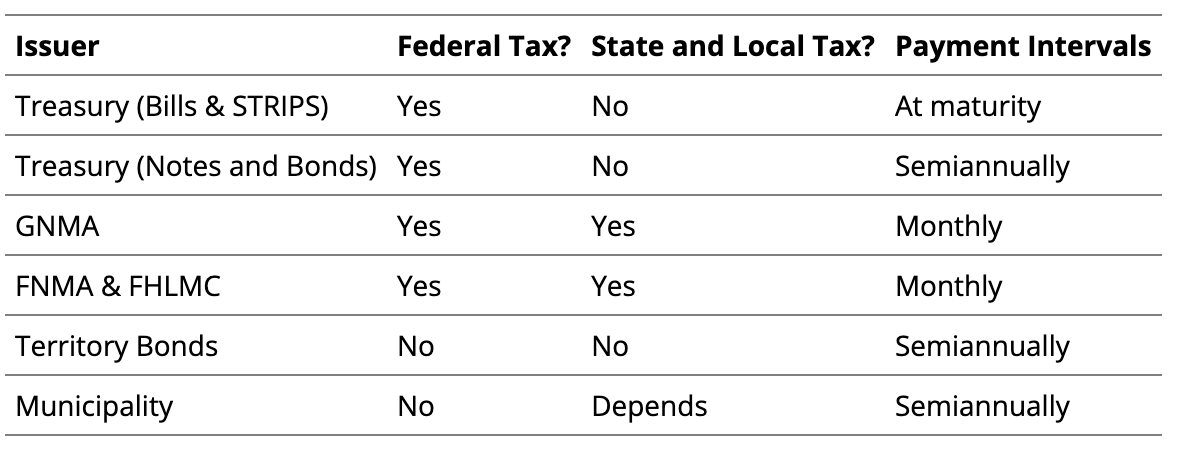
interest is tax exempt at the federal level
capital gains is still taxable
settle T+1 and pay accrued interest
General Obligation (GO) Munis
issued to generate capital for infrastructure or property improvements that benefit the community
capital improvements
don’t produce revenues so principal and interest paid from taxes
GO bonds are known as full faith and credit bonds because they are backed by the municipality's taxing power.
requires a vote
Bonds issued by states are backed by income taxes, license fees, and sales taxes.
Bonds issued by towns, cities, and counties are backed by
property taxes, also called "ad valorem" or real estate taxes,
license fees,
other sources of direct income to the municipality.
School, road, and park districts may also issue municipal bonds backed by property taxes.
GO bonds represent a debt of the municipality and often require voter approval.
A debt limit is the amount of debt that a municipal government may incur as set by state or local law.
Debt limits make a bond safer for investors.
The lower the debt limit, the less risk of excessive borrowing.
The law must be changed to issue GO bonds that exceed a municipality's debt limit.
Revenue Bonds
used to finance a municipal facility that generates sufficient income to pay the bond
interest payments are made from revenues
projects funded by these → utilities, housing, transportation, education, health, industrial, sports
not subject to statutory debt limits
don’t require voter approval
issued by authorities (quasi-governmental entities)
interest from bonds issued by the US is tax free to US taxapayers
Tax-equivalent yield
the higher the tax bracket, the greater the tax exemption’s value
municipal bond investment’s tax benefit, find the tax-equivalent yield
tax-free yield / (100% - investor’s tax bracket/rate)
municipal yield will always be less than corporate yield
after-tax yield of a taxable bond = corporate yield * (100% - tax bracket)
Taxation on Bond Interest
Muni notes (short-term municipal debt)
generated funds for a municipality that expects other revenues soon and are repaid when the muni receives the anticipated funds
Tax anticipation notes (TANs) finance current operations in anticipation of future tax receipts. This helps municipalities to even out cash flow between tax collection periods.
Revenue anticipation notes (RANs) are offered periodically to finance current operations in anticipation of future revenues from revenue-producing projects or facilities.
Tax and revenue anticipation notes (TRANs) are a combination of the characteristics of both TANs and RANs.
Bond anticipation notes (BANs) are sold as interim financing that will eventually be converted to long-term funding through a sale of bonds.
Tax-exempt commercial paper is often used in place of BANs and TANs for up to 270 days; maturities are most often 30, 60, or 90 days.
Grant anticipation notes (GANs) are issued with the expectation of receiving grant money, usually from the federal government.
Construction loan notes (CLNs) are issued to provide interim financing for the construction of housing projects.
Variable-rate demand notes have a fluctuating interest rate and are usually issued with a put option. This means that the investor could periodically (e.g., weekly, monthly) return the security to the issuer for its stated value.
Money market instruments
focused on short-term debt securities for short-term needs
=<1 year left until maturity
high-quality debt (safer)
very liquid and there is an active market
most issued at a discount and mature at par
their rate of return is low so they’re not suitable for long-term investors
Jumbo Certificate of Deposit (CD)
Banks issue and guarantee jumbo certificates of deposit (CDs) with fixed interest rates
Jumbo CDs have minimum face values of $100,000, although face values of $1 million or more are common.
Most mature in one year or less.
Some jumbo CDs that can be traded in the secondary market are known as negotiable CDs.
Negotiable CDs are considered to be money market instruments.
If a jumbo CD is not negotiable, it is not liquid and is not considered a money market security
Jumbo CDs are issued at face value, not at a discount, and pay interest at maturity.
Longer maturities will pay interest every six months.
A negotiable CD is a bank's promise to pay principal and interest and is secured by no physical asset and is backed only by the bank's good faith and credit.
Bankers’ Acceptances (BAs)
used in the import-export business as a short-term time draft
postdated check or line of credit
issued at a discount
finance international trade
pays for goods and services in a foreign country
bill of exchange or letter of credit
Commercial Paper (Promissory Notes)
short-term, unsecured debt
sell them to raise cash to finance accounts receivable
Repurchase Agreements (Repos)
raises cash by temporarily selling some of the assets it holds, with an agreement to buy back the assets at a specific future date (the maturity date), and at a slightly higher price
investor makes a profit on the difference b/t what they paid at the asset sale and what they receive at repurchase
in a reverse repo, a dealer agrees to buy securities from an investor and sell them back later at a higher price
Federal Funds Loans
any excess reserves from the Fed can be loaned from one member bank to another for the purpose of meeting the reserve requirement
Asset-backed securities
value and income payments are derived from a specific pool of underlying assets
the pool of assets include different types of loans
Pooling the assets into securities allows them to be sold to general investors more easily than selling them individually
securitization
allows the risk of investing to be diversified b/c each security will now representing only a fraction of the total value of the pool
created and issued by investment banks
Collateralized Mortgage Obligations (CMOs)
CMOs pool a large number of mortgages.
They often contain mortgage-backed securities like FNMA and FHLMC certificates.
The pool of mortgages is structured into maturity classes called tranches.
Pay monthly principal and interest payments.
Repays principal to only one tranche at a time, highest tranche to lowest
Investors in higher (short-term) tranche receive all their principal before the next tranche begins to receive principal repayments.
Changes in interest rates affect the rate of mortgage prepayments (refinancing), which affects the flow of interest payment and principal repayment to the CMO investor.
Collateralized Debt Obligations (CDOs)
CDOs are complex asset-backed securities.
CDOs do not specialize in any single type of debt; usually their portfolios consist of
non-mortgage loans, bonds, auto loans, leases, credit card debt, a company's receivables, or even products that derive their value from an underlying asset of any of the assets listed (derivative products).
Like CMOs, CDOs represent different types of debt and credit risk.
The different types of debt and risk categories are often called tranches or slices.
Each tranche has a different maturity and risk associated with it.
The higher the risk, the more the CDO pays.
Investors choose a tranche with a suitable risk profile.
CDOs are like CMOs in that illiquid debt can be made liquid through securitization.
 Note
Note  Flashcards (96)