U1 Concept 1: Biology Review
 Studied by 0 people
 Call Kai
 Learn
Learn Practice Test
 Spaced Repetition
 Match
Match Flashcards
 Knowt Play
1/22

There's no tags or description
Looks like no tags are added yet.
Name | Mastery | Learn | Test | Matching | Spaced | Call with Kai |
|---|
No analytics yet
Send a link to your students to track their progress
23 Terms
Cell
Basic unit of life
Organelle
specialized structure that performs important cellular functions within a eukaryotic cell
Macromolecule
A very large organic molecule composed of many smaller molecules
Nucleotide
monomer of nucleic acids made up of a 5-carbon sugar, a phosphate group, and a nitrogenous base
Fatty acid
hydrocarbon chain often bonded to glycerol in a lipid
Monosaccharide
A single sugar molecule such as glucose or fructose, the simplest type of sugar.
Amino acid
Building blocks of protein
Enzyme
A type of protein that speeds up a chemical reaction in a living thing
Catalyst
substance that speeds up the rate of a chemical reaction
Active site
The part of an enzyme or antibody where the chemical reaction occurs.
Differentiation
process in which cells become specialized in structure and function
List the characteristics that all living things share.
1. Made of cells—> basic form of life
2. Responds to stimuli—> maintains homeostasis
3. Able to grow and reproduce
4. Use energy—> ATP (have metabolism)
5. Contains DNA & RNA—> heredity information-> stirred in chromosomes (46, except sex cells=23)
6. Adapt to environment
Describe the role of each organelle in the overall function of the cell.
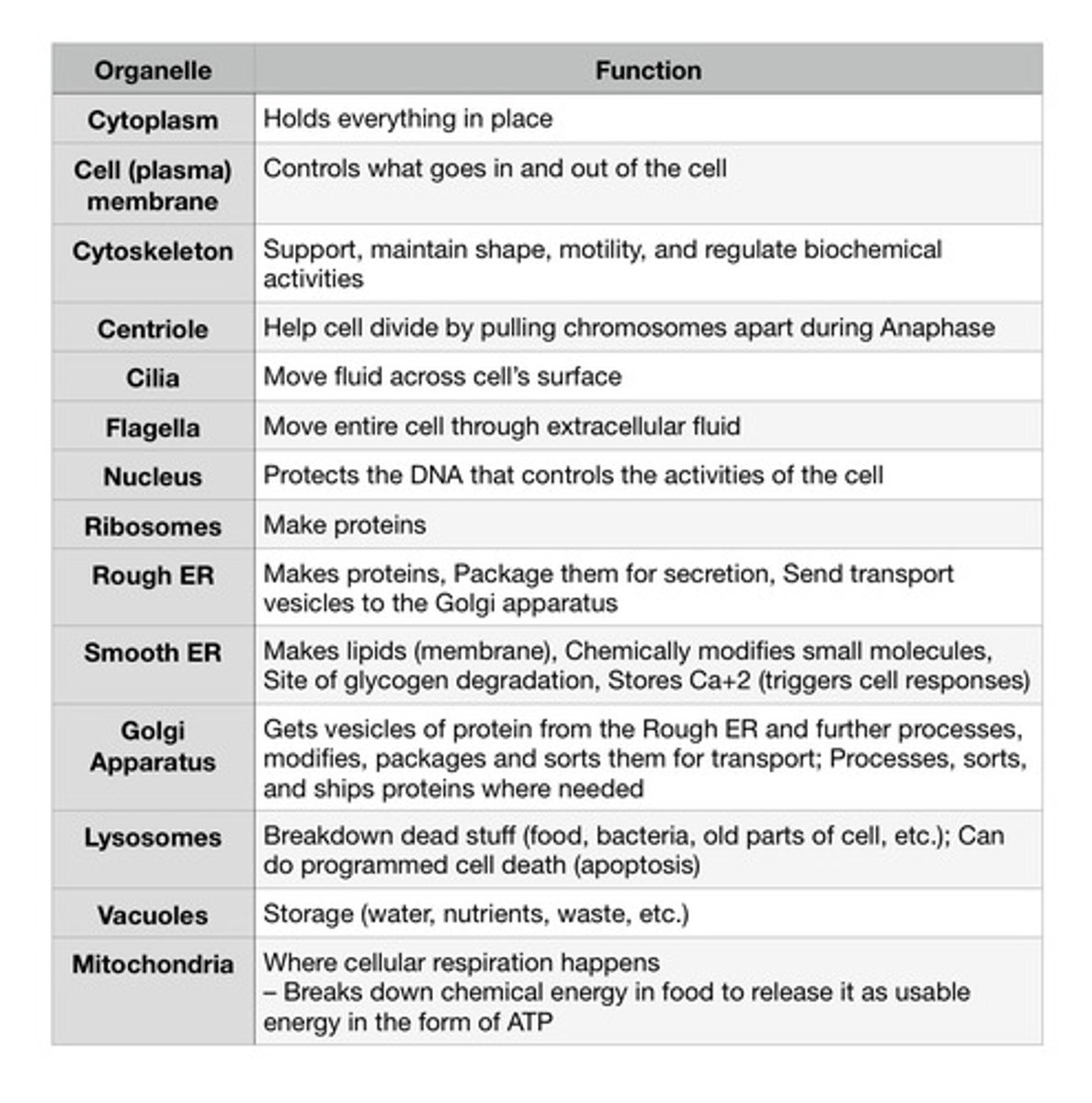
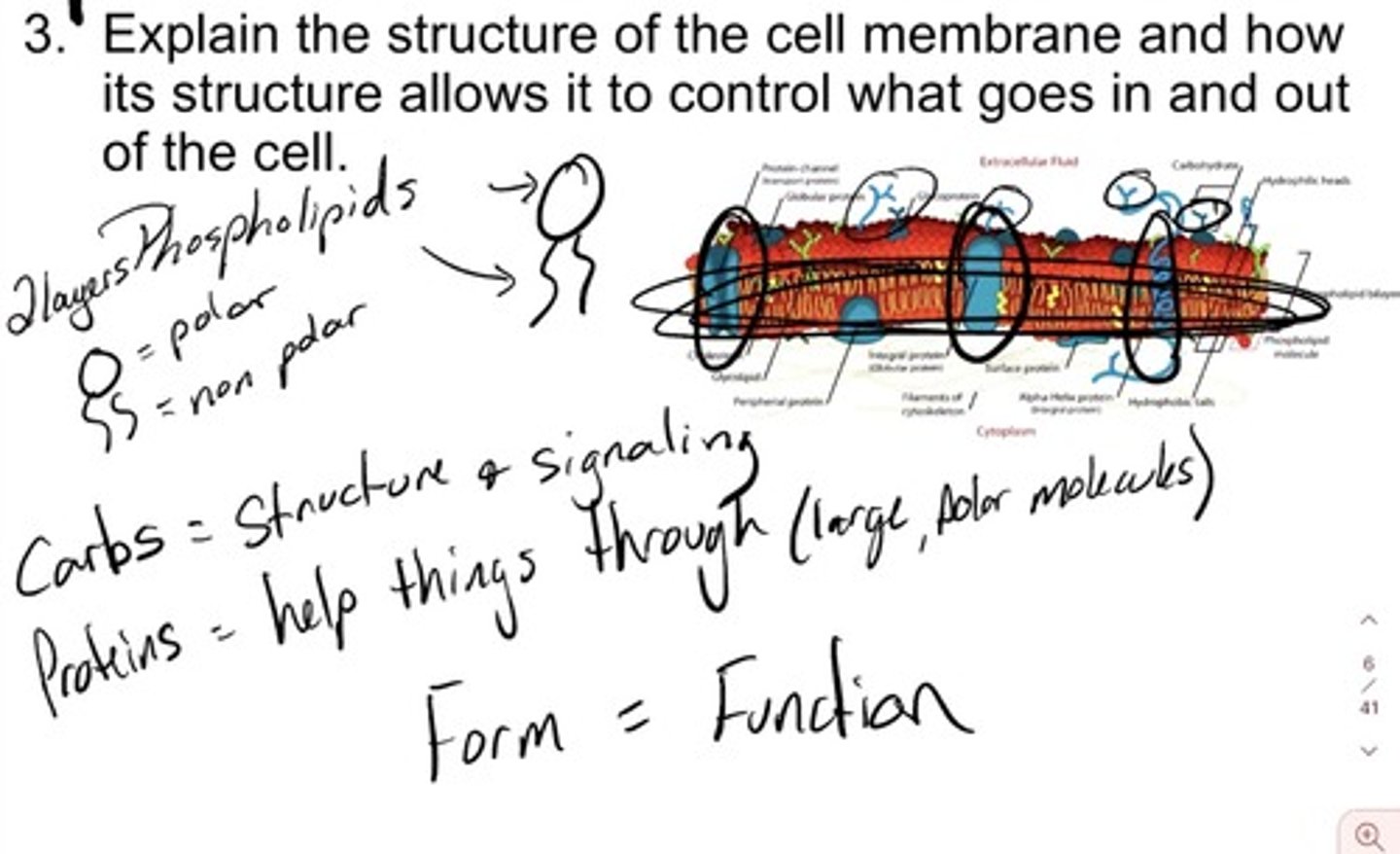
Explain the structure of the cell membrane and how its structure allows it to control what goes in and out of the cell.
Selectively permeable membrane
The arrangement of the phospholipids allows some molecules to easily pass through and others to require more effort.
Pass easily: Small, non-polar, hydrophobic, neutral molecules and water (even though H2O is polar it is reallyyyy tiny!)
Cannot pass easily: Polar molecules (must go through protein channels) and large molecules (must use vesicles)
Explain the importance of each macromolecule to the overall function of the cells and thus the human body.
1) Carbohydrates: quick energy
2) Lipids: long-term energy, cushion
3) Proteins: everything
Never) Nucleic acids: hereditary information
(Numbered in order body breaks down)
Macromolecules make us who we are and keep us alive
Distinguish between the following terms: DNA, chromosomes, and genes. Then explain their relationship to proteins.
DNA contains the genetic information. It is organized into 46 chromosomes, which are sectioned of into thousands of genes—> these code for and make proteins
Explain the role of enzymes in biochemical reactions, including the importance of their specificity.
Enzymes are catalysts (speed up reactions)
Highly specific—> lock & key
Every reaction is regulated by enzymes
(***enzymes are proteins)
List the levels of organization within an organism.
Organism—> organ systems—> organs—> tissues—> cells—> organelles
Example: human—> cardiovascular system—> heart—> cardiac tissue—> cardiac myocytes—> mitochondria
Summarize the process of the cell cycle in somatic (body) cells. Include the name of each sub- phase, and the critical importance of chromosome duplication prior to cell division.
3 main phases:
Interphase: where the cell spends most of its "life"
- DNA is doubled sister chromatids (I X) during the end of this phase in preparation for division
Mitosis: where the cell begins to divide
- Consists of Prophase, Metaphase, Anaphase, and Telophase
Cytokinesis: where the cytoplasm splits forming 2 identical daughter cells
- These cells are also identical to the parent cell unless a random mutation occurred.
***if the chromosome don't duplicate prior to cell division then there will be half the number of chromosomes in the daughter cells and they will not be identical, they will be missing chromosomes, and will likely die
Explain what is meant by the phrase "form dictates function" and why it will be an essential theme in this course.
Form dictates function is so important because our bodies are made the way they are for a reason. If we can understand the structure of our bodies it will help us understand the function. Each part of our body looks a certain way and is built to fit needs of the function.
Identify an organelle based on a diagram or description of its structure.
Given the description of a cell's function, determine the most essential organelles needed in the cell to carry out that specific function.
Given appropriate context, be able to arrange a list of body organization levels from smallest to broadest, or vice versa.
 Note
Note  Flashcards (27)