Psychology 1XX3 Development, Evolution, Neuroscience, Vision
 Call Kai
 Learn
Learn Practice Test
 Spaced Repetition
 Match
Match Flashcards
 Knowt Play
1/267

There's no tags or description
Looks like no tags are added yet.
Name | Mastery | Learn | Test | Matching | Spaced | Call with Kai |
|---|
No analytics yet
Send a link to your students to track their progress
268 Terms
What is development
Changes that occur in a lifetime
Maturation
Biologically-timed unfolding of changes according to a genetic plan
Learning
Storing of new information that is processed to become automatic (Ex. look both ways before you cross)
Interactionist perspective
Interactions between maturation and learning = development, biological maturation restricts the timeline of learning
4 methods of measuring abilities in infants
Habituation, Event-related potentials, High-amplitude sucking method, Preference method
Habituation goal
Determines if an infant can detect the difference between 2 stimuli
Habituation
A decrease in responsiveness to a stimulus following its repeated presentation
Dishabituation
An increase in responsiveness to a stimulus that is different from the habituated stimulus, indicates ability to perceive different stimuli (Ex. Test colour perception)
Habituation procedure
Tests ability to differentiate between stimuli, repeatedly present same stimulus and measure any physiological changes (ex. heart rate), overtime infants become habituated to stimulus and physiological changes return to resting state
Event-related potentials
Measure of the brain’s electrical activity via special cap with array of electrodes that detects changes in neuron activity in specific areas of the brain to indicate response to certain stimuli (Ex. Auditory stimuli = Temporal region activity)
High-amplitude sucking method
Measured by pacifier, baseline sucking level is measured and stimulus is presented, if infant likes stimulus, it will increase rapidity to continue presentation of stimulus, and lack of sucking indicated lack of preference
Preference method
Measures preference between stimuli, compares level of visual attention given to each stimuli to observe preference, longer = likey
Competence-performance distinction
An infant may fail tests due to inability to perform actions, not because they lack the cognitive ability, cannot assume results correlate with actions
Developmental studies
Study developmental changes over lifetime, longitudinal and cross-sectional
Longitudinal design
Examines same individuals repeatedly over their lifetime, expensive and time-consuming, unreliable (death) practice effect bias (improvement on exposure-basis rather than developmental-basis)
Cross-sectional design
Test different individuals of different age-groups at once, faster comparison, cannot distinguish between generational effects and natural development, does not directly track changes with age
Canalization principle
Genotype restricts the phenotype to a small # of possibilities (Ex. all infants babble despite coming from different language backgrounds), we all share basic phenotypic traits despite environment influences
Range-of-reaction principle
Genotype establishes a range of possible phenotypes in response to different life experiences
Canalization
Restricts upper and lower bound phenotype of trait based on species (Ex. 4ft - 6ft), for general population, based on gene pool
ROR
Establishes your personal expression of a trait based on your individual environment
How do genes influence your environment
Passive, evocative, active
Passive genotype correlations
Influences most in early life, your parent’s choice of environment was influenced by their own genes, and will thus complement yours
Evocative genotype correlations
Influence most throughout lifespan, inherited traits impact how others react and behave towards you (Ex. difficult temperament, others may think you’re annoying(
Active genotype correlations
Genotype influences the kinds of environments you seek
Critical period
Specific time in development in which stimulation is necessary to see permanent changes in specific abilities (Ex. vision), after this, same stimulation will not illicit same benefit (ex. deprivation outside cp has no consequence), more stimulation ≠ better development
Types of brain development
Experience-expectant & experience-dependent
Experience-expectant brain growth
The brain expects a certain amount of environmental stimuli in which it develops normally
Experience-dependent brain growth
The brain develops according to personal experiences, recflects the subtle developments in strucuture
Sensitive periods
Critical periods except learning may still occur post-period, flexibility in timings and type of stimulation for normal development
Biological exuberance
Infants produce trillions more synapses than found in the adult brain
The Mozart effect
The enhancing effect of music is only temporary
Marshmellow experiment
As we develop, we gain the ability to delay immediate gratification, low restraint = 1 marshmallow now, high restraint = 2 later
Adaptations
Biological traits that help an individual get better suited to their environment to survive and reproduce, includes mental functions (Ex. memory retrieval), arise due to pressures of natural selection
Evolution
Change in gene frequencies
Stabilizing selection
Selection consistent with the average trait
Sexual selection
Female mating preferences, physical appearance contributes to fitness
Inter-sexual selection con
Physical appearance may increase males chance of successful mating, but may decrease their chance of survival (Ex. peacock feathers)
Inter-sexual selection
Female choice (attractiveness), anatomical traits differ between sexes
Intra-sexual selection
Male competition, exists mostly during breeding season
Species-specific behaviour
Behaviour is an evolved trait that distinguishes species (Ex. Movement, habitat, social system)
Altruism
Negative effect on actor, positive effect on recipient
4 types of social behaviour
Cooperation, altruism, selfish, spite
Cooperation
Positive effect on both actor and recipient, increase in group success maximizes chances of overall success (Ex. Geese foraging in groups increases personal success of obtaining food as others scan for predators)
Selfish
Positive effect on actor, negative effect on recipient
Spite
Negative effect on both actor and recipient
Eusocial Hymenoptera
Level of social organization, individuals spend their lives serving the colony without reproducing, run by relatedness, genes can be successful and altruistic if they helped identical copies of themselves
Selfish gene
Natural selection favours the selfish gene that best serves own interest, altruism = decrease of fitness, selfish = increase of fitness
Cost vs benefit
Interaction of social behaviours (Ex. you help out someone even if it doesnt benefit you, but itll benefit the group)
Lemons and evolution of altruism
Kill themselves if overpopulation occurs to allow for more nutrients, but altruistic lemon genes die with these lemons, and selfish lemons reproduce, does not explain evolution of altruism
Types of fitness
Direct and indirect
Direct fitness
Genes passed through personal reproduction
Indirect fitness
Genes passed through genetic relatives reproduction
Inclusive fitness
Direct + Indirect fitness
Hamilton’s Rule
Predicts when altruistic behaviours are favoured (when rB > c)
c = reproductive cost to actor
B = reproductive benefit to recipient
r = degree of relatedness between actor and recipient
Relatedness
Probability that actor and recipient share genes
Hamilton’s rule relatedness degree
Full sibling = 0.5
Parent = 0.5
Half sibling = 0.25
Uncle/Aunt = 0.25
Hamilton’s rule example
Sacrifice yourself to save 3 brothers = rB > c, altruism will triumph
c = 1
B = 3
R = 0.5
Cinderella effect
Step-siblings suffer increased abuse when compared to direct offspring
Aggression and relatedness
Aggression increases as relatedness decreases (Ex. In-laws)
Cues of kin recognition
Mother’s association, phenotype matching, co-residence with siblings
Dispersal and kinship
Those who do not disperse from kin are more likely to act altruistically for kin than those who disperse (Ex. female ground squirrels)
Direct reciprocity
Individuals help each other and both benefit
Phenotype matching
Increased prosocial behaviour towards those who resemble us, evaluation of relatedness based on phenotypic similarity
Indirect reciprocity
Individuals help others who have helped others, establish good rep by helping so others will want to help as well
Outcome variance
Leads to sex-differences in risk-taking tolerance, males generally exhibit higher outcome variance than women
Sex and adaptive problems
Metabolic demands of reproduction, higher strain on women
Parental investment, women investing more resources in are more selective in mate choice, while the lesser-investing sex competes for mating opportunities
Genetic cuckoldry, when a male unknowingly invests resources in offspring that are not genetically his own, having been deceived by a female's infidelity
Renée Descartes
The mind is a separate entity in control of our actions and thoughts, physical vs mental
Neuron
Specialized communication cells
Absolute Refractory Period
Begins when action potential is initiated and ends when membrane potential dips below threshold, a neuron is completely incapable of firing a second action potential, no matter how strong the stimulus is
Relative Reactive Period
Lasts until resting potential is re-established, Na+ channels open to allow 2nd action potential to occur if stimulus is strong enough to overcome undershoot making it harder to initiate a new action potential
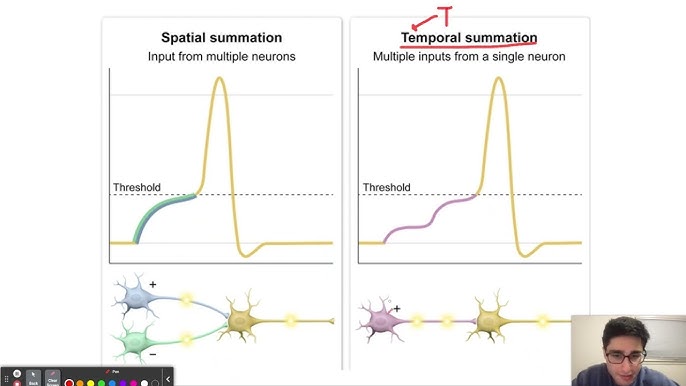
Temporal summation
High frequency stimulation by 1 pre-synaptic neuron
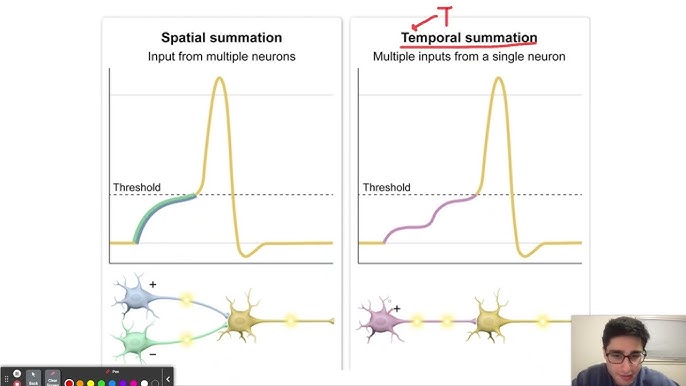
Spatial summation
Simultaneous stimulation by several pre-synaptic neurons
Spatio-temporal summation
Temporal + spatial summation occur at the same time, used if temporal/spatial alone may not be enough to translate proper degree of pain
Regulatory channels
Leaky K channel, Voltage-gated channel, Ligand-gated channel, Sodium channel, Potassium channel
Neural development
Begins 18 days after conception, Neural plate folds to form neural tube where the brain and spinal cord connect
Ventricular zone
Cells begin dividing asymmetrically to produce glial cells and neurons
Neuron migration
Neurons migrate from ventricular zone to cortical surface by using radial glial cells as ‘ropes’
Dualist Framework
Mind and brain are separate, mind is outside of the body but controls actions
Receptive parts of neurons
Dendrites and cell body
Dendrite function
Connects to end of other neuron to relay info
Cell body function
Carries genetic info, maintains structure, provides energy
Trasmissive parts of neuron
Axon & axon terminal
Axon terminal
Contains terminal boutons, connect with others on other neurons
2 types of potassium channels
Leak and Voltage-gated Potassium channel
Leaky K Channel
Allows K+ to exit neuron, maintains resting potential
Voltage-Gated potassium channel
Closed in resting state, +Na enters in low concentration
Action potential
Fundamental unit of communication for neurons
Dorsal
Back
Ventral
Front
Human standing orientation
Rostral = Top of head
Ventral = In front of head
Dorsal = Back
Caudal = Below head
Brain orientation (account for tilt)
Dorsal = Top
Ventral = Bottom
Rostral = In front of
Caudal = Back
Medial
Towards inside of brain
Lateral
Towards outside of brain
What did Phineas Gage’s case support
The brain has specialized sides for specific behaviour
Microelectrodes
Used to electrically stimulate areas of the brain and observe behaviour to build anatomical maps of the brain
Single cell recording
Small electrode inserted into nervous tissue and neural activity is recorded, pattern of firing reveals particular neurons functional role
CT scan
Non-invasive, produces X-ray slices of the brain, low resolution, difficult to examine but helpful to diagnose brain injuries
MRI
Non-invasive, magnetic field localizes tissue to create detailed map of soft tissues, expensive and long,
PET Scan
Invasive, radioactive tracer (ex. glucose) is ingested and tracked to measure metabolic activity, tracks brain function related to cognitive tasks
fMRI
Non-invasive, detects changes in blood oxygen levels and identifies active brain regions during specific tasks, bad for precise timing (oxygen spike more delayed than functional activity of the brain)

