Nervous System: Neurophysiology
 Call Kai
 Learn
Learn Practice Test
 Spaced Repetition
 Match
Match Flashcards
 Knowt Play
1/58

Earn XP
Description and Tags
These flashcards cover key terms and concepts from the Anatomy & Physiology lecture focused on the nervous system and neurophysiology.
Name | Mastery | Learn | Test | Matching | Spaced | Call with Kai |
|---|
No analytics yet
Send a link to your students to track their progress
59 Terms
Ion Channels
Transmembrane proteins that allow specific ions to move into or out of the cell.
Leak Channels
Ion channels that are always open, allowing current to pass through.
Gated Channels
Ion channels that require a specific stimulus to open.
Chemically Gated Channels
Ion channels that open when a ligand binds to the receptor.
Voltage-Gated Channels
Ion channels that open in response to changes in membrane potential.
Mechanically Gated Channels
Ion channels that open in response to mechanical stimuli.
Resting Membrane Potential (RMP)
The potential difference in a resting neuron, typically -70mV.
Electrochemical Gradient
The combined effect of concentration gradient and electrical gradient on ion movement.
Equilibrium Potential for K+
The voltage at which the concentration and electrical gradients for K+ are balanced, typically -90mV.
Equilibrium Potential for Na+
The voltage at which the concentration and electrical gradients for Na+ are balanced, typically +61mV.
Graded Potentials
Local changes in membrane potential that vary in magnitude and decay rapidly.
Action Potentials (APs)
Rapid, all-or-nothing changes in membrane potential that propagate down the axon.
Absolute Refractory Period
The phase during which a neuron cannot fire another action potential.
Relative Refractory Period
The phase when a stronger stimulus is required to fire another action potential.
Depolarization
A decrease in membrane potential toward zero, making the inside of the cell more positive.
Hyperpolarization
An increase in membrane potential, making the inside of the cell more negative.
Threshold Potential
The critical level of depolarization needed to initiate an action potential, around -55mV.
Voltage-Gated Na+ Channel
Ion channel that opens to allow Na+ influx and is responsible for the rising phase of the action potential.
Voltage-Gated K+ Channel
Ion channel that opens to allow K+ efflux and is responsible for the repolarization phase of the action potential.
Contiguous Propagation
The slow propagation of action potentials in unmyelinated axons.
Saltatory Propagation
The rapid propagation of action potentials in myelinated axons, jumping from node to node.
Chemical Synapse
Type of synapse where neurotransmitters are released to transmit signals between neurons.
Postsynaptic Potential
Graded potential in the postsynaptic cell resulting from the opening of ion channels.
Excitatory Postsynaptic Potential (EPSP)
Depolarizing postsynaptic potential that makes a neuron more likely to fire.
Inhibitory Postsynaptic Potential (IPSP)
Hyperpolarizing postsynaptic potential that makes a neuron less likely to fire.
Neurotransmitter Removal
The process by which neurotransmitters are cleared from the synaptic cleft.
Temporal Summation
Summation of EPSPs occurring rapidly in time from the same presynaptic neuron.
Spatial Summation
Summation of EPSPs from multiple presynaptic neurons at the same time.
G-Protein Coupled Receptors (GPCRs)
Receptors that, when activated by neurotransmitters, stimulate intracellular changes via G-proteins.
Ion Channel-Linked Receptors
Receptors that open ion channels upon neurotransmitter binding, causing rapid changes in membrane potential.
Second Messenger Pathways
Intracellular signaling pathways initiated by GPCRs that lead to cell changes.
cAMP
One of the most common second messengers involved in intracellular signaling.
Concentration Gradient
The difference in concentration of ions across the membrane.
Action Potential Phases
The three phases of an action potential: depolarization, repolarization, and hyperpolarization.
Na+/K+ Pumps
Transport proteins that maintain the concentration gradients of Na+ and K+ across the membrane.
Membrane Potential
The voltage difference across the plasma membrane due to the distribution of ions.
Dendrites
The part of a neuron that receives signals and conducts them toward the cell body.
Axon Hillock
The region of the neuron where action potentials are initiated.
Synaptic Cleft
The space between the presynaptic and postsynaptic neurons.
Presynaptic Neuron
The neuron that releases neurotransmitters into the synaptic cleft.
Postsynaptic Neuron
The neuron that receives neurotransmitters at the synapse.
Neurotransmitter
Chemical messengers that transmit signals across a synapse.
Electrical Synapse
Type of synapse where direct ionic flow occurs between neurons via gap junctions.
Graded Potentials Decay
The phenomenon where graded potentials decrease in magnitude as they spread over distance.
Strong Stimulus
A stimulus that is capable of causing an action potential during the relative refractory period.
Motor Constant
A term used to describe the relationship between motor neurons and muscle fibers.
Membrane Polarization
The state of the cell membrane having an electric charge due to ion distribution.
Concentration Gradient of Na+ and K+
ICF: 140mM K+ 15mM Na+
ECF: 5mM K+ 140 mM Na+
Resting Membrane Potential
There are 25 K+ leak channels for every 1 Na+ leak channel
Graded Potentials
Changes in membrane potential that are local and vary in magnitude.
Ligand Gated ion channels
Ion channels that open or close in response to the binding of a specific ligand, allowing ions to flow across the membrane and changing the membrane potential.
3 different States of the channel;
1.) closed
2.) open (activated)
3.) Inactivated State
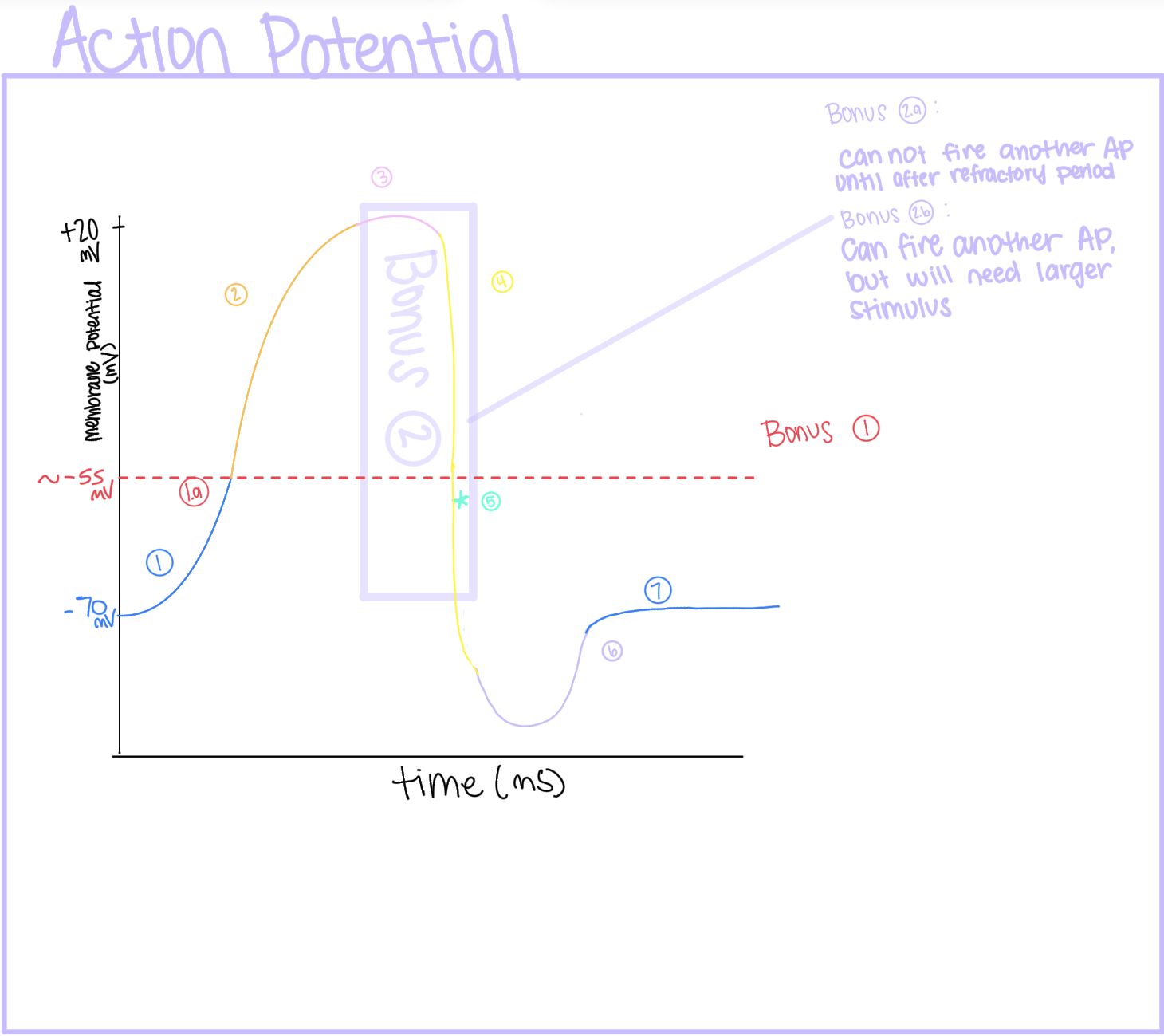
Label the AP
1.) Resting Sate
1.a) Threshold
2.) Depolarization; Na+ v-gates open, Na+ influx
3.) Na+ channels are deactivated
4.) Repolarization; K+ v-gates open, K+ efflux
5.) Na+ channels reset; enter a closed state
6.) Hyperpolarization; K+ channels remain open
7.) Resting potential returns to membrane potential
Bonus:
1.) Threshold Potential
2.) Refractory Period
2.a) Absolute Refractory
2.b) Relative Refractory
Absolute Refractory
The period during which a second action potential cannot be initiated, regardless of the strength of the stimulus, due to the inactivation of sodium channels.
Relative Refractory
The period following an absolute refractory period during which a second action potential can be initiated, but only by a stronger-than-normal stimulus, as some sodium channels have reset.
Chemical Synapse
1.) AP arrives to the Presynaptic terminal
2.) AP triggers Ca+ channels to open
3.) Ca+ causes synaptic vesicles to release neurotransmitters through exocytosis
4.) Neurotransmitters diffuse along the synaptic cleft and bind to receptors on the post-synaptic neuron
5.) Binding leads to ion channel opening, resulting in depolarization or hyperpolarization of the post-synaptic membrane.
6.) The process concludes with neurotransmitter removal from the synaptic cleft
Neurotransmitter for EPSP
Glutamate
Neurotransmitter for IPSP
GABA
Removal of Neurotransmitter from Synapse
Diffusion and Absorption: Neurotransmitters diffuse away from cleft and returned to presynaptic neuron
Degradation: degraded by enzymatic reactions in the cleft
Reuptake: transported back into the presynaptic neuron for reuse
Explore top notes

