L16: Kidneys - Reabsorption and Regulation
 Call Kai
 Learn
Learn Practice Test
 Spaced Repetition
 Match
Match Flashcards
 Knowt Play
1/16

There's no tags or description
Looks like no tags are added yet.
Name | Mastery | Learn | Test | Matching | Spaced | Call with Kai |
|---|
No analytics yet
Send a link to your students to track their progress
17 Terms
Describe the mechanisms of reabsorption from proximal tubule. What roles do Na+ and the Na+-K+ ATPase pump play in reabsorption of other solutes?
Na+ is reabsorbed by active transport through tubular epithelium.
Electrochemical gradient drives anion absorption through and between epithelium.
Water moves by osmosis, following solute reabsorption. Concentrations of other solutes increase as fluid volume in lumen decreases. Water moves through and between cells.
Permeable solutes (K+, Ca2+, urea) reabsorbed by diffusion through membrane transporters or by paracellular pathway through and between cells
Basically, the proximal tubule reabsorbs bulk of filtered water and solutes using primary active transport (ATP driven), secondary active transport (gradient driven and antiport), facilitated diffusion, passive paracellular diffusion, osmosis, and endocytosis. The Na+ K+ ATPases act as motor for proximal tubule. Sitting on the basolateral membrane and constantly pumping Na+ out of cell, it creates a directed electrochemical gradient of Na+. This is the energy source that secondary transport on apical membrane use to drag other solutes out filtrate and into body.
Describe the concentrations of the tubule lumen, proximal tubule cell, and interstitial fluid. Also describe the movement of solutes and Na+ from the lumen to interstitial fluid.
Na+ is high in the tubule lumen whereas glucose is low. Na+ moving down its electrochemical gradient uses SGLT protein to pull glucose into the cell against its concentration gradient.
Na+ is low in the proximal cell whereas glucose is high. The second step involves GLUT, where glucose diffuses out of the basolateral side of the cell with the GLUT protein into the interstitial fluid. (interstitial glucose is low, Na+ is high)
When Na+ enters the proximal cell, an ATPAse is used where Na+ is pumped out into the interstitial fluid using a Na+ K+ ATPase.
In general terms, how do the kidneys conserve fluid volume in our bodies?
They conserve fluid volume by initially filtering large amounts of water out the blood, then reabsorbing 99% back into the bloodstream. They achieve this by using sodium to pull water back via osmosis, creating a salty environment in deep kidney tissue to draw out moisture. They also rely on hormones like ADH to open specific water channels thar rescue water from the urine just before excretion.
Explain the process of ion and water reabsorption throughout the nephron. Where is water reabsorbed? Where are ions reabsorbed? What are aquaporins?
As isosmotic fluid leaves proximal tubule, it becomes much more concentrated in descending limb. Only water is allow to be reabsorbed since the lumen has the higher osmotic pressure than the tubule, forcing ions to stay in. The more ions makes it more concentrated (300mOsm). It is also collected by distal convoluted tubule and collecting duct with ADH presence.
As the fluid goes up the ascending limb, the reverse occurs where the removal of solute in thick ascending limb creates hypoosmotic fluid. Ions are allowed to be reabsorbed due to osmotic pressure, where it creates osmotic gradient thus pressure (100mOsm). It is also collected by distal convoluted tubule and collecting duct with ADH presence.
Aquaporins are specialized membrane channel proteins that act as a rapid, selective pores for water, allowing it to move quickly across cell membranes via osmosis without letting ions pass through.
Why do the deeper regions of the renal medulla have a higher osmolarity than the more superficial layers of the renal medulla and the renal cortex? How does this affect water and ion reabsorption?
The reason why the deeper regions of medulla have a higher osmolarity than the superficial regions is because of the accumulation of sodium chloride and urea.
The ascending limb actively pumps Na+, K+, and Cl- ions out of tubule into interstitial fluid. This results in the medulla having higher osmolarity.
The descending limb is permeable to water, so as the fluid dives into salty medulla, water is pulled out concentrating the fluid in the loop.
Urea leaks out the collecting ducts into the interstitium as well, causing around fifty percent of osmolarity.
The high osmolarity creates a strong osmotic gradient that allows the collecting ducts to reabsorb water (concentrating the urine) and enables efficient recovery of ions.
Explain the concept of countercurrent exchange.
The mechanism where two fluids flow in opposite directions to maximize transfer of solutes. Filtrate entering descending limb becomes MORE concentrated as it loses water. In between the loop, the blood in the vasa recta removes the water leaving loop of Henle. The ascending limb pumps out Na+, K+ and Cl- and filtrate becomes hyperosmotic. The NKCC transporters move 1Na 1K and 2Cl from tubule to kidney, as it uses the sodium gradient from the Na K ATPase. Its to salt the medulla while leaving water behind.
How does countercurrent exchange in the nephron aid in producing a relatively small volume of dilute urine when necessary?
The loop of Henla and vasa recta work together to pump solutes out of filtrate and trap them in renal medulla to create gradient. When water needs to be conserved, ADH makes collecting ducts permeable. The gradient acts as vacuum where water is pulled out filtrate and back into blood, resulting in small amount of urine.
What tissue synthesizes vasopressin? Is this the same tissue that releases it into the circulation?
The tissue that makes vasopressin (ADH) is the hypothalamus. The tissue that releases vasopressin is the posterior pituitary gland.
What stimulates the release of vasopressin?
Decrease in blood pressure stimulates carotid and aortic baroreceptors sending sensory neuron to hypothalamus which creates vasopressin to collecting duct epithelium.
Decreases atrial stretch due to low blood volume stimulates atrial stretch receptor sending sensory neuron to hypothalamus.
Osmolarity greater than 280mOsm stimulates hypothalamic osmoreceptors sending interneurons to hypothalamus.
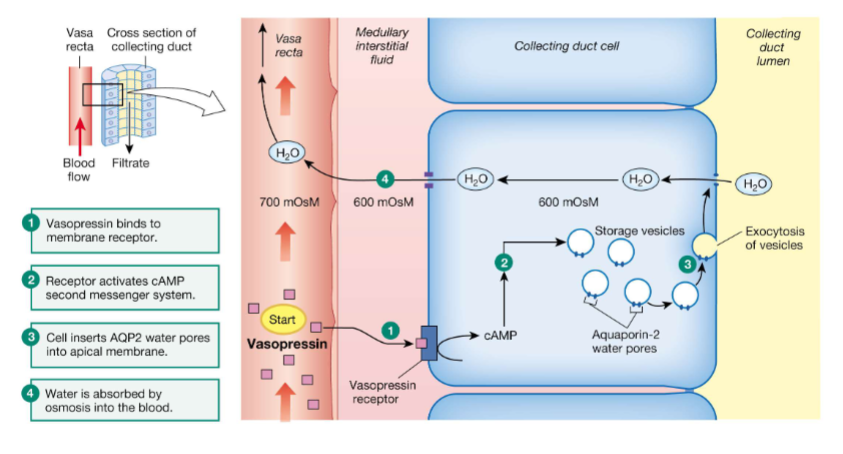
What are vasopressin’s target cells? What is the effect of vasopressin on these cells? How dies it affect reabsorption and plasma osmolarity?
Its target cells are principal cells in the collecting ducts and vascular smooth muscle cells in arterial vessels. In the kidneys, VP binds to V2 receptors triggering signaling cascade causing aquaporin-2 channels to move from cell’s interior to the apical membrane (urine facing). At higher concentrations, VP binds to V1 receptors on smooth muscle causing vasoconstriction to increase BP. Opening aquaporin gates causes kidneys to become highly permeable to water as it pulled out of the urine and back into blood (facultative reabsorption). As more water is reabsorbed to blood, the concentrated solutes in plasma is diluted causing plasma osmolarity to decrease.
What cells produce renin? What stimulates the production of renin?
Juxtaglomerular cells located on the walls of afferent arterioles make renin. Sodium depletion, decreased perfusion pressure, sympathetic stimulation from beta adrenergic agonists, reduced NaCl load in macula densa stimulate production (increasing blood pressure and volume).
How do the macula densa cells influence the activity of granular cells?
Macula densa influence activity of juxtaglomerular cells by acting as chemical sensors that dictate whether granular cells should release renin via monitoring NaCl levels in the kidney fluid.
NaCl high (high BP/flow) results in macula densa releasing adenosine INHIBITING JG cells from releasing renin.
NaCl low results in macula densa releasing prostaglandins PGE2 which stimulate JG cells to make renin to raise BP.
How does renin affect angiotensin concentrations in the plasma?
It acts as a rate-limiting enzyme in RAAS pathway. It affects angiotensin concentrations by catalyzing the conversion of angiotensin to angiotensin I. The increase in AT I provides necessary substrate for ACE to produce angiotensin II, raising plasma concentrations of both active forms to regulate blood pressure and fluid balance.
What is ACE and where is it found? What does it do?
It is the angiotensin-converting enzyme and it is found in the endothelium of the inner blood vessels (also in lungs, kidneys, heart, and brain). It increases BP by converting angiotensin I into II and by breaking down substances that would otherwise relax vessels.
What effects does angiotensin II have on ion and water reabsorption and blood pressure? Explain the mechanisms.
On ion reabsorption, it INCREASES Na+ and Cl- reabsorption (saving them from being lost in urine) and INCREASES K+ and H+ excretion. It does this directly at proximal tubule and indirectly by stimulating aldosterone release.
On water reabsorption, it INCREASES water reabsorption. It happens because water passively follows the reabsorbed sodium, and since AT II triggers ADH release, directly pulling free water back into blood.
On blood pressure, it INCREASES BP via constricting directly the blood vessels (increase resistance) and activating sympathetic nervous system.
Why does reabsorption reach a saturation point? Define the renal threshold.
It reaches a saturation point because it relies on physical carrier proteins in the kidney tubules; there are limited number of proteins. Plus, these proteins have a maximum speed at which they can work. When all transporters are fully occupied, any excess substance cannot be reabsorbed and is lost in urine.
The renal threshold is the specific plasma concentration of a substance at which the filtered load exceeds the kidneys capacity to reabsorb it, causing the substance to first appear in the urine.
Why and how is secretion different from excretion?
Secretion is the movement of ions or molecules from one location to another within the body. Excretion is the movement of a substance from inside the body to outside the body.

