Plant phys exam: 8 phototropism
 Studied by 0 people
 Call Kai
 Learn
Learn Practice Test
 Spaced Repetition
 Match
Match Flashcards
 Knowt Play
1/34

There's no tags or description
Looks like no tags are added yet.
Name | Mastery | Learn | Test | Matching | Spaced | Call with Kai |
|---|
No analytics yet
Send a link to your students to track their progress
35 Terms
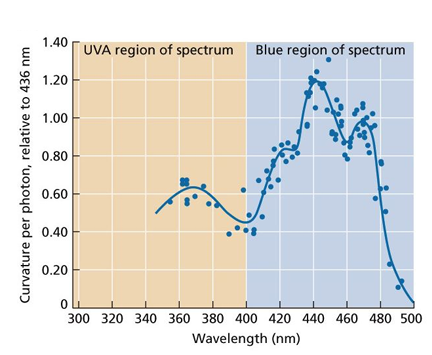
What is unique about blue light photoreceptors?
“three fingered” action spectra is unique for all blue light mediated responses
What are some of the responses to blue light?
phototropism, chloroplast movements, open/closing of guard cells, solar tracking in leaves
Plants can ______and _______to the quantity and position of light source
perceive and respond
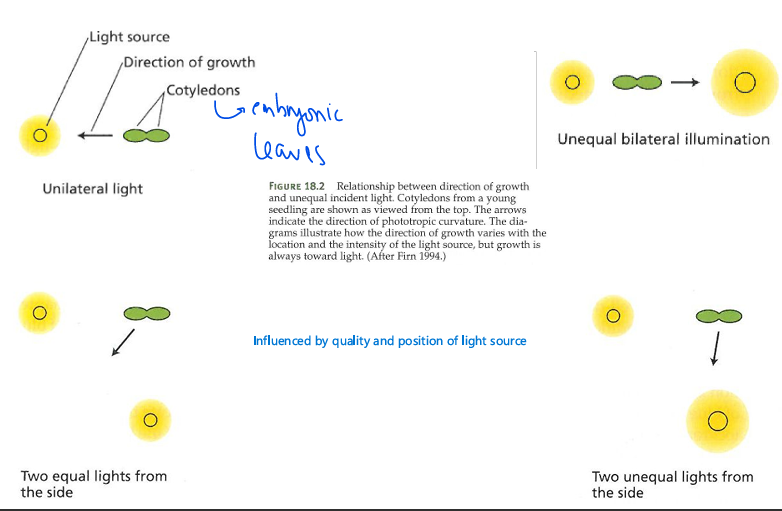
What are cotyledons?
embryonic leaves
Describe Darwin’s phototropism studies
1- no treatment: growth & curvature towards
2- cut off tip: little growth & no curvature
3- opaque sleeve at base coleoptile: growth and curvature
4- clear cap on top: growth & curvature
5- opaque cap on tip: growth but NO curvature
What was the conclusions to Darwin’s experiment
Response (growth) site is separate from perception site
Shaded side of coleoptile grows faster than the lighted side
Coleoptile tip is site of phototropic perception
Describe Darwin’s second experiment
mica sheet: inserted across, inserted on shaded side, or inserted on light side
gelatin: placed between tip and stump= normal growth
conclusion:
Chemical signal moved down shaded side of coleoptile (if blocked-no growth)
Chemical signal is water soluble and mobile
Overall conclusions from Darwin’s experiments
1. Growth regulator was present normally in tip
2. Growth regulator isn’t induced/synthesized by unidirectional light source
3. Proposed that light causes the accumulation of the chemical on the shaded side of the coleoptile (redistributed in response to unidirectional light)
What wavelengths produce optimal phototropic curvature?
blue wavelengths (440/480n)
Any substance that promotes coleoptile elongation is…
an auxin
Using known concentrations one can determine how much curvature is produced at that concentration of auxin
how much auxin was present in a tissue by comparing how much curvature was produced by that tissue coleoptile etc.
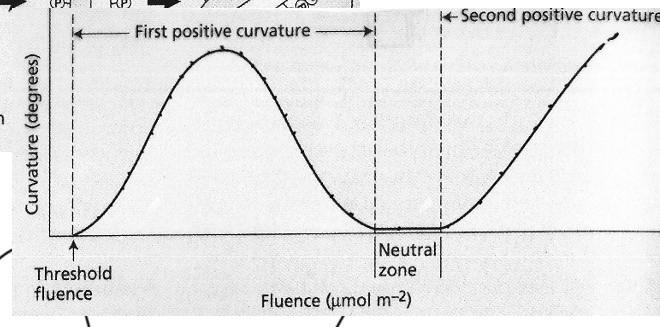
What is fluence
total number of photons provided to a 1 M2 surface area over a given time interval
Lower and higher fluences produce curvature (first & second positive curvature)
What it the neutral zone in fluence?
the low point between the first positive and second positive
What is phototropic curvature correlated with?
protein kinase activity
PHOT1
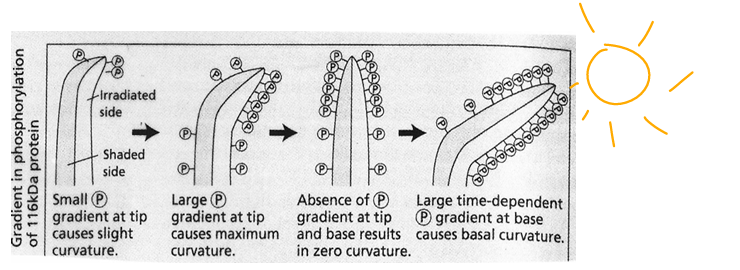
Describe the photoreceptors in phototropism
PHOT1: mediates phototropism in response to low and high fluence blue light
PHOT2: mediates phototropism in response to high fluence blue light only
has some redundant function with PHOT1
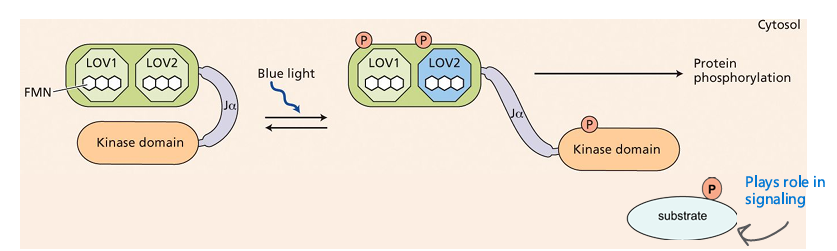
Phot 1 and Phot 2 are Phototropins:
light activated serine/threonine kinases associated with plasma membrane
Phototropin is a dimer and each monomer has 3 important regions
What makes up the important regions of phototropin monomer?
1- photosensor
2- Ser/Thr Autophosphorylating Kinase Domain
3- La helix
Describe photosensors
light absorption
Flavin mononucleotide (FMN- part of FADH2) bound to LOV domain
LOV domains is the sensor; named for organisms that have a LOV domain.
L - light (photosynthetic organisms)
O - oxygen (bacteria)
V - voltage (drosophila/vertebrates-K+ channels)
Describe the Ser/Thr Autophosphorylating Kinase Domain
activated when FMN absorbs blue light
Blue Light Absorption leads to conformational change in protein
Activates kinase domain
autophosphorylates itself
phosphorylates substrates
Describe the role of the Ja helix
links the light absorption domain to kinase domain
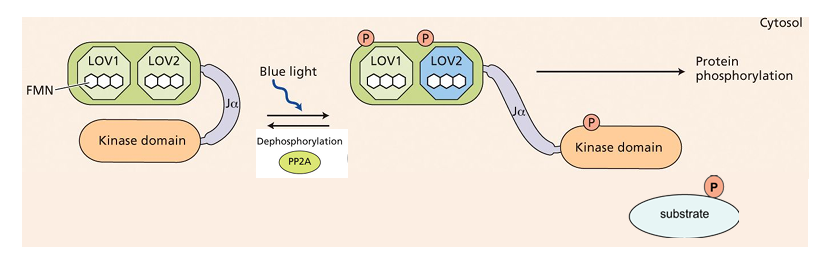
Describe the Inactivation of phototropins:
Phosphatase (PP2A) removes the activating phosphate
What is the response to blue light absorption
Flavin mononucleotide absorbs blue light
Conformational change in protein occurs
Activates kinase domain
autophophorylates itself
phosphorylates substrates that produce phototropic response
What happens during phototropic response?
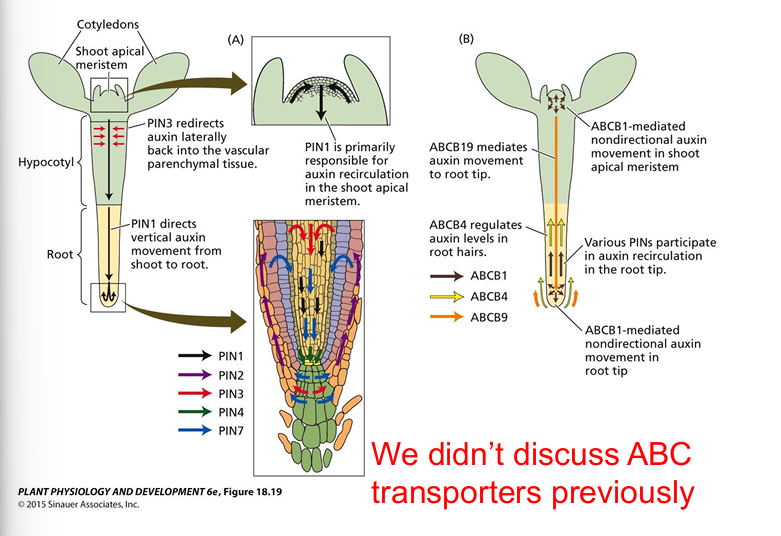
1. PHOT1 phosphorylates and inhibits the activity of ABCB19 • ABC19 is a protein in membrane enhances PIN1 efflux from cells • PIN1 is destabilized - prevents auxin efflux from cells
2. Auxin accumulates above cotyledons • hypocotyls cease growing/elongating (due to decrease in cell elongation)
3. PIN3 is localized to lateral walls of shaded side of stem • auxin transport resumes along shaded side of hypocotyl
4. Growth resumes (takes 15-20 minutes
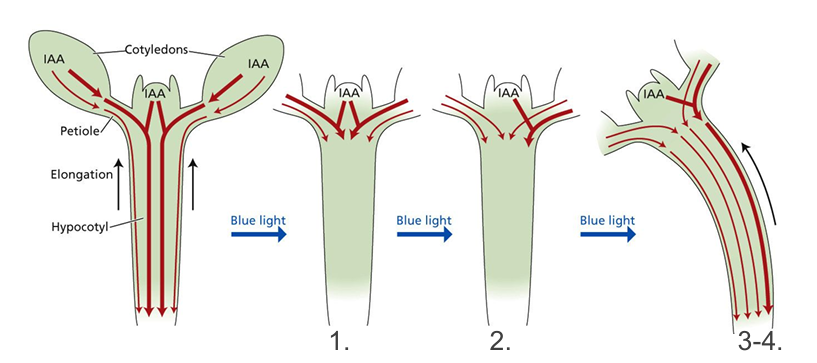
Describe the directional movement of auxin
Auxin: exists in two forms
protonated (IAAH)
unprotonated (IAA-)
depends on pH
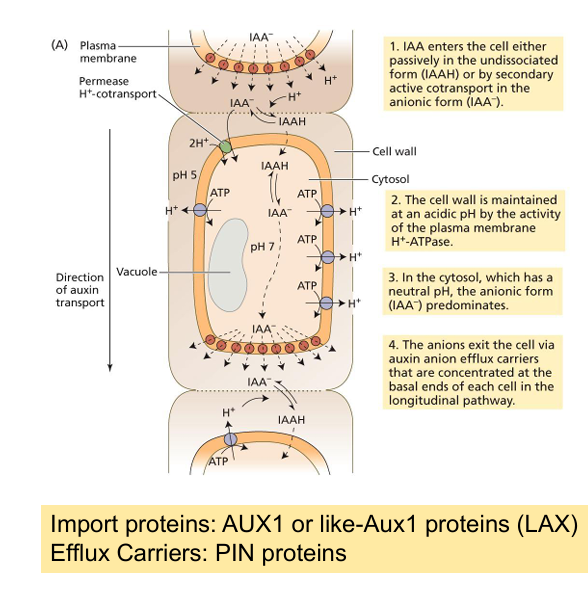
PIN transporters
Review slide for PIN and ABC transporters
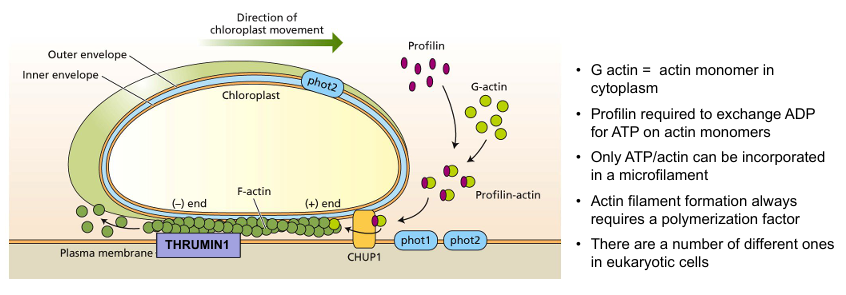
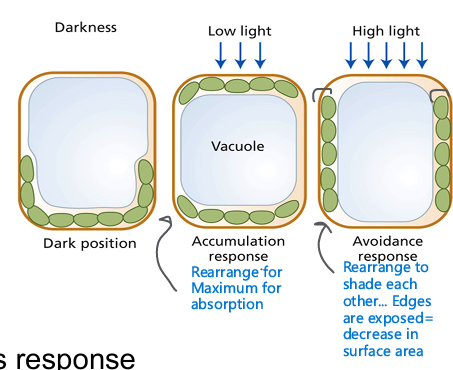
Describe chloroplast movements
Chloroplasts can move in any direction: mediated by PHOT1 & PHOT2
When a small amount of light is given to part of a cell, the cell’s chloroplasts move to the irradiated area (accumulation respone)
But when part of a chloroplast is irradiated with strong light, the chloroplast escapes from the light (avoidance response
Describe phot1 and phot2 mutants
phot1- weak accumulation response/good avoidance response
phot2- good accumulation response/ no avoidance response
What happens in a phot1/phot2 double mutant?
no accumulation OR avoidance response
What can we conclude about phot1 and phot2?
PHOT2: Key role in avoidance response
PHOT1 and PHOT2 required for accumulation response
Chloroplast movement is mediated by:
dynamic reorganization of short actin filaments, called chloroplast actin filaments (cp-actin)
located between each chloroplast and the plasma membrane
These actin filaments are distinct from the cytoplasmic microfilaments
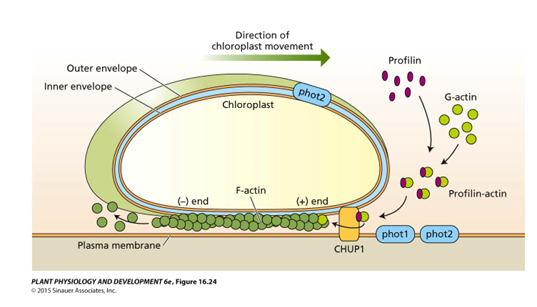
Describe Chloroplast Unusual Positioning 1 (CHUP1)
involved in blue-light mediated chloroplast movements
chup1 mutants are defective in chloroplast movement in response to blue-light
cp-actin filaments are not detected in chup1 mutant cells,
But cytoplasmic actin filaments are clearly observed
CHUP1 is normally attached to the chloroplast outer envelope & plasma membrane
• Functions as an actin polymerization factor
Evolved to assemble cp-actin filaments during blue light mediated chloroplast movements
How is the chloroplast influenced by strong blue light?
PHOT2 causes rapid severing of the cp-actin filaments
CHUP1 is reorganized and becomes asymmetrically redistributed to the “front end” of the chloroplast
cp-actin filaments are polymerized at the interface between the plasma membrane and the chloroplast
Polymerized cp-actin filaments are bundled and anchored to the plasma membrane by a plasma membrane protein, THRUMIN1
Actin polymerization itself push CHUP1 forward, thereby pushing the CHUP1-bound chloroplast – myosin doesn’t seem to be involved.
All plants have…
CHUP1 protein- it is conserved
What are the characteristics of CHUP1?
plant-specific actin polymerization factor that functions specifically in cp-actin-based chloroplast movement