Chapter 22: Scientific Revolution and Enlightenment
 Studied by 0 people
 Call Kai
 Learn
Learn Practice Test
 Spaced Repetition
 Match
Match Flashcards
 Knowt Play
1/42

There's no tags or description
Looks like no tags are added yet.
Name | Mastery | Learn | Test | Matching | Spaced | Call with Kai |
|---|
No analytics yet
Send a link to your students to track their progress
43 Terms
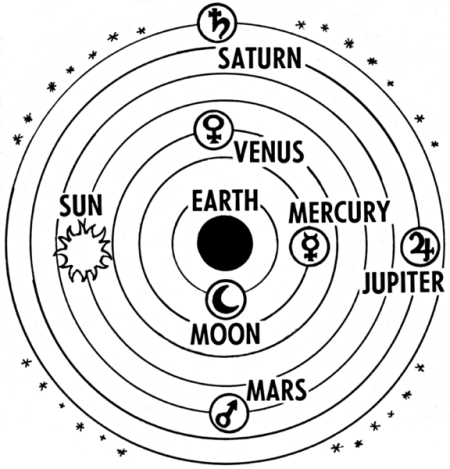
Geocentric Theory
The earth-centered view of the universe.
During the Middle Ages, most scholars believed that the earth was an immovable object located at the center of the universe.
This idea came from Aristotle, a Greek philosopher
Supported by common sense
In religion, Christianity taught that God had placed the Earth at the center of the universe
Scientific Revolution
A change in European thought — a new way of thinking about the natural world that was based upon careful observation and willingness to question accepted beliefs (the ideas of the ancient thinkers and the church), replacing old assumptions with new theories
Began in the mid-1500s
Discoveries by explorers opened the possibility of new truths to be found
The printing press spread ideas (old and new)
Impact: moved into other fields of life, and philosophers and scholars began to rethink the relationship between government and the people (the rights/liberties of citizens)
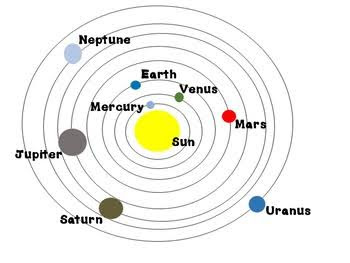
Heliocentric Theory
Nicolaus Copernicus: astronomer that questioned the geocentric model of the universe. He reasoned that the stars, the earth, and the other planets revolve around the sun.
The Sun-centered model of the universe.
Johannes Kepler
A mathematician that used Tycho Brahe’s data to conclude that certain mathematical laws govern planetary motion. One of these laws showed that the planets revolve around the sun in elliptical orbits instead of circles, showing that Copernicus’s basic ideas were true (by mathematically demonstrating that the planets revolve around the sun)
Galileo Galilei
An Italian scientist who built on the new theories about astronomy
Built his own telescope
Published the Starry Messenger
Supported the theories of Copernicus
Conflict with the Catholic Church: The Catholic Church warned him not to defend the ideas of Copernicus because they went against church teaching and authority. The pope summoned him to Rome and, under the threat of torture, he was forced to state that the ideas of Copernicus were false.
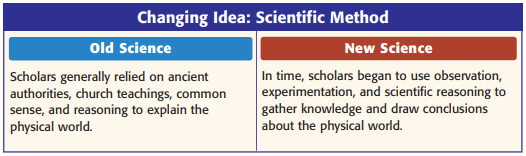
The Scientific Method
A new approach to science
A logical procedure for gathering and testing ideas
Begins with a problem or question arising from observation. Scientists then form a hypothesis, or unproven assumptions. They experiment to test the hypothesis, and then analyze their data to reach a conclusion.
The work of Francis Bacon and René Descartes helped to advance this new approach
Francis Bacon
Contributed to the Scientific Method
Believed that by better understanding the world, scientists would generate practical knowledge that would improve people’s lives
Rather than reasoning from abstract theories and relying on the conclusions of ancient thinkers, he urged scientists to experiment and then draw conclusions (experimental method)
Rene Descartes
Developed analytical geometry
Believed that scientists needed to reject old assumptions and teachings
Mathematician
Contributed to the Scientific Method
Relied on mathematics and logic, rather than experimentation
Believed that everything should be doubted until proven by reason
“I think, therefore I am”
Isaac Newton
English scientist
Helped to bring together the breakthroughs of Copernicus, Kepler, and Galileo under a single theory of motion.
The law of universal gravitation — every object in the universe attracts every other object
Edward Jenner
British physician who introduced a vaccine to prevent smallpox — inoculation using germs from a cattle disease called cowpox gave permanent protection from smallpox.
The world’s first vaccination.
What were some of the new scientific instruments developed during the Scientific Revolution?
Microscope
Mercury barometer
Thermometer
The notions of reason and order spurred many breakthroughs in science and then moved into other fields of life.
Enlightenment
The Scientific Revolution prompted new ways of thinking, causing scholars and philosophers to reevaluate old beliefs about government, religion, economics, and education
A new intellectual movement that stressed reason, thought, and individuals’ abilities to solve problems
Also known as the Age of Reason
Mid-1700s
Thomas Hobbes
English political thinker
Experienced the political turmoil of England
Leviathan
Humans: naturally selfish and wicked
A strong government with total power is needed to keep citizens under control (with the power of a leviathan, a sea monster)
The Social Contract
The Social Contract
The agreement by which people create a government and hand over their rights to a strong ruler, in exchange for law and order.
Sacrifice freedom for security and stability (consent of the governed)
Developed by Thomas Hobbes
John Locke
English philosopher
Experienced the turmoil of the English Civil War
Humans: naturally good, honest, capable of improvement, and with the ability to govern themselves
People are born free and equal
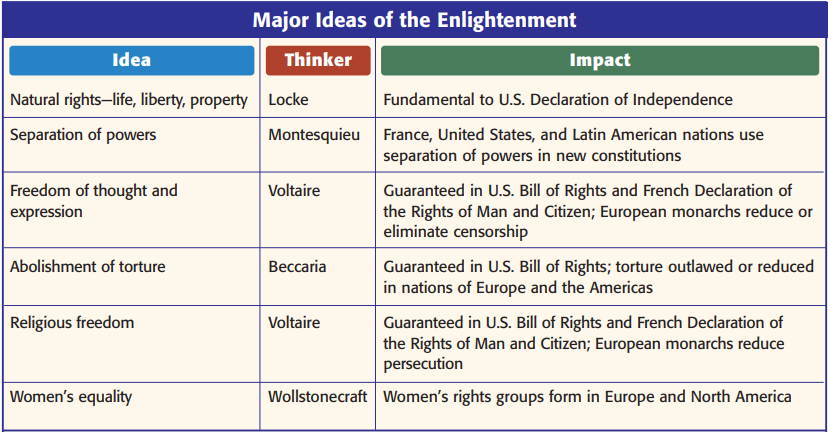
Three natural rights: life, liberty, and property
The purpose of government is to protect these natural rights. If the government fails, citizens have the right to rebel
Consent of the governed: a government’s power comes from the consent of the people
Three Natural Rights
Life, liberty, and property
The philosophe John Locke
Philosophes
Mid-1700s social critics in France
The French word for philosophers
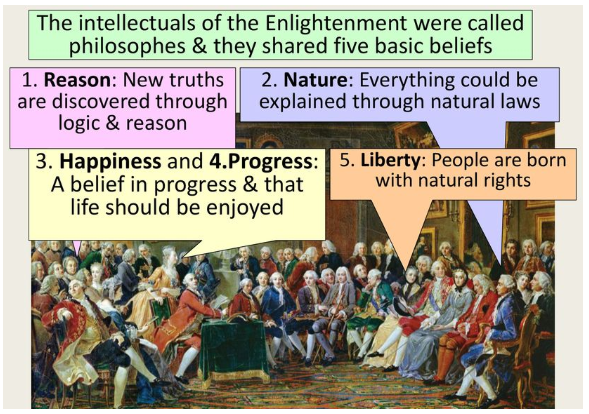
Believed that people could apply reason to all aspects of life
Five concepts formed the core of their beliefs
5 Core Beliefs of the Philosophes
Reason: believed truth could be discovered through reason or logical thinking
Nature: believed that what was natural was also good and reasonable
Happiness: rejected the medieval notion that people should find joy in the hereafter and urged people to seek well-being on earth
Progress: stressed that society and humankind could improve
Liberty: called for the liberties that the English people had won in their Glorious Revolution and Bill of Rights
Voltaire
Philosophe that used a pen name
Made frequent targets of the clergy, aristocracy, and government, earning him enemies at the French court, prison sentences, and an exile (he was an enemy of the state)
Fought for tolerance, reason, and freedom of religion, speech, though, and expression
Against titles of nobility
Free and equal
Montesquieu
Huge fan of Great Britain: believed that Britain was the best-governed and most politically balanced country of his own day. There was executive, legislative, and judicial power.
Separation of powers: division of power among different branches; keeps any individual or group from gaining total control of the government — checks and balances
On the Spirit of Laws
Separation of power maximizes freedom
Rousseau
Committed to individual freedom
Argued that civilization corrupts people’s natural goodness — “man is born free, and everywhere he is in chains”
Believed that the only good government was one that was freely formed by the people and guided by the “general will” of society — Direct Democracy
Against representative democracy
In favor of a direct democracy (mobocracy) where people directly vote for law creation (but people are uneducated, and the majority wins)
People agree to give up some of their freedom in favor of the common good
His view of the Social Contract: an agreement among free individuals to create a society and a government
Consent of the governed
All people are equal, and titles of nobility should be abolished
Beccaria
Philosophe that focused on the justice system
Laws exist to preserve social order, not to avenge crimes
Speedy trial
Punishment should fit the crime
Against capital punishment, torture, and the death penalty
Rights of the accused
Mary Wollstonecraft
Urged equality between men and women
Proto-feminism (idea of feminism didn’t exist yet
Disagreed with Rousseau that women’s education should be secondary to men’s
Pushed for women to have jobs in the male-dominated fields of medicine and politics
Voting for women
How did the ideas of Hobbes and Locke differ?
Hobbes believed humans were naturally selfish and needed a strong, absolute ruler to maintain order, an idea that justified authoritarian government. Locke argued the opposite: people were born with natural rights—life, liberty, and property—and governments existed to protect those rights.
What did Montesquieu admire about the government of Britain?
Montesquieu admired Britain’s system of separating power among different branches of government. He believed this structure prevented tyranny by ensuring no single group could dominate. His admiration shaped his theory of checks and balances, a major Enlightenment contribution.
How did Enlightenment thinkers view the relationship between science and religion?
Many Enlightenment thinkers believed reason and scientific inquiry should guide human understanding, even in areas traditionally dominated by religion. They did not always reject religion but argued that faith should not contradict observable evidence. This approach encouraged religious toleration and reduced the authority of the Church in intellectual life.
How did the printing press contribute to the spread of Enlightenment ideas?
The printing press allowed books, pamphlets, and essays by philosophes to be produced cheaply and distributed widely across Europe. This made Enlightenment ideas accessible to a growing literate public. As a result, new political and scientific ideas spread faster than ever before.
In what ways did the Enlightenment challenge traditional authority and beliefs?
Enlightenment thinkers questioned the divine right of kings, the authority of the Church, and long‑standing social hierarchies. They argued that reason, not tradition, should guide government and morality. This intellectual shift weakened old institutions and encouraged calls for reform.
How did the Enlightenment influence the American and French Revolutions?
Revolutionaries in both countries drew heavily on Enlightenment ideas about natural rights, popular sovereignty, and the right to overthrow unjust rulers. These principles shaped key documents like the Declaration of Independence and the Declaration of the Rights of Man. Enlightenment thought provided the ideological foundation for challenging monarchy and creating new political systems.
In what ways did the Enlightenment contribute to the rise of modern democracy?
The Enlightenment emphasized individual rights, equality before the law, and government based on consent—all core democratic principles. Philosophes argued that rulers should be accountable to the people, not above them. These ideas helped inspire constitutional governments and representative institutions.
How did the Enlightenment thinkers justify the legitimacy of political authority?
Thinkers like Locke argued that governments were legitimate only if they protected citizens’ natural rights and were based on a social contract. If rulers violated this contract, the people had the right to replace them. This shifted political authority from divine right to rational, human-centered principles.
What were Montesquieu's views on the separation of powers, and how did they impact political theory?
Montesquieu believed dividing government into executive, legislative, and judicial branches prevented tyranny by balancing power. His ideas became a cornerstone of Enlightenment political theory. They directly influenced modern constitutions, especially the U.S. system of checks and balances.
What criticisms did Enlightenment philosophers have of absolute monarchy, and how did they propose alternatives?
They criticized absolute monarchy for concentrating power in a single ruler, which they argued led to tyranny and the abuse of natural rights. They proposed alternatives such as limited government based on consent (Locke), the separation of powers (Montesquieu), and direct democracy (Rousseau) to ensure that authority remained accountable to the people.
In what ways did Mary Wollstonecraft contribute to Enlightenment discussions on women's rights and political equality?
Wollstonecraft challenged the idea that women were naturally inferior. She advocated for equal education for men and women and urged women to enter male-dominated fields like medicine and politics. Her work expanded Enlightenment ideas of equality to include women.
How did the Enlightenment lead to a more secular outlook?
By emphasizing reason, scientific evidence, and critical thinking, Enlightenment thinkers encouraged people to question religious ideas that were accepted as fact. This reduced the Church’s influence over politics, education, and intellectual life. As a result, European society became more secular and focused on human progress rather than divine authority.
Salons
Social gathering held by wealthy women in Paris
In the 1700s, Paris was the cultural and intellectual capital of Europe
Enlightenment ideas were most intense at these social gatherings
Where philosophers, writers, artists, scientists, and other intellectuals met to discuss ideas
Helped spread Enlightenment ideas to educated people all over Europe
Denis Diderot
Created a large set of books to which many leading scholars of Europe contributed articles and essays — Encyclopedia
Helped spread Enlightenment ideas to educated people all over Europe
Baroque
European art of the 1600s and early 1700s had been dominated by this style, which was characterized by a grand, ornate design (can be seen in the Palace of Versailles)
Neoclassical
The artistic style of the late 1700s. Artists and architects worked in a simple and elegant style that borrowed ideas and themes from classical Greece and Rome.
Enlightened Despots (Form of Absolutism Influenced by the Enlightenment)
Monarchs who embraced Enlightenment ideas and made reforms
Still absolute rulers — had no intention of giving up power
Hoped to enhance their own rule and make their country stronger through some reforms
Frederick II (Prussia)
Joseph II (Austria)
Catherine the Great (Russia)
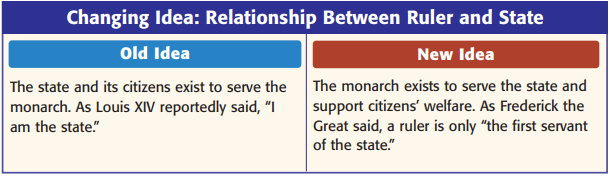
Changing Relationship between Ruler and State
What kind of reforms did enlightened despots make?
Enlightened despots introduced reforms inspired by Enlightenment ideals, aiming to strengthen their states while appearing more rational and humane. They expanded education, reformed legal systems, reduced torture, promoted religious toleration, and tried to modernize economies. However, they kept tight control over political power, using reform to reinforce—not weaken—their authority.
What does it mean to be “the first servant of the state?” In regard to the enlightened despots.
When enlightened despots called themselves “the first servant of the state,” they meant that their primary duty was to govern for the benefit of their people rather than for personal luxury or divine privilege. This reflected Enlightenment ideas that rulers should use reason, improve society, and promote the common good. Even so, they still maintained absolute power, blending Enlightenment rhetoric with traditional monarchy.
 Note
Note  Flashcards (66)