Exam 3: PBSI 340
 Call Kai
 Learn
Learn Practice Test
 Spaced Repetition
 Match
Match Flashcards
 Knowt Play
1/92

There's no tags or description
Looks like no tags are added yet.
Name | Mastery | Learn | Test | Matching | Spaced | Call with Kai |
|---|
No analytics yet
Send a link to your students to track their progress
93 Terms
Instrumental Learning
synonymous to response outcome learning
learning in which the probability of a given behavior is altered by its consequences
the behavior is a tool “instrument” in producing the outcome
Operant Learning/Conditioning
A form of instrumental learning in which the organism specifically learns to manipulate its environment to achieve a desired outcome.
Subset of instrumental learning
OL=IL but not vice versa
Instrumental Criteria (Same as before)
The behavior modification depend on a form of neural plasticity
The modification depends on the organism’s experiential history
The modification outlasts the environmental conditions and the experience has a lasting effect on performance
Imposing a temporal relationship between a response and an outcome alters the response
Additional Operant Criteria (new)
The nature of the behavioral change is not constrained (either an increase OR decrease in response can be established)
The nature of the reinforcer is not constrained ( a variety of outcomes can be used to produce the behavioral deficit)
Discrete-Trial Method
A form of instrumental learning where an organism may only perform a behavior to earn a response only at specific times.
→ Ex: iClicker quizzes
Free-Operant Method
A form of instrumental learning where an organism may perform a behavior to earn a response at any time.
→ Ex: Checking socials
The type of instrumental learning depends on…
Nature of the reinforcer (+) or (-)
Relation to the behavior
Reward Learning/Positive Reinforcement
Behavior leads to an appetitive outcome.
increases likelihood of behavior
Punishment Learning/Positive Punishment
Behavior leads to an aversive outcome
decreases likelihood of behavior
Omission Learning/Negative Punishment
Behavior removes an appetitive outcome.
Decreases likelihood of behavior.
Ex: press → no food
Escape/Avoidance Learning or Negative Reinforcement
Behavior removes an aversive outcome.
Ex: shuttle → no shock
Increases likelihood of behavior
Skinner Box
Animal presses lever → reward or punishment
Used for:
Reward: bar press → food
Omission: bar press → no food
Punishment: bar press → shock
Shuttle box
Animal moves compartments to avoid shock
Used for: Escape/Avoidance learning
Cannot use Skinner for Escape/Avoidance because of biological constraints
Learning occurs in…
a heterogenous behavioral substrate
some action-outcome relationships are learned more easily than others
Contingency in Instrumental learning
Extra US’s undermine Pavlovian conditioning
Extra outcomes disrupt instrumental conditioning
Temporal Relationship
timing between response and outcome matter or
timing between CS and US matter
Continuous Reinforcement (CRF)
every response is rewarded
1:1 ratio of behavior to reinforcer
Behavior always produces the reinforcer
Fixed Ratio (FRX)
X responses → reward
Stable X:1 ratio of behavior to reinforcer
X number of responses always produces the reinforcer
Variable Ratio (VRX)
unpredictable number of responses
Average of X:1 ratio of behavior to reinforcer
the number of responses needed to produce the reinforcer will vary, but average out to X
Fixed Interval (FIX)
reward after a fixed time
stable interval separates rewardable behaviors
behavior will only produce reinforcer after a constant amount of time has passed
Variable Interval (VIX)
reward after variable time
average interval separates rewardable behaviors
behavior will only produce reinforcer after a variable amount of time has passed
Learned Helplessness
Idea that unavoidable aversive events impair performance on future avoidable aversive events
Uncontrollable events → impair future learning
failure to act even when escape is possible
Learned Helplessness: Experiment (Maier, Overmier, Seligman)
Master (escapable shock)
Yoke (inescapable shock)
Unshocked
Learned Helplessness: Signal Active Avoidance
3 groups:
Escape → can escape
Yoked → cannot escape
Unshocked
Findings:
After 24 hrs all groups were allowed to move to the side with no shock
Yoke too the longest to learn the second time
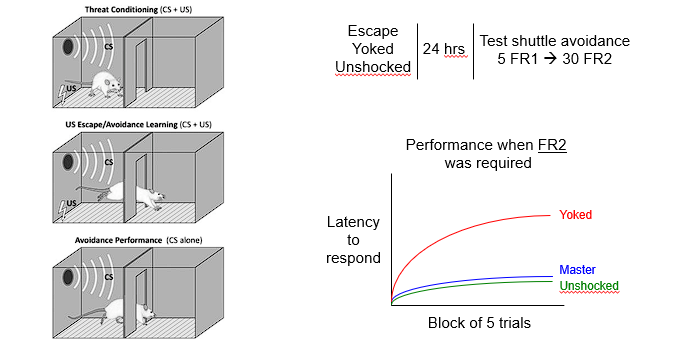
Learned helplessness hypothesis
Causes motivational and associative deficit
Related to Julian Rotter’s locus of control
→ Internal: “I believe that I can control my own future”
→ External: “My life is directed by forces outside of my control”
Contributes to common psychiatric disorders, including anxiety, depression and PTSD
Learned Helplessness: Behavioral Therapy
Groups:
IR = Inescapable shock → then restrained
IE = Inescapable shock → then escapable
RR = Restrained → Restrained (control)
II= Inescapable → Inescapable
Key Points:
Animals that experience control again → start responding normally + escape faster + show recovery
LH is NOT permanent!
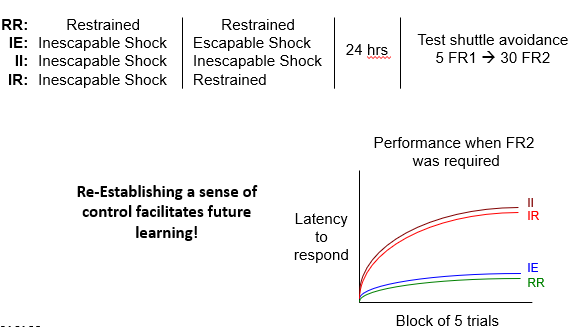
Learned Helplessness: Behavioral Immunization
Groups:
EI = Escapable → Inescapable
II = Inescapable only
RI = control
What happens:
Animal gets ES → learns I can control
Later gets IE → no control is possible
Findings:
Animals with prior control stilly try to escape + resist helplessness
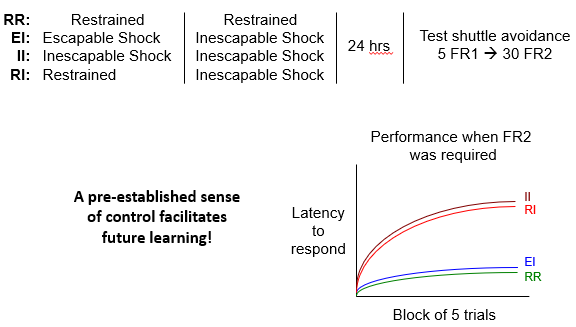
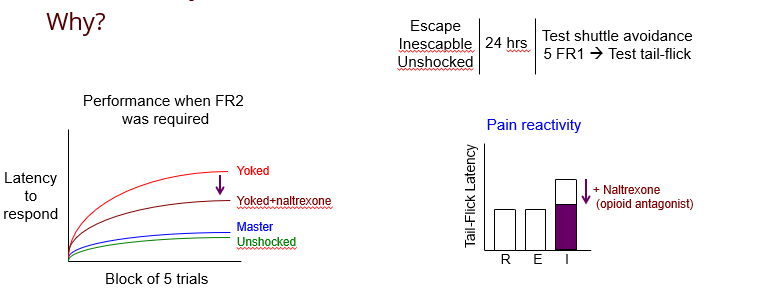
Learned Helplessness: Endogenous Opioids
Learned helplessness can be conditioned in most mammalian species
But Why? Experiment:
Groups:
Escapable shock → Master
Inescapable shock → Yoked
Unshocked control
Then, measure tail flick latency (pain sensitivity test)
Findings:
Normal Reaction: w/o Naltrexone
After IE → brain releases opioids
Animals feel less pain so less likely to learn.
Reaction with Naltrexone:
Naltrexone blocks the endogenous opioids
Pain is felt normally → more likely to learn.
Response-Outcome Contiguity is Key
Organisms are always behaving in some way!
Example: Dog training
Dog sits on command:
Receives treat immediately
→ Dog associates sitting with treat
Dog poops in house while owner is away:
Dog walks around, eats food, sleeps, goes on abt its day
Dog greets owner upon return, owner yells at dog about poop
→ Dog learns the wrong lesson - if there is a long delay, it becomes harder to identify which behavior is responsible
Exceptions to the Importance of Contiguity
Secondary (Conditional) Reinforcers
Marking Stimuli
Secondary ( Conditional) Reinforcers
Something that is not inherently rewarding on its own becomes reinforcing through association with a primary reinforcer
ex: gold stars in classrooms
Why this matters for contiguity:
secondary reinforcers can be delivered immediately, even when the primary reward is delayed
child does something good → gold star → gold star gets exchanged for treasure chest
Gold star preserves the behavioral connection by bridging the time gap.
Marking Stimuli
A brief cue that identifies the target response from among the many behaviors occurring around it.
brief, auditory or visual
not necessarily valued
Ex: Shaping activity
when the organism emits a closer approximation to the desired behavior, the trainer may use a click or other brief marker, this helps distinguish the correct response from other recent actions.
Instrumental Behavior: Goal Directed or Habitual?
Typically begins at goal-directed and becomes habitual over time
Goal-Directed Behavior
A behavior is goal-directed if it is controlled by the current value of the outcome.
organism represents outcome
organism cares about whether that outcome is still desirable
organism uses that valuation to guide responding
Habitual Behavior
A behavior is habitual if it continues even when the outcome is no longer valued.
That means:
the response has become more automatic
the behavior is less sensitive to the current worth of the outcome
action may be controlled more by stimulus-response history than by outcome evaluation
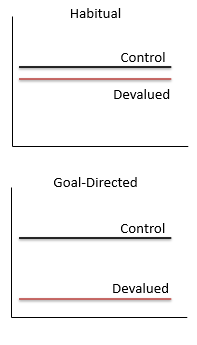
Reinforcer Devaluation
Similar to US devaluation
Procedure:
Establish an R-O contingency
→ ex: lever press → sucrose
Devalue the outcome
→ ex: sucrose paired with LiCI (illness/nausea) or sucrose left alone as control
Test whether animal still performs the response
Findings:
If the anima reduces lever pressing after sucrose has been devalued, the behavior was goal-directed.
If animal keeps pressing despite devaluation, the behavior is habitual.
Feedback Functions
A feedback function describes how changes in response rate affect the rate of reinforcement
In other words: if the organism responds faster, how much more reinforcement does it get?
Ratio Schedules: Feedback Functions
Ratio Schedules produce more responding than interval schedules
On a ratio schedule, reinforcement depends directly on the number of responses, so → more responses = more rewards
This means the extra effort is profitable
Interval schedules: Feedback Functions
Interval schedules reach an asymptote earlier than ratio feedback functions
On an interval schedule, reinforcement depends mainly on time passing. Once the interval has passed, the NEXT response may be rewarded, but responding faster during the interval does not increase the reward rate indefinitely.
Concurrent Schedules of Reinforcement
A concurrent schedule exists when the organism has 2 response options available at the same time, and each leads to reinforcement according to its own schedule.
Concurrent Schedules: Example
Level A: gets a large pile of food, but on a 10-minte fixed interval schedule
Level B: single pellet, but on a 5:1 fixed ratio schedule
What the organism must evaluate:
amount of reward
schedule structure
delay
work requirement
A bigger reward is not always better if it is available less often or less directly, a smaller reward may attract more responding if it is easier or more frequently obtainable
The Matching Law
If:
the response alternatives require similar effort
switching between them is easy
Then:
the distribution of responses is directly proportional to the rate of reinforcement received for that behavior, esp when multiple options are available
Generalized Matching Law
OG matching law works only under ideal conditions — this is used when not under those conditions
Generalized Matching law takes differences in effort, reinforcer strength and switching from one response to the other
Concurrent Chain Schedules
Lock the organism’s initial choice in for the remainder of a trial
Choice Link: Organism can select either option
Terminal Link: Once choice is made, the choice is locked in + only the selected choice is available for the rest of the trial
Drive-Reduction Theory: Clark Hull
Reinforcers satisfy biological needs, and they do so by reducing internal drives.
Hull’s View
If an organism has a physiological deficit that creates a drive a reinforcer works bc it reduces that drive
ex: food is reinforcing → reduces hunger, water → reduces thirst
Problems with Drive-Reduction Theory
Long and Implausible list of drives
DR can’t explain all of reinforcement → you’d have to invent drives for many behaviors
Ex: Monkeys working to watch a toy train → not reducing any real biological drive
Learning can occur without Drive Reduction
Ex: Rats learn to seek saccharine bc it’s sweet even tho no nutritional value
if reinforcement required reduction of physiological need, then this should not be a strong reinforcer bc it does not solve caloric deficiency
Premack Principle
When 2 behaviors are available, the more probably behavior can reinforce the less probable behavior, but the less probable behavior will not reinforce the more probable behavior.
Ex: First do your homework, then you get to watch TV
But, A reinforcer is not universally reinforcing, its reinforcing power depends on the organism’s existing preference structure
Premack vs. Hull
Differences:
Premack didn’t designate a special class of events as reinforcing
Problems with Premack’s Approach
Difficult to quantify time spent performing individual behaviors
How to quantify drinking behavior?
How do we determine which behavior is probable?
Early View: NB Mechanisms of Instrumental learning
Believed that all learning occurred via common mechanism
Modern View: NB mechanism of Instrumental Learning
Multiple systems underlie different types of memory
Learning in a T-maze
Early in training: Place learning (spatial/explicit)
Lesioning HC disrupts place learning, facilitates habit learning
Late in training; Response learning (habit/implicit)
Lesioning the Basal ganglia disrupts habit learning
Basal Ganglia: Structures
Striatum and Substantia Nigra
Striatum: Structures
Global Pallidus
Ventral Pallidum
Substantia Nigra: Structures
Subthalamic nucleus
Ventrolateral nucleus of the thalamus
Striatum: Function
involved in motivation, reinforcement + planning movements
it connects: reward → action
receives dopaminergic input from the substantia nigra
2 key receptors
Substantia Nigra: Function
Produces dopamine
Neurons synapse onto neurons in the striatum
Habit System
Amygdala
Basolateral nucleus encodes reward magnitude and valence
Striatum
Integrates positive and negative with behavior over multiple trials
Habit learning is incremental → more trials = stronger habit
Executive Control
Executive control is making choices after weighing things like immediate reward, future reward and punishment to make the best decision.
organisms need to do more than just represent the reward
Orbital Frontal Cortex
allows the organism to weigh the relative value of alternative outcomes
Value: Estimate of relative gain both now and in the future
Delayed Discounting
Value decreases as delay increases
can be modeled in both animals and humans
Lesions of OFC → bias behavior to immediate reward (in rats)
Increased limbic activity → immediate reward (in humans)
OFC activity → delayed reward
People with substance-use disorders tend to be biased towards immediate rewards
Direct vs Indirect Pathways
Two classes of striatal projection neuron
distinguished by type of dopamine receptor (D1 v D2)
D1 vs D2
D1:
receptor expressing direct pathway
involved in reward learning and initiating action
D2:
receptor expressing indirect pathway
involved in punishment learning and inhibiting action
Direct v Indirect PW: Experiment
Set- Up:
2 groups of rats implanted w mechanist to stimulate either 1. direct pathway (D1 medium spiny neurons) or indirect pathway (D2 medium spiny neurons)
Both groups were presented with 2 levers:
Lever 1: engaged stimulation
Lever 2: no stimulation
Findings:
Direct pathway mice worked for stimulation
Indirect pathway mice avoided stimulation
Conclusion:
D → encodes reward
I → controls punishment
Both involve dopamine
Direct vs Indirect: CPP
Another experiment utilizing the D&I were used in relation to CPP:
Results:
Direct pathway rats preferred stimulation side
Indirect pathway rats avoided the stimulation side
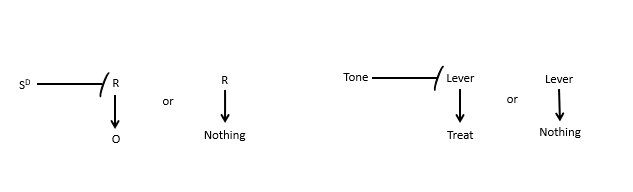
Discriminative Stimulus
indicates whether the R-O relation is in effect
Basically → a stimulus that signals whether a response will produce an outcome
SD kind of sets the conditions under which the response is effective
Ex:
Tone on → lever gives treat
Tone off → lever press gives nothing
Here the animal is not just learning Lever press → food
It is learning:
Tone present: lever press → food
Tone absent: lever press → nothing
Avoidance learning (SD)
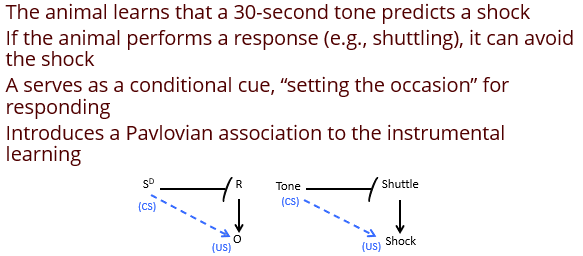
Avoidance learning is not purely instrumental and not purely Pavlovian. It is a hybrid:
The cue predicts danger, which is Pavlovian.
The cue signals when the instrumental response can successfully avoid the outcome.
Why do animals exhibit a conditional avoidance response?
Hypothesis: It is reinforced by the non-occurrence of shock.
Two-Factor Theory of Avoidance
Avoidance is explained by 2 learning processes, one pavlovian and one instrumental.
Factor 1: Pavlovian
Early in training:
Tone (CS) paired w shoch (US)
Tone → fear
Animal learns:
Tone predicts shock
Tone becomes aversive bc it produces conditioned fear
Factor 2: Instrumental fear reduction
Later in training:
animal shuttles when tone comes on
shuttling turns off tone or prevents shock
reduces fear (reinforcer)
The reinforcer is no longer “non-occurrence of shock” in the abstract.
Instead, the theory says the true reinforcer is:
reduction of conditioned fear
Problems with 2 factor theory: Kamin Experiment
Prediction of 2FT → if fear reduction is the reinforcer then, ending the tone shd be enough
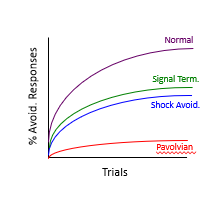
Experiment Conditions:
Normal Avoidance
Signal Termination only
Shock avoidance only
Pavlovian
Results:
Normal = best learning
Signal termination = weaker than expected
Shock avoidance = better than expected
Prediction does not always match reality
Other Problems with 2 Factor Theory
Presenting CS along should extinguish conditional fear
Animals show no true signs of fear to the CS under normal circumstances
→ Fear expression returns IF the animal is blocked from performing the avoidance response
A higher magnitude shock should increase avoidance performance BUT they actually decrease performance
Solutions to 2 Factor Theory
View the avoidance response as a conditional inhibitor
Differentiate between different response patterns to aversive outcomes
Add a third phase to the two-factor theory
Low-Imminence threat
Pre- encounter behavior
Anxiety
environmental stimuli indicate a predator could be near
High-imminence threat
Post encounter behavior
Fear
Predator is near
Fight or Flight
Circa-Strike behavior
Panic
Predator is attacking
Two-Way Shuttle-Box Active Avoidance
Involves the animal learning to shuttle back and forth to avoid shock in response to a tone
Features:
Active → fear behaviors (defensive freezing) ineffective for successful avoidance
Two-Way → Neither side of the chamber is considered safe
One-Way Avoidance
Involves a shuttle box with 2 very different chambers. Measures latency to enter the other chamber
Features:
Can be active or passive:
Active → starts on dangerous side of chamber
Passive → starts on safe side of chamber
One Way → one side of the chamber is always safe
Platform Mediated Avoidance
Involves a food deprived animal given a lever to press to earn food pellets. Animal must learn to stop pressing for food and escape to safe platform when tone plays.
Features:
Active or Passive strat
Involves multiple schedules of reinforcement
Active avoidance learning involves suppressing …
freezing → primary defensive behavior in mammals
Freezing depends on…
2 regions of the Amygdala:
Basolateral Amygdala
involved in emotional associations (fear)
Central Amygdala
involved in fight or flight behaviors (freezing)
Avoidance depends on…
Basolateral Amygdala → emotional associations
PFC → suppressing freezing
Striatum → motivated action (avoidance)
Dorsal medial → Goal-directed avoidance
Dorsal lateral → habitual avoidance
Basolateral Amygdala neurons..
Different types mediate diff levels of threat imminence
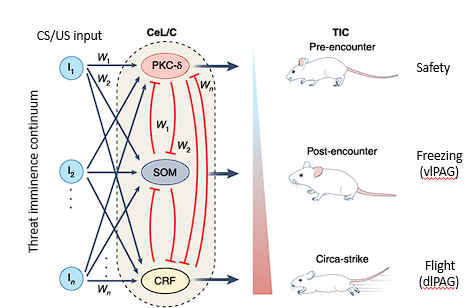
PKC → Pre-encounter → Safety
SOM → Post-encounter → Freezing
CRF → Circa strike → ForF
Stimulus Control
ability of a given stimulus to control behavior
Ex: Like a traffic light
Color: High Stimulus Control
Location/Shape: low stimulus control
Stimulus Dimensions
One Aspect of a particular stimuli
color, location, shape, pitch, texture etc.
Stimulus Generalization
occurs when responding to 1 stimulus is also observed when a dif stimulus is presented
common when a stimulus dimension has high stimulus control
Stimulus Discrimination
occurs when responding to 1 stimulus but not another
common when a stimulus dimension has low stimulus control
Differential Responding
a strategy where changes to 1 stimulus dimension are made, then you study the differences in responding
Stimulus Generalization Gradient
Extent to which responding changes across stimulus variations
Factors impacting stimulus control
Sensory capacity - can organism perceive stimulus?
Sensory orientation - is organism properly oriented to perceive stim?
Stimulus intensity - is stimulus bright/loud enough?
Motivation - is organism motivated to attend to the stimuli?
Stimulus Filter
bias toward visual or auditory cues during specific motivational states
Stimulus Discrimination Training

