Physics
0.0(0)
Studied by 8 people Call Kai
 Learn
Learn Practice Test
 Spaced Repetition
 Match
Match Flashcards
 Knowt Play
Card Sorting
1/277

Earn XP
Description and Tags
any equations are given in May/June 2023 exams
Last updated 4:09 PM on 6/14/23
Name | Mastery | Learn | Test | Matching | Spaced | Call with Kai |
|---|
No analytics yet
Send a link to your students to track their progress
278 Terms
1
New cards
what is ‘kg’
kilogram, used to measure mass
2
New cards
1 Forces and motion
(a) Units
(b) Movement and position
(c) Forces, movement, shape and momentum
(b) Movement and position
(c) Forces, movement, shape and momentum
3
New cards
what is ‘m’
metres, used to measure distance
4
New cards
what is ‘m/s’
metres per second, used to measure speed
5
New cards
what is ‘m/s squared’
meters per second squared, used to measure acceleration
6
New cards
what is ‘n’
newtons, measures force
7
New cards
what is ‘N/kg’
newtons per kilogram, is the amount of force applied to every 1kg of mass
8
New cards
what is ‘n/m’
newton metre, measures moments
9
New cards
what is ‘kg m/s’
kilogram-meter per second, is used to measure momentum
10
New cards
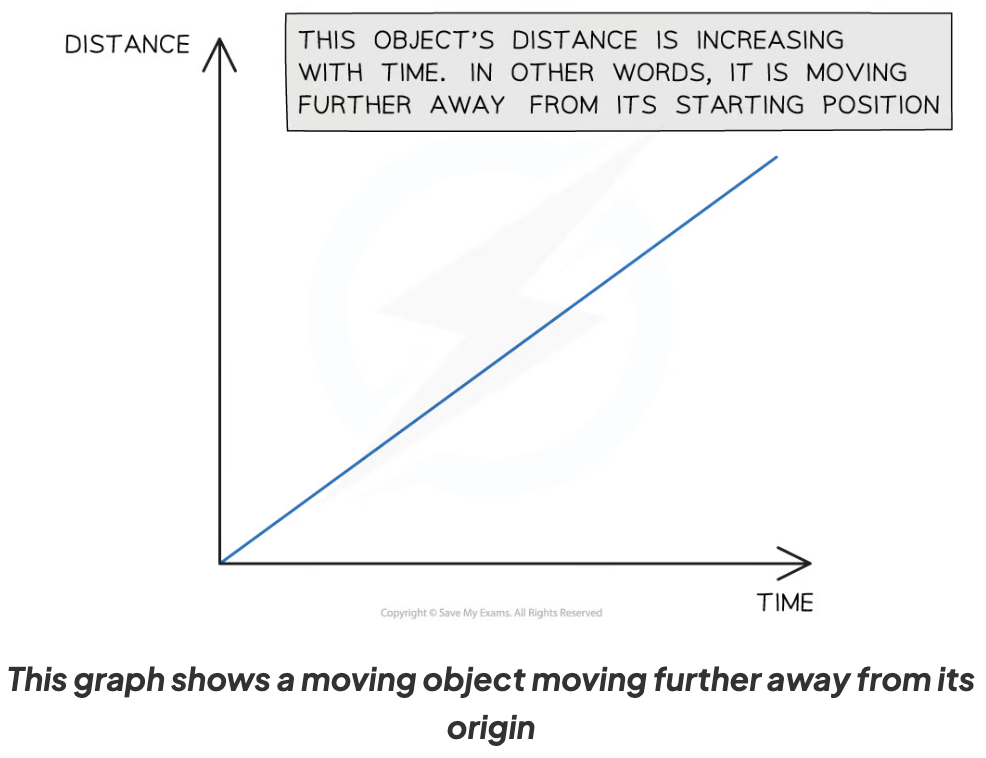
what do distance time graphs show
* A distance-time graph shows how the **distance** of an object moving in a straight line (from a starting position) varies over time:
\
\
11
New cards
what do distance time graphs line represent
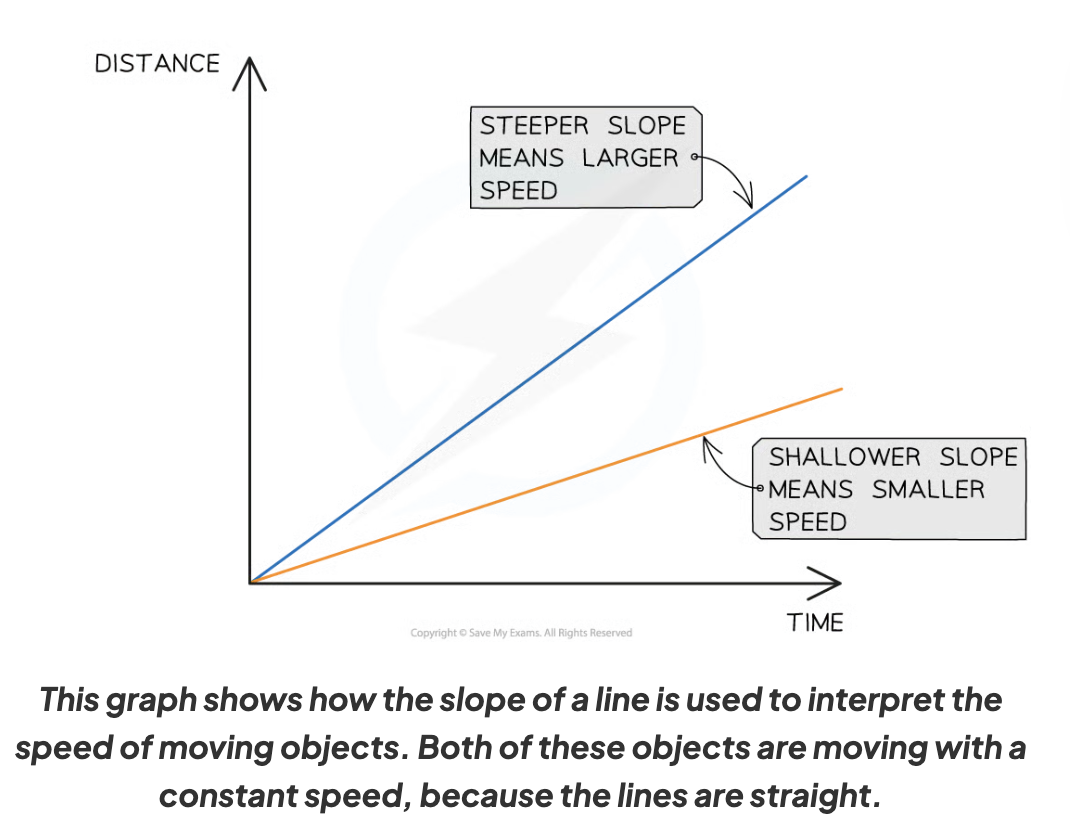
* Distance-time graphs also show the following information:
* If the object is moving at a **constant speed**
* How **large** or **small** the speed is
\
* A **straight line** represents **constant speed**
* The slope of the straight line represents the **magnitude** of the speed:
* A very **steep** slope means the object is moving at a **large** speed
* A **shallow** slope means the object is moving at a **small** speed
* A **flat**, **horizontal** **line** means the object is **stationary** (not moving)
* If the object is moving at a **constant speed**
* How **large** or **small** the speed is
\
* A **straight line** represents **constant speed**
* The slope of the straight line represents the **magnitude** of the speed:
* A very **steep** slope means the object is moving at a **large** speed
* A **shallow** slope means the object is moving at a **small** speed
* A **flat**, **horizontal** **line** means the object is **stationary** (not moving)
12
New cards
How is changing speed represented on a distance time graphs
\
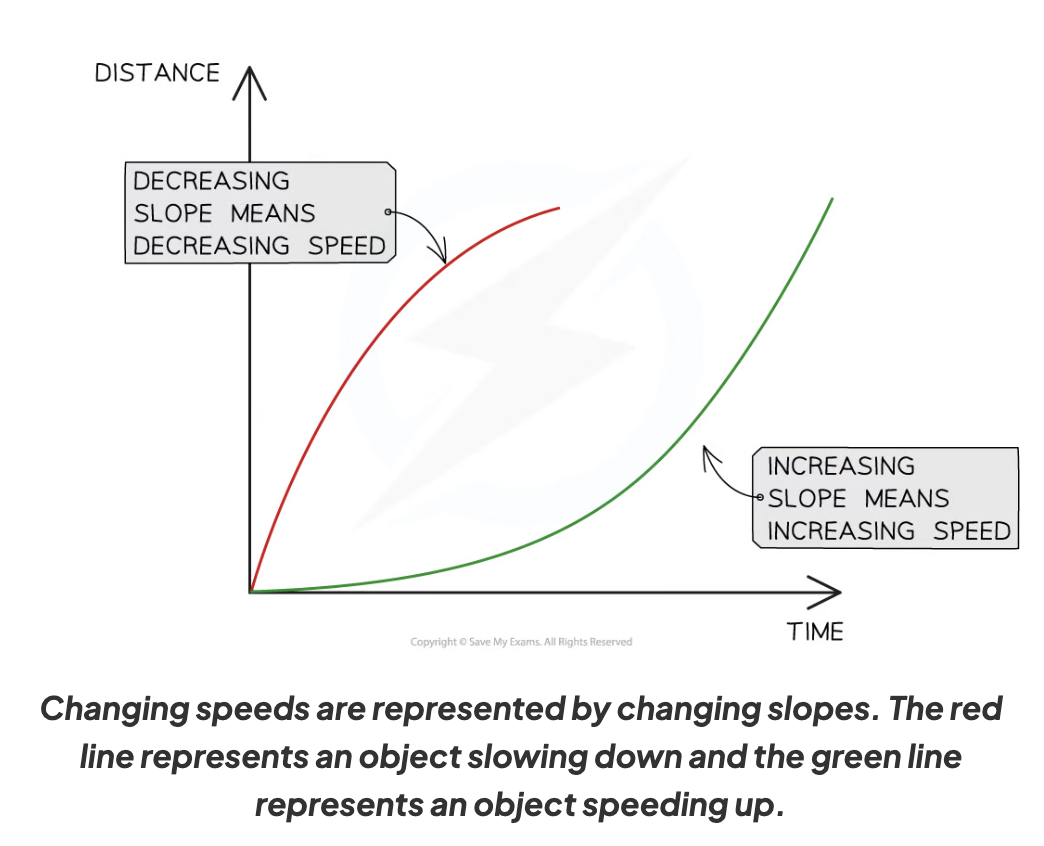
* Objects might be moving at a **changing speed**
* This is represented by a **curve**
\
* In this case, the slope of the line will be changing
* If the slope is **increasing**, the **speed** is **increasing** (accelerating)
* If the slope is **decreasing**, the **speed** is **decreasing** (decelerating)
\
* The image below shows two different objects moving with changing speeds
\
* Objects might be moving at a **changing speed**
* This is represented by a **curve**
\
* In this case, the slope of the line will be changing
* If the slope is **increasing**, the **speed** is **increasing** (accelerating)
* If the slope is **decreasing**, the **speed** is **decreasing** (decelerating)
\
* The image below shows two different objects moving with changing speeds
\
13
New cards
How can you calculate the gradient on a distance-time graph
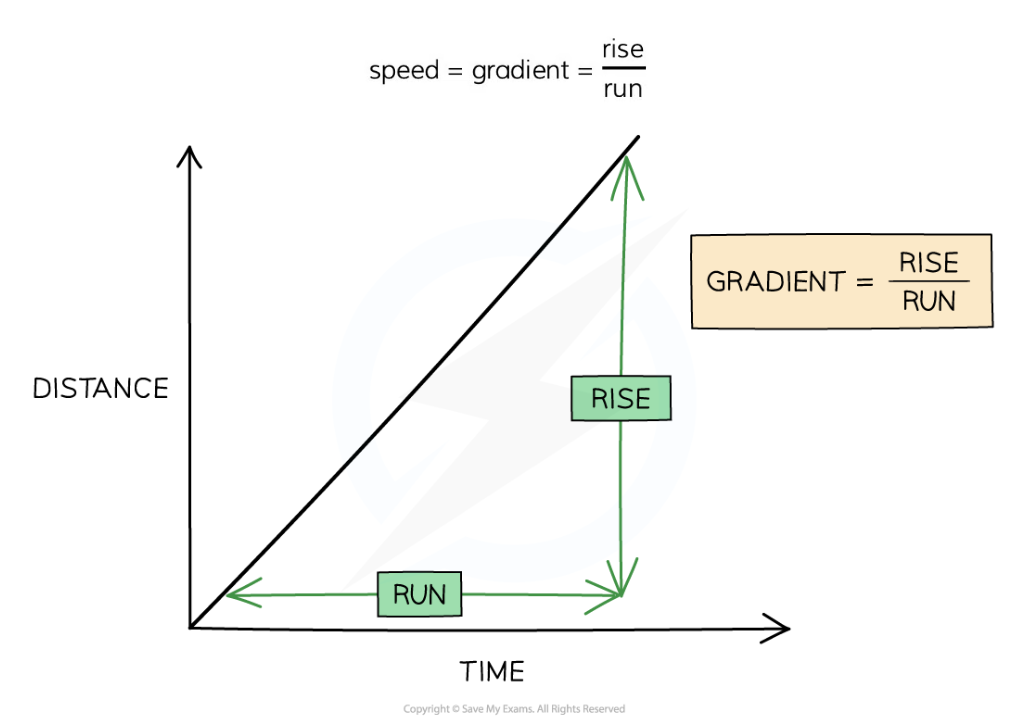
The **speed** of a moving object can be calculated from the **gradient** of the line on a **distance-time** graph
***The speed of an object can be found by calculating the gradient of a distance-time graph***
\
* The **rise** is the **change** in y (distance) values
* The **run** is the **change** in x (time) values
gradient = rise/run
***The speed of an object can be found by calculating the gradient of a distance-time graph***
\
* The **rise** is the **change** in y (distance) values
* The **run** is the **change** in x (time) values
gradient = rise/run
14
New cards
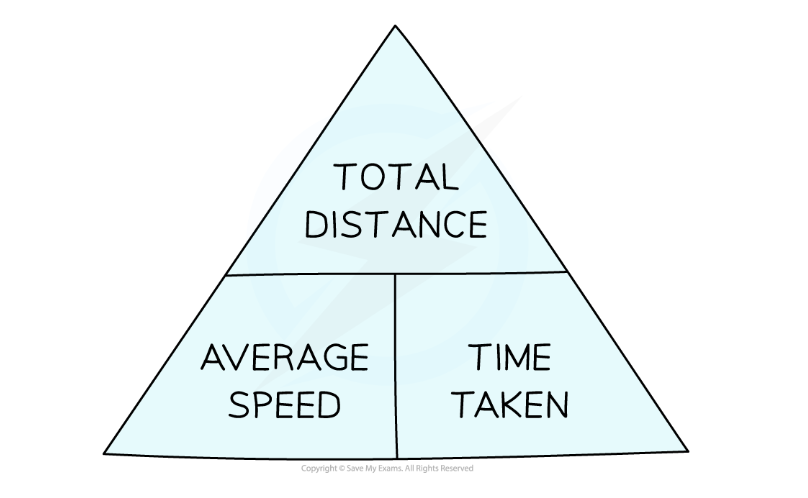
equation for speed
avg speed = distance moved/time taken
15
New cards
TRIPLE/PRACTICAL: 1.5 practical: investigate the motion of everyday objects such as toy cars or tennisballs
\
\
1. Measure out a height of 1.0 m using the tape measure or metre ruler
2. Drop the object (paper cone or tennis ball) from this height, which is the distance travelled by the object
3. Use the stop clock to measure how long the object takes to travel this distance
4. Record the distance travelled and time taken
5. Repeat steps 2-3 three times, calculating an average time taken for the object to fall a certain distance
6. Repeat steps 1-4 for heights of 1.2 m, 1.4 m, 1.6 m, and 1.8 m
\
\
\
16
New cards
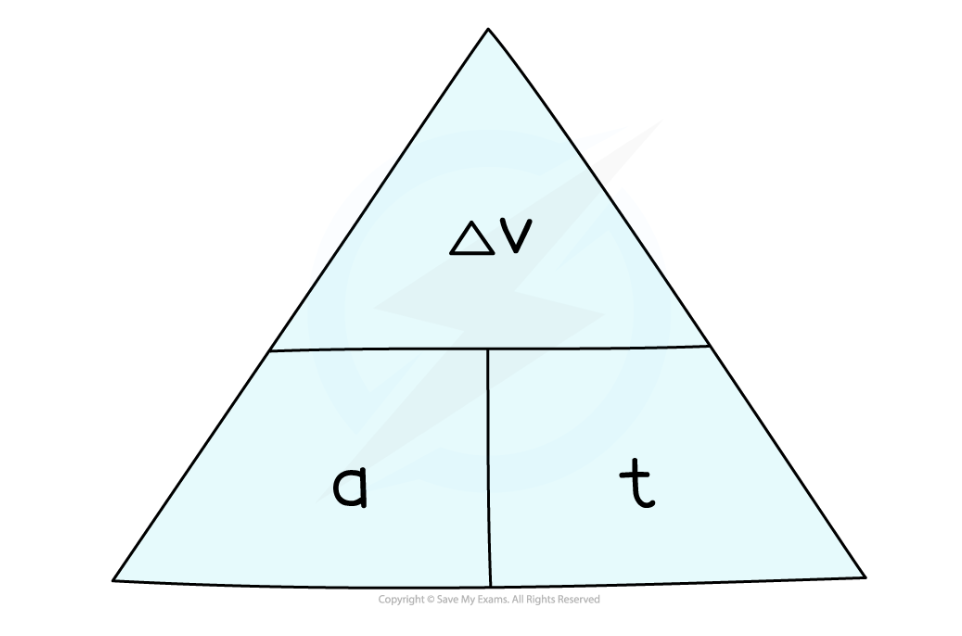
equation for acceleration
acceleration = change in velocity/time taken
17
New cards
What does a velocity time graph show
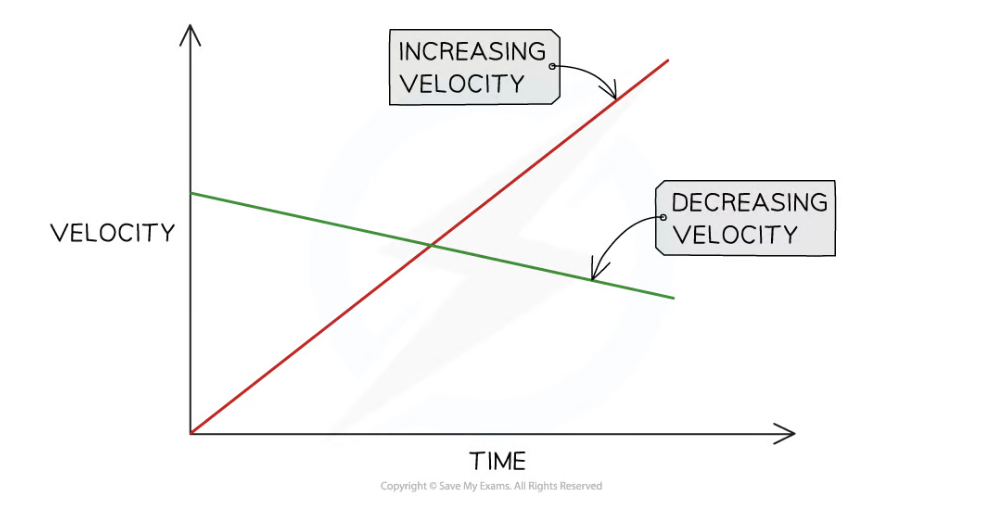
* A velocity-time graph shows how the velocity of a moving object varies with time
* The red line represents an object with **increasing** velocity
* The green line represents an object with **decreasing** velocity
* The red line represents an object with **increasing** velocity
* The green line represents an object with **decreasing** velocity
18
New cards
what does the line on a velocity time graph show
* Velocity-time graphs also show the following information:
* If the object is moving with a **constant acceleration/deceleration**
* The **magnitude** of the acceleration/deceleration
\
* A **straight line** represents **constant acceleration**
* The **slope** of the line represents the **magnitude** of acceleration
* A **steep** slope means **large** **acceleration** (or deceleration) - i.e. the object's speed changes very **quickly**
* A **gentle** slope means **small** **acceleration** (or deceleration) - i.e. the object's speed changes very **gradually**
* A **flat line** means the acceleration is **zero** - i.e. the object is moving with a **constant velocity**
* If the object is moving with a **constant acceleration/deceleration**
* The **magnitude** of the acceleration/deceleration
\
* A **straight line** represents **constant acceleration**
* The **slope** of the line represents the **magnitude** of acceleration
* A **steep** slope means **large** **acceleration** (or deceleration) - i.e. the object's speed changes very **quickly**
* A **gentle** slope means **small** **acceleration** (or deceleration) - i.e. the object's speed changes very **gradually**
* A **flat line** means the acceleration is **zero** - i.e. the object is moving with a **constant velocity**
19
New cards
how can the acceleration of an object be calculated from the gradient of a velocity-time graph
acceleration = gradient = rise/run
20
New cards
determine the distance travelled from the area between a velocity-time graph and the time axis
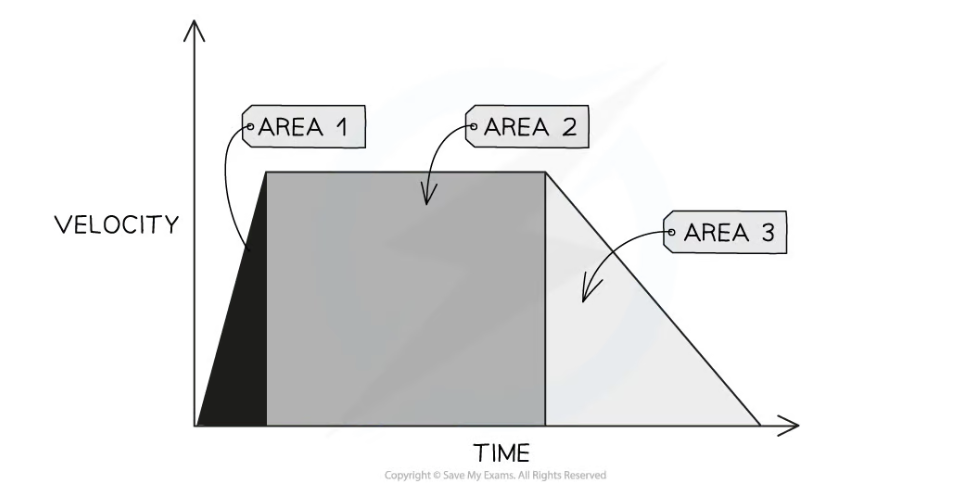
* **Enclosed** areas under velocity-time graphs represent **total displacement** (or **total distance travelled**)
* If an object moves with **constant acceleration**, its velocity-time graph will comprise of **straight lines**
* In this case, calculate the distance travelled by working out the **area** of **enclosed rectangles and triangles** as in the image above
* If the area beneath the graph forms a **triangle** (i.e. the object is **accelerating** or **decelerating**), then the area can be determined by using the following formula:
\
**Area = ½ × Base × Height**
\
* If the area beneath the graph forms a **rectangle** (i.e. the object is moving at a **constant velocity**), then the area can be determined by using the following formula:
\
**Area = Base × Height**
* If an object moves with **constant acceleration**, its velocity-time graph will comprise of **straight lines**
* In this case, calculate the distance travelled by working out the **area** of **enclosed rectangles and triangles** as in the image above
* If the area beneath the graph forms a **triangle** (i.e. the object is **accelerating** or **decelerating**), then the area can be determined by using the following formula:
\
**Area = ½ × Base × Height**
\
* If the area beneath the graph forms a **rectangle** (i.e. the object is moving at a **constant velocity**), then the area can be determined by using the following formula:
\
**Area = Base × Height**
21
New cards
use the relationship between final speed, initial speed, acceleration and distance moved:
(final speed)2 = (initial speed)2 + (2 × acceleration × distance moved)
22
New cards
describe the effects of forces between bodies such as changes in speed, shape or direction
* Changes in **speed**: forces can cause bodies to speed up or slow down
* Changes in **direction**: forces can cause bodies to change their direction of travel
* Changes in **shape**: forces can cause bodies to **stretch**, **compress**, or **deform**
\
\
\
* Changes in **direction**: forces can cause bodies to change their direction of travel
* Changes in **shape**: forces can cause bodies to **stretch**, **compress**, or **deform**
\
\
\
23
New cards
8 different types of forces on objects
\
gravitational attraction
compression
electrostatic
thrust
upthrust
tension
reaction force
air resistance
\
1. grace carelessly electrocuted thomas up the rear ass
gravitational attraction
compression
electrostatic
thrust
upthrust
tension
reaction force
air resistance
\
1. grace carelessly electrocuted thomas up the rear ass
24
New cards
what is gravitational force
* **Gravitational** (or **weight**) - the force between any two objects with mass (like the Earth and the Moon)
25
New cards
what is electrostatic force
* **Electrostatic** - the force between any two objects with charge (like a proton and an electron)
26
New cards
what is thrust
the force pushing a vehicle (like the push from rocket engines on the shuttle)
27
New cards
what is upthrust
* **Upthrust** - the upward force on any object in a fluid (like a boat on the surface of a river)
28
New cards
what is air resistance
* **Air resistance** (or **drag**) - the force of friction between objects falling through the air (like a skydiver in freefall)
29
New cards
what is compression
* **Compression** - forces that squeeze an object (like squeezing a spring)
30
New cards
what is tension
* **Tension** - forces that stretch an object (like two teams in a tug-of-war)
31
New cards
what is reaction force
* **Reaction force** - the force between any two objects in contact (like the upwards force from a table on a book)
32
New cards
how do vector quantities differ from scalar quantities
* Scalars are quantities that have only a **magnitude**
* For example, **mass** is a scalar quantity since it is a quantity that has no direction to it
* **Vectors**
* Vectors have both a **magnitude** and a **direction**
* **Velocity** is a vector quantity since it is described with both a magnitude and a direction
* When describing the velocity of a car it is necessary to mention both its speed and the direction in which it is travelling
* For example, **mass** is a scalar quantity since it is a quantity that has no direction to it
* **Vectors**
* Vectors have both a **magnitude** and a **direction**
* **Velocity** is a vector quantity since it is described with both a magnitude and a direction
* When describing the velocity of a car it is necessary to mention both its speed and the direction in which it is travelling
33
New cards
is force a scalar or vector quantity
force is a vector quantity
34
New cards
what is a resultant force
* A **resultant force** is a single force that describes all of the forces operating on a body
* When many forces are applied to an object they can be combined (added) to produce one final force which describes the **combined action** of all of the forces
* This single resultant force determines:
* The **direction** in which the object will move as a result of all of the forces
* The **magnitude** of the final force experienced by the object
\
* The resultant force is sometimes called the **net force**
* When many forces are applied to an object they can be combined (added) to produce one final force which describes the **combined action** of all of the forces
* This single resultant force determines:
* The **direction** in which the object will move as a result of all of the forces
* The **magnitude** of the final force experienced by the object
\
* The resultant force is sometimes called the **net force**
35
New cards
calculate the resultant force of forces that act along a line
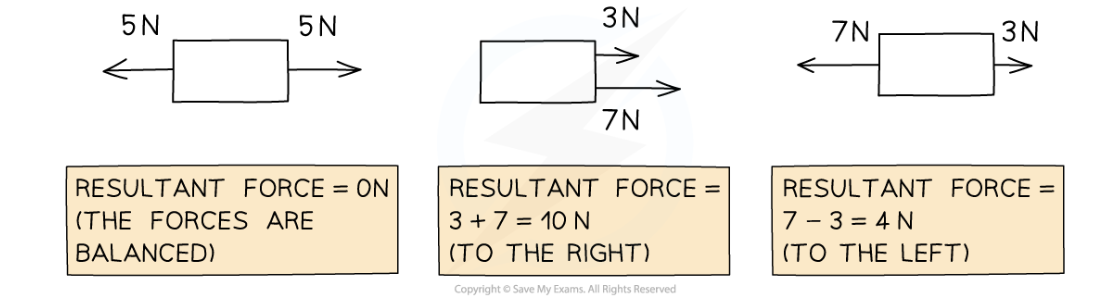
* Resultant forces can be calculated by adding or subtracting all of the forces acting on the object
* Forces working in opposite directions are **subtracted** from each other
* Forces working in the same direction are **added** together
\
* If the forces acting in opposite directions are equal in size, then there will be no resultant force – the forces are said to be **balanced**
* Forces working in opposite directions are **subtracted** from each other
* Forces working in the same direction are **added** together
\
* If the forces acting in opposite directions are equal in size, then there will be no resultant force – the forces are said to be **balanced**
36
New cards
what is friction
The force which opposes the motion of an object
* Frictional forces always act in the opposite direction to the object's motion
* Friction emerges when two (or more) surfaces rub against each other:
* At a molecular level, both surfaces contain **imperfections** - i.e. they are not perfectly smooth
* These imperfections tend to push against each other
* Frictional forces always act in the opposite direction to the object's motion
* Friction emerges when two (or more) surfaces rub against each other:
* At a molecular level, both surfaces contain **imperfections** - i.e. they are not perfectly smooth
* These imperfections tend to push against each other
37
New cards
force equation
force = mass × acceleration
38
New cards
weight equation
weight = mass × gravitational field strength
39
New cards
what is stopping distance (in a car)
**The total distance travelled during the time it takes for a car to stop in response to some emergency**
* the stopping distance of a vehicle is made up of the sum of the thinking distance and the braking distance
Stopping distance = Thinking distance + Braking distance
* the stopping distance of a vehicle is made up of the sum of the thinking distance and the braking distance
Stopping distance = Thinking distance + Braking distance
40
New cards
what is the thinking distance
* **Thinking distance** = the distance travelled in the time it takes the driver to react (reaction time) in metres (m)
41
New cards
what is the braking distance
* **Braking distance** = the distance travelled under the braking force in metres (m)
42
New cards
factors affecting vehicle stopping distance,
* vehicles speed
* vehicle mass
* road conditions
* drivers reaction time
* vehicle mass
* road conditions
* drivers reaction time
43
New cards
describe the forces acting on falling objects
* Falling objects experience **two forces**:
* **Weight** (due to gravity)
* **Air resistance** (due to friction)
* **Weight** (due to gravity)
* **Air resistance** (due to friction)
44
New cards
what is terminal velocity
the constant speed that a freely falling object eventually reaches when the resistance of the medium through which it is falling prevents further acceleration.
45
New cards
TRIPLE/practical: investigate how extension varies with applied force for helical springs, metal wires and rubber bands
1. Set up the apparatus as shown in the diagram, initially without any masses hanging from the spring / rubber band
2. Align the marker to a value on the ruler, record this initial length of the spring / rubber band
3. Add the 100 g mass hanger onto the spring / rubber band
4. Record the mass (in kg) and position (in cm) from the ruler now that the spring / rubber band has extended
5. Add another 100 g to the mass hanger
6. Record the new mass and position from the ruler now that the spring / rubber band has extended further
7. Repeat this process until all masses have been added
8. Remove the masses and repeat the entire process again, until it has been carried out a total of three times, and an average length (for each mass attached) is calculated
\
\
\
* \
46
New cards
\
\
what is hookes law
\
what is hookes law
\
**The extension of an elastic object is directly proportional to the force applied, up to the limit of proportionality**
**The extension of an elastic object is directly proportional to the force applied, up to the limit of proportionality**
47
New cards
\
describe elastic behaviour as the ability of a material to recover its original shape after the forces causing deformation have been removed
describe elastic behaviour as the ability of a material to recover its original shape after the forces causing deformation have been removed
* When some objects, such as springs or rubber bands, are stretched they will return to their original shape and length once the forces are removed
* Other materials, such as plastic, remain permanently deformed (stretched)
\
* A change of shape is called a **deformation** and can either be:
* Elastic
* Inelastic
\
\
\
* Other materials, such as plastic, remain permanently deformed (stretched)
\
* A change of shape is called a **deformation** and can either be:
* Elastic
* Inelastic
\
\
\
48
New cards
TRIPLE: momentum equation
momentum = mass × velocity
49
New cards
TRIPLE: use the idea of momentum to explain safety features
* **Seat belts**
* These are designed to stop a passenger from colliding with the interior of a vehicle by keeping them fixed to their seat in an abrupt stop
* They are designed to stretch slightly to increase the time for the passenger’s momentum to reach zero and reduce the force on them in a collision
\
* **Airbags**
* These are deployed at the front on the dashboard and steering wheel when a collision occurs
* They act as a soft cushion to prevent injury on the passenger when they are thrown forward upon impact
\
* **Crumple zones**
* These are designed into the exterior of vehicles
* They are at the front and back and are designed to crush or crumple in a controlled way in a collision
* This is why vehicles after a collision look more heavily damaged than expected, even for relatively small collisions
* The crumple zones increase the time over which the vehicle comes to rest, **lowering the impact force** on the passengers
\
\
\
\
### **Crash Mats**
* Crash mats used in gymnasiums help reduce the risk of injury for falls in gymnastics and climbing
* They are thick and soft to offer shock absorption of the force created by the person landing on the mat
\
* When a person lands on a crash mat with a large force, for example after jumping, the soft landing means their body is in contact with the mat for a longer period of time than if it was otherwise not there
* This **increases** the **contact** **time** over which their momentum is reduced creating a **smaller** **impact** **force** and a lower chance of injury
* These are designed to stop a passenger from colliding with the interior of a vehicle by keeping them fixed to their seat in an abrupt stop
* They are designed to stretch slightly to increase the time for the passenger’s momentum to reach zero and reduce the force on them in a collision
\
* **Airbags**
* These are deployed at the front on the dashboard and steering wheel when a collision occurs
* They act as a soft cushion to prevent injury on the passenger when they are thrown forward upon impact
\
* **Crumple zones**
* These are designed into the exterior of vehicles
* They are at the front and back and are designed to crush or crumple in a controlled way in a collision
* This is why vehicles after a collision look more heavily damaged than expected, even for relatively small collisions
* The crumple zones increase the time over which the vehicle comes to rest, **lowering the impact force** on the passengers
\
\
\
\
### **Crash Mats**
* Crash mats used in gymnasiums help reduce the risk of injury for falls in gymnastics and climbing
* They are thick and soft to offer shock absorption of the force created by the person landing on the mat
\
* When a person lands on a crash mat with a large force, for example after jumping, the soft landing means their body is in contact with the mat for a longer period of time than if it was otherwise not there
* This **increases** the **contact** **time** over which their momentum is reduced creating a **smaller** **impact** **force** and a lower chance of injury
50
New cards
TRIPLE : use the relationship between force, change in momentum and time taken:
force = change in momentum/time taken
51
New cards
TRIPLE : demonstrate an understanding of Newton’s third law
* Newton's **third law of motion** states:
\
**Whenever two bodies interact, the forces they exert on each other are equal and opposite**
\
* Newton's third law explains the following important principles about forces:
* All forces arise in **pairs** - if object A exerts a force on object B, then object B exerts an **equal** and **opposite** force on object A
* Force pairs are of the **same type** - for example, if object A exerts a **gravitational** **force** on object B, then object B exerts an equal and opposite **gravitational** **force** on object A
\
* Newton's third law explains the forces that enable someone to walk
\
**Whenever two bodies interact, the forces they exert on each other are equal and opposite**
\
* Newton's third law explains the following important principles about forces:
* All forces arise in **pairs** - if object A exerts a force on object B, then object B exerts an **equal** and **opposite** force on object A
* Force pairs are of the **same type** - for example, if object A exerts a **gravitational** **force** on object B, then object B exerts an equal and opposite **gravitational** **force** on object A
\
* Newton's third law explains the forces that enable someone to walk
52
New cards
TRIPLE : moment equation
moment = force × perpendicular distance from the pivot
53
New cards
TRIPLE : where does the weight of the body act through
the centre of gravity
54
New cards
TRIPLE : use the principle of moments for a simple system of parallel forces acting in one plane
If an object is balanced, the total clockwise moment about a pivot equals the total anticlockwise moment about that pivot
55
New cards
TRIPLE : understand how the upward forces on a light beam, supported at its ends, vary with the position of a heavy object placed on the beam
* The forces should be **perpendicular** to the distance from the pivot
* For example, on a horizontal beam, the forces which will cause a moment are those directed upwards or downwards
* For example, on a horizontal beam, the forces which will cause a moment are those directed upwards or downwards
56
New cards
what is an ampere
An ampere is a unit of measure of the rate of electron flow or current in an electrical conductor.
57
New cards
what is a coulomb
A coulomb (C) is the standard unit of electric charge in the International System of Units (SI).
58
New cards
what is a joule
joule, unit of work or energy in the International System of Units (SI);
59
New cards
what is an ohm
ohm. \[ ōm \] The SI derived unit used to measure the electrical resistance of a material or an electrical device
60
New cards
what is a second
time
61
New cards
what is a volt
1. the SI unit of electromotive force, the difference of potential that would carry one ampere of current against one ohm resistance.
62
New cards
what is a watt
The watt (abbreviated W) is the International System of Units' (SI) standard unit of power (energy per unit time), the equivalent of one jouleper second.
63
New cards
what is insulation
* The conducting part of a wire is usually made of copper or some other metal
* If this comes into contact with a person, this poses a risk of electrocution
\
* For this reason, wires are covered with an insulating material, such as rubber
\
* If this comes into contact with a person, this poses a risk of electrocution
\
* For this reason, wires are covered with an insulating material, such as rubber
\
64
New cards
what is double insulation
* Such appliances are said to be **double insulated**, as they have two layers of insulation:
* Insulation around the wires themselves
* A non-metallic case that acts as a second layer of insulation
\
* Double insulated appliances do not require an earth wire or have been designed so that the earth wire cannot touch the metal casing
* Insulation around the wires themselves
* A non-metallic case that acts as a second layer of insulation
\
* Double insulated appliances do not require an earth wire or have been designed so that the earth wire cannot touch the metal casing
65
New cards
what is earthing
* Many electrical appliances have metal cases
* This poses a potential safety hazard:
* If a live wire (inside the appliance) came into contact with the case, the case would become electrified and anyone who touched it would risk being electrocuted
\
* The earth wire is an additional safety wire that can reduce this risk
* If this happens:
* The earth wire provides a **low resistance path to the earth**
* It causes a **surge of current in the earth wire** and hence also in the live wire
* The high current through the fuse causes it to **melt and break**
* **This cuts off the supply of electricity to the appliance**, making it safe
* This poses a potential safety hazard:
* If a live wire (inside the appliance) came into contact with the case, the case would become electrified and anyone who touched it would risk being electrocuted
\
* The earth wire is an additional safety wire that can reduce this risk
* If this happens:
* The earth wire provides a **low resistance path to the earth**
* It causes a **surge of current in the earth wire** and hence also in the live wire
* The high current through the fuse causes it to **melt and break**
* **This cuts off the supply of electricity to the appliance**, making it safe
66
New cards
what are fuses and circuit breakers
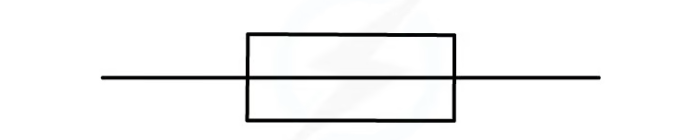
* Fuses and circuit breakers are safety devices designed to **cut off the flow of electricity** to an appliance if the **current becomes too large** (due to a fault or a surge)
* Fuses usually consist of a glass cylinder containing a thin metal wire
* If the current in the wire becomes too large:
* The wire **heats up** and **melts**
* This causes the wire to break, breaking the circuit and stopping the current
\
\
\
\
* A circuit breaker consists of an automatic electromagnet switch that breaks the circuit if the current exceeds a certain value
* This has a major advantage over a fuse because:
* It doesn't melt and break, hence it can be reset and used again
* It works much faster
\
* For these reasons, circuit breakers are used in mains electricity in homes
* Sometimes they are misleadingly named "Fuse boxes"
\
\
* Fuses usually consist of a glass cylinder containing a thin metal wire
* If the current in the wire becomes too large:
* The wire **heats up** and **melts**
* This causes the wire to break, breaking the circuit and stopping the current
\
\
\
\
* A circuit breaker consists of an automatic electromagnet switch that breaks the circuit if the current exceeds a certain value
* This has a major advantage over a fuse because:
* It doesn't melt and break, hence it can be reset and used again
* It works much faster
\
* For these reasons, circuit breakers are used in mains electricity in homes
* Sometimes they are misleadingly named "Fuse boxes"
\
\
67
New cards
understand why a current in a resistor results in the electrical transfer of energy and an increase in temperature, and how this can be used in a variety of domestic contexts
* When electricity passes through a component, such as a resistor, some of the electrical energy is turned into heat therefore increasing its temperature
* This is because energy is transferred as a result of **collisions** between:
* **Electrons** flowing in the conductor, and
* The **lattice of atoms** within the metal conductor
\
* Electricity, in metals, is caused by a **flow of electrons**
* This is called the **current**
* his heating effect is **utilised** in many appliances, including:
* Electric heaters
* Electric ovens
* Electric hob
* Toasters
* Kettles
* This is because energy is transferred as a result of **collisions** between:
* **Electrons** flowing in the conductor, and
* The **lattice of atoms** within the metal conductor
\
* Electricity, in metals, is caused by a **flow of electrons**
* This is called the **current**
* his heating effect is **utilised** in many appliances, including:
* Electric heaters
* Electric ovens
* Electric hob
* Toasters
* Kettles
68
New cards
power equation
power = current × voltage
69
New cards
energy transferred equation
energy transferred = current × voltage × time
70
New cards
what is a.c.
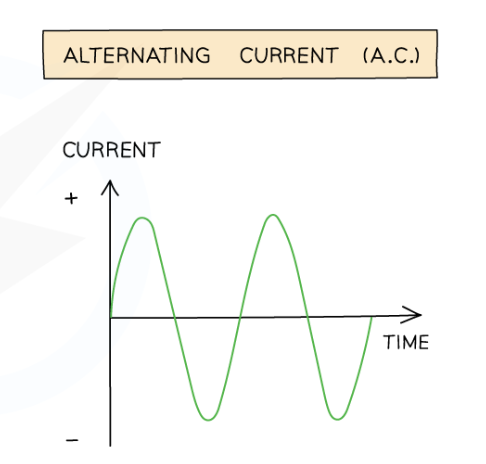
* An alternating current (a.c.) is defined as
\
**A current that continuously changes its direction, going back and forth around a circuit**
* An a.c. power supply has two identical terminals that switches between positive and negative
* The current is therefore defined as positive **or** negative, depending on which direction it is flowing at that time
\
* The **frequency** of an alternating current is the number of times the current changes direction back and forth each second
* In the UK, **mains electricity** is an **alternating** current with a frequency of 50 Hz and a potential difference of around 230 V
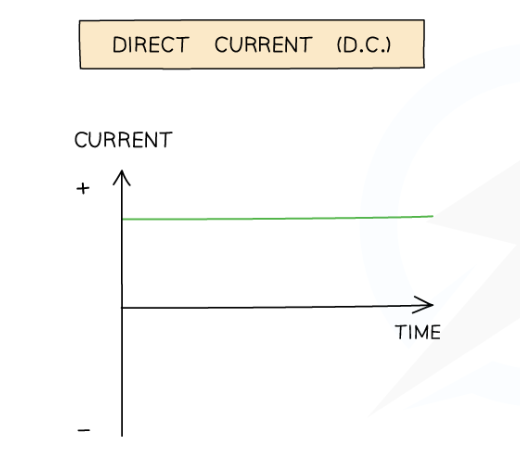
* On an oscilloscope, direct current and alternating current are represented in the following way:
\
**A current that continuously changes its direction, going back and forth around a circuit**
* An a.c. power supply has two identical terminals that switches between positive and negative
* The current is therefore defined as positive **or** negative, depending on which direction it is flowing at that time
\
* The **frequency** of an alternating current is the number of times the current changes direction back and forth each second
* In the UK, **mains electricity** is an **alternating** current with a frequency of 50 Hz and a potential difference of around 230 V
* On an oscilloscope, direct current and alternating current are represented in the following way:
71
New cards
what is d.c.
* A direct current (d.c.) is defined as
\
**A current that is steady, constantly flowing in the same direction in a circuit, from positive to negative**
* The potential difference across a cell in a d.c. circuit travels in **one direction only**
* This means the current is only positive or only negative
\
* A d.c. power supply has a fixed positive terminal and a fixed negative terminal
* Electric **cells**, or **batteries**, produce direct current (d.c.)
* \
\
**A current that is steady, constantly flowing in the same direction in a circuit, from positive to negative**
* The potential difference across a cell in a d.c. circuit travels in **one direction only**
* This means the current is only positive or only negative
\
* A d.c. power supply has a fixed positive terminal and a fixed negative terminal
* Electric **cells**, or **batteries**, produce direct current (d.c.)
* \
72
New cards
which of a series or parallel circuit is more appropriate for particular applications, including domestic lighting
* A **series** circuit consists of a string of two or more components connected in a loop
* The **advantages** of a series circuit are:
* All of the components can be controlled by a **single** **switch**
* Fewer wires are required
\
* The **disadvantages** of a series circuit are:
* The components cannot be controlled **separately**
* If one component breaks, they will all stop working as well
\
### **Parallel Circuits**
* A **parallel** circuit consists of two or more components attached across **different** **branches** of the circuit
* The **advantages** of a parallel circuit are:
* The components can be **individually** **controlled**, using their own switches
* If one component breaks, then the others will continue to function
\
* The **disadvantages** of a parallel circuit are:
* Many more wires involved so much more complicated to set up
* All components have the same voltage as the supply, so harder to control if components need to have different voltages
* The **advantages** of a series circuit are:
* All of the components can be controlled by a **single** **switch**
* Fewer wires are required
\
* The **disadvantages** of a series circuit are:
* The components cannot be controlled **separately**
* If one component breaks, they will all stop working as well
\
### **Parallel Circuits**
* A **parallel** circuit consists of two or more components attached across **different** **branches** of the circuit
* The **advantages** of a parallel circuit are:
* The components can be **individually** **controlled**, using their own switches
* If one component breaks, then the others will continue to function
\
* The **disadvantages** of a parallel circuit are:
* Many more wires involved so much more complicated to set up
* All components have the same voltage as the supply, so harder to control if components need to have different voltages
73
New cards
how is the current in a series circuit depends on the applied voltage and the number and nature of other components
The amount of current flowing around a series circuit depends on two things:
* The **voltage** of the power source
* The **number** (and type) of components in the circuit
\
* **Increasing** the **voltage** of the power source drives **more** **current** around the circuit
* So, decreasing the voltage of the power source reduces the current
\
* **Increasing** the **number** of components in the circuit **increases** the **total** **resistance**
* Hence **less** **current** flows through the circuit
* The **voltage** of the power source
* The **number** (and type) of components in the circuit
\
* **Increasing** the **voltage** of the power source drives **more** **current** around the circuit
* So, decreasing the voltage of the power source reduces the current
\
* **Increasing** the **number** of components in the circuit **increases** the **total** **resistance**
* Hence **less** **current** flows through the circuit
74
New cards
describe how current varies with voltage in wires, resistors, metal filament lamps and diodes, and how to investigate this experimentally
I have no clue
75
New cards
describe the qualitative effect of changing resistance on the current in a circuit
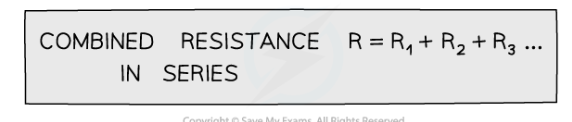
* When two or more resistors are connected in series, the **total** (or **combined**) **resistance** is equal to the **sum** of their individual resistances
* For example, for three resistors of resistance *R1,* *R2* and *R3*, the total resistance can be calculated using:
\
\
* Where *R* is the total resistance, in Ohms (Ω)
* Increasing the number of resistors **increases** the overall resistance, as the charge now has **more** resistors to pass through
* The **total** **voltage** is also the **sum** of the voltages across each of the **individual** **resistors**
* In a **series** circuit, the voltage of the power supply is **shared** between all components
* For example, for three resistors of resistance *R1,* *R2* and *R3*, the total resistance can be calculated using:
\
\
* Where *R* is the total resistance, in Ohms (Ω)
* Increasing the number of resistors **increases** the overall resistance, as the charge now has **more** resistors to pass through
* The **total** **voltage** is also the **sum** of the voltages across each of the **individual** **resistors**
* In a **series** circuit, the voltage of the power supply is **shared** between all components
76
New cards
describe the qualitative variation of resistance of light-dependent resistors (LDRs) with illumination and thermistors with temperature
LDR
As illumination __increases__, resistance __decreases__
\
Thermistor
As temperature __increases__, resistance __decreases__.
As illumination __increases__, resistance __decreases__
\
Thermistor
As temperature __increases__, resistance __decreases__.
77
New cards
can lamps and LEDs be used to indicate the presence of a current in a circuit (Y/N)
yes
78
New cards
voltage equation
voltage = current × resistance
79
New cards
what is current
current is rate of flow of charge
80
New cards
charge equation
charge = current x time
81
New cards
what is electric current in solid metallic conductors
electric current in solid metallic conductors is a flow of negatively charged electrons
82
New cards
why current is conserved at a junction in a circuit
At a junction current ‘splits’ to take both paths.
It comes back together when the paths meet again.
It comes back together when the paths meet again.
83
New cards
True or false
the voltage across two components connected in parallel is the same
the voltage across two components connected in parallel is the same
true
(read aloud 3x)
(read aloud 3x)
84
New cards
## calculate the currents, voltages and resistances of two resistive components connected in a series circuit
VT = V1 + V2
IT = I1 = I2
RT = R1 + R2
\
IT = I1 = I2
RT = R1 + R2
\
85
New cards
how are joules and volts related
the volt is a joule per coulomb
86
New cards
energy transferred equation
energy transferred = charge × voltage
87
New cards
TRIPLE: identify common materials that are electrical conductors
* A **conductor** is a material that allows **charge** (usually electrons) to flow through it easily
* Examples of conductors are:
* Silver
* Copper
* Aluminium
* Steel
\
* Conductors tend to be **metals**
* Examples of conductors are:
* Silver
* Copper
* Aluminium
* Steel
\
* Conductors tend to be **metals**
88
New cards
TRIPLE: identify common materials that are electrical insulators,
* An **insulator** is a material that has **no free charges,** hence does **not** allow the flow of charge through them very easily
* Examples of insulators are:
* Rubber
* Plastic
* Glass
* Wood
\
* Some non-metals, such as wood, allow some charge to pass through them
* Although they are not very good at conducting, they do conduct a little in the form of **static** electricity
* For example, two insulators can build up charge on their surfaces and if they touch this would allow that charge to be conducted away
\
\
\
* Examples of insulators are:
* Rubber
* Plastic
* Glass
* Wood
\
* Some non-metals, such as wood, allow some charge to pass through them
* Although they are not very good at conducting, they do conduct a little in the form of **static** electricity
* For example, two insulators can build up charge on their surfaces and if they touch this would allow that charge to be conducted away
\
\
\
89
New cards
TRIPLE:practical: investigate how insulating materials can be charged by friction
1. Take a polythene rod, hold it at its centre and rub both ends with a cloth
2. Suspend the rod, without touching the ends, from a stand using a cradle and nylon thread
3. Take a Perspex rod and rub it with another cloth
4. Without touching the ends of the Perspex rod bring each end of the Perspex rod up to, but without touching, each end of the polythene rod
5. Record any observations
6. Repeat for different materials
\
90
New cards
TRIPLE: explain how positive and negative electrostatic charges are produced on materials by the loss and gain of electrons
* When certain insulating materials are rubbed against each other they become **electrically charged**
* This is called **charging by friction**
\
* The charges remain on the insulators and cannot immediately flow away
* One becomes positive and the other negative
\
* An example of this is a plastic or polythene rod being charged by rubbing it with a cloth
* Both the rod and cloth are insulating materials
\
* This occurs because negatively charged electrons are **transferred** from one material to the other
* The material, in this case, the rod, **loses** electrons
\
* Since electrons are negatively charged, the rod becomes **positively** charged
* As a result, the cloth has **gained** electrons and therefore is left with an equal **negative** charge
* This is called **charging by friction**
\
* The charges remain on the insulators and cannot immediately flow away
* One becomes positive and the other negative
\
* An example of this is a plastic or polythene rod being charged by rubbing it with a cloth
* Both the rod and cloth are insulating materials
\
* This occurs because negatively charged electrons are **transferred** from one material to the other
* The material, in this case, the rod, **loses** electrons
\
* Since electrons are negatively charged, the rod becomes **positively** charged
* As a result, the cloth has **gained** electrons and therefore is left with an equal **negative** charge
91
New cards
TRIPLE: know that there are forces of attraction between unlike charges and forces of repulsion between like charges
* When two charged particles or objects are close together, they also exert a **force** on each other
* This force could be:
* **Attractive** (the objects get closer together)
* **Repulsive** (the objects move further apart)
\
* Whether two objects attract or repel depends on their **charge**
* If the charges are the **opposite**, they will **attract**
* If the charges are the **same**, they will **repel**
* This force could be:
* **Attractive** (the objects get closer together)
* **Repulsive** (the objects move further apart)
\
* Whether two objects attract or repel depends on their **charge**
* If the charges are the **opposite**, they will **attract**
* If the charges are the **same**, they will **repel**
92
New cards
TRIPLE: explain electrostatic phenomena in terms of the movement of electrons
* All objects are initially electrically **neutral**, meaning the negative (electrons) and positive charges are evenly distributed
* However, when the electrons are transferred through friction, one object becomes **negatively** charged and the other **positively** charged
* The object to which the electrons are transferred **to** becomes **negatively charged**
* The object from which the electrons **leave from** becomes **positively charged**
\
* This difference in charges leads to a force of **attraction** between itself and other objects which are also electrically neutral
* This is done by attracting the opposite charge to the surface of the objects they are attracted to
\
* In the example below, when the cloth and rod are rubbed together, the electrons are **transferred to** the **cloth** and **leave from** the **rod**
* However, when the electrons are transferred through friction, one object becomes **negatively** charged and the other **positively** charged
* The object to which the electrons are transferred **to** becomes **negatively charged**
* The object from which the electrons **leave from** becomes **positively charged**
\
* This difference in charges leads to a force of **attraction** between itself and other objects which are also electrically neutral
* This is done by attracting the opposite charge to the surface of the objects they are attracted to
\
* In the example below, when the cloth and rod are rubbed together, the electrons are **transferred to** the **cloth** and **leave from** the **rod**
93
New cards
TRIPLE: explain the potential dangers of electrostatic charges, e.g. when fuelling aircraft and tankers
* A build-up of static charge is a potential danger when refuelling aeroplanes
* Fuel runs through pipes at a fast rate
* This fuel is very flammable
\
* The friction between the fuel (a liquid insulator) and the pipe causes the fuel to **gain charge**
* If this charge were to cause a spark, the fuel could ignite and cause an explosion
* This is prevented by the fuel tank being connected to the Earth with a copper wire called the **bonding line** during the refuelling
* The conductor **earths** the plane by carrying the charge through to the Earth which removes the risk of any sparks
* Fuel runs through pipes at a fast rate
* This fuel is very flammable
\
* The friction between the fuel (a liquid insulator) and the pipe causes the fuel to **gain charge**
* If this charge were to cause a spark, the fuel could ignite and cause an explosion
* This is prevented by the fuel tank being connected to the Earth with a copper wire called the **bonding line** during the refuelling
* The conductor **earths** the plane by carrying the charge through to the Earth which removes the risk of any sparks
94
New cards
TRIPLE:explain some uses of electrostatic charges, e.g. in photocopiers and inkjet printers
* Photocopiers use static electricity to copy paper documents, most commonly in black and white
* An image of the document is projected onto a positively charged copying plate
* The plate loses its charge in the light areas and keeps the positive charge in the dark areas (i.e the text)
* A negatively charged black toner powder is applied to the plate and sticks to the part where there is a positive charge
* The toner is then transferred onto a new blank sheet of white paper
* The paper is heated to make sure the powder sticks (hence why photocopied paper feels warm)
* The photocopy of the document is now made
\
* Inkjet printers work in a similar way, but instead of the black toner powder, a small jet of coloured ink is negatively charged and attracted to the correct place on the page
* An image of the document is projected onto a positively charged copying plate
* The plate loses its charge in the light areas and keeps the positive charge in the dark areas (i.e the text)
* A negatively charged black toner powder is applied to the plate and sticks to the part where there is a positive charge
* The toner is then transferred onto a new blank sheet of white paper
* The paper is heated to make sure the powder sticks (hence why photocopied paper feels warm)
* The photocopy of the document is now made
\
* Inkjet printers work in a similar way, but instead of the black toner powder, a small jet of coloured ink is negatively charged and attracted to the correct place on the page
95
New cards
what does degree measure
temperature
96
New cards
what does hz measure
The number of periods or cycles per second is called frequency. The SI unit for frequency is the hertz (Hz). One hertz is the same as one cycle per second.
97
New cards
what does metre measure
distance
98
New cards
what does m/s measure
metre per second , speed
99
New cards
what does ‘s’ measure
seconds, time
100
New cards
explain the difference between longitudinal and transverse waves
* Longitudinal waves are defined as:
\
**Waves where the points along its length vibrate parallel to the direction of energy transfer**
\
* Transverse waves are defined as:
\
**Waves that vibrate or oscillate perpendicular to the direction of energy transfer**
\
**Waves where the points along its length vibrate parallel to the direction of energy transfer**
\
* Transverse waves are defined as:
\
**Waves that vibrate or oscillate perpendicular to the direction of energy transfer**

