ISSUES AND DEBATES Paper 3
 Studied by 0 people
 Call Kai
 Learn
Learn Practice Test
 Spaced Repetition
 Match
Match Flashcards
 Knowt Play
1/18

There's no tags or description
Looks like no tags are added yet.
Name | Mastery | Learn | Test | Matching | Spaced | Call with Kai |
|---|
No analytics yet
Send a link to your students to track their progress
19 Terms
1) What is:
- Cultural bias
- Ethnocentrism (+what is it)
- Cultural relativism
2) What are the 2 types of cultural bias?
1) - Cultural bias: Tendency to judge people in terms of one's own cultural assumption
- Ethnocentrism: (Type of Cultural bias) seeing world from ones own cultural perspective and believing the perspective is the norm
- Cultural relativism: insists behaviour can be properly understood only if the cultural context is taken in to consideration
2) - Alpha bias: exaggerating differences between cultures
- Beta Bias: ignoring/minimising cultural differences, assuming findings are universal
1) What is:
- Cultural bias
- Ethnocentrism
- Cultural relativism
2) What are the 2 types of cultural bias?
3) What does "WEIRD" stand for? What does it mean + who coined the term?
> What is an imposed etic? + give an example
1) Cultural bias: Judging people and behaviour using the standards of one’s own culture.
> Ethnocentrism: A form of cultural bias where one’s own culture is seen as normal or superior.
> Cultural relativism: The view that behaviour should be understood within its cultural context.
2) Alpha bias: Exaggerating differences between cultures.
Beta bias: Ignoring or minimising cultural differences and assuming universality.
3) WEIRD: Western, Educated, Industrialised, Rich, Democratic, ppl most likely to be studied (Henrich et al).
> Imposed etic: Applying theories or measures from one culture to another (e.g. Strange Situation).
>> Ainsworth's research was assumed to be universal BUT in Japan Takahasi found babies = insecure as they were rarely separated
Evaluate Cultural Bias
- Smith and Bond + COUNTER
- Gould (WW1)
- Henrich et al > Arnett
+ Led to emergence of cultural psychology, strive to avoid ethnocentric assumptions by taking emic approach
- Smith n Bond; Asch-type experiments in collectivist cultures produced MORE conformity than og studies in US individualist culture, suggest topics like social influence should only be applied to individualist cultures..
COUNTER: in age of increased media globalisation individualist-collectivist distinction no longer applies; Takano n Osaka found 14/15 studies compared in US n Jap found no evidence of individ.. or collect.. Suggest cultural bias in research may be less of an issue in recent research
- Gould; Psychologist used WW1 to pilot first IQ tests on 1.75 mill recruits.. African American scored lowest > used to spread racist view that minorities were 'mentally-unfit' - Henrich et al; reviewed 100's of studies in leading psychology found 68% ppts from US > Arnett found 80% = undergrads
1) What is Universality?
- What is Gender Bias?
2) 2 Variations of Gender Bias + give examples:
- Alpha bias
- Beta Bias
3) What is Androcentrism?
> What is the opposite?
1) Universality: The idea that psychological characteristics apply to all humans. Gender and cultural bias threaten universality.
> Gender bias: Differential treatment or representation of men and women that leads to theories or research which do not accurately represent both sexes
2) Alpha bias (Hare-Mustin & Marek): Exaggeration of differences between men and women. e.g. Freud
> Beta bias (Hare-Mustin & Marek): Minimisation of differences between men and women. e.g. Fight or Flight
3) Androcentrism: A male-centred perspective where male behaviour is seen as the norm.
> Gynocentrism: A female-centred perspective.
Evaluate Gender Bias (2 cons 1 Pro)
+ Gilligan > Formanowicz et al
- Maccoby and Jacklin > COUNTER Joel et al > COUNTER Ingalhalikar et al.
- Freud
+ Gilligan showed that early psychological theories ignored women’s experiences > Formanowicz et al found research on Gender bias is funded n published less.
Raises awareness of systematic bias
- Maccoby and Jacklin; girls have superior verbal ability boys have better spatial, these are hardwired b4 birth, > Joel et al used brain scans.. no difference, shows we should be wary of accepting research findings as fact
COUNTER: Ingalhalikar et al. women better at multitasking stereotype could have truth; F brains benefit from better connections between R/LH .. suggest may be bio differences
- Freud; his theory viewed femininity as failed masculinity and proposed penis envy > shows androcentrism and an example of gender bias affecting psychological research and theory
1) Define Nature and Nature
> Define Hereditary
>> What is the Debate?
2) What is an Interactionalist approach
> What is Epigenetics
1) Nature: Behaviour caused by inherited/biological factors.
Nurture: Behaviour caused by environmental factors (social, cultural, learning experiences).
> Hereditary: Process by which mental and physical traits are passed genetically.
>> Nature–Nurture debate: The discussion about whether behaviour is caused by innate or environmental factors.
2) Internationalist approach: Behaviour explained by both biological (nature) and environmental (nurture) influences.
> Epigenetics: Environmental experiences can switch genes on or off without changing DNA; e.g., PKU – a genetic disorder where diet influences phenotype.
Evaluation of nature-nurture debate
(3 pro + counter, 1 Con)
+ Rhee and Waldman > COUNTER Plomin
+ Magurie
- Reimer (CASE STUDY)
- Caspi et al
+ Rhee and Waldman; genetic influences accounted for 41% of variance in aggression, showing even w diff environment from bio parent they still showed traits of aggression
COUNTER: Plomin says 'niche-picking' is present; people create their own 'nurture' by actively selecting environments appropriate for their 'nature' (e.g. aggressive children would hang w other aggro kids)
- Caspi et al; MAOA gene effect on behaviour depends on environment > limits purely nature explanations
- David Reimer (raised as girl) Dr. Money says it was a success but David innately didn't feel like girl > Shows innate biology (nature) overrode socialisation attempts (nurture)
+ Nurture: Magurie, taxi dirvers; posteriori hippocampus increased
1) What is Free will
- Determinism
1) Free will: Notion suggesting we are self-determined and free to choose and behaviour ISN'T caused by bio or external forces.
Determinism: View that an individual's behaviour is shaped or controlled by internal/ external forces rather than a persons will
1) What are the 5 types of determinism + Explain them
(HB stands for human behaviour)
1. Hard determinism: All behaviour has identifiable causes; free will is an illusion.
2. Soft determinism: Behaviour may be caused, but humans retain the ability to make rational conscious choices (William James).
3. Biological determinism: Behaviour is controlled by genetic, neurological, or hormonal factors, though environment may interact.
4. Environmental determinism: Behaviour is controlled by past experiences and reinforcement (Skinner).
5. Psychic determinism: Behaviour is shaped by unconscious drives and childhood conflicts (Freud).
Evaluation of free will and determinism (1 pro 2 con)
- Nesdat et al
+ Robert et al
- Determinism is reductionist; assuming behaviour is fully caused ignores complexity of human decision-making, limiting validity.
- Nesdat; MZ twins had concordance rate of 68% not 100% tho suggest bio doesn't completely explain behaviour
+ Robert's et al; looked at adolescence w strong belief in fatalism (believed lives were decided by events outside their control) > they were more likely to develop depression; shows even the belief we have free will may have positive impact in our mind/ behaviour
1) What is Holism + 2 examples
2) Reductionism; what is it based on + Give 2 types
1) Holism: Behaviour should be understood as a whole, integrated experience, not in isolated parts.
> Gestalt psychology: Idea that the whole is greater than the sum of its parts and individual components do not capture the essence of behaviour.
> Humanistic approach: Focuses on individual subjective experience, which cannot be reduced to simpler elements
2) Reductionism: Behaviour should be explained in terms of smaller, simpler components; aligns with the scientific principle of parsimony (simplest explanation preferred).
> Biological reductionism: Explains behaviour at the physiological or genetic level (e.g., genes, hormones, neurotransmitters).
> Environmental reductionism: Explains behaviour via stimulus-response associations learned through experience.
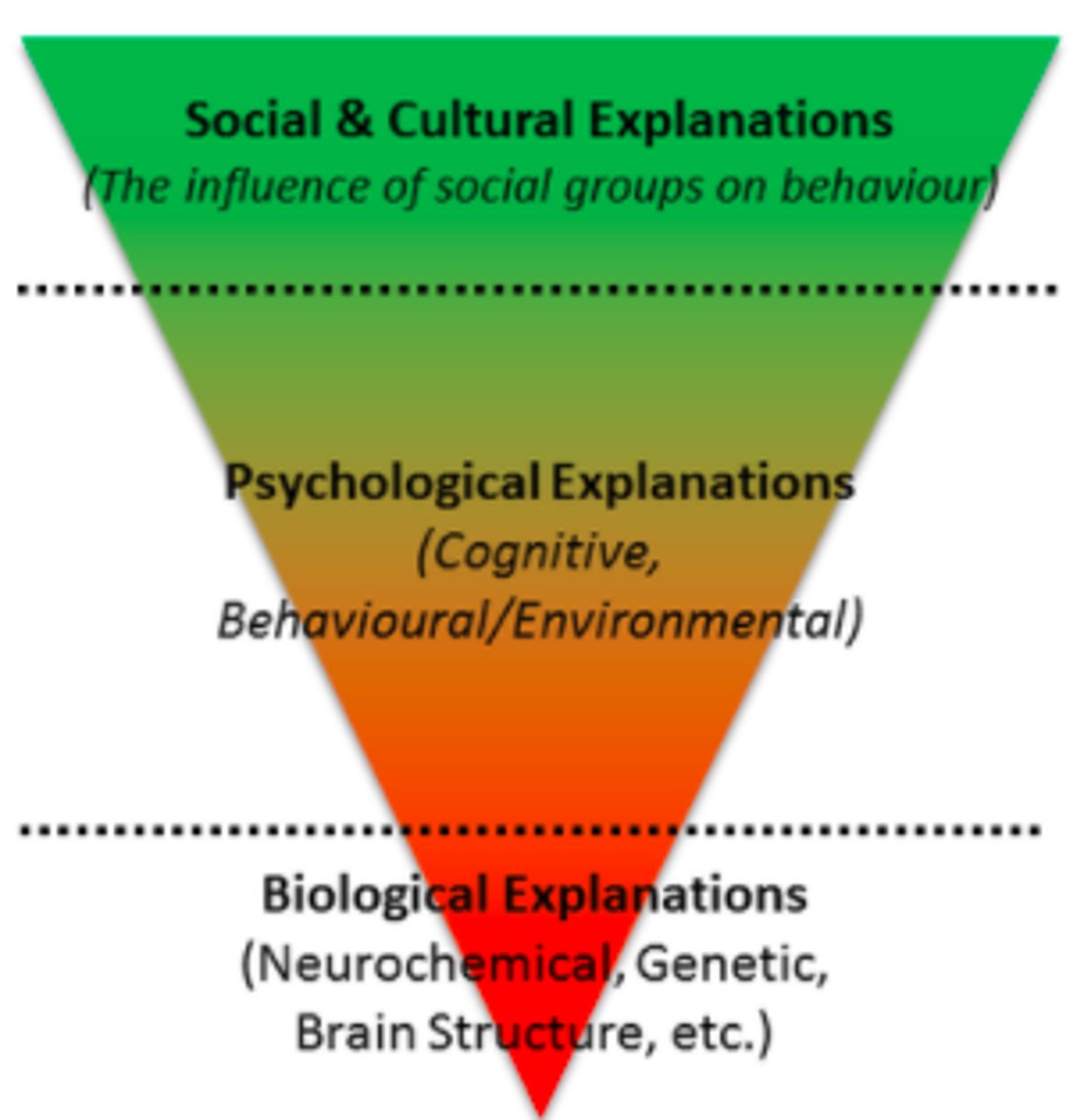
3) What are Levels of explanation
- What are the Lowest, Middle and Highest levels of Explanations?
Evaluate Holism (2 pro 1 con)
Rogerian Therapy (IRL application) > Smith et al
- Nesdat et al
3) The idea that there are several ways (levels) that can be used to explain behaviour
Lowest = Biological Explanations
Middle = Psychological Explanations
Highest = Social and Cultural Explanations
- If we accept there are diff factors that contribute to e.g. Depression it's difficult to know which is most influential, so difficult to know which to priorities > lacks feasibility
+ Rogerian therapy; considers the whole person making treatment more effective > Smith et al. did a meta-analysis of 475 studies found client-centered therapy to be effective
+ Flexible can explain why people w similar biology behave diff as it doesn't solely look at bio implications in behavior but also environmental and others. Nestadt et al; 68% concordance rate for OCD in MZ twins compared to 31% in DZ twins shows that biological reductionism alone can’t explain behaviour
Evaluate Reductionism (1 pro 2 Con)
+ Often the basis for scientific approach; operationalises variables and breaks down behaviours in to small parts, making it more Objective. COUNTER: can be oversimplified leading to reduced validity and ignores complexity of other behaviours
- Some behaviours can only be understood at a higher level; Process like conformity can only be explained at lvl which they occur; need to look at the whole group and situation to really understand what's going on. Suggest higher levels (or holistic) explanations provide more valid account.
- Reductionism may overlook/ ignore how culture, social norms, and relationships influence behaviour; can lead to cultural bias, Takahashi (when using SS) found that Japanese infants showed much higher separation anxiety, not because of poor attachment but due to cultural child-rearing practices.
1) What is Idiographic approach
- What does it focus on?
- Objective or Subjective?
- What type of data is desired?
- Examples
2) Nomothetic approach
- What does it focus on?
- Objective or Subjective?
- What type of data is desired?
- Examples
1) Idiographic: Approach focuses more on individual cases and emphasises unique personal exp. of human nature
- Focus on individual/ smaller groups
- Private, Subjective and conscious exp.
- Qualitative info unique to individual
Examples: Humanistic; Rogers aimed to explain the process of self-development, derived from in-depth conversations w clients in therapy (Rogerian therapy)
2) Nomothetic: Use of large groups to study HB through this general laws are established
- Focus on larger groups
- Objective knowledge thru scientific methods (to establish general laws)
- Investigators gain numerical Quantitative data that can be categorised
Example: Behaviorist; B.F. Skinner main aim was to establish general laws w studying animals and conditioning
Evaluate Idiographic approach ( 2 pro 2 con)
+ Uses in depth qualitative methods of investigations which can provide global description of one individual > Can shed light on general laws or challenge them. e.g. HM case may reveal important things about normal functioning which may contribute to our overall understanding
+ Has irl application w Rogerian therapy; considers the whole person making treatment more effective
- Idiographic methods (like case studies, interviews) take a lot of time to conduct and analyse, which makes it harder to build a broad evidence base quickly.
- often uses subjective, qualitative methods, it's harder to test, replicate, or verify findings
Evaluate Nomoethic approach (2 pro 1 con)
- Can lead to loss of understanding for individual; knowing there is a 1% risk of developing schizophrenia tells us little about what life is like for someone who has been diagnosed with disorder. Understanding the subjective exp. is useful when it comes to devising appropriate treatment
+ Nomoethic research is similar to those used in natural science e.g. establishing objectivity through standardisation
- Reductionist as it oversimplifies complex HB by focusing on measurable variables and ignoring emotions, motivations, or context > But more feasible
1) What does Ethical implications mean
- Give an Example
2) What does it only apply to?
- Define this
Ethical Implications: potential positive or negative effects that research may have on participants or wider society.
> Example: A study on LTM using student participants is unlikely to have major consequences for individuals or society, whereas a study on depression could affect participants’ well-being and have wider social implications.
2) Socially sensitive research (SS): Sieber & Stanley define SS research as studies with potential consequences or implications for participants or the wider social group.
1) How can the way a research question is phrased affect socially sensitive research?
2) What ethical issues should researchers consider when studying socially sensitive topics?
3) Why should researchers consider how their findings might be used in socially sensitive research
1) Research question – How the question is phrased can affect interpretation of findings.
Example: Cole et al. highlighted “heterosexual bias” in research on relationships, where homosexual relationships are judged against heterosexual norms.
2) Dealing with participants – Ethical issues in socially sensitive research include:
Informed consent
Confidentiality
Protecting participants from stress (e.g., DV victims worried about an ex finding out about their participation)
3) Use of findings – Researchers should anticipate how results may be applied, as this can affect what participants disclose and the type of data collected.
Evaluate Social sensitivity (2 pros 1 con)
+ Kinsey et al
- Griffiths
+ Kinsey et al; (anonymous interviews with 5,000+ men) helped challenge societal bias (homosexuality removed from DSM). Shows SS research can correct social misconceptions.
+ Research can inform government policies (education, childcare, healthcare), ensuring decisions are evidence-based rather than politically motivated.
- Poorly conducted SS research can have lasting negative social effects; e.g., Burt’s twin studies falsely suggested intelligence was heritable, which influenced the 11+ exam and grammar school system.
- Griffiths; study into gambling addiction used regular gamblers who were asked to play on slot machines which could reinforce their need to gamble, which could be exploititive
 Note
Note  Flashcards (32)