11.1 | Crustal Deformation
 Call Kai
 Learn
Learn Practice Test
 Spaced Repetition
 Match
Match Flashcards
 Knowt Play
1/41

There's no tags or description
Looks like no tags are added yet.
Name | Mastery | Learn | Test | Matching | Spaced | Call with Kai |
|---|
No analytics yet
Send a link to your students to track their progress
42 Terms
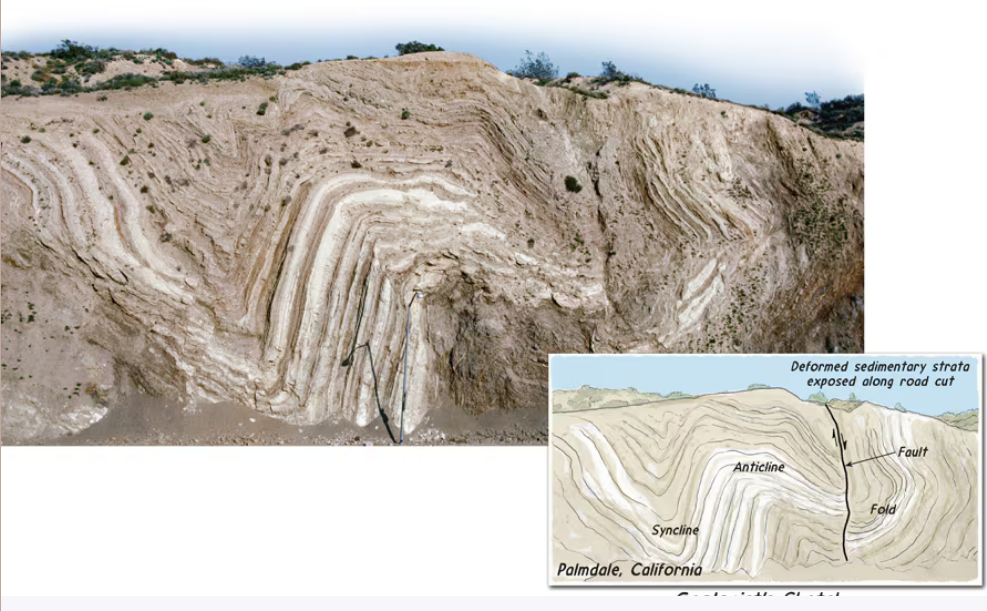
Folding & faulting indicate...
compressional forces
Tectonic forces cause rocks to ____, _____, and _____
move, tilt, change shape
Deformation
changes/processes of folding, faulting, shearing, compression, or extension of rock
Where does deformation mainly occur?
along plate boundaries
Tectonic/Geologic Structures
features that reflect a rock’s tectonic history
What are the different types of tectonic structures?
folds, faults, joints/cracks, & foliation
Stress
force per unit area acting on a solid surface (s = f/a)
Confining Pressure
force/stress applied uniformly in all directions, reduces rock volume
Differential Stress
force stronger in 1 direction & unequal in all directions
Most deformation is caused by…
differential stress
What are the 3 types of differential stress?
compressional, tension, shear
Rock Strength
resistance to being deformed permanently by stress
What does rock strength depend on?
temperature, confining pressure, duration of applied stress
Compressional Stress
differential stress that shortens rock bodies, associated with convergence, produces mountains
How does compressional stress affect the crust vertically & horizontally?
shorten horizontally, thicken vertically
Tensional Stress
differential stress pulling rock body apart, associated with divergent plate boundaries
How does tensional stress affect the crust vertically & horizontally?
stretch/lengthen horizontally, thin vertically
What forces are present in the Basin & Range province of North America?
tensional
Shear Forces
differential stress causing 2 adjacent rocks to slide past 1 another, associated with transform plate boundaries
Strain
irreversible change in shape/size of rock caused by differential stress
How can you determine the type of stress that deformed a rock?
measuring strain
How does solid rock change its shape?
small-scale shearing
What are the two ways rock can undergo small scale shearing?
slippage along parallel surfaces of weakness, within defect bonds in a mineral grain (break & reform)
Recrystallization
atom movement from high stress to low stress position within mineral grain
What are the 3 types of deformation?
elastic, brittle, ductile
Elastic Deformation
rock returns to original size & shape when stress removed, temporary deformation
How does elastic deformation occur?
chemical bonds in mineral act like a spring, stretch not break, snap bask when stress is removed
Elastic deformation causes events known as…
earthquakes
Brittle Deformation
rocks break into smaller pieces, sudden fracturing causes material to lose strength
How does brittle deformation occur?
stress breaks chemical bonds holding material together
Ductile Deformation
rock changes shape without breaking under stress
How does ductile deformation occur?
slippage along surfaces of weakness, gradual reshaping of mineral grains
Solid State Flow
rock flows very slowly, changes shape without fractures or melting
Where does ductile deformation occur?
high temps & confining pressures
Rock deformation at shallow depths is ____, while rock deformation at greater depths is ____
brittle, ductile
What factors influence how a rock deforms?
temperature, confining pressure, rock type, time
Describe the role of temperature in deformation:
higher temps, ductile
cooler temps, brittle fracture
Describe the role of confining pressure in deformation:
higher pressure induces ductile deformation by preventing fracture
______ pressure and _____ temperature create ductile deformation
higher, higher
Describe how rock type influences deformation:
strong brittle rocks like granite, basalt, and quartz sandstone brittley deform
weak rocks like clay, rock salt, shale, limestone, and schist ductiley deform
Rock salt has intergrown crystals. Why does it deform ductiley instead of brittley?
mineral grains continually recrystallize, allowing salt dome formations
Describe how time influences deformation:
stress applied slowly overtime allows ductile deformation
stress applied too quickly causes elastic & brittle deformation

