Multi-Store model
 Studied by 0 people
 Call Kai
 Learn
Learn Practice Test
 Spaced Repetition
 Match
Match Flashcards
 Knowt Play
1/9

There's no tags or description
Looks like no tags are added yet.
Name | Mastery | Learn | Test | Matching | Spaced | Call with Kai |
|---|
No analytics yet
Send a link to your students to track their progress
10 Terms
Name the 3 components of the multistore model of memory (3)
sensory register
Short term memory
Long term memory
Identify 2 sub stores within the sensory register
Iconic (visual)
Echoic (auditory)
Identify the process which determines whether information passes from sensory to short and short to long (2)
sensory → short term = Attention
short term → long term = Rehearsal
What claims does the multi-store model make about the types of coding in short and long term memory
STM coding is acoustic (sound)
LTM coding is semantic (meaning)
Draw a diagram of the multi-store model of memory (8)
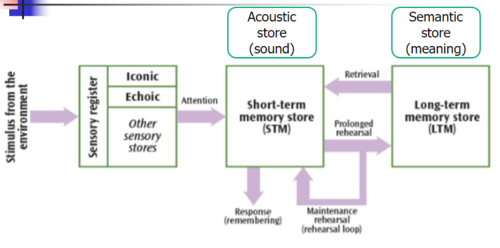
Explain how Glazer & Cunitz’s study of the primacy-recency effect has shown that short and long term memory are distinct components, as the multi-store model claims (3)
Participants recall more items from the beginning and end of sequences
Items from the beginning are rehearsed and stored in LTM
Items from the end are still in STM
Explain how case studies of HM / Clive Wearing have shown short term and long term memory are distinct components (3)
HM and Clive Wearing had intact STM
But transfer of information to LTM was impaired
Selective impairment implies distinct components
Explain how the case study of brain damage to patient KF provides evidence against the multi-store model (3)
STM poor when words were read
But better when he read them himself
Suggests that there are separate processing components in STM, so it’s not unitary
Explain how the case study of HM provides evidence against the multi-store model (4)
acquired a new skill (mirror drawing)
But couldn’t recall learning it
Suggesting that there are separate components within LTM: procedural and episodic memory
So LTM isn’t unitary
Identify who found evidence to support the following claims made by the multi-store model:
capacity of STM = 7
duration of STM = 18-30s
duration of LTM = lifetime
coding of STM = acoustic
coding of LTM = semantic
capacity of STM = 7 = Miller, Jacobs
duration of STM = 18-30s = Peterson & Peterson
duration of LTM = lifetime = Bahrick
coding of STM = acoustic = Baddeley (1966)
coding of LTM = semantic = Baddeley (1966)
 Note
Note  Flashcards (39)