Investment model (maintenance)
 Studied by 0 people
 Call with Kai
 Learn
Learn Practice Test
 Spaced Repetition
 Match
Match Flashcards
 Knowt Play
1/19

There's no tags or description
Looks like no tags are added yet.
Name | Mastery | Learn | Test | Matching | Spaced | Call with Kai |
|---|
No study sessions yet.
20 Terms
Who proposed this model?
Rusbult (1980).
Why was it developed?
As a way of understanding why some people persist in some romantic relationships but not others.
What are the different stages of the investment model?
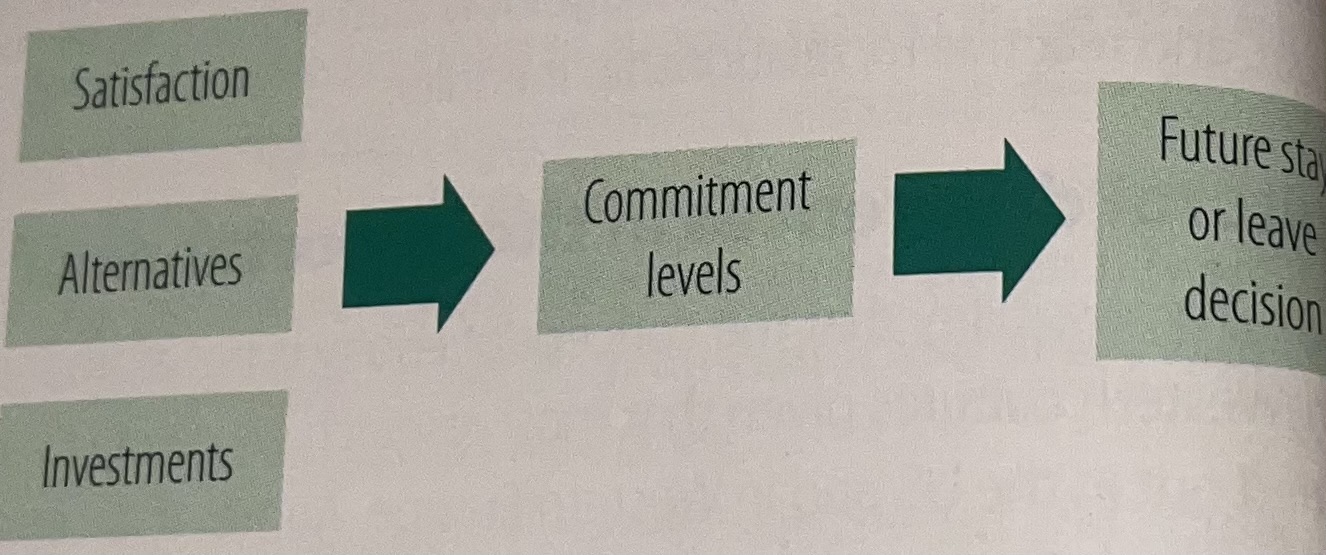
Explain satisfaction level.
Satisfaction - degree to which a person’s needs are gratified by their partner.
Satisfaction level refers to the positive vs negative emotions in the relationship, influenced by the extent partners’ most important needs are fulfilled.
(Eg a partner may be satisfied that their partner fulfills their domestic and sexual needs)
Explain quality of alternatives.
This is how much of an individual’s most important needs might be better fulfilled outside the current relationship (other people, being single)
This might lead the partner to choose the alternative over the current relationship.
Although people may persist with a relationship because of a lack of options if no alternatives are present.
Explain investment size.
A measure of all the resources attached to the relationship. These values would be diminished completely if the relationship was to end.
Examples - energy, partner’s friends and family, possessions and gifts
Why do investments increase dependence on the relationship?
Because they increase connections with the partner that would be costly to break.
Investments can create a powerful psychological inducement to persist with a relationship.
Why do partners make these investments?
in the hope that they create a strong foundation for a lasting future together.
Explain commitment level (middle stage).
It describes the likelihood that an involvement will persist.
What commitment level do romantic partners with high satisfaction levels have?
A high commitment level. They anticipate little gain and high loss if they were to leave the relationship - quality of alternatives is low and investment is high.
When is a commitment level low?
When satisfaction levels and investment in the relationship are both low and the quality of alternatives is high.
How do people become dependant on a relationship?
If they’re satisfied with their relationship or if their investment size is too high (eg kids, place to live)
This explains why by some people stay in abusive relationships.
KEY STUDY: What was the aim of Le and Agney’s 2003 study?
To investigate how the components of the investment model - satisfaction, quality of alternatives and investments - relate to commitment levels.
KEY STUDY: What was the procedure of Le and Agney’s 2003 study?
Meta-analysis of 52 studies, all of them having measured at least one component of the Investment Model and its link to commitment.
The combined sample included over 11,000 participants (54% male, 46% female) from five countries (USA, UK, Netherlands, Israel, Taiwan).
KEY STUDY: What were the findings of Le and Agney’s 2003 study?
All three factors - satisfaction level, quality of alternatives, and investment size - were strongly correlated with commitment.
The strongest predictor of commitment was satisfaction (correlation = .68).
Quality of alternatives had a negative correlation with commitment (–.48), and investment size showed a positive correlation (.46).
Commitment also predicted whether individuals stayed or left their relationships (correlation = .47): higher commitment → more likely to stay.
KEY STUDY: What were the conclusions of Le and Agney’s 2003 study?
The findings support the Investment Model:
People are most committed to their relationships when they are satisfied, have poor alternatives, and have invested heavily.
Commitment is a strong predictor of real-life relationship persistence.
Positive eval
Research support for investment model - Le (2010) found in a meta-analysis that commitment level was the strongest predictor of whether couples stayed together. This supports Rusbult’s model. This also adds temporal validity, as it’s a modern study.
RWA - explains why people stay in abusive relationships, they have low satisfaction level but high investment size. This is supported by Rusbult and Martz’s 1995 research into partner commitment in battered women.
HOWEVER point
It’s difficult to measure variables in the investment model (eg satisfaction level, quality of alternatives) that lead to commitment in the relationship. They are based on self report - so suffer from low validity.
HOWEVER…
Rusbult developed the ‘Investment Model Scale’ (1998) to overcome the problem. The scale was high in both reliability and validity in measuring these variables.
ALTHOUGH….
This scaled is still based on self report.
Negative eval
Oversimplified model - Goodfriend and Agnew (2008) suggest that investment size should include future plans of investments (eg eventually having kids), not just current ones. These would still be diminished if the relationship ended. Some relationships may persist because of a motivation to see future plans come true.
Conclusion
The model is helpful in explaining why people stay in abusive relationships, making it a superior maintenance explanation to equity theory.
It is relevant in all cultures.
 Note
Note  Flashcards (91)