elasticity chp 5
 Call Kai
 Learn
Learn Practice Test
 Spaced Repetition
 Match
Match Flashcards
 Knowt Play
1/39

There's no tags or description
Looks like no tags are added yet.
Name | Mastery | Learn | Test | Matching | Spaced | Call with Kai |
|---|
No analytics yet
Send a link to your students to track their progress
40 Terms
elasticity
is a measure of the responsiveness of one variable to changes in another
price elasticity of demand formula
% change in quantity/ % change in price
price elasticity of demand
it is always a negative number, whihc is why we use the absolute value
a larger number (in absolute value) indicates greater elasticity
what is the categorizing price elasticity of demand
when it is less than 1= inelastic
when it is greater than 1= elastic
when it equals 1= unit elastic
consumers of goods with elastic demand are _____ to price changes
sensitive
consumers of goods with inelastic demand are ______ to price changes
less sensitive
how will a perfectly elastic graph look?
completely horizontal
how would a relatively elastic graph look like?
horizontal line but slightly slanted
how would a unit elastic graph look like?
looks similar to a U
how does a relatively elastic graph look like?
it is vertical and slightly slanted
how does a perfectly inelastic graph look like?
completely vertical
what are the 4 determinants of elasticity
availability of close substitutes
proportion of income spent on a product
luxuries versus necessities
time period
good with elastic demand have many substitutes, represent a large portion of one’s budget, tend to be luxuries, and have a long time horizon for decisions
whats the midpoint method?
when calculating percentage changes, the midpoint method results in the same number regardless of the direction of the change
whats the midpoint method formula
Q1-Q0/ (Q0+Q1)/2
how do you find the elasticity and total revenue
total revenue= price x quantity
elasticity and total revenue
when demand is inelastic, price changes are larger than quantity changes (in percentage terms)
an increase in price results in higher total revenue
a decrease in price results in lower total revenue
when demand is elastic, quantity changes are larger than price changes (in percentage terms)
an increase in price results in lower total revenue
a decrease in price results in higher total revenue
when demand is unit elastic, quantity changes are equal to price changes (in percentage terms)
an increase in price does not change total revenue
a decease in price does not change total revenue
when you move down a linear demand curve, what happens to elasticity?
it falls from elastic to inelastic
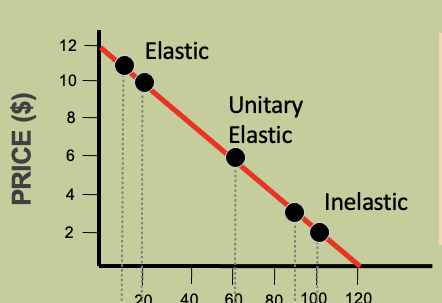
total revenue is _____ when demand is unit elastic
maximized
what are other elasticities of demand?
price, cross and income
cross elasticity of demand
measures how changes in the price of one good affect the demand for another good
cross elasticity of demand formula
% change Qb/ % change Pa
unlike for price elasticity, the sign (+ or -) matters
the sign determines whether goods are substitutes or complements
when the cross elasticity of demand is greater than 0, that means goods A and B are substitutes!!
when the cross elasticity of demand is less than 0, that means goods A and B are complements!!
ex: if the price of salads increases, demand for salad dressing decreases
income elasticity
measures how responsive quantity demanded is to changes in consumer income
income elasticity of demand
% change in quantity/ % change in income
the sign of the answer (+ or -) also matters
the sign determines whether goods are normal, luxury, or inferior with respect to income
normal goods
between 0 and 1
an income increases, consumers buy more normal goods.
as income decreases, consumers buy fewer normal goods
luxury goods
usually greater than 1
an increase increases, purchases of luxury goods increase by more than the change in income
inferior goods
usually goods less than 0
an income increases, consumers buy fewer inferior goods
as income decreases, consumers buy more inferior goods
price elasticity of supply
measure the responsiveness of quantity supplied to changes in price
elasticity of supply formula
% delta quantity supplied / % delta price
the answer is always a positive number because of the law of supply
elasticity of supply definition
increases over time as businesses adjust their production decisions
market period
output and the number of firms are fixed
short run
the number of firms does not change but each firm can adjust output
long run
firms can enter or exit the industry
elasticity of supply over time
supply becomes more elastic (flatter) over time, from the short run to the long run
incidence of a tax
describes who bears the economic burden of a tax
this is influenced by elasticity
3 types of taxes
progressive, flat and regressive
progressive tax
a tax in which those with higher income pay a higher average tax rate (ex: federal income tax)
flat tax
a tax that is a constant proportion of one’s income (ex: medicare tax)
regressive tax
a tax in which those with higher incomes pay a lower average tax rate

