accounting LN 1: introduction and the accounting equation
 Call Kai
 Learn
Learn Practice Test
 Spaced Repetition
 Match
Match Flashcards
 Knowt Play
1/114

Earn XP
Description and Tags
(as of feb 3)
Name | Mastery | Learn | Test | Matching | Spaced | Call with Kai |
|---|
No analytics yet
Send a link to your students to track their progress
115 Terms
The Accounting Equation:
A = L + SE
ASSETS = LIABILITIES + STOCKHOLDERS' EQUITY
Investing =
Financing (Creditor Financing + Owner Financing)
Economics Resources
= Claims against resources (nonworner claimes on assest + owner claims of assets)
Assest A are the resources that represent what?
PROBABLE future economic benefits
PROBABLE future economic benefits rules
can be measured with reasonable precision
the resources we obtained/controlled by the accounting entity from PAST transactions
benefits = future cash receipt or reduction of liabilities
what can the future economic benefits of assests be
future cash receipt or a reduction of liabilities
examples of asset accounts
Cash, Accounts Receivable (A/R), Inventory, Prepaid Expenses, PP&E
assets are classified into what two types
current and noncurrent assets
current assets
resources that will be converted to cash, consumed, or sold within one year of the
balance sheet date
how are current assets presented in the balance sheet
in order of liquidity
examples of current assets
cash
marketable securities
accounts receivable
inventory
prepaid expenses
cash
and cash equivalents – currency, bank deposits, certificates of deposit
Marketable securities
short-term investments that can be quickly sold to raise cash
Accounts receivable
amounts due to the company from customers arising from the sale of products on credit. asset.
Inventory
goods purchased or produced for sale to customers
Prepaid expenses
costs paid in advance for rent, insurance, or other services
noncurrent assets
resources that will be converted to cash, consumed, or sold more than one year
from the balance sheet date.
examples of noncurrent assets
Property, plant and equipment (PP&E)
Intangible and other assets
Long-term investments
Property, plant and equipment (PP&E)
includes land, factory buildings, warehouses, office
buildings, machinery, office equipment, and other items used in the operations of the company
Intangible and other assets
patents, trademarks, franchise rights, goodwill, and other items that
provide future benefits, but do not possess physical substance
Long-term investments
investments in shares of other firms that management does not intend to sell
in the near future
liabilities are…
obligations to transfer assets or provide services that represent probable future
obligations:
rules of probable future obligations (in Liabilities)
the future sacrifice of benefits can be measured with reasonable precision
the obligations are a result of past transactions or events.
the obligations can be a future cash payment or an obligation to deliver goods or services.
examples of liability accounts
Accounts Payable, Interest/Wages/Notes Payable, Deferred/Unearned Revenue
what are liabilities classifed into
current and non-current liabilities
liabilities equation
L = CL + NCL
current liabilities
obligations that are due within one year of the balance sheet date (short-term
financing).
what are current liabilities listed in
in order of maturity
examples of current liabilities
accounts payable
accrued liabilities
short term borrowings
deferred rev
current maturities of long-term debt
accounts payable
amounts owed to suppliers for goods and services purchased on credit
Accrued liabilities
obligations for expenses that have been recorded but not yet paid
Short-term borrowings
short-term debt payable to banks or other creditors
Deferred (unearned) revenue
an obligation created when the company accepts payment in advance
for goods or services it will deliver in the future
Current maturities of long-term debt
the portion of long-term debt that is due to be paid within one
year
Noncurrent liabilities are also known as
long-term liabilities
Noncurrent liabilities
are obligations that are to be paid after one year of the
balance sheet date (long-term financing)
long-term financing
obligations that are to be paid after one year of the
balance sheet date
examples of noncurrent liabilities
Long-term debt – amounts borrowed from creditors that are scheduled to be repaid more than one year in the future
Other long-term liabilities – various obligations, such as warranty and deferred compensation liabilities, long-term tax liabilities
Equity reflects…
capital provided by the owners of the company
what remains of an entity after deducting the liabilities?
the residual interest
the residual interest
s the daily interest that accrues on a credit card balance between the end of a billing cycle (statement date) and the day your payment posts, appearing on your next statement even if you pay the current balance in full.
what is owners equity called for corporate entities
stockholder’s equity (SE) or shareholders’ equity.
SE equation
SE = Contributed Capital + Earned Capital
Contributed capital
represents stockholders’ investment s and consists of the following accounts:
Common stock
Additional paid-in capital
Treasury stock
common stock
- the capital received from the primary owners of the company
additional paid-in capital
- amounts received from the primary owners in addition to the par value or stated value of the common stock
treasury stock
- the amount paid for common stock that the company has reacquired
earned capital
the cumulative net income (or losses) after deducting dividends paid to shareholders
retained earnings
the accumulated earnings that have not been distributed to stockholders as
dividends
Accumulated other comprehensive income or loss (AOCI)
accumulated changes in equity that are not reported in the income statement.
Revenues (R) represent what?
increases in net assets (assets minus liabilities) that are caused by the company’s
transferring goods and services to customers.
expenses represent what?
decreases in net assets that are caused by the company’s revenue-generating
activities.
typical expenses
Cost of goods sold (COGS): the cost of products that are delivered to customers during the accounting period.
Operating expenses: Depreciation expense, wages expense, selling, general, and administrative expenses (SG&A)
Non-operating expenses: Interest expense
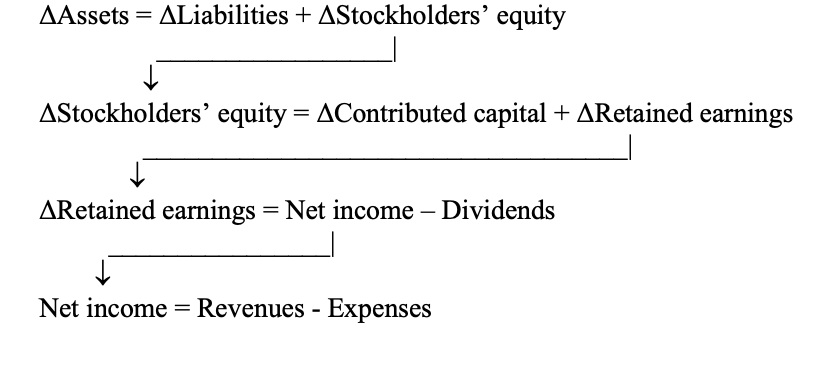
Net Income equation
NI = REV - EXPENSES
The relation between B/S and I/S via the accounting equation
when are balance sheets prepped
at a certain point in time
liquidity
the ease of converting non cash assets to cash
what are the most liquid assets
current assets
historical cost
original acquisition cost - physical assets are reported as this in the balance sheet
reliability
the use of historical cost to report asset value - has the advantage of reliability
executory contract
when conditions 1 and 2 of liabilities r met but the transaction that caused the obligation has not occured → liability is not recorded
what is special about grocery stores
few current assets but LARGE operating cash flow → good liquidity → even though it has ratios less than 1
GAAP
Generally Accepted Accounting Principals conventions, rules, guidelines etc that govern financial reporting
Constantly changing
Rule-based
SEC
Securities and Exchange Commission
Entity that sets all the rules/standards for financial reporting
FASB
Financial Accounting Standards board
who has power over FASB
the SEC
what is the single source of the US GAAP
The FASB Accounting Standard Codification
IASB
International Accounting Standards Board
is the IASB private or public, and what does it develop?
Private sector
Develops the IFRS (International Finance Reporting Standards)
difference between IASB and GAAP
Principle based (not rule based like GAAP)
Sarbanes-Oxley Act (SOX)
US federal law in response to corporate and accounting scandals bug businesses
Very government involved in businesses (biggest move since FDR)
what did the Sarbanes-Oxley Act (SOX) establish
Established Public Company Accounting Oversight Board (PCAOB) -
PCAOB purpose
overseeing everything that accounting firms do and their role as auditors
Section 404 of SOX
Requires annual assessment of internal controls and procedures for financial reporting by management
The external auditor is required to examine and report on the management's assessment of internal controls and effectiveness
FOR RELIABILITY AND TRUSTWORTHINESS
10-K
ANNUAL REPORT
Issued every year by management
Purpose: to update shareholders/interest parties of the company
elements of 10 K
MD&A, Financial Statements, Footnotes, Independent Auditor reporst
MD&A
summarizing activities of the current and past years + assessment of the future
financial statements
balance sheet, income statement, statement of shareholders equity, statement of cash flows
footnotes
summary of accounting policies/schedules of financial statements/commitments/disclosures, etc.
Independent Auditor repost prupose
Done by independent CPA
Attest fairness of all financial statements
Most opinions are unqualified
10-Q
quarterly report, same thing as 10-K but for the quarters
Things filed wit SEC
10-k, 10-Q, 8-K, Registration statement, proxy statement
8-K
filed whenever an event that is deemed material (change of auditor) occurs
Registration statement/prospectus:
documents that must accompany a new issue of securities that potential investors may find relevant
Securities
tradeable financial instruments
Proxy Statement:
information on directors compensation - provided to shareholders before voting on corporate matters
GAAS
auditing standards
PCAOB makes what
all the standards all the auditors should follow
first thing to do when starting your own business
raise cpaital
who ways to raise capital
Equity (owner financing) = raising cash from selling stocks
Creditor (non-owner financing) = like a bank loan
fancy name for raising capital
FINANCING ACTIVITIES
Equity (owner financing)
raising cash from selling stocks
No obligation for the owners/company to pay people back when someone buys the stock. You can just resell the stock
Creditor (non-owner financing)
The creditor is not the owner of the company because the company has an obligation to pay the buyer back
Liabilities are present here
Second thing to do once you get money for your business
acquire resources needed to produce and sell products and services
Investing activities
acquiring resources need to produce and sell products and services (assests)
Assets
everything that you buy in your investing activities. Resources providing future benefits to the company
Accounting Equation or B/S Equation, and what does it show?
Assets = Liabilities (the amount of capital you get from banks) + Equity (the capital you get from buyers of stocks)
Shows where the money comes from and where a company spends the money
balance sheet breaks down the WHAT of a company
breakdown of assets, liabilities and equity. All about the accounting equation.
Third thing to do (after you have assets) for your business
start operation
Operating Activities
production, promotion and selling products and services

