CM2: Module 2
 Call Kai
 Learn
Learn Practice Test
 Spaced Repetition
 Match
Match Flashcards
 Knowt Play
1/35

There's no tags or description
Looks like no tags are added yet.
Name | Mastery | Learn | Test | Matching | Spaced | Call with Kai |
|---|
No analytics yet
Send a link to your students to track their progress
36 Terms
Organizational Planning
Strategic Planning
The setting of broad, long-range goals by top managers.
aims to provide an understanding of the functions of the business, as well as a map for its future.
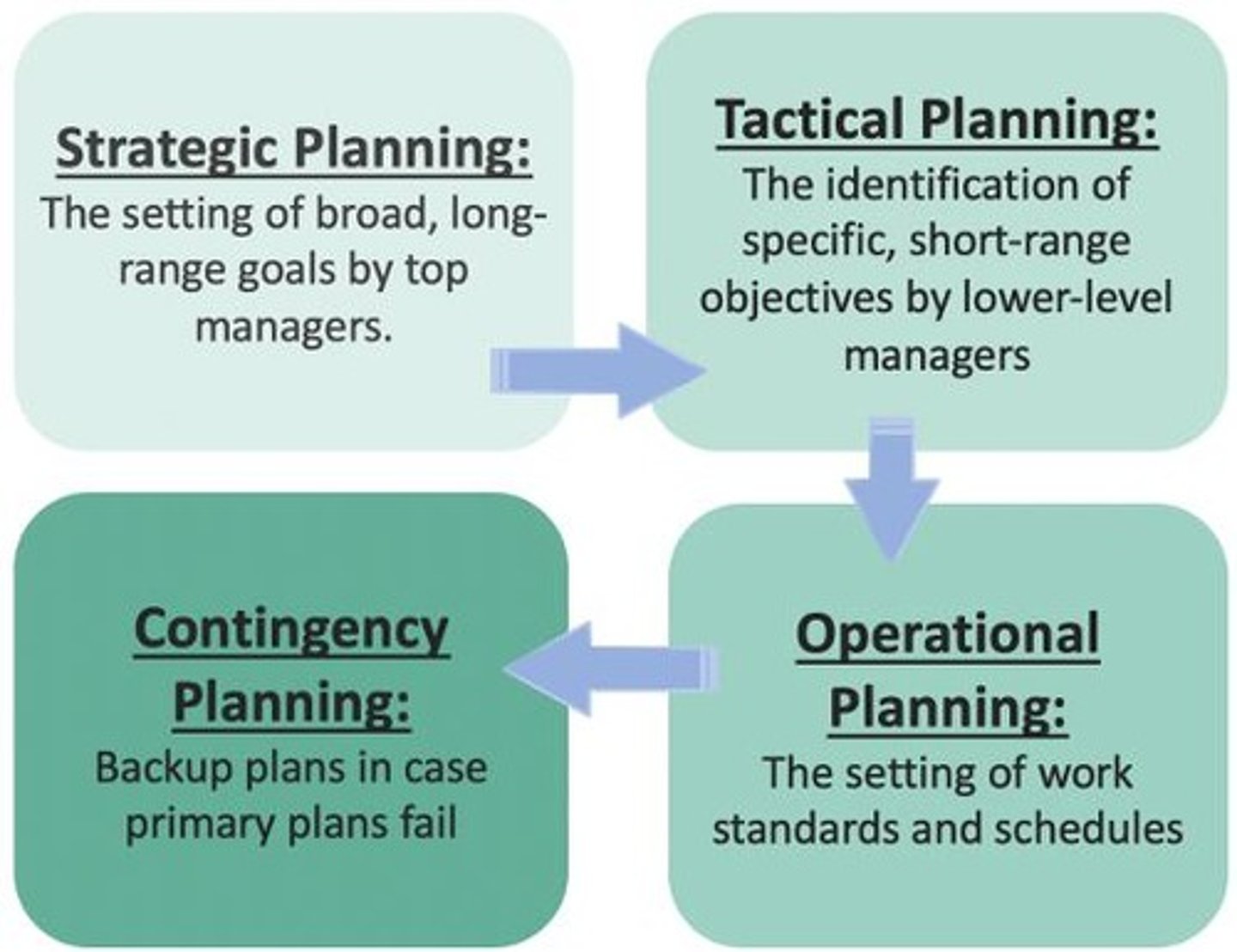
Tactical Planning
The identification of specific, short-range objectives by lower-level managers.
Operational Planning
The setting of work standards and schedules.
Contingency Planning
Backup plans in case primary plans fail.
What are the key questions addressed in Strategic Planning?
What business are you in?
Where are you now?
How did you get there?
Where do you want to be in the future?
How are you going to get there?
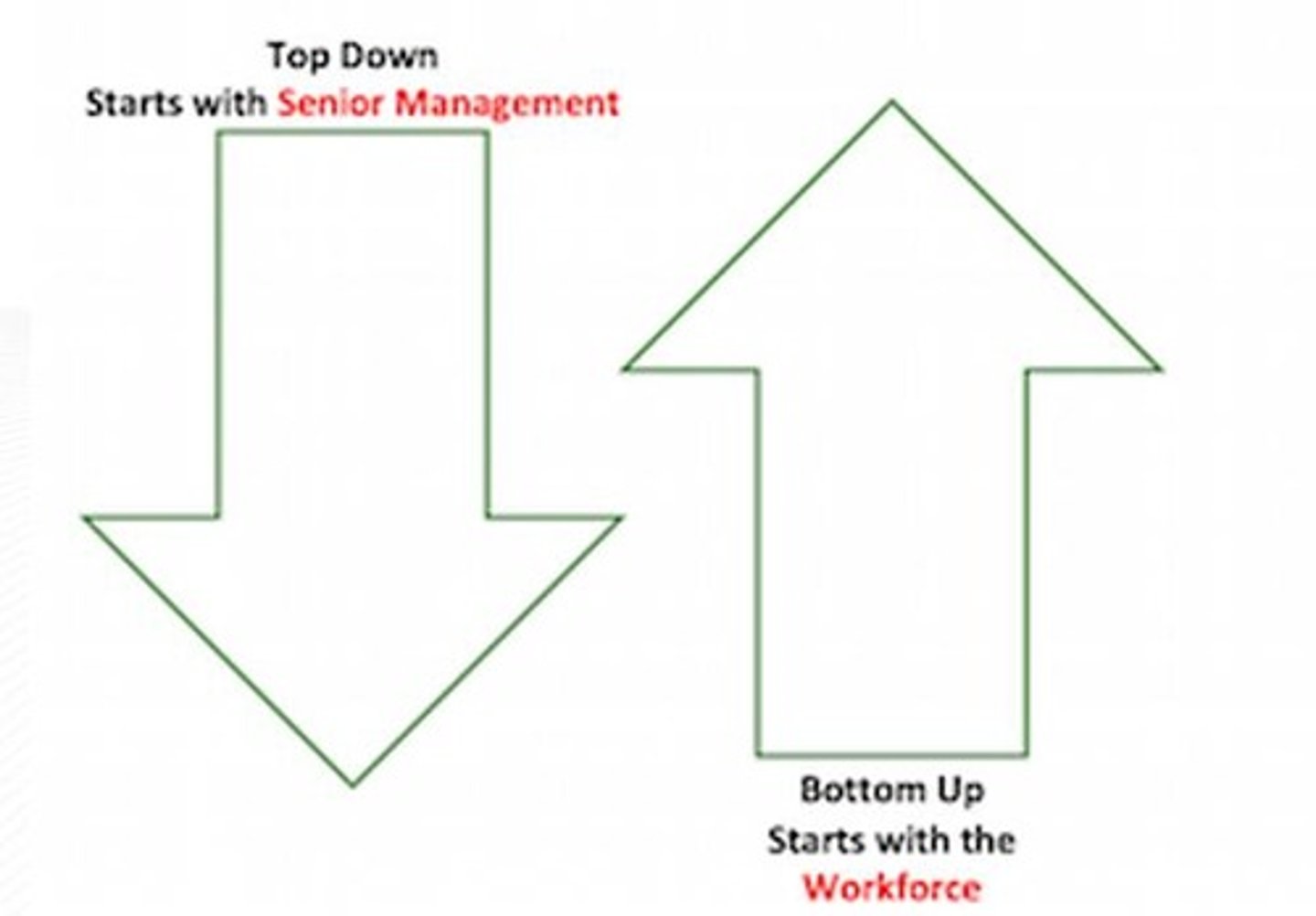
Top Down approach in Strategic Planning
Starts with Senior Management
Pros of the Top Down approach
Widespread familiarity,
clearer communication,
problems are easily located,
faster implementation.
Cons of the Top Down approach
Poor leadership impact,
less room for creativity,
team disengagement,
low proximity to decision-makers.
Bottom-Up approach in Strategic Planning
Starts with the Workforce
Pros of the Bottom-Up approach?
More informed decisions,
better team morale,
more room for creativity.
Cons of the Bottom-Up approach
Low momentum,
shift in leadership dynamics,
lack of high-level insight.
Business Strategic Planning
The process that an organization employs to make decisions about its business direction.
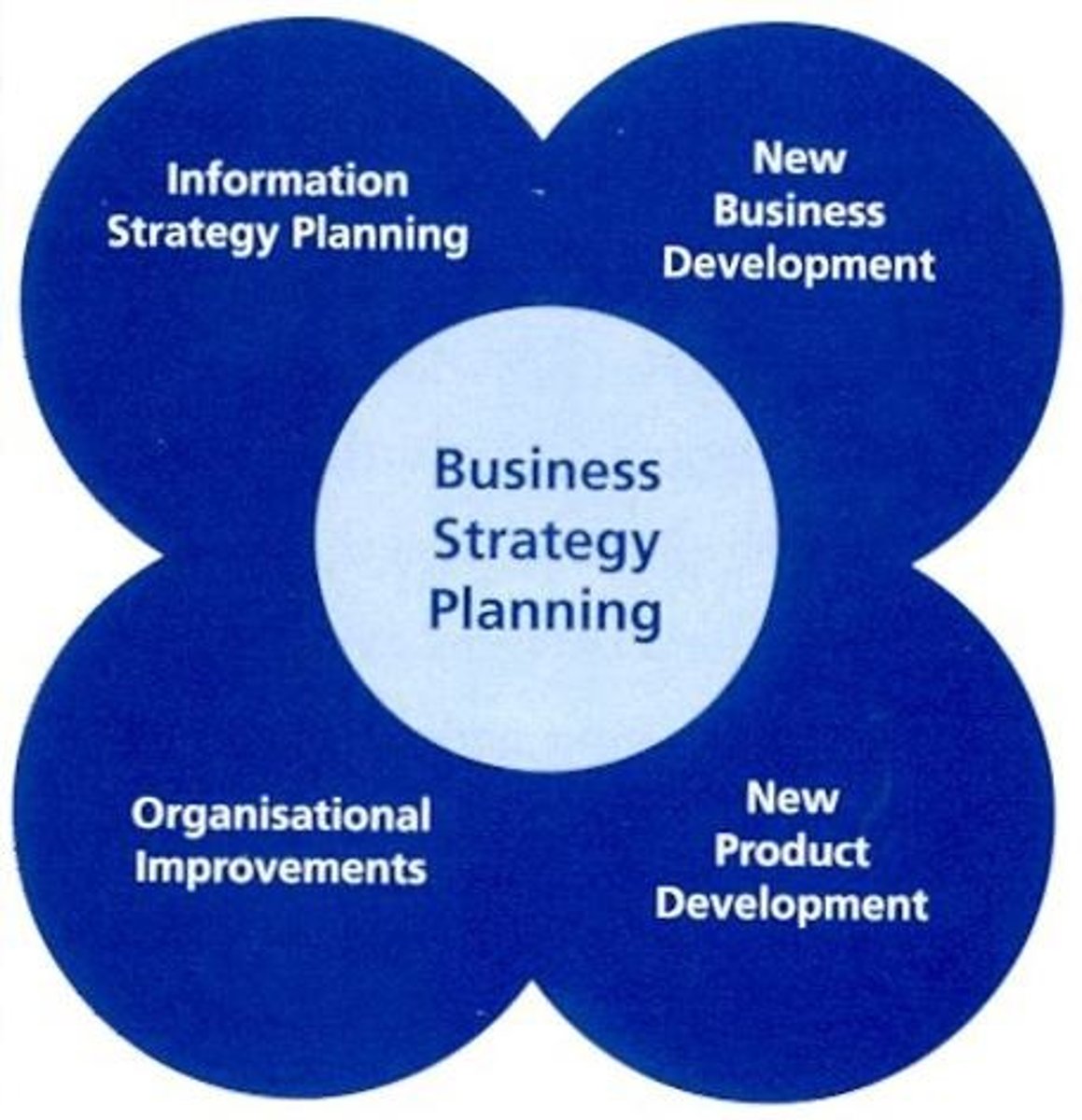
Information Strategy Planning
Deals with the whole 'information resource' of an organization and its relation with the general business environment.
should be integrated with Business Strategy and other aspects of the organisation.
As business and information strategies become aligned, organisations can answer questions such as:
Is IT adequately supporting our activities?
Can we reduce the cost of core processes?
Can IT help us 'tie in' to clients on a long-term basis?
Is IT improving staff satisfaction and motivation?
Can new services and products be created?
Can IT help us gain new markets?
How can the organisation's information and knowledge be managed as a resource?
How can the new technologies be used to address changing business needs?
Strategic Planning Cycle
Strategic Plan -> Propose Goals -> Open Issues -> Initial Options -> Gap Analysis -> Swot Analysis
What are the elements of Effective Strategic Planning?
Vision, Mission, Objectives, Strategy, Approach, Tactics.
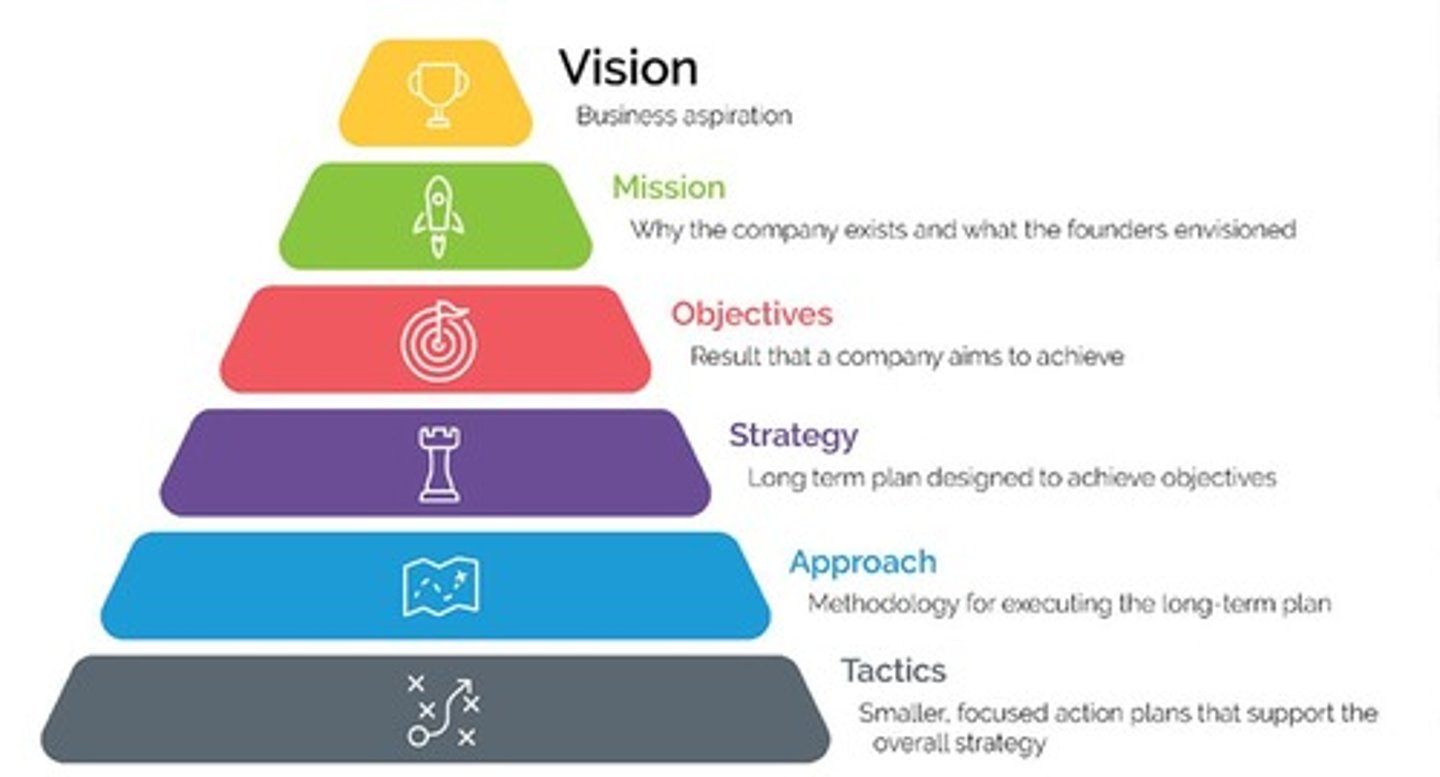
Vision
Business Aspiration.
Mission
Why the company exists and what the founders envisioned.
Objectives
Results that a company aims to achieve.
Strategy
A long-term plan designed to achieve objectives.
Approach
Methodology for executing the long-term plan.
Tactics
Smaller, focused action plans that support the overall strategy.
Information Strategy Planning (ISP)
Its purpose is to develop a plan for implementing business systems to support business needs.
Stages in developing an ISP
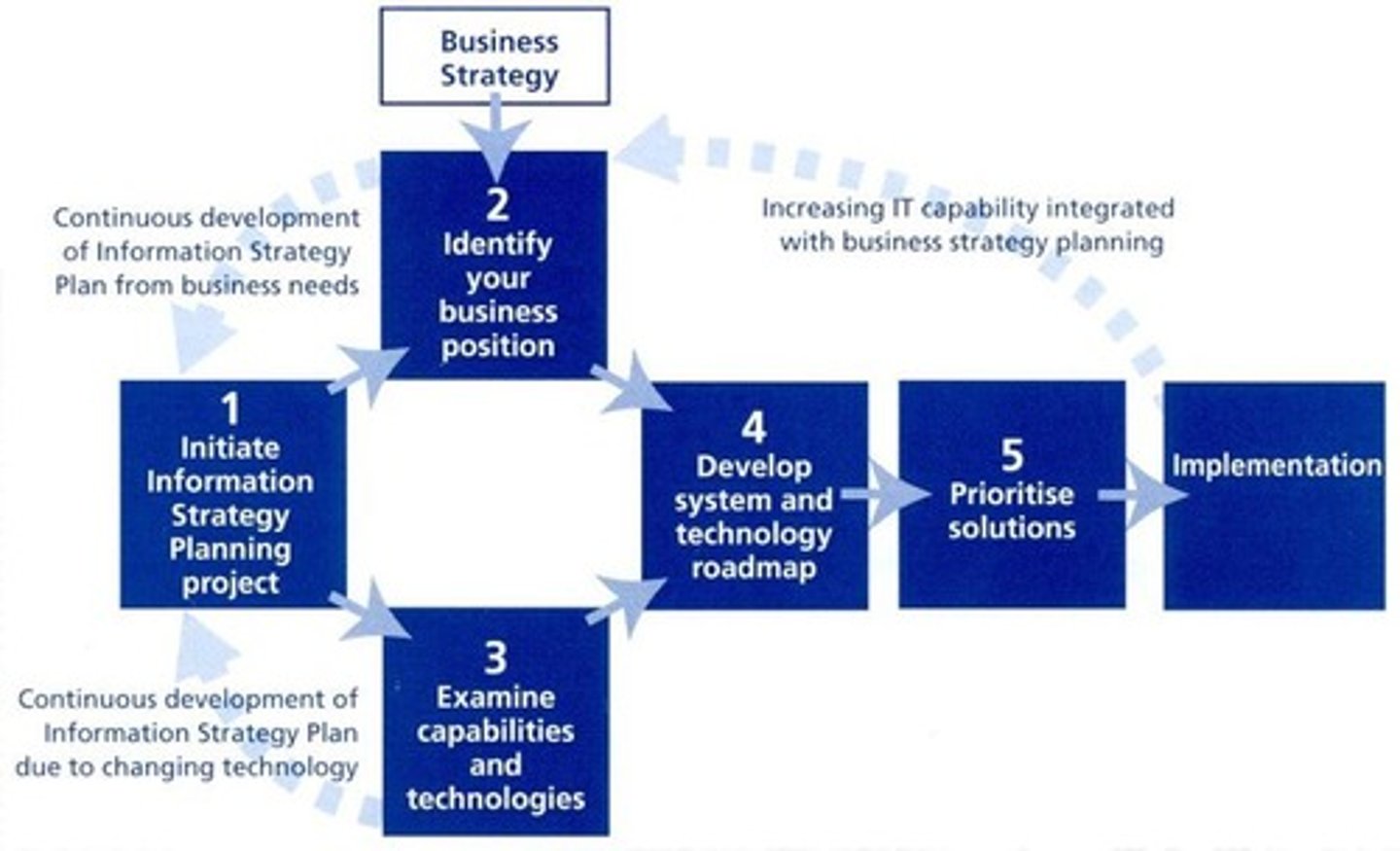
Objectives of ISP
Establish an information strategy based on an evaluation of the business strategy.
Establish a development plan of user-oriented systems to meet business information needs and priorities.
Define an information architecture for the future development of compatible data-sharing systems.
Establish a technical strategy for the best use of new information technology.
Define the most effective organization of the information system function within the enterprise
Other needs addressed by ISP
Evaluate the effectiveness of existing systems.
Identify data as a corporate resource and establish a basis for its analysis and control.
Assess the impact of the effective use of information technology on the overall organization of the enterprise.
Increase the awareness of management about developments in and opportunities of information technology.
Other Benefits of ISP
Improve communications within the enterprise about the effective use of information technology.
Involve users in the management of system development to increase their confidence in the possibilities offered by new systems.
1. Initiate Information Strategy Planning Project
i. Gain senior management approval and sponsorship
ii. Appoint a champion
iii. Appoint team and schedule activities
iv. Involve business managers and employees
2. Identify Your Business Position
i. Assess your current business position
ii. Examine your future business direction
iii. Decide what role IT should play in your business
3. Examine Capabilities and Technologies
i. Identify your current IT capabilities and key technologies
ii. Identify your current IT capability
Iii. Identify external systems and technologies
4. Develop System and Technology Roadmap
i. Map your project life cycle processes
ii. Examine your information sharing requirements
iii. Explore the relevance of the Internet / E-business to your organisation.
iv. Decide which major systems you will need
v. Plan your infrastructure requirements
vi. Standardise your systems/technologies
vii. Plan your people training and requirements
5. Prioritise Solutions
i. Prioritise critical software systems
ii. Indicate resources and timeframes
iii. Plan how you will manage changes to the document.
iv. Communicate and seek feedback
v. Get authorisation
It is also important that the developed strategy to be presented is clear to a defined audience, such as:
Senior managers
IT managers and staff
Participants in the planning process
User representatives
Other parties affected by the plan (Clients, Sub-contractors, Associated companies, Unions)
Advantages of Pilot Projects
Reduced risk of time and cost over runs
Reduced risk in selecting the wrong system
Benefits are achieved earlier thus increasing management and user confidence
The organisation is able to revise its requirements
The level of training required can be assessed
The approach fits well with the construction industry's tendency to fund IT systems on a project basis
Factors for Implementation
Specification of user requirements
Software selection
Sequence of implementation
What are the major issues when replacing expensive 'legacy' systems?
Timescales and resources
Managing expectations Training and support
Explore top notes

