slide 9 pt 1
 Call Kai
 Learn
Learn Practice Test
 Spaced Repetition
 Match
Match Flashcards
 Knowt Play
1/84

There's no tags or description
Looks like no tags are added yet.
Name | Mastery | Learn | Test | Matching | Spaced | Call with Kai |
|---|
No analytics yet
Send a link to your students to track their progress
85 Terms
what is genetics?
the study of heredity
what are 4 things included in the study of heredity
Transfer of traits from parents to offspring
2. Expression and variation of those traits
3. Structure and function of genetic material (RNA, DNA)
4. How genetic material changes or evolves
the genome is __ of the genetic material housed in a cell
ALL
what does the genome consist of
Chromosome
• Plasmids (Bacteria and Fungi)
• Mitrochondrial (Eukaryotes)
• Chloroplast (Photosynthetic Eukaryotes)
the genome is made of , but what is the exception?
DNA , viruses
chromosomes are a cellular structure made of
packaged DNA
where are Eukaryotic Chromosomes located
in the nucleus
Eukaryotic Chromosomes shape
linear
Eukaryotic Chromosomes packaging
DNA is wound around histone proteins
Eukaryotic Chromosomes number
cells usually have variable numbers of chromosomes
Prokaryotic Chromosomes packaging
no histones
Prokaryotic Chromosomes location
no nucleus
Prokaryotic Chromosomes shape
circular
Prokaryotic Chromosomes number of chromosomes
1 single chromome
gene is the fundamental unit of —
heredity
genes are part of a chromome that causes
some cell function
gene is a length of DNA that contains the information necessary to
make a protein or RNA molecuels
what are the 3 categories that describe the job that a specific length of DNA is designed to do
Structural genes: Encode proteins
2. Genes that encode RNA
3. Regulatory genes: Genes that control gene expression
Supercoiling occurs when the —
DNA double helix is twisted even further upon itself.
A superhelix is simply the — formed by a—. When the DNA axis itself crosses over itself, it creates a—
geometric shape, supercoiled molecule, secondary helix—a helix made of a helix.
Genomes have to be compacted to fit inside —
the cell
E. coli genome how many chromosomes
Single chromosome
E. coli how many genes
4,288 genes
E. coli genome length
Length of 1 mm (1000x longer than the
cell!)
Humans genome how many chromosomes
46 chromosomes
humans how many genes
31,000 genes
humans genome length
Length of 6 feet (180000x longer than the
cell!)
DNA is Made of strands of —
nucleotides
what are the nucleotides that make up DNA
Phosphate
• Deoxyribose sugar
• Nitrogen base
2 examples of nitrogen bases
Purines and Pyrimidines
Purines are made of
Adenine (A) and Guanine
(G)
Pyrimidines- are made of
Thymine (T) and
Cytosine (C)
what the DNA Structure arrangement
Antiparallel arrangement
explain the actual Antiparallel arrangement
5’ to 3’ (prime) or 3’ to 5’
Nucleic Acids are the Building blocks of —
DNA
Nucleic Acids Components
Phosphate Group
• Nitrogenous Base
• Five Carbon Sugar
Phosphodiester bonds-
explain
covalent bonds that link
phosphate group attached
to the 5’ carbon of one
nucleotide to the hydroxyl
group attached to the 3’
carbon of the next
DNA Replication is
Duplication of the chromosome
DNA Replication steps summary
Chromosome uncoils
2. The hydrogen bonds holding the double helix together “unzip”
3. Two new strands are made, using the original strands as templates
what is Origin of replication:
The site where DNA replication starts
Origin of replication is a Segment of —-
DNA that has lots of As and Ts
Why would the origin of replication section be a good site for DNA replication to start?
Fewer H-bonds, easier to split the helix
how many steps in dna replication?
5
DNA gyrase function
relieves supercoiling
tension in front of the replication fork
as the helix opens (negative
supercoils)
Helicase function
breaks H bonds between
nitrogenous base pairs- separates
the DNA strands
A bacterial chromosome will have two
—
replication forks
replication forks are where
Where new DNA is being synthesized
DNA Polymerase III The enzyme that
—
synthesizes replicating DNA
DNA Polymerase III Must have an — to
start
RNA primer
DNA Polymerase III can only read tempate in what direction, what does it mean in makin?
Can only read the template
strand in the 3 ’→ 5’ direction
• Which means it can only make
DNA in the 5’ → 3’ direction
DNA Polymerase III is the — strand
Leading strand
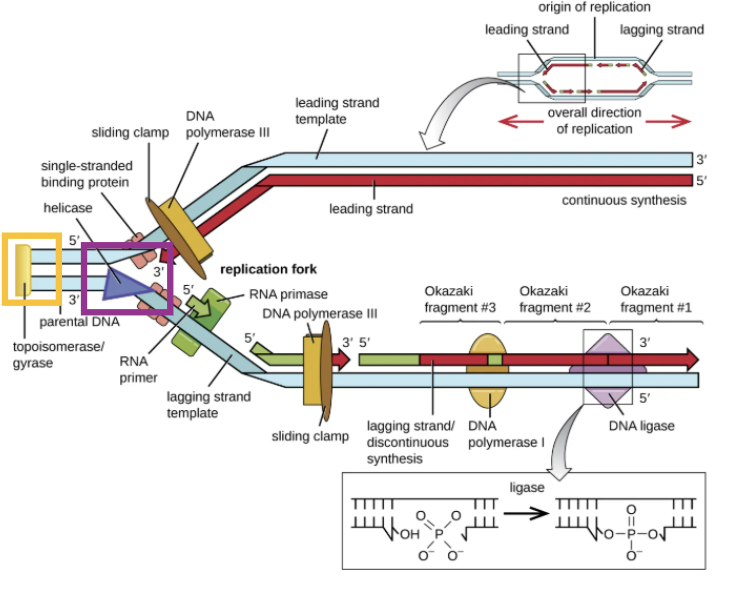
explain this and explain what the yellow and purple are
Step 1: Unzipping the double helix
• Enzymes first must make supercoiled
DNA accessible
DNA gyrase relieves supercoiling
tension in front of the replication fork
as the helix opens (negative
supercoils) (YELLOW)
Helicase breaks H bonds between
nitrogenous base pairs- separates
the DNA strands (PURPLE)
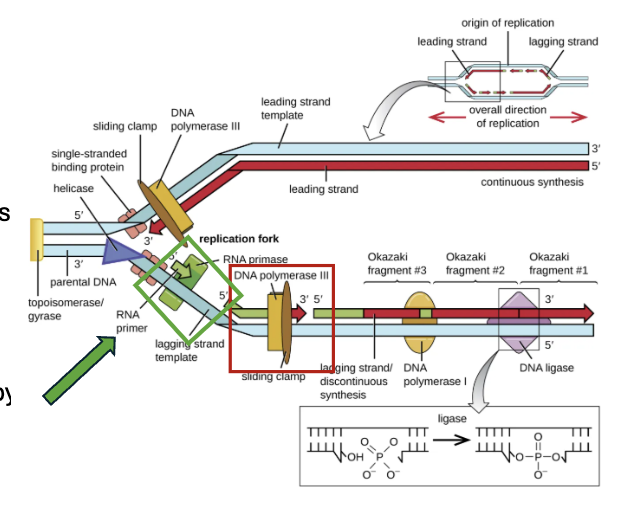
explain and what is red and green
Step 2: RNA Primers
DNA Polymerase III (we’ll come back to this
enzyme) can’t make DNA without a
nucleotide “guide” (RED)
• A short sequence of RNA, called an RNA
primer, is made at the origin of replication by
a primase enzyme to start the replication
process (GREEN)
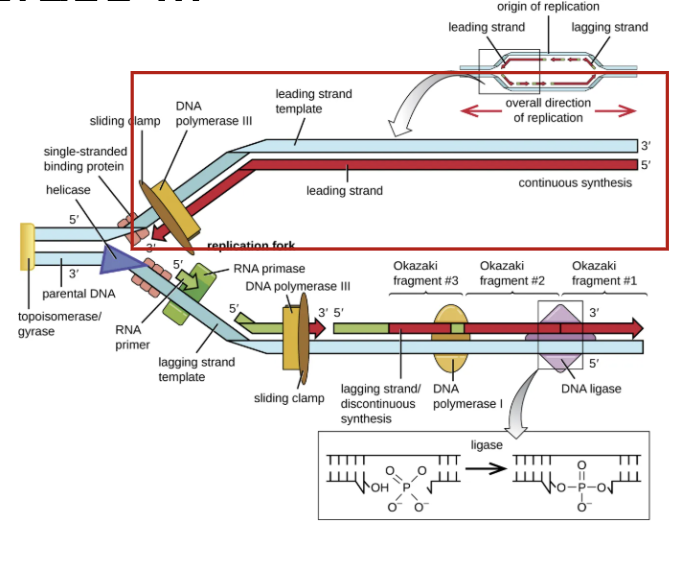
explain and what is the red
Step 3: DNA Polymerase III
DNA Pol III: The enzyme that
synthesizes replicating DNA
• Must have an RNA primer to
start
• Can only read the template
strand in the 3 ’→ 5’ direction
• Which means it can only make
DNA in the 5’ → 3’ direction
this is the Leading strand
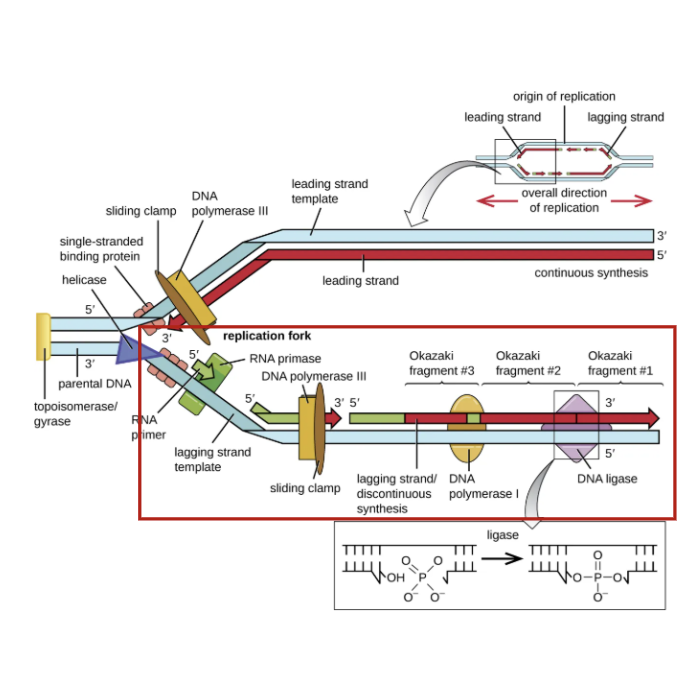
explain
Step 3: DNA Pol III
• Lagging strand synthesis
• Each fragment requires a new
primer
• DNA Pol III works backwards on
this strand, still making the new
DNA in the 5’ → 3’ direction
• The short DNA fragments are
called Okazaki fragments
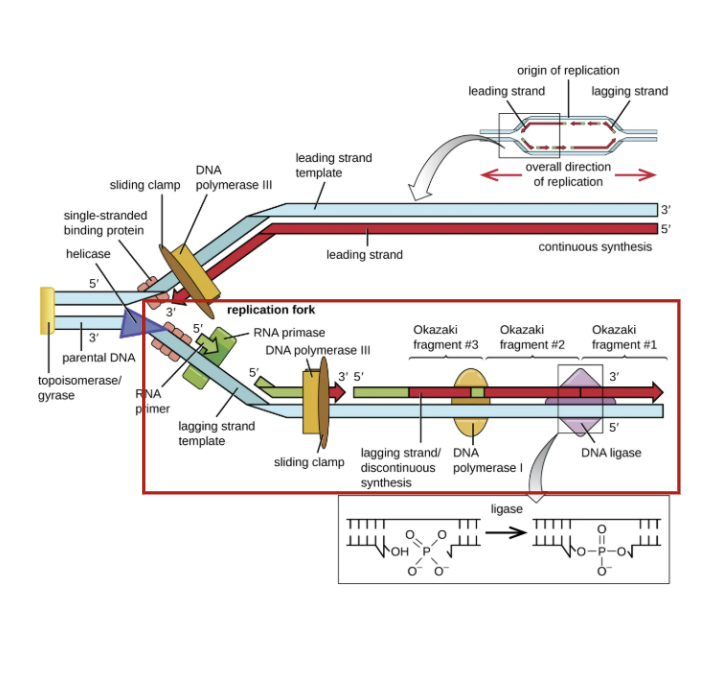
explain
Step 4: DNA Pol I
• DNA Polymerase I
• Removes the RNA primers from
the Okazaki fragments
• The gaps between fragments are
filled in
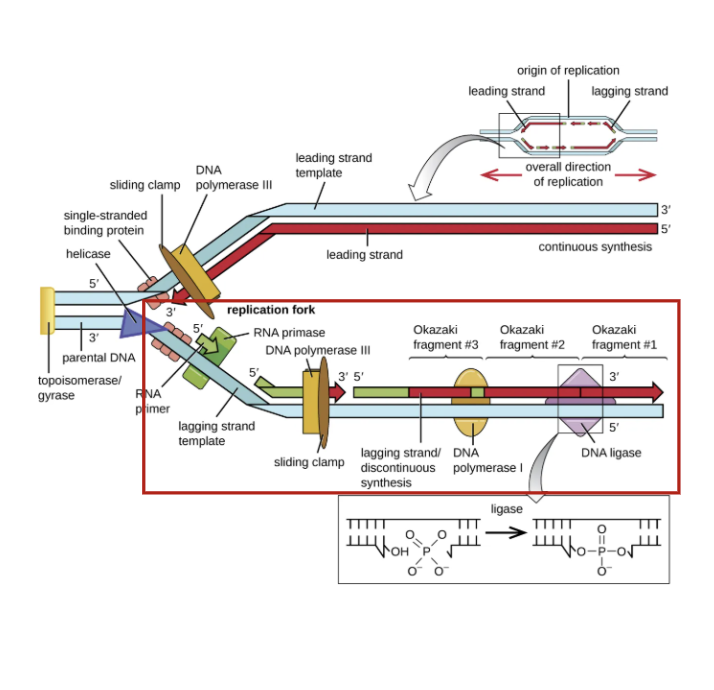
explain
Step 5: Ligase
• Ligase
• Connects the phosphate
sugar backbone
segments of fragments
on the lagging strand
A bacterial chromosome will have two
—
replication forks
replication forks is where
• Where new DNA is being synthesized
What happens when we hit the end? of DNA Replication
They reach a termination site and replication shuts down
• A helicase cuts (nicks) the still-connected strands
• They become two daughter chromosomes
Rate of Replication
• Has to be —
• ~— bases per second in bacteria
fast!, 750
DNA Encodes three things:
Proteins
• RNA
• Expression regulators
Codons- definiton
groups of three base
pairs that encode an amino acid
DNA is transcribed into —
—
messenger RNA (mRNA
How does RNA differ from DNA?
• —
Single stranded
• Uracil replaces Thymine
• Different sugar (ribose instead of deoxyribose)
Several different forms of — exist
• Only — becomes protein
RNA, mRNA
Transcription does what
Making mRNA
Transcription Three steps:
1. Initiation
2. Elongation
3. Termination
• The enzyme responsible for transcription
RNA Polymerase
Step 1: Initiation
RNA Pol has to recognize a specific spot on a gene that needs to be
transcribed into mRNA
Promoter region: definition
two sets of DNA sequences that guide RNA Pol to the
start site
Sigma factor definition
: Special protein that helps RNA Pol find the promoter
Step 2: Initiation
RNA Pol unzips the DNA helix and forms a bubble where
transcription can occur
in Step 2: Initiation Only one strand of DNA is transcribed:
template strand, 3’ to 5’ strand is the template strand
start codon: TAC (AUG on the template strand) is where
—
translation starts on mRNA
what happens in Elongation
The mRNA molecule is synthesized, mRNA molecule is 5’ to 3’, DNA is “re-zipped” after transcription occurs
Termination what happens
RNA Pol hits a site on the DNA that signals termination
• The complete mRNA is separated and released from the
transcription machinery
How long is mRNA?
• Varies
• Can be as short as 100 nucleotides
• Average: 600 nucleotides
• Up to 1500 nucleotides!
dna -rna - amino acid genetic code what is it
A, T, G, C → U, A, C, G → Amino
Acids
what is Messenger RNA (mRNA) sequence
5’-AUGUUCGCUAGUUAA-3’
Translation steps
1. Initiation
2. Elongation
3. Termination
4. Protein Folding
5. Processing
Translation Step 1: what happens and what 2 players are therer
mRNA leaves the
transcription site and
moves to the ribosomes
mRNA binds the small
subunit of the ribosome at the start codon: AUG
tRNA binds to the large
subunit of the ribosome
tRNAs begin to move onto the
ribosome
• Unique tRNA for each
codon
• Pool of all tRNAs surround
the ribosomes in the
cytoplasm
What is a tRNA? and what do they carry
Transfer RNA
Separate class of RNA molecules
Carry amino acids to the ribosome during translation
Anticodon:what happens
the tRNA pairs with the mRNA codon and
is complementary. AUG on mRNA → UAC on tRNA
AMEOBA SISTERS

