Waves, Rectilinear, Interference/Diffraction/Polarization
 Call Kai
 Learn
Learn Practice Test
 Spaced Repetition
 Match
Match Flashcards
 Knowt Play
1/71

There's no tags or description
Looks like no tags are added yet.
Name | Mastery | Learn | Test | Matching | Spaced | Call with Kai |
|---|
No analytics yet
Send a link to your students to track their progress
72 Terms
A theory that also suggests that velocity of light in rarer medium is greater than in denser medium. It also explains the interference, diffraction, and colors in thin films. And affirmed by Foucault in 1850
Huygen’s wave theory
A disturbance in a medium that carries energy without a net movement of particles
Wave
A transverse wave, characterized by alternating electric and magnetic fields propagating perpendicular to the direction of the wave
Light
A type of wave in which the displacement of the particle is parallel to the motion of the wave e.g.: sound waves, ultrasound waves, seismic p-waves
Longitudinal wave
A type of wave in which the displacement of the particle is perpendicular to the motion of the wave. e.g.: ripples on water, seismic s-waves, electromagnetic waves
Transverse wave
A type of transverse wave where it starts at a point and travel at an infinite distance in which the points maximum and zero displacement vary from instant to instant. There is wave propagation
Travelling wave
A type of transverse wave where it is resulted from the interference of waves reflected back and forth between two fixed barriers. There is no wave propagation
Standing wave
An upward motion of the wave
Crest
A downward motion of the wave
Trough
The distance from the equilibrium position and it could be positive and negative
Displacement
The maximum displacement of the particles within the wave from their normal equilibrium positions
Amplitude
In the longitudinal wave, areas of maximum displacement are known as
Compressions and rarefactions
The distance traveled by light as it goes through one complete vibration, i.e. distance between two successive crests or two successive troughs
Wavelength
Tenth-billionth part of a meter
Angstrom
One-billionth part of a meter
Nanometer
One-millionth part of a meter
Micrometer
The completion of the regular periodic event of a wave
Cycle
The time required by the wave to complete one cycle of one vibration
Period
The number of complete waves generated by the source in one second (hertz)
Frequency
The rate or speed at which the wave travels in a given period of time
Velocity
Wavelength and Frequency are inversely proportional
True
When light passes from one optical medium to another, the velocity and the wavelength will change but the frequency remains the same
True
It is a dark image formed by intercepting light rays
Shadow
“In a homogenous and isotropic medium, light travels in a straight line”
Isaac Newton
It is blocked by an opaque object will produce a shadow known as Umbra (absolute geometric shadow)
Point source
It is blocked by an opaque object will produce a shadow with 2 regions
Extended source
A Latin word which means “shade” of the shadow with sharp boarder, the inner part of the shadow which is completely dark
Umbra
It is derived from the Latin word “paene” which means “nearly”, it is the outer region of partial darkness around the umbra
Penumbra
An annular eclipse where the region that begins past the end of the umbra cone.
Antumbra
The uniform central region of illumination
Full Illumination
The outer annular region of illumination with partial darkness
Partial Illumination
Shadow formed will be the same shape as the aperture
True
A natural phenomenon that further demonstrates the Law of Rectilinear Propagation of Light
Eclipse
The earth moves between the sun and the moon, blocking sun’s light
Lunar Eclipse
It happens when the moon is between the earth and the sun; the moon’s shadow covers part of the earth
Solar Eclipse
Type of solar eclipse when the moon passes between the sun and earth but the alignment is not perfect and leaving a crescent shaped Sun
Partial Solar Eclipse
Type of solar eclipse when the moon located in the middle of the sun, and it doesn’t completely cover the entire disk of the sun. This results in a thin ring of sunlight that is visible around the outside of the moon
Annular Solar Eclipse
Type of solar eclipse when the moon completely blocks the sun, creating a shadow on the earth’s surface. This results a visible halo around the dark moon in front of the sun
Total Solar Eclipse
It is the simplest type of camera which doesn’t use a lens to form the image of an object; it consists of a light-tight box of adjustable length and dark interior, also known as Camera Obscura
Pinhole Camera
Arab physicist who first described the camera obscura effect
Alhazen
He is the first to be able to manipulate the image by fitting the pinhole camera with convex lenses and mirrors, i.e. concave mirror would enable the device to reflect an image right side up
Giovanni Battista della Porta
It is used to solve problems involving rectilinear propagation of light, they are pair of triangles which share a common apex/angle; wherein their side lengths are congruent
Similar Triangles
The path of a single photon or particle of light
Light Ray
Light rays are spread apart as if originating from a point
Divergent Pencil
Light rays come together to meet at a single point
Convergent Pencil
Light rays never meet
Parallel Pencil
Collections of different pencils of light arising from an extended source
Beam of Light
The reciprocal of the distance from the point in question to the source or focus. General term by which convergence or divergence of light may be expressed
Vergence
Type of Lunar Eclipse when entire moon passes through full shadow
Total Lunar Eclipse
Type of Lunar Eclipse where some part of the moon passes through full shadow
Partial Lunar Eclipse
Type of Lunar Eclipse when moon passes only through partial shadow
Penumbral Lunar Eclipse
A phenomenon which occurs when two waves meet, collide, or intersect while traveling along the same medium. It is interaction of waves at point of crossing
Wave Interference
Type of interference where the crest of one wave meets the crest of a wave, they will interfere in such a manner as to produce a “super-crest”, or “super trough” when trough interfere to one another. The wave are IN PHASE
Constructive Interference
Type of interference of a crest with trough and has the tendency to decrease resulting amount of displacement of the medium. The waves are OUT OF PHASE
Destructive Interference
When two waves interfere, the resulting displacement of the medium at any locations is the algebraic sum of the displacements of the individual waves at the same location
Superposition Principle
Who proposed the Superposition Principle?
Thomas Young 1801
When both constructive and destructive patterns occur, it is called ____
Rouge waves
Two waves sets merging together result in combined wave heights
Constructive Interference
Two waves sets off phase result in cancelling out wave heights
Destructive Interference
When you see colors, colors in soap bubbles, colors produced by anti-reflective coatings of lenses are the evidences of the type of ______
Constructive Interference
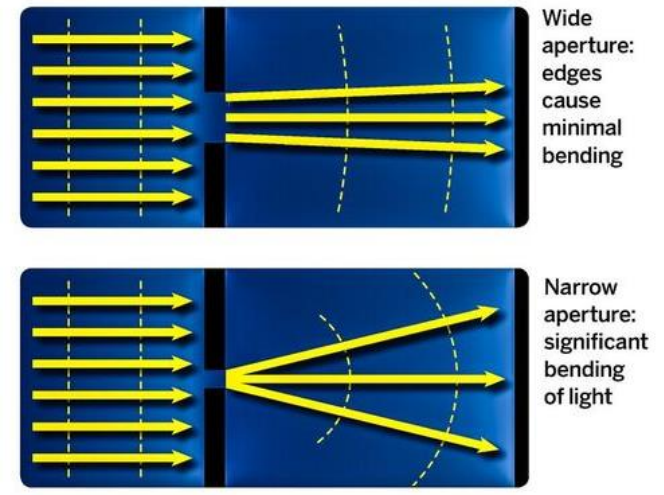
The apparent bending of waves around small obstacles and the spreading out of waves past small openings
Diffraction
A bright region in the center, together with a series of concentric rings of decreasing intensity around it and it is discovered by George Airy
Airy Disk
Hologram on credit card, rainbow pattern on CD or DVD is an example of _____
Diffraction
An optical component with a regular pattern which splits light into several beams traveling in different directions. The directions of these beams depend on the spacing of the grating and the wavelength of the light so that the grating acts as a dispersive element. They are commonly used in monochromator and spectrometers
Diffraction Grating
The process of transforming unpolarized light into polarized light
Polarization
It is the type of polarization where the light wave that is vibrating in more than one plane
Unpolarized Light
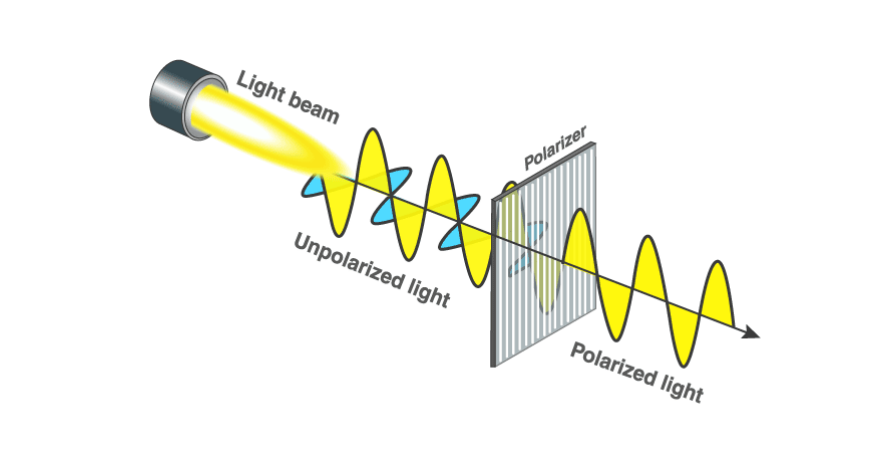
It is the type of polarization where the light wave in which the vibrations occur in a single plane
Polarized Light
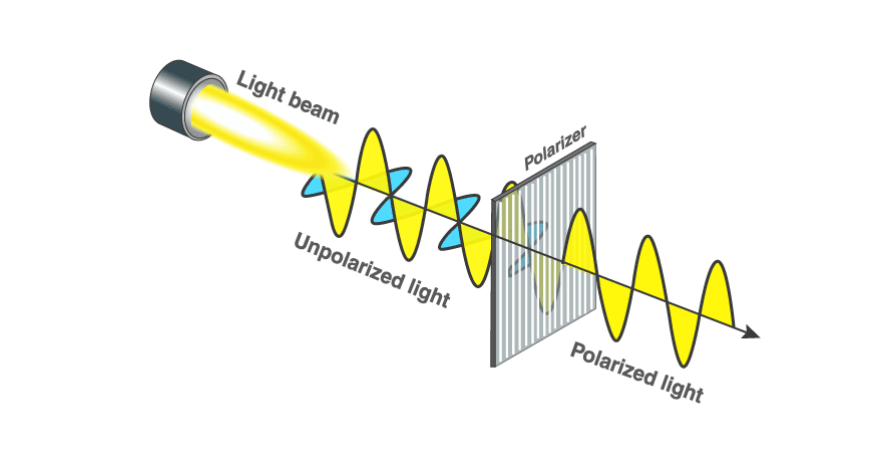
The 4 methods of polarization (TRRS)
Transmission, reflection, refraction, scattering
One of the method in polarization where the polaroid filter is used in which it is capable of blocking one of the two planes of vibration of an electromagnetic wave
Transmission
One of the method in polarization when a beam of ordinary light is reflected from the surface of transparent medium like glass or water. The degree of polarization varies with angle of incidence
Reflection
One of the method in polarization when the path of the beam changes its direction.
Refraction
One of the method in polarization when the light is seen in a direction perpendicular to the direction of the incidence, it is found to be plane polarized.
Scattering
Explore top notes

Explore top flashcards
