anth2020 reading summaries
 Call Kai
 Learn
Learn Practice Test
 Spaced Repetition
 Match
Match Flashcards
 Knowt Play
1/21

There's no tags or description
Looks like no tags are added yet.
Name | Mastery | Learn | Test | Matching | Spaced | Call with Kai |
|---|
No analytics yet
Send a link to your students to track their progress
22 Terms
Hau’ofa (westernisation)
Hau’ofa draws attention to/debunks several dominant Western narratives about the Islands – make a list of 3-4 and consider whether these narratives are persistent today. What if any new dominant Western narratives have arisen since the 1990s?
The savage culture of the indigenous people in european colonialism and christian missionaries
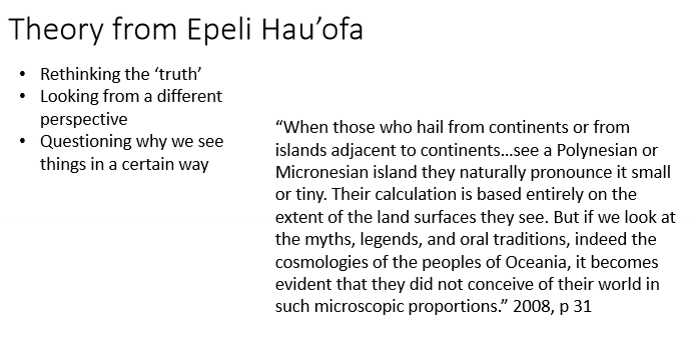
The islands are too small to sustain life, too little resources and can't grow economically or socially
Called it as islands in a far sea and not a collection of islands in the sea to emphasise the smallness
Misunderstood language, and the idea that all the islands are the same
Grouping island life with the third world country narrative just because it is different
The islands are isolated
What, in his view, is the significance of the term Oceania vs Pacific Islands?
The pacific islands is small areas of land sitting ontop of the water, but oceania is more romantic and larger
Hau’ofa was awarded a PhD in Anthropology from ANU. What, if any, influences of anthropology do you see in his argument/perspective?
Applied anthropologies with the case studies and thoughts of real people
The input of myths and stories of islands
Collective vs individual thought
Meanings behind words and terms and what thoughts they evoke
Considering his last paragraph especially, what avenues do you think he might suggest for ‘Oceania rising’?
Educating people on the power and stories of the islands
Power to indigneous people
Increasing connection relationships with the islands and realising their potential
Telling islanders to be proud of their heritage
Maintaining self sufficiency
Using more resources from the island
Tengan pasifika theory
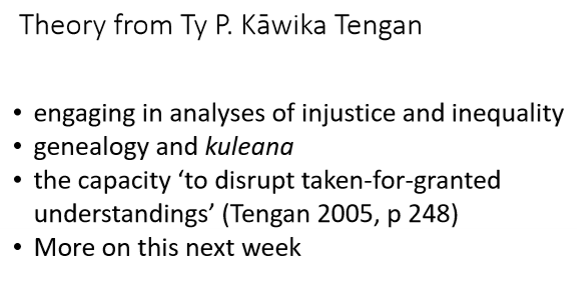
Hau’ofa pasifika theory
Hau’ofa criticism of anthropology in oceania
What are some of his critiques, and ways forward?
Misrepresentation of culture and identity because we distort it for a scientific or neutral focus
Issues with communication, what do we actually want from them?
Pacific islanders go into it with the thought that they will learn more about their culture and are disappointed that its more generalised
We are scientists not novelists
Gross exaggerations and stereotypes in the past
Romanticism of certain cultures and shaming of others
Anthropologists study what they want to see, like in melanesia there are several studies on fighting, paying off brides etc but none on love and kindness
Need to work side by side with governments, cultures and academics to create a more varied pool of information
Stop monopolising research
Not involved enough with the communities we are researching
Anthropologists need to learn the culture and nuances of the places they are studying
How have things changed and stayed the same since 1975?
The world has generally become more sensitive to racist comments and evaluations, for example there are ethics boards
More people of colour and cultures are anthropologists
More education and understanding of different cultures
Stereotypes still persist
• Epeli argued for Indigenous Pacific islanders to produce narratives that are “our own distinctive creations” (Hau‘ofa 2000) • keeping cultural depth and reach, roots and routes, always articulated together • How to make broad connections and new relationships without losing cultural specificity • “Culture and identity can, and must, be viewed in more expansive and fluidic terms than are typically afforded “native” traditions by modern discourse, but this expansive and fluidic reach must also not come at the expense of the more familiar depth and specificity” Diaz 29
Tengan Kula reading
What is kuleana and why is it important?
Rights and responsibilities of a person in Hawaiian culture (Oiwi)
Central to her feelings and actions as an indigenous anthropologist
The right to care for ones ancestors and honour traditions, to make the bones alive
It chooses them and is a gift from the ancestors so it must be honoured, guides everyday actions and choices
Ethical contention on if anthropology is honouring due to the harm it has caused
Honouring to place and also to be investigative in ethnography an research
What is unsettled and unsettling ethnography?
Anthropology and ethnography that cannot be defined, whether that is indigenous culture that is always changing or opinions that are contested, but these reduce generalisations and stereotypes
Allows relationships and responsibility of anthropologists work to be taken
Struggle characterises the result and research
Lughood
gender and post colonial theory; why so much focus on culture, what is an insider/outsider, culture creates the other,
Waiko
gender; British and Aust administration segregated PNG women and others, regulating movement,
clothing in the name of ‘protection’
• Document/understand more about ‘colonised women’s’ experiences
• Village is a colonial creation, enacted by colonial segregation for the Indigenous population,
especially women
• Melissa Demian, Michael French Smith, Ceridwen Spark ethnographies about Port Moresby
• Sex and hierarchies, double standards, white men can marry/have sexual relations with PNG
women but nobody was allowed to ‘cross’ racial lines
• Hawai’i sovereignty movement (Trask)
• Keep Hawaii Hawaiian: Welcome to Hawaii - the home of aloha, and the birthplace of surfing
(Vol. 2022, Issues 5–12). (n.d.). [Video recording]. ABC TV.
• Grace Mera Molisa critique of post-independence politics and statebuilding in Vanuatu, of
foreign ‘aid’/experts and local leaders
Jolly
gender; bride price and bead construction in vanuatu, debates around if kastoms should be kept with the intoduction of the cash economy, discussions need to be held with women about if they enjoy the practices and how they are effected, explifies the importance of origin, and of worth between the islands
Taylor
gender; importance of kava in vanuatu, related to fertility and the cosmos, for womens use it was heavily regulated by colonialism, for women particularly there is a discourse in the socio-political place of modernity vs tradition
McGavin
Identity; pacific islander identity in australia “nesian”, authentic behavour and ideas around how ‘islander’ someone can be, behaviours that make you ‘authentic’, race, stereotypes, connections to home
Teaiwa
Identity, nuclear testing; • The bomb and the bikini symbols of destruction, phallic element, destroying Bikini Atoll, erasure of the Bikinian people contrasting the visibility of bikini clothing/female body • Not well known that bikini was named after Bikini bombing; obfuscation • Bikini means ‘beach’ in Marshallese language, symbolising surrendering the beach for test • Christian goodwill, to help the international community • Justified by US/others in terms of small population being affected, promised they could return after a short time • Does tourism continue some of these dynamic, different kinds of tourism? • bikinis were named after the Bikini atoll nuclear testing, representing entwined acts of colonialism, sexism, patriarchy. • Exposure of women’s bodies to male gaze • exposure of Bikinians to bodily suffering and harm. • Bikini Islanders were erased yet tourists walk around the islands in bikinis, enjoying tropical paradise • Bikini is the local language term for ‘beach’
Trask
Identity; sovreignity issues with colonialism and strive for independence, fabrication from white anthropologists and not using stories from the people rather academics, idea of liberation from culture (disagree), don’t know about their own past, lack of ethics in evidence
Iamo
Identity; criticisms of margret mead, had too much white bias in work, emphasised and ignored certain parts of new guinea, emphasised western power, belief that they needed to be saved
Jetnil-Kijiner
nuclear testing; poetry book and video ‘tell them’, ideas around climate change effecting sea level rise and being left behind, importance of mothers and nature,
Kabutaulaka
Questioning narratives; representation of melanesia, racial mapping (blackness associated), “noble savages” and negative representation, the melanesian way (celebration of diversity?)
Banivanua Mar
Questioning narratives, decolonisation; • Sees decolonisation in the Oceanic world as an indigenous and an international phenomenon • Indigenous peoples responded to these limits by developing rich intellectual, political and cultural networks transcending colonial and national borders • not as an historic event, but as a fragile, contingent and ongoing process continuing well into the postcolonial era • “while traces of Indigenous peoples’ presence and movements are often detectable in the archive, it is often our informed imagination that must picture their thoughts, emotions, desires, anger and intentions”
Marsh
• many women have always engaged with “feminism,” even if the label had been rejected • there is a need for feminism in the Pacific • developing relevant definitions and agendas for such feminisms such as Mana Wahine and Mana Tama’ita’i • Pacific feminism ‘can navigate different oceans of thought, charting its way between interconnected islands of culture, class, religion, and other ideological institutions and frameworks, mapping solutions embedded in specific, contextualized understandings’
DeLisle
Nurse midwives in guam: • Eradicating traditional practices • Because they didn’t align with the US beliefs (medical, hygiene) – ‘modernity’ • Had already experienced Spanish colonialism including disease and violence, erasure and co-optation of local beliefs to add to their control • They thought of themselves as liberators, ‘rehabilitation’, development, public health, education, assimilation • Wanted American settlers, farmers to move there and work on the land, including a wage economy • Midwives, involved healing more broadly, godmothers • Their practices seemed unsafe, unhygienic, not modern to the colonial authorities • Pregnancy, reproduction, the next generation • Older generation and seen as threat to authority • Government wanted to train the younger generation in this vein of assimilation • Blending traditional and western cultural systems • Continuing traditional practices • Adopting some medical aspects to help ensure continuity in other ways PLACENTAL POLITICS: • Using old practices as forms of resistance; insistence on the old while practicing the new and vice versa (para 3) • Persistence, with links to the concept of Resurgence • Relations with the land and other elements (spiritual) • Important for mental and physical wellbeing for women giving birth and for the community in general • Pattera leadership • Burying placenta form of protection for baby, health for mother • Asserting some autonomy in shaping who the baby becomes and in doing so, the future • colonizers sought to maintain their own health and stamina in a foreign environment while exerting control over and “civilizing” the local population • medical treatment to sustain a labour force • Maternity care to increase the birth rate • Biomedical knowledge is one way populations are disciplined and controlled • Surveillance, Record-keeping, Medicalisation • In the name of producing the right population • In the name of health and vitality – but to benefit who/what?
Diaz
"Milanesians" in minesota, • a Chuukese community of almost 700 people has sprung up in rural, southwest Minnesota plains; Chuukese now comprise three-quarters of the town’s population • “They want to continue to be Micronesian in what they think is modern America by revitalizing outrigger canoe building and sailing using traditional knowledge from their kinship relations in the Central Carolines.” • Developing a partnership to practice indigenous Micronesian cultural traditions in Dakota homelands, waters, and skyways without replicating the sins of settler colonial dispossession and disenfranchisement, canoe revitalisation practices, community resilience and decolonisation through revitalisation
Molisa
critique of post-independence politics and statebuilding in Vanuatu, of foreign ‘aid’/experts and local leaders
clifford geetz
associated with symbolism in culture
lim-bunnin
can’t use the word transgender because it implies a binary gender, assumes there is order to genders which implies inequality, western academia often flattens impact through assumptions, gender does not conflict with body

