12: Competition
 Call Kai
 Learn
Learn Practice Test
 Spaced Repetition
 Match
Match Flashcards
 Knowt Play
1/50

There's no tags or description
Looks like no tags are added yet.
Name | Mastery | Learn | Test | Matching | Spaced | Call with Kai |
|---|
No analytics yet
Send a link to your students to track their progress
51 Terms
Competition:
What are the two types of competition?
Intraspecific = within the same species
Interspecific = between different species, both reduce fitness
What is intraspecific competition?
Individuals of the same species compete for the same limited resources (e.g., food, space), leading to reduced growth, survival, or reproduction
What is interspecific competition?
Different species compete for shared resources, negatively affecting both populations
Example of interspecific competition (lions & hyenas)?
Both compete for the same prey → shared resource use limits growth of both populations
Mechanisms:
What is interference competition?
Direct competition through physical interactions (territorial defense, aggression, toxins) that prevent access to resources
What is exploitative competition?
Indirect competition where individuals consume shared resources, reducing availability for others
Example of exploitative competition?
Trees block sunlight, limiting growth of understory plants
Can interference and exploitative competition occur in both types?
Yes, both intra- and interspecific competition can involve either mechanism
Models:
What do Lotka–Volterra competition models do?
They mathematically describe how two species interact and predict outcomes like coexistence or exclusion
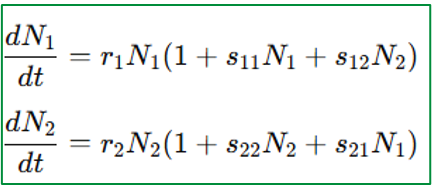
What do N₁ and N₂ represent?
Population sizes of species 1 and species 2
What do r₁ and r₂ represent?
Intrinsic growth rates of each species (how fast they grow without limits)
What do s₁₁ and s₂₂ represent?
Intraspecific competition (self-limitation within each species)
What do s₁₂ and s₂₁ represent?
Interspecific effects (impact of one species on the growth of the other)
What do negative s values indicate?
They reduce population growth; more negative = stronger competitive effect
Interspecific Competition:
What are the four possible outcomes?
Species 1 wins, species 2 wins, coexistence, or competitive exclusion (unstable, depends on starting sizes)
What is competitive exclusion?
One species outcompetes the other, leading to its local extinction
When is exclusion unstable?
When the outcome depends on initial population sizes rather than fixed conditions
Intraspecific:
What happens as population density increases?
Competition intensifies, reducing survival, growth rate, and body size
Grasshopper example (Denno & Roderick)?
High density leads to lower survival, slower development, and smaller adult size
Plant example (Tilman)?
Higher density → reduced biomass and smaller plants due to competition for resources
How does this relate to logistic growth?
As populations approach carrying capacity, self-limitation (intraspecific competition) increases
What is self-thinning?
Over time, crowded populations lose individuals as competition eliminates weaker ones
What is the self-thinning rule?
High initial density results in fewer but larger individuals later
Environment & Parameters:
How does nitrogen availability affect competition?
More nutrients increase growth rate (r), allowing faster population growth
How does density affect s₁₁?
Higher density increases self-limitation (more negative s₁₁)
What causes negative s values?
Limited resources create competition that reduces growth
How does environment affect competition models?
Changes both growth rates (r) and competition strength (s values)
Lab Studies:
What did Gause (1934) demonstrate?
Competitive exclusion using Paramecium species in controlled lab conditions
What happened when Paramecium species were grown separately?
Only intraspecific competition occurred, and populations grew normally
What happened when grown together?
One species (P. aurelia) outcompeted the other → competitive exclusion
When is interspecific competition stronger than intraspecific?
When s₁₂ and s₂₁ are larger than s₁₁ and s₂₂ → exclusion occurs
When can species coexist in experiments?
When they use different resources or occupy different niches
Why are lab studies important?
They allow control of variables and clear testing of competition outcomes
Environment:
How can environment change competition outcomes?
By altering survival, reproduction, and competitive ability of species
Example (Tribolium beetles)?
Warm/humid conditions favor one species
Cold/dry conditions favor another
What biological factors change with environment?
Reproduction rate, survival, development speed, and behaviors like cannibalism
How does this relate to L-V models?
Environmental changes modify r and s values, shifting competition outcomes
Field Studies:
What did Connell (1961) show with barnacles?
Competition plays a key role in limiting species distributions in nature
What happened when Balanus was removed?
Chthalamus expanded into the mid intertidal zone
Why is Chthalamus normally absent there?
It is excluded by interspecific competition from Balanus
What determines realized niches in nature?
A combination of competition, predation, and environmental stress
What limits the fundamental niche?
Abiotic stress (e.g., desiccation, temperature)
Why are field studies important?
They show how multiple factors interact in real ecosystems
Character Displacement:
What is it?
Evolutionary change in traits due to competition, making species more different
Character Displacement: When is it most evident?
In sympatric populations (species living together)
Character Displacement: Why does it occur?
To reduce niche overlap and decrease competition
Finch example?
G. fortis evolves larger beaks; G. fuliginosa smaller beaks when together
What happens in sympatry vs allopatry?
Sympatry → greater trait differences; allopatry → more similar traits
What happens during drought in finches?
Large, hard seeds dominate → birds with larger beaks survive better
How does competition drive evolution?
Strong competition favors traits that reduce overlap in resource use
How does this relate to L-V models?
Strong competition (large negative s₁₂, s₂₁) selects for reduced overlap, lowering competition over time

