Language Disorders Exam 2
 Studied by 0 people
 Call Kai
 Learn
Learn Practice Test
 Spaced Repetition
 Match
Match Flashcards
 Knowt Play
1/66

There's no tags or description
Looks like no tags are added yet.
Name | Mastery | Learn | Test | Matching | Spaced | Call with Kai |
|---|
No analytics yet
Send a link to your students to track their progress
67 Terms
Language Sampling
critical element of assessment
allows the SLP to see how children use language in naturalistic interactions
important alongside standardized tests
Factors of Language Sampling (Miller)
Nature of Interaction
Setting
Materials
Sample Size
Method of Recording
Nature of Interaction
who is interacting with the child and how are they interacting (e.g., play, interview)
idealistic language sample = collect variety of samples w/ diff partners
spontaneous conversation
allow child to initiate topics
Setting
setting affects the sample
outside therapy room is preferred (Ex. Home and Class)
Materials
materials may affect sample
new toys are more exciting than toys they know
materials = age-appropriate and of interest to the child
relate item to language (get them to talk)
Sample Size
the number of utterances obtained or the period of time in which the language sample is collected
collect at LEAST 50-100 utterances
Method of Recording
recording of the language sample also affects sample (RECCOMMENDED!!!)
can’t remember everything
HIPPA = no phone!
video recording only necessary if interested in nonlinguistic information (Ex. gesture use or eye contact)
Positive Interactions
1) Parallel play/talk
2) Interactive Conversation
3) Follow Child’s Lead
4) Limit questions
5) Give child options in play
6) Use utterances that are a little longer than what child says
7) Be comfy w/ pauses
8) Have materials that motivate the child
9) be comfy being silly and having fun
Parallel Play
imitate their vocalizations and verbalizations
describe what a child is doing or seeing
(e.g., "You're building a tall tower")
older child = talk about what you are doing as you play
(e.g., “I’m making a tower with my blocks. It’s a tall tower. The tower fell down.”)
Interactive Conversation
Want more than yes/no answers
Ask interactive questions/play games
older children = play in role-playing activities
(e.g., Let’s play school. You’ll be the teacher and I’ll be the student.”)
Follow Child’s Lead
respond to all questions and topics
unless they are overly obsessive
Limit Use of Questions
1 question every 4 speaking turns
too many questions can reduce length of the child’s utterances
makes them disinterested
Give child options in play
allows children to feel in control
helps w/ shy kids or those who don’t like structure
Use utterances that are a little longer than what child says
expand utterance to help them learn
Ex. “Doggie eat,” expand it to “The doggie is eating.”
Be comfy w/ pauses
allows the child the opportunity to initiate
be able to both initiate and respond to be effective communicators
pause continues for several seconds = use parallel talk to keep conversation going
Have materials that motivate the child
find out what child enjoys
give them the opportunity to change activities if they get bored, and have a variety of materials available
role-playing toys and manipulatives (pens, markers, snacks)
be comfy being silly and having fun
child will enjoy it more! more interactive
Guidelines for Transcription
transcribe the language sample as soon as possible after recording
Transcribe the language sample orthographically
(You only need to transcribe the sample phonetically if you are concerned with the child’s articulation or phonology)
Use Miller’s format to transcribe the sample
Miller’s Format for Transcription
writing each child and adult utterance on a separate line, with one speaker’s utterance indented to help differentiate between the speakers
Marks:
( )
[ ]
/ /
xxx
…
C
A
( )
Questionable transcription
[ ]
Gloss or contextual notes (Ex. [playing with dolls])
/ /
Phonetic transcription
xxx
Unintelligible utterance
…
Pause
C
Child
A
Adult
Mean Length of Utterance (MLU)
Total morphemes ÷ Total utterances
Ex) 100 utterances and 320 morphemes
MLU = 320 ÷ 100 = 3.2
Rules for Segmenting Utterances
A sentence = utterance.
A command = utterance
Run on sentences with "and" should contain no more than one joining clause. Sentences with more than one "and" should be divided into additional utterance.
Ex) I love mommy and I love daddy and I love my dog
C1. I love mommy and I love daddy
C2. and I love my dog
Other complex and compound sentences are one utterance.
Pauses, inhalations, and falling intonation = end of an utterance
“choo-choo” = one word (child wouldn't say “choo” by itself)
“easy-peasy” = one word
“um” does NOT equal an utterance (“um, my mom.” = 2 words)
Quantitative Measures in Language Sample Analysis
Error Analysis
Mean Length of Utterance (MLU)
Mean Length of Response (MLR)
Error Analysis
Review the transcribed language sample
Tally grammatical forms/functions used incorrectly
Tally forms/functions missing when expected
Count an error only if it violates the rules of the child’s dialect
If a child says “goed” instead of “went” for the past tense of “go,” they cannot…
inflect the word (typical of early stages)
Length Measures (MLU and MLR)
better than age for measuring syntactic development
Should not be used alone to diagnose language delay
Utterances can be long but still contain errors
Good for:
Tracking change in expressive language
Guiding assessment focus
MLU (Mean Length of Utterance)
Average number of morphemes per utterance
Count free + bound morphemes, then average
MLR (Mean Length of Response)
Average number of words per utterance
Count words, then average
Brown’s Stages (based on MLU)
Stage I: 1.75
Stage II: 2.25
Stage III: 2.75
Stage IV: 3.5
Stage V: 4.0
Calculating MLU
Start with the second page of the transcription (building rapport)
Use only fully transcribed utterances
Exclude utterances with blanks
Include portions in parentheses (doubtful transcriptions)
Count each free and bound morpheme as one
Include exact repetitions
Stuttering: count once in most complete form
Emphasis (e.g., no, no, no!): count each occurrence
Do not count fillers (mm, oh)
Do count no, yeah, hi, like
Count the following as one word/morpheme:
Compound words (birthday, pocketbook)
Proper names (Disneyland, Mr. Brown = 1 word/2 morphemes)
Ritualized reduplications (choo-choo, night-night, peek-a-boo)
Irregular past tense (saw, did): count as one
Overgeneralizations (goed, comed): count as two
Diminutives (doggie, mommy): count as one
Auxiliaries (is, have, will, can, must, would): separate morphemes
Reduced forms (gonna, wanna, hafta): count as one
Inflections (-s, -ed, -ing): count as separate morphemes
Contractions:
can’t, don’t: count as one
All others (he’s, aren’t): count as two
Add total morphemes ÷ total utterances (≥ 50)
Calculating MLR
Count words only, not morphemes
Do not count bound morphemes or inflections (-s, -ed, -ing)
All other rules are the same as MLU
Total words ÷ total utterances (≥ 50)
Count Words and Morphemes and Find MLR and MLU:
1) I like to go to the zoo
2) My dad eats two sandwiches
3) She is going to Sally’s house
4) He walked to town
5) My doggie love see saw
1) 7 words, 7 morphemes
2) 5 words, 7 morphemes
3) 6 words, 8 morphemes
4) 4 words, 5 morphemes
5) 4 words, 4 morphemes
6) Total = 26 words, 31 morphemes
6) MLR (mean length of response): 26 (total # of words)/5 (total number of utterances) = 5.2
7) MLU (Mean Length of Utterance): 31 (total # of morphemes)/5 (total # of utterances) = 6.2
Sampling Considerations
High rate of imitation
Frequent self-repetitions
High proportion of question answering (either Y/N or Wh)
Frequent routines (counting, alphabet, commercials, songs, listing, etc.,)
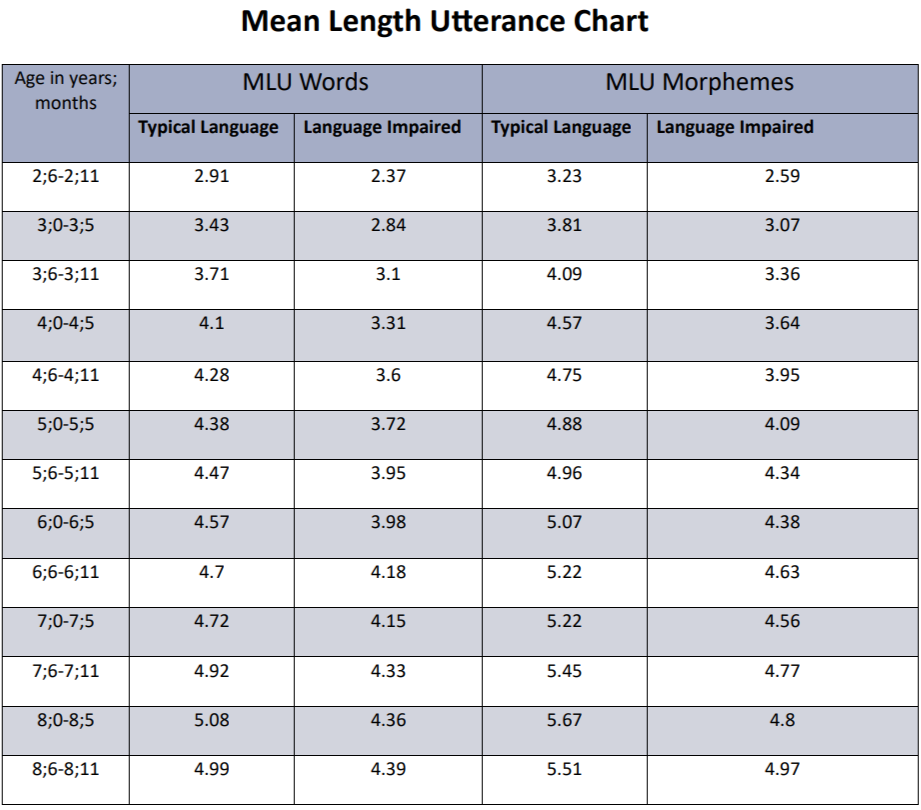
MLU Chart
Chart
Calculating MLU for School-Age Children
Use T-Units and C-Units
T-Unit
A T-unit = one main clause plus all dependent clauses and nonclausal phrases attached to it
Example (1 T-unit):
I went to the library that is across town because it had the book I needed for school.
Clauses beginning with and, but, or start a new T-unit
Example (2 T-units):
I went to the library
but I didn’t get a book because none of them looked interesting
Coordinated clauses are separate T-units unless there is co-referential subject deletion
1 T-unit: He goes and loses it.
2 T-units: He goes and he loses it.
Co-referential subject deletion reflects more advanced syntax, so it remains one unit
C-Unit
A C-unit is similar to a T-unit but allows single words or phrases
Used when responses are appropriate to the examiner’s question
Example:
Adult: Who went with you?
Child: Juan
How Many T-Units in the Following Utterance: I went for a walk but then I had to run home after it started raining.
2 T-Units
“but” breaks the T-Units
How Many T-Units in the Following Utterance: She couldn't decide if she wanted pizza or if she wanted hamburgers for dinner when her mom asked but she decided on hamburgers because she had pizza the night before.
3 T-Units
“or” and “but” break the T-Units
Analysis for Utterances
Miller’s analysis
Analysis for Sentences
T and C Units Analysis
How Many Utterances?
I went to the movies and I went to the mall and I bought a shirt and I bought some shoes and I ate popcorn and I got a stomach ache and I went home and went to bed
C1: I went to the movies and I went to the mall
C2: and I bought a shirt
C3: and I bought some shoes
C4: and I ate popcorn
C5: and I got a stomach ache
C6: and I went home and went to bed **NO I SUBJECT BEFORE WENT = keep it in same utterance
Brown’s 14 Morphemes
According to Brown, a morpheme is considered acquired when it’s realized in ___ of its obligatory contexts.
90%
Obligatory Context
Obligatory context (oc) is a place in the sentence that requires a morpheme in order to make the sentence grammatically correct according to the rules of that child’s dialect
Ex) Where did you send it?
“I sent it to ____.”
Ex) Did you send it?
“Yes.”
Ex) Target morpheme: plural –s
Sentence: Two dog ___
This is an obligatory context for plural –s
Correct: Two dogs
Incorrect: Two dog
GOAL Selection Based on Assigning Structural Stage
Assigning Structural Stage helps determine:
Which Brown’s morphemes are mastered
Which forms/functions to target in therapy
Multiple goals are often possible for children with language impairment
GOAL Prioritization
Highest priority
High priority
Lower priority
Targets used sometimes suggest the child is ready to learn them
Example: Present progressive –ing
Used inconsistently → high priority goal
Highest Priority
Forms/functions used 10–50% of the time in obligatory contexts
High Priority
Forms/functions used 1–10% of the time and understood
Lower Priority
Forms/functions used 50–90% of the time or ot used at all and not understood
Type-Token Ratio (TTR)
a measure of vocabulary diversity
the ratio for children between 3 and 8 is typically .45 (or 45%). If a child’s TTR is less than ____, their vocabulary is not adequately diverse
.45
Calculating TTR
Tally the number of types of words (each time a word is used for the first time).
Tally the tokens for each word (the subsequent time each word is used.)
Divide the number of different words by the total number of words to get the TTR.
TTR Example:
C1: I love mommy
C2: I love daddy
C3: She love me
“I” - 2
“love” = 3
“mommy” = 1
“daddy” = 1
“she” = 1
“me” = 1
6 New Words/9 Total Words = 67%
Developmental Sentence Scoring (DSS)
found by assigning scores to diff. grammatical forms that demonstrate the most significant developmental progression in a child's language that could be considered clinically useful
Take # of points divided by # of utterances
Grammatical Forms in DSS
Indefinite pronouns – refer to non-specific people or things (someone, anything, nobody).
Personal pronouns – refer to specific people or things (I, you, he, she, they).
Main verbs – show the main action or state of being in a sentence. They carry the core meaning.
Secondary (helping/auxiliary) verbs – help the main verb by adding tense, mood, or voice (is, have, will, can).
Negatives – words that show denial or absence (not, never, no).
Conjunctions – words that connect words, phrases, or clauses (and, but, because).
Interrogatives – words used to ask questions.
Wh-questions – questions that start with who, what, where, when, why, or how to get specific information.
Ex)
I will eat lunch here
l am eating a cookie
What you eating?
You like eating apples
Nobody says that
Do you want to eat some cookies
Indef. Pronoun:1(I) + main verbs: 4(will eat) + sentence point: 1 = 6
Indef. Pronoun: 1(I) + Main Verb: 3 (am=auxiliary, not copula) + Sentence Point: 1 = 5
Wh-Q’s: 1 (What) + Personal pronouns: 1 (you) + sentence point: 0 (not a real sentence, missing “are”) = 2
Personal Pronouns: 1 (you) + Main Verbs: 1 (like) + Secondary Verbs: 6 (Eating) + Sentence point: 1 = 9
Indefi. Pronouns: 4 (nobody) + main verbs: 3 (says) + Indef Pronouns: 4, 1 (that) + Sentence Point: 1 = 9
Personal Pronouns: 1 (you) + Main verb: 1 (want) + Secondary Verb: 1 (eat) + Negatives: 1 + Interogative Reversals: 3 + Indefinite Pronouns: 3
 Note
Note  Flashcards (24)