history of our planet week 4.2
 Studied by 0 people
 Call Kai
 Learn
Learn Practice Test
 Spaced Repetition
 Match
Match Flashcards
 Knowt Play
1/14

Earn XP
Description and Tags
evolution of plants and carbon silicate cycle interactions
Name | Mastery | Learn | Test | Matching | Spaced | Call with Kai |
|---|
No analytics yet
Send a link to your students to track their progress
15 Terms
Could life have played a role?
Microfossils
Molecular clocks
Carbon isotope signature of photosynthetic microbial communities
a new genetic code
Lots of phosphorous: involved in the base pairs and in metabolic processes
Fertilisers rich in P as it’s a limiting nutrient – without it cannot run metabolisms, undergo cellular reproduction
Important in plants and all life
Leaky bucket metaphor: to increase plant productivity make sure there’s sufficient P – add it into something, productivity and activity usually goes up
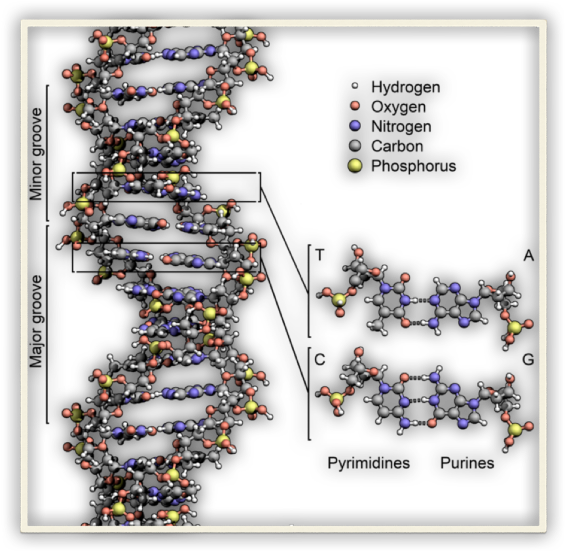
Biological amplification of weathering: -why
Source of nutrients, especially P
Biological amplification of weathering: how
Organic acids, carbonic acid, chelating agents, soil stabilisation, enhanced hydrological cycle, rock splitting
Biological amplification of weathering: global consequences
Release of P, increased organic carbon burial, source of O2
Release of Ca and Mg from silicates sink of CO2 with formation of marine carbonates, planetary cooling
Byproduct of plant wanting phosphorous and releasing calcium and magnesium
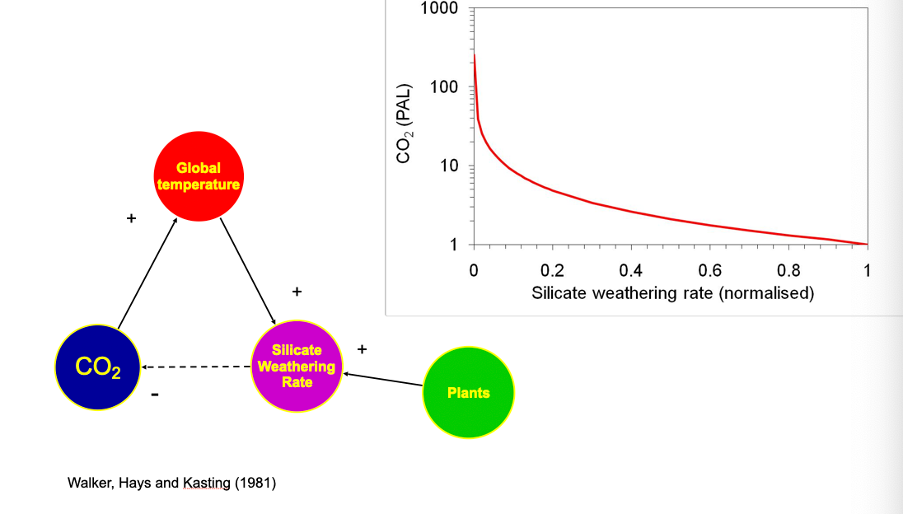
hypothesis for global cooling
Nuclear winter didn’t last very long – injected lots of ash and sulphur but only approx. 10 yrs – but this was long enough to kill large animals
This theory:
Colonisation of and by plants increases silicate weathering and export of calcium magnesium to the ocean and therefore carbonate formation and burial which decreases carbon dioxide concentrations in the atmosphere which reduces global temps.
Right now that might be self limiting as if uts gets really cold then its going to be too cold for photosynthesis. The positive feedback loop results in snowball earth. The ice sheets snap close – lots of photosynthesis stops. Theres no bio weathering etc as its all ice. Eventually co2 builds up and up until its so warm that snowball earth begins to melt
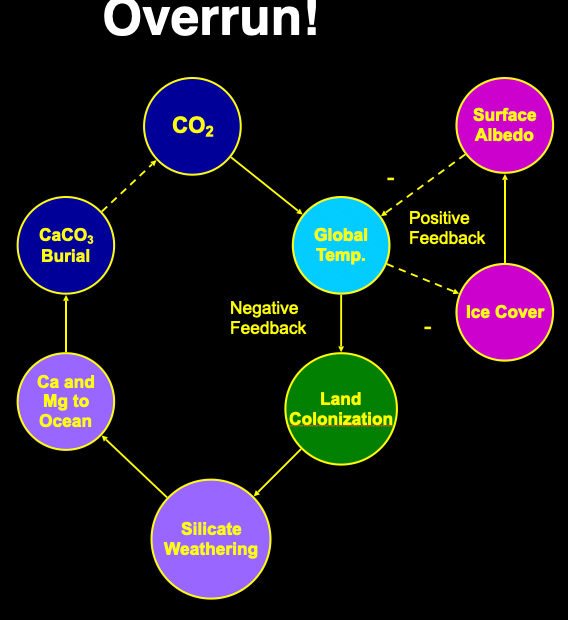
evolution of land plants
Organisms that needed to live in water – undergone series of evolutionary adaptations – can move further and further away from water, get bigger and higher, undertake more primary productivity
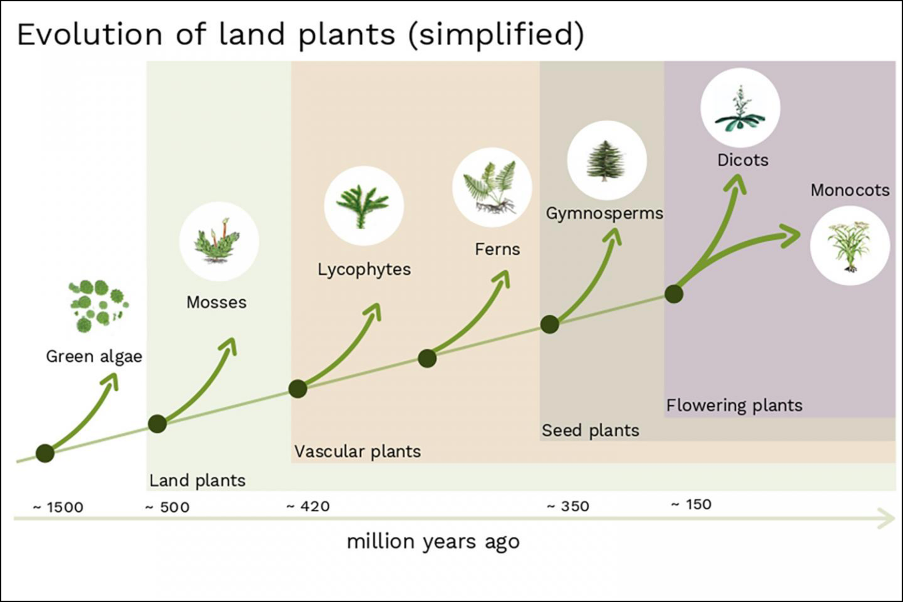
The phylogenetic ‘tree’ of plants:
First land plants were bryophytes
Liverworts
Hornworts
Mosses
Tied to moist habitats to complete their life cycle

Earliest land plants (ordrovician):
cryptospores ~475 Ma
First fragments of plants ~460 Ma
Bryophytes
trilete spores ~445 Ma
Found in groups of 4 (tetrads)
Trilete (‘Y’) marks indicate dessication-resistant spores
These are the first type of seeds of a plant that doesn’t need water in which to reproduce
Vascular plants (mid silurian):
Fossils from 425 Ma
Maintain internal water pressure (homiohydric)
No leaves or roots
Tube like structures
Could live on surface of rocks and regulate internal water pressure
Leaves and roots (late Silurian)
Fossils from 420 Ma
Baragwanathia related to modern clubmosses
Small leaves (microphylls) and proper roots
Come areas such up nutrients
Other areas become more specialised for photosynthesis
first trees (mid Devonian):
Wattieza ~385 Ma
Stumps have been known since 1870 from Gilboa, new York
Recently reunited with the crown of the tree
Up to 8m high
For spore dispersal
No proper leaves
Rignin – hard material in trees and plants – to build hard, stiff structure – go higher – beet other plants for sunlight etc.
The first forests (late Devonian):
Archaeopteris ~375 ma
Up to 10m high with 1.5 m trunk diameter
Widespread forests
New source of organic carbon for burial (lignins)
Must also have increased weathering
Large forests important for hydrological cycle – form rich soil deposits – hold water and co2 – amplify weathering
First forests would’ve had local climatic impacts
Rain forests today generate their own water
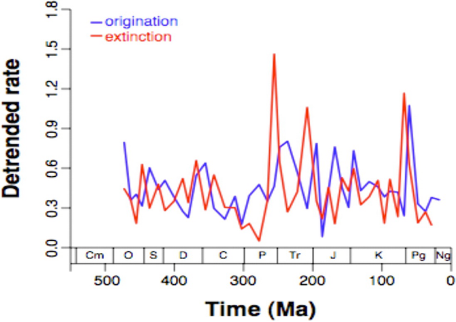
Consequences of extinctions:
Origination rates increase after extinctions as empty ecological niches are filled
After the end of the cretaceous extinction mammals diversified, rapidly increasingly in average size filling many of the niches vacated by dinosaurs
 Note
Note  Flashcards (334)