Human phisology Exam III
 Call Kai
 Learn
Learn Practice Test
 Spaced Repetition
 Match
Match Flashcards
 Knowt Play
1/53

There's no tags or description
Looks like no tags are added yet.
Name | Mastery | Learn | Test | Matching | Spaced | Call with Kai |
|---|
No analytics yet
Send a link to your students to track their progress
54 Terms
What are the muscle types
Smooth, Cardiac, Skeletal
What is the shape of smooth muscle fibers
Cylinders with pointed ends; Uninucleated; Parallel lines, forming sheets
Where are smooth muscle located
walls of hollow internal organs and blood vessels
What are the Involuntary muscles
Skeletal, Smooth, Cardiac
What are the Voluntary muscles
Skeletal
What muscle is under control of autonomic nervous system
Smooth Muscle
Cardiac Muscles are
Uninucleated, striated, and tubular; Branched, interlock at intercalated disks
How do cardiac muscles avoid fatigue
They relax completely between contractions which, prevents fatigue
What is contraction
Rhythmic, involuntary tensing of the cardiac muscle without nervous stimulation
What is the shape of skeletal muscles
Tubular, multinucleated, and striated; long; run the muscle length
What is the structural order of the skeletal muscle: Periosteum covering bone → Tendon → Fascia →
Skeletal Muscle → Epimysium → Perimysium → Muscle Fascicle → Endomysium
What is the Muscle fascicle divided into
Endomysium→ Nuclei & Striations → Sarcolemma → Sarcoplasm → Myofibrils → Myofilaments
What is a Sarcolemma
Plasma membrane
What is a Sarcoplasm
Cytoplasm
What is a Sarcoplasmic reticulum
Endoplasmic reticulum
I Bands
Light Bands
A Bands
Dark bands
H Bands
Central band of A band
Z-lines (Discs)
Dark lines in the middle of the I bands
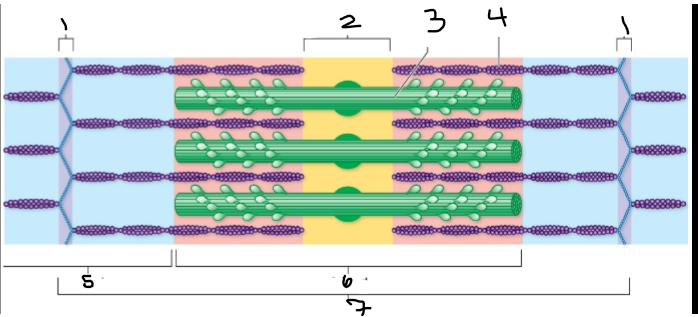
1
Z disks
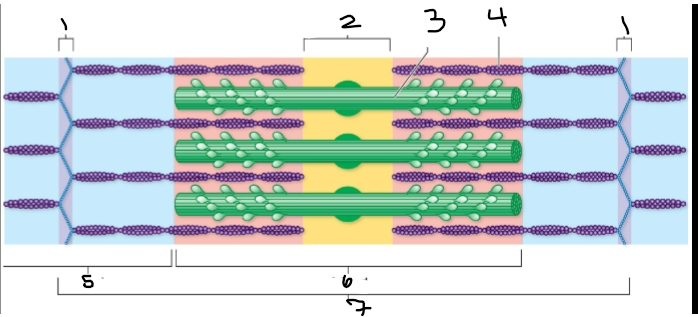
2
H band
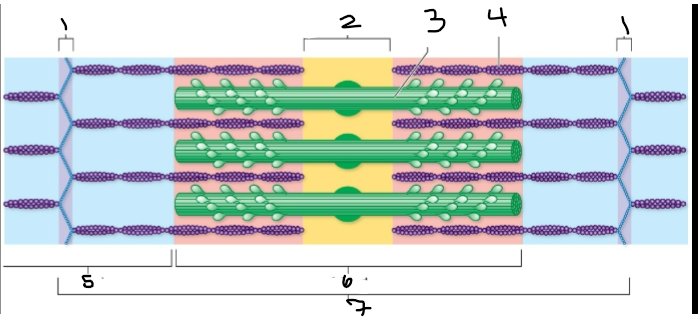
3
Thick Filaments
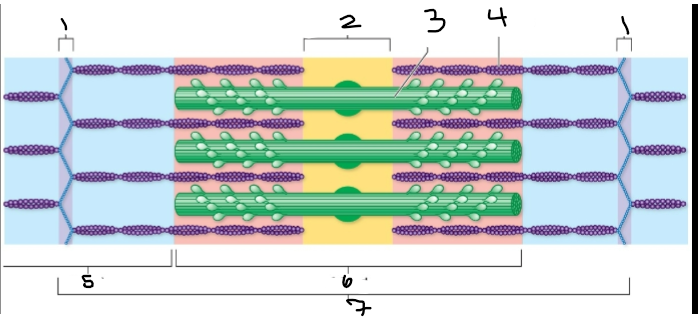
4
Thin filament
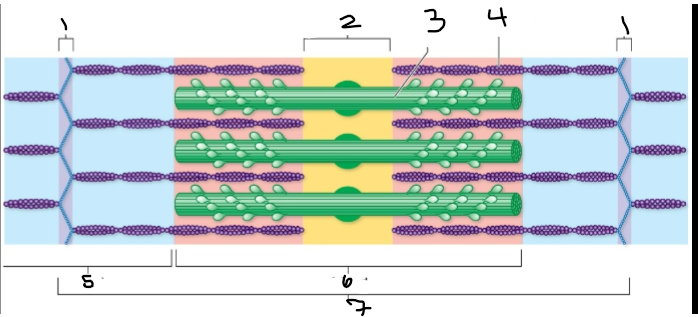
5
I band
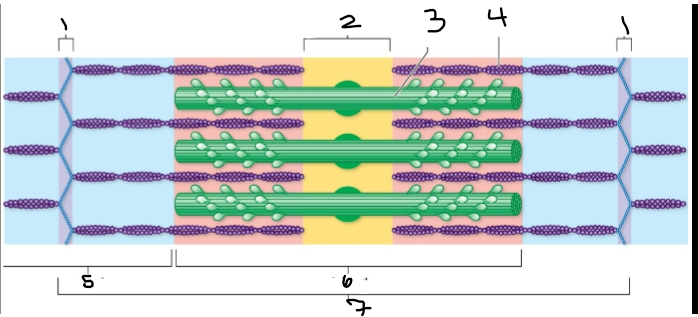
6
A Band
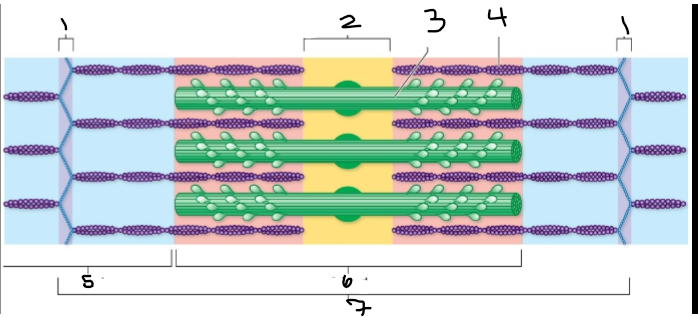
7
Sarcomere
What contains all the thick filaments
A bands
What only contains thin filaments
I bands
What are the center of the A band
H bands
What are found in the center of each I band
Z discs
What is a sarcomere
Basic subuint of striated muscle contractions
Area from z disc to z disc
3 dimensional hexagon
Sliding Filament Theory
When a muscle contracts, sarcomeres shortens
Sliding Filament Theory
A bands
Dont shorten; move closer together
Sliding Filament Theory
I Bands
Shorten; thin filaments do not
Sliding Filament Theory
H bands
Thin filaments slide over; Disappears
Thin Filament Protein
Actin; proteins called Tropomyosin & Troponin that prevent myosin binding at rest
Thick Filament protein
Myosin; Has two globular heads with actin-binding sites and ATP binding sites
What causes the shortening of the myofibrils
Shortening of the sarcomeres- Distance between z lines are reduced
How is the sarcomeres shortening accomplished
by sliding of myofilaments- length remains untouched
What produces the sliding
asychronous power strokes
What happens to the A band
same length, but pulled towards origin of muscle; pulled together as I bands shorten
Cross bridges
Linking of thick and thin filaments
300-400 globular -___ subunits arranged in a double row and twisted to form a helix
Actin
What physically blocks cross bridges
Tropomyosin

