AP Biology Unit 7 Natural Selection
 Call Kai
 Learn
Learn Practice Test
 Spaced Repetition
 Match
Match Flashcards
 Knowt Play
1/61

There's no tags or description
Looks like no tags are added yet.
Name | Mastery | Learn | Test | Matching | Spaced | Call with Kai |
|---|
No analytics yet
Send a link to your students to track their progress
62 Terms
Evolution
Change in the genetic makeup of a population over time
Descent with Modification
Proposing that species change over generations by passing modified, inheritable traits from parents to offspring
Natural Selection
Individuals that have certain traits tend to survive + reproduce at higher rates than other individuals b/c of those traits
Fitness
The ability to survive and reproduce
Heritable Traits:
Characteristics can be passed from parent to offspring
Adaptations occur
Adaptations
Inherited characteristics of organisms that enhance their survival and reproduction
Artificial Selection
The selective breeding of domesticated plants and animals to encourage the occurrence of desirable traits
Natural Selection vs Artificial Selection
Natural Selection | Artificial Selection |
|
|
Relative Fitness
The reproductive success of a specific genotype or individual compared to the most successful genotype in a population
3 modes of Natural Selection
Directional selection
Stabilizing selection
Disruptive selection
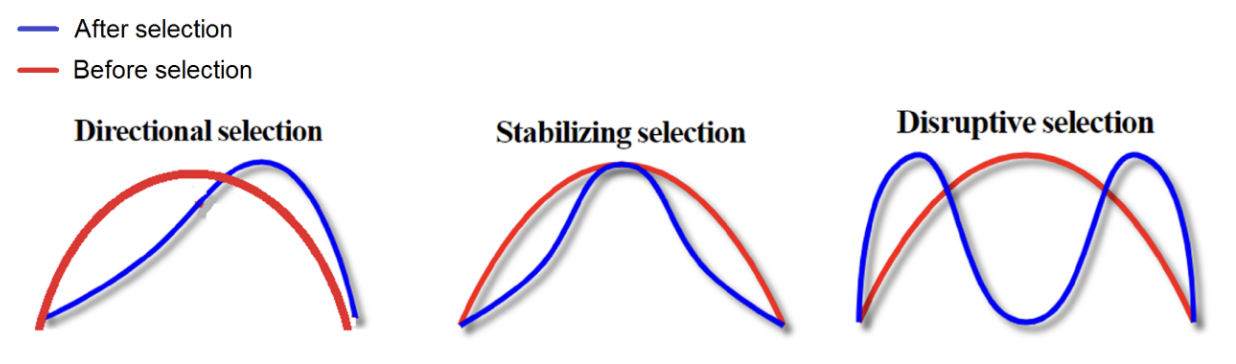
Directional Selection
Selection towards one extreme phenotype
Stabilizing Selection
Selection towards mean and against the extreme phenotypes
Disruptive Selection
Selection against the mean. Phenotypic extremes = highest relative fitness
S*xual Selection
A type of natural selection that explains why many species have unique traits
Males often have useless structures simply because females choose that trait
Can produce traits that = harm to survival (Ex: color feathers in peacocks make them easier to spot by predators)
Population
A group of individuals of the same species that live in the same area and interbreed to produce fertile offspring
Gene Pool
A population’s genetic makeup
Consists of all copies of every type of allele
If there is only one allele present for a particular locus in the population, it is fixed
Many fixed alleles=less genetic diversity
A population’s allele frequencies will change over time
Microevolution
Small-scale genetic changes in a population
Evolution driven by random occurrences like:
Mutations
Genetic Drift
Migration/gene flow
Natural selection
Mutation Results:
Mutations result in genetic variation
Can form new alleles (traits)
Genetic Drift
Chance events that cause a change in allele frequency from one generation to the next
Genetic Drift Characteristics:
Significant to small populations
Can lead to a loss of genetic variation
Can cause harmful alleles to become fixed
Two types: Bottleneck effect & Founder effect
Bottleneck Effect
When a large population is drastically reduced by a non-selective disaster (famine, fires, natural disasters, hunting, etc.)
Some alleles may become overrepresented, underrepresented, or absent
Founder Effect
When a few individuals become isolated from a large population and establish a new small population with a gene pool that differs from the large population —> Loss of genetic diversity
Gene Flow
Transfer of alleles in or out of a population due to fertile individuals or gametes
Alleles can be transferred between populations (Ex: pollen being blown to a new location)
Hardy-Weinberg
A model used to assess whether natural selection or other factors are causing evolution
Hardy-Weinberg Results:
If there are NO differences, then the population is NOT evolving, and if there ARE differences, then the population MAY BE evolving
5 conditions must be met to be in Hardy-Weinberg equilibrium:
No mutations
Random mating
No natural selection
Extremely large population size
No gene flow
If any of these conditions are not met, then microevolution occurs
More genetic diversity equals what?
Better ability to respond to changes in environment
More likely to be individuals who can withstand changes
Species with low genetic diversity → risk of decline/extinction
Ex: due to poaching and poisoning, a Condor was reduced to 27 individuals. It lowered the gene pool. Even though restoration efforts have increased, they have lost diversity.
Hardy-Weinberg Equations
q + p = 1 and q2+2qp+p2=1
q = recessive allele
p = dominant allele
2qp = heterozygous
Squared = homozygous
Comparative Morphology
Analysis of the structures of living and extinct organisms
Homology
Characteristics in related species that have similarities, even if the functions differ
Embryonic Homology
Many species have similar embryonic development
Vestigial Structures
Characteristics that are similar in two species because they share a common ancestor
Convergent Evolution
Similar adaptations that have evolved in distantly related organisms due to similar environments
Analogous Structures
Structures that are similar but have separate evolutionary origins (Ex: wings in birds vs bats vs bees)
Biogeography
The distribution of animals and plants geographically
Ex: Species on oceanic islands resemble mainland species
Ex: Species on the same continent are similar + distinct from species on other continents
Systematics
Classification of organisms + determining their evolutionary relationships
Taxonomy
The naming and classifying species
Phylogenetics
Hypothesis of evolutionary history → Use phylogenetic trees to show evolution
Phylogenetic Trees
Diagrams that represent the evolutionary history of a group of organisms
Similar to cladograms, but trees show amount of change over time measured by fossils
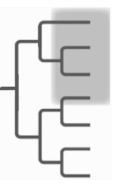
Cladograms
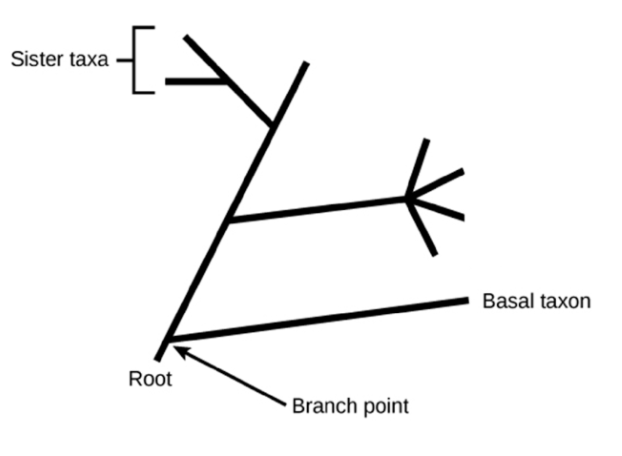
A line = a Lineage (direct line of descent)
A branch point = a node
Node (Branch Point): represents common ancestors
Clades: a group that includes a common ancestor.
Species in a clade have shared derived features
Root: the common ancestor of all the species
Sister Taxa: Two clades that emerge from the same node
Basal Taxon: A lineage that evolved from the root and remains unbranched
Synapomorphy
A derived character shared by clade members
Derived Characteristic: similarity inherited from the most recent common ancestor of an entire group
Ancestral Characteristic: similarity that arose before the common ancestor
Many cladograms and trees include an outgroup
Outgroup: A lineage that is the least closely related to the rest of the organisms
Monophyletic Group
Includes the most recent common ancestor of the group and all of its descendants (clade)
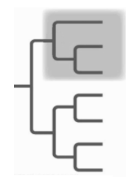
Paraphyletic Group
Includes the most recent common ancestor of the group, but not all its descendants.
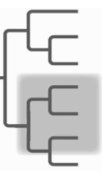
Polyphyletic Group
Does not include the most recent common ancestor of all members of the group
Species
A group able to interbreed and produce viable, fertile offspring
Speciation
Formation of new species → results in diversity of life forms; occurs due to Reproductive Isolation
Geography’s impact on speciation:
Allopatric Speciation
Sympatric Speciation
Allopatric Speciation
A physical barrier divides the population, or a small population is separated from the main population
Populations are geographically isolated. Prevents gene flow & is often caused by natural disasters
Sympatric Speciation
New species evolve while still inhabiting the same geographic region as the ancestral species
Usually, due to the exploitation of a new niche
Reproductive Isolation
Occurs when populations cannot successfully reproduce with each other → prevents gene flow and can lead to speciation (formation of new species)
Two types of Reproductive Isolation
Prezygotic Barriers
Postzygotic Barriers
Prezygotic Barriers
Prevent mating or hinder fertilization
Temporal Isolation: Species reproduce at different times
Behavioral Isolation: Different courtship behaviors prevent mating
Habitat Isolation: Species live in different habitats within the same area
Gametic Isolation: Egg and sperm cannot fuse
Postzygotic Barriers
Prevent a hybrid zygote from developing into a viable, fertile adult
Reduced Hybrid Viability: Genes of different parent species interact in ways that impair the hybrid’s development/survival
Reduced Hybrid Fertility/Sterility: a hybrid can develop to a healthy adult, but it is sterile (no kids) → results due to differences in # of chromosomes between parents
Hybrid Breakdown: The hybrid of the 1st generation may be fertile, but when they mate → offspring will be sterile (no reproduction)
Macroevolution
Large evolutionary patterns (Ex: adaptive radiation + mass extinction)
Stasis
No change over long periods of time
Punctuated Equilibrium
When evolution occurs rapidly after a long period of stasis
Gradualism
When evolution occurs slowly over hundreds, thousands, or millions of years
Divergent Evolution
Groups with the same common ancestor evolve and accumulate differences, resulting in the formation of a new species
Adaptive Radiation
If a new habitat or niche becomes available, species can diversify rapidly
Convergent Evolution
Two different species develop similar traits despite having different ancestors → analogous traits
Extinction
The termination of a species
Extinctions have occurred throughout the Earth’s history (5 mass extinctions)
Human activity affected extinction rates
Anytime there is ecological stress, extinction rates can quicken
Exit species → opens up a niche that a different species can exploit

