WEEK 6 – BEFORE AND AFTER LIBERATION
0.0(0)
Studied by 0 people Call Kai
 Learn
Learn Practice Test
 Spaced Repetition
 Match
Match Flashcards
 Knowt Play
Card Sorting
1/18

Earn XP
Description and Tags
Last updated 9:05 PM on 3/16/23
Name | Mastery | Learn | Test | Matching | Spaced | Call with Kai | Chat |
|---|
No analytics yet
Send a link to your students to track their progress
19 Terms
1
New cards
When was the “liberation”? How did it happen?
August 15th, 1945
\
→ Sudden surrender of the Japanese + rapid evacuation from Korea of Japanese citizens + gov officials + repatriation of Koreans from neighbouring countries/regions.
\
→ Sudden surrender of the Japanese + rapid evacuation from Korea of Japanese citizens + gov officials + repatriation of Koreans from neighbouring countries/regions.
2
New cards
What legacy did the colonial era leave in Korea?
* Wartime mobilization → Koreans were used to it + lost a lot of men bc of Japan’s involvement in WWII
* Class conflict and deeper class divides → mostly leftover from the many Koreans who migrated to the countryside during the war. '
* Political instability/political factionalism
* @@Specter@@ of collaboration during the colonial era.
\
→ seen in reading: Yi Taejun, “Before and After Liberation” → interesting bc written at the time it happened and Hyon was the alter-ego of Yi Taejun:
* Debate on the merit of Korean officials who stayed in Korea vs those who went abroad to fight for Korea during the War. (ex. The Korean nationalist government was staying in exile in Nanking (China))
\- In this new era, Hyon is associated w/ the Communist Party, although that’s not how he sees things.
\- “since liberation had been achieved not by the power of the Koreans themselves but by an international alliance, it can’t exist now outside the sphere of international politics
* Class conflict and deeper class divides → mostly leftover from the many Koreans who migrated to the countryside during the war. '
* Political instability/political factionalism
* @@Specter@@ of collaboration during the colonial era.
\
→ seen in reading: Yi Taejun, “Before and After Liberation” → interesting bc written at the time it happened and Hyon was the alter-ego of Yi Taejun:
* Debate on the merit of Korean officials who stayed in Korea vs those who went abroad to fight for Korea during the War. (ex. The Korean nationalist government was staying in exile in Nanking (China))
\- In this new era, Hyon is associated w/ the Communist Party, although that’s not how he sees things.
\- “since liberation had been achieved not by the power of the Koreans themselves but by an international alliance, it can’t exist now outside the sphere of international politics
3
New cards
Important Political Actors Post-Liberation (just names + affiliation)
Yo Unhyong (south)
\
Cho Mansik (north)
\
Kim Gu (nationalist leader)
\
Kim Ilsung (obviously north)
\
Syngman Rhee (south)
\
Cho Mansik (north)
\
Kim Gu (nationalist leader)
\
Kim Ilsung (obviously north)
\
Syngman Rhee (south)
4
New cards
Yo Unhyong
Moderate leftist
\
Organizer of the Committee for the Preparation for Korean Independence (CPKI) → advocated for peace during Japanese evacuation
\
Was active in the independence movement from abroad
\
Organizer of the Committee for the Preparation for Korean Independence (CPKI) → advocated for peace during Japanese evacuation
\
Was active in the independence movement from abroad
5
New cards
Cho Mansik
Christian Nationalist Leader
\
Activist in the independence movement
\
Strong rival to Kim Ilsung but was purged bc of his views and religious background, later died in foggy/unclear circumstances.
\
He founded the Korean Democratic party in 1945.
\
Activist in the independence movement
\
Strong rival to Kim Ilsung but was purged bc of his views and religious background, later died in foggy/unclear circumstances.
\
He founded the Korean Democratic party in 1945.
6
New cards
Kim Gu
Nationalist leader
\
Involved in Tonghak Movement + was arrested for “plotting to assassinate the governor-general”.
\
Strongly opposed the division of Korea, i.e., the US-Soviet trusteeship.
\
Involved in Tonghak Movement + was arrested for “plotting to assassinate the governor-general”.
\
Strongly opposed the division of Korea, i.e., the US-Soviet trusteeship.
7
New cards
Kim Ilsung
* member of the Chinese guerrilla communist forces in the 1930s.
* seemingly “loyal” to the Soviet
* became the dominant political leader in the North
* seemingly “loyal” to the Soviet
* became the dominant political leader in the North
8
New cards
Syngman Rhee
* Lived in the US for 40 yrs → strong anticommunist beliefs + allied w/ Washington + american pov
9
New cards
How did the US/Soviet Trusteeship of Korea develop?
The Cairo Conference of 1943 established US/Soviet trusteeship for Japan’s colonial possessions
\
→ trying to limit Soviet Russia’s control/influence in the peninsula + establish US leadership in the Pacific
→ became a joint occupation divided by the 38th parallel.
\
→ trying to limit Soviet Russia’s control/influence in the peninsula + establish US leadership in the Pacific
→ became a joint occupation divided by the 38th parallel.
10
New cards
What happened in the South in the 3 weeks between liberation and the US’s arrival?
the CPKI had already established a ProvisionalGovernment → the Korean People’s Republic (KPR) of which Syngman Rhee was the chairman
11
New cards
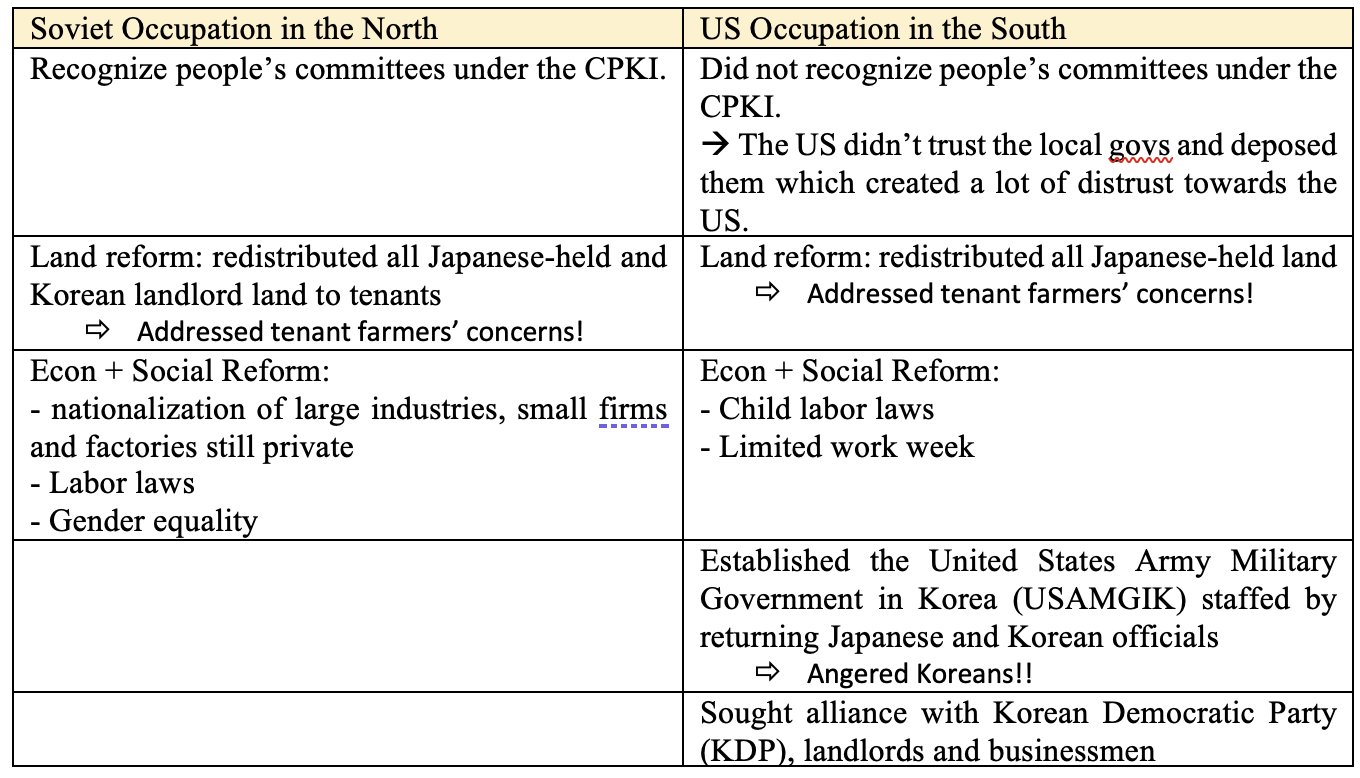
Comparison of Occupation Policies
In the beginning, the occupation of the South was much more violent. The US didn’t trust the local govs and deposed them which created a lot of distrust towards the US. Felt like the US had only come to save the privileged —> the peasants and farmers rebelled.
In the beg, Russia’s communist views weren’t shown too strongly in the North, its goal aligned w/ the Provisional gov and it was quite peaceful.
\
Koreans migrated North/South depending on their politcal views ==> polarization!!!
\
Since Japan owned most of the major industries during the colonial era, it was very easy and didn’t see any conflict for Soviet Russia to take over them and create the Communist Party → even more of an incentive for the US to ensure democratic development in the South.
In the beg, Russia’s communist views weren’t shown too strongly in the North, its goal aligned w/ the Provisional gov and it was quite peaceful.
\
Koreans migrated North/South depending on their politcal views ==> polarization!!!
\
Since Japan owned most of the major industries during the colonial era, it was very easy and didn’t see any conflict for Soviet Russia to take over them and create the Communist Party → even more of an incentive for the US to ensure democratic development in the South.
12
New cards
When were the Korean separate governments created?
ROK: Aug 15, 1948
\
DPRK: Sept 3, 1948
\
DPRK: Sept 3, 1948
13
New cards
What stirred the Civil War in the **ROK**?
Syngman Rhee established an authoritarian rule w/ the support of social/econ elites, the police and military
\
\+ used brutal military force on its ppl if they showed resistance/disapproval
\
\+ could abuse the presidential power bc there was a lack of presidential governance (checks and balances) + he was backed up by the US.
\
\+ used brutal military force on its ppl if they showed resistance/disapproval
\
\+ could abuse the presidential power bc there was a lack of presidential governance (checks and balances) + he was backed up by the US.
14
New cards
What stirred the Civil War in the **DPRK**?
\+ Eliminated all moderate pilitical membership (ex. Christians, landlords)
\
\+ The political base was in the peasants and the porr
\
\+ Extensive training and expansion of the army → introduced the idea that Korea came first and didn’t want to be dominated by other powers.
\
\+ The political base was in the peasants and the porr
\
\+ Extensive training and expansion of the army → introduced the idea that Korea came first and didn’t want to be dominated by other powers.
15
New cards
What do you call those to moved to the North and those to the South? What did these movements create?
North: wolbuk
South: wollam
\
polarization!!
South: wollam
\
polarization!!
16
New cards
When did the Korean War begin? What was the starting factor?
June 25, 1950
\
North Koreans attacked the South at the 38th parallel backed by Russia and China.
→ The South was backed by the US, then the UN ratified supports to defend against the Northern Invasion.
\
North Koreans attacked the South at the 38th parallel backed by Russia and China.
→ The South was backed by the US, then the UN ratified supports to defend against the Northern Invasion.
17
New cards
Debates on the start of the Korean war:
* It started w/ the conflicts between communist and anti-communist ideologies and we could argue the Jeju Island uprising on April 3 1948 was the real starting point
* More generally, it’s assumed to be June 25th 1950 when the North Korean Army crossed the 38th parallel to try to reunify the peninsula under a communist regime and the south resisted.
* More generally, it’s assumed to be June 25th 1950 when the North Korean Army crossed the 38th parallel to try to reunify the peninsula under a communist regime and the south resisted.
18
New cards
Why did China enter the war? What was the US reaction?
* As a defensive measure to protect its border?
* To come to the aid of North Koreans who had participated in the
Chinese revolution and the anti-Japanese resistance?
* Retaliation for the interposition of the US navy between Taiwan and the mainland?
\
The US resorted to chemical weapons to fight back the Chinese and the Soviet.
* To come to the aid of North Koreans who had participated in the
Chinese revolution and the anti-Japanese resistance?
* Retaliation for the interposition of the US navy between Taiwan and the mainland?
\
The US resorted to chemical weapons to fight back the Chinese and the Soviet.
19
New cards
The Aftermath of the war:
* Destruction of cities, villages, infrastructure; massive casualties
* Heavily militarized border
* Polarization of politics/anti communism (South)
vs. ==self-branded socialism== (North)
* North Korea: self autonomy and self defense
* South Korea: difficult development into a democratic system
* Heavily militarized border
* Polarization of politics/anti communism (South)
vs. ==self-branded socialism== (North)
* North Korea: self autonomy and self defense
* South Korea: difficult development into a democratic system