Discourse (Spoken & Written) - Formal + Strategies
 Studied by 0 people
 Call Kai
 Learn
Learn Practice Test
 Spaced Repetition
 Match
Match Flashcards
 Knowt Play
1/32

There's no tags or description
Looks like no tags are added yet.
Name | Mastery | Learn | Test | Matching | Spaced | Call with Kai |
|---|
No analytics yet
Send a link to your students to track their progress
33 Terms
Existing features
As the text is already rehearsed, the features present in the text are specifically employed for a particular purpose
If it is an unplanned text
Speakers rely on their own expertise to make it appear like a rehearsed text, not a spontaneous text.
Openings
Mostly scripted/rehearsed
Introduces people/topic
Can be of a convention - e.g. Welcome to Country, or welcoming TV viewers
Can reinforce identity and setting
Closings
Generally accepted - has a stable convention form and meaning - is not reconstructed and is not used with creativity
e.g. Thank you - is socially understood and formulaic, and also attends to face needs and politeness
Formulaic
The word/phrase has a socially understood meaning, as opposed to a meaning based off of its face-value
Non-fluency features
Are not typical (as they are rehearsed), but if are employed, are done so with a specific purpose
Errors can still be made if a person forgot to recall, etc.
Pauses - used for deliberate emphasis
Repetition - Deliberate emphasis
Filled pauses - used to capture attention - e.g. “Well.. the judge has accepted our proposal”
Adjacency Pairs
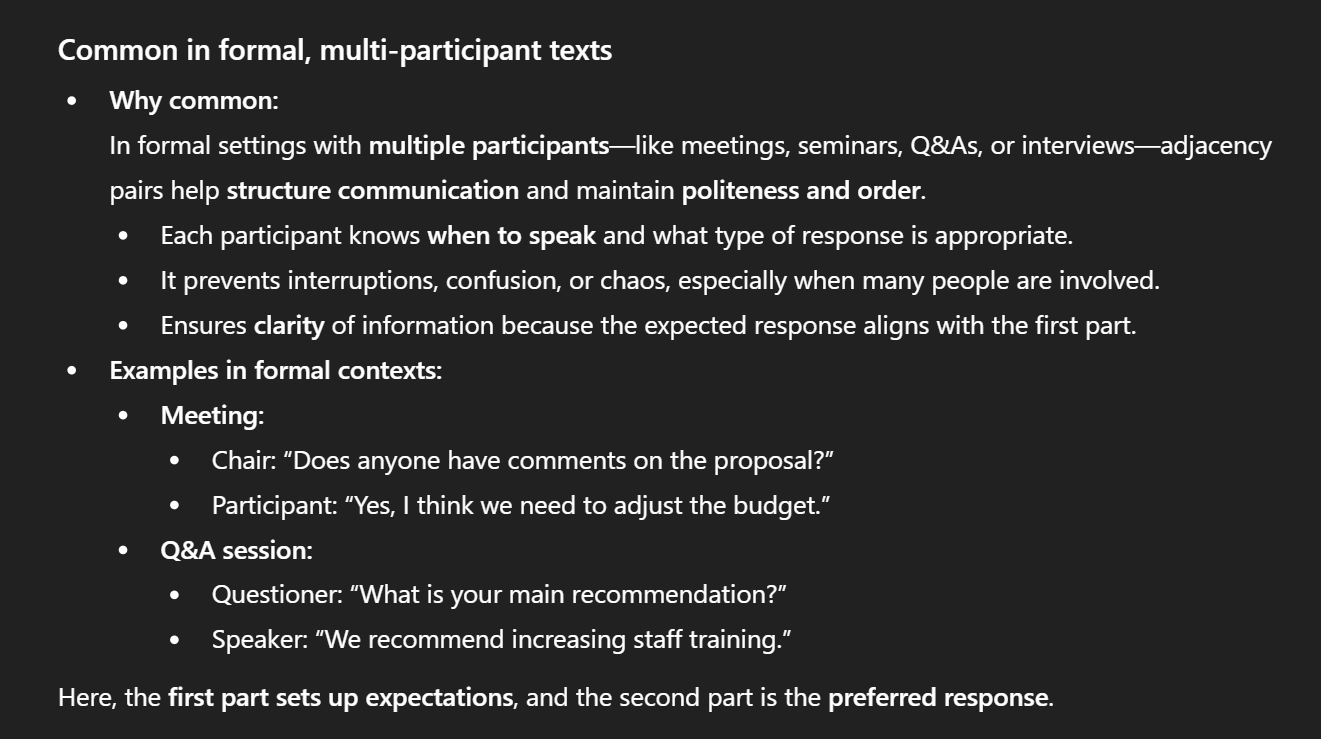
Preferred Vs Dispreffered Adjacency Pairs
Preferred: The response the first speaker expects or anticipates
Example: Question → direct answer, greeting → greeting back
Dispreferred: A response that violates expectation, creating tension, delay, or awkwardness
Example: Question → silence, irrelevant answer, or disagreement
Backchanneling/minimal responses
Attends to the positive face needs of the person talking
May need more firm back-channeling and responses, as minimal response (uh, yeah) may be dismissive or too casual in certain contexts
Larger social distance - need to be firm with the backchannelling to indicate that they are paying attention
Discourse Particles
They can organize a conversation, introduce a new speaker, a topic shift, manage a topic, interrupt, back-channel, hedge, direct speech, facilitate turn taking.
These are words, not utter sounds. Do not mix with pause fillers.
Overlapping
Very rare - as it is rehearsed - speakers already know their roles
Cooperative [RARE in formal] - these can indicate eagerness and can be a form of back-channeling, as they tend to support and add extra to what a speaker is saying. Can strongly reveal a collaborative conversation.
Non-cooperative (interruptions) [MORE COMMON]- this might reflect a difference in power hierarchical; relationships between speakers as one wants to control the conversation.
Discourse Strategies (Formal) - Overview
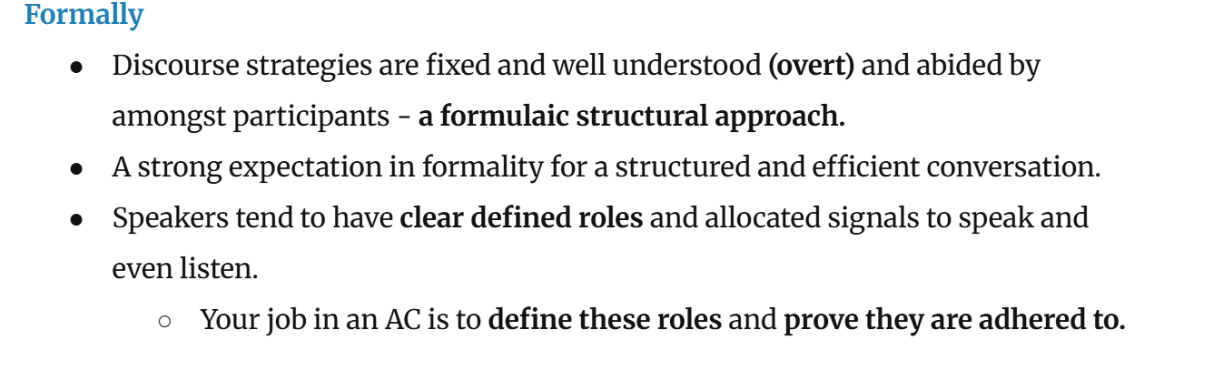
Turn-taking
Is much more smooth and organised - why:
Expectation of compliance with norms
Formal contexts (meetings, interviews, seminars, Q&As) have a stronger social hierarchy or roles.
Participants are expected to follow conversational conventions to avoid interrupting, overstepping, or creating confusion.
Larger social distance
When participants are less familiar, uncontrolled or overlapping speech may be seen as rude or unprofessional.
Smooth turn-taking helps maintain politeness and social order.
Importance of clarity
Formal texts often transmit important information.
Structured turn-taking ensures that each speaker is heard clearly, reducing miscommunication.
Topic Management
Is more pre-planned and topics are moved from or towards in a careful and pre-determined manner
Hosts/more powerful people - control the topic
Have an agenda - and shifts are used to follow this
Repair Sequences
Indicating Collaboration + engagement
May be done by someone of a higher power - reinforcing defined roles for speakers
Code Switching (not specific to formality)
Can be used to signal cultural identity, progressive values and attain social harmony amongst an audience – by appealing to broader cultural backgrounds.
When a speaker switches between two or more languages within a text, such as using borrowings.
Can reflect cultural identity or bolster a sense of group identity and solidarity, threaded by a shared ethno-linguistic background.
Cohesion + Coherence
Must be more, as the participants are not familiar with one another + there is less assumed knowledge
There is less opportunity to clarify in formal texts - must be clear initially itself
clarity reinforces inclusivity - as by not relying on assumed knowledge they encompass more people
Information Flow
Helps clarity and structuring of information to be more cohesive and understandable - more people can easily understand
Referencing
Anaphoric - helps avoid repetition in formal texts.
Cataphoric - can build suspense, especially effective in literary formal texts.
Deictic-Less common as there are less assumptions in formal texts.
Repetition
In speeches to deliberately create a lasting impression on the audience - to reinforce persuasive or rhetorical intent (mostly)
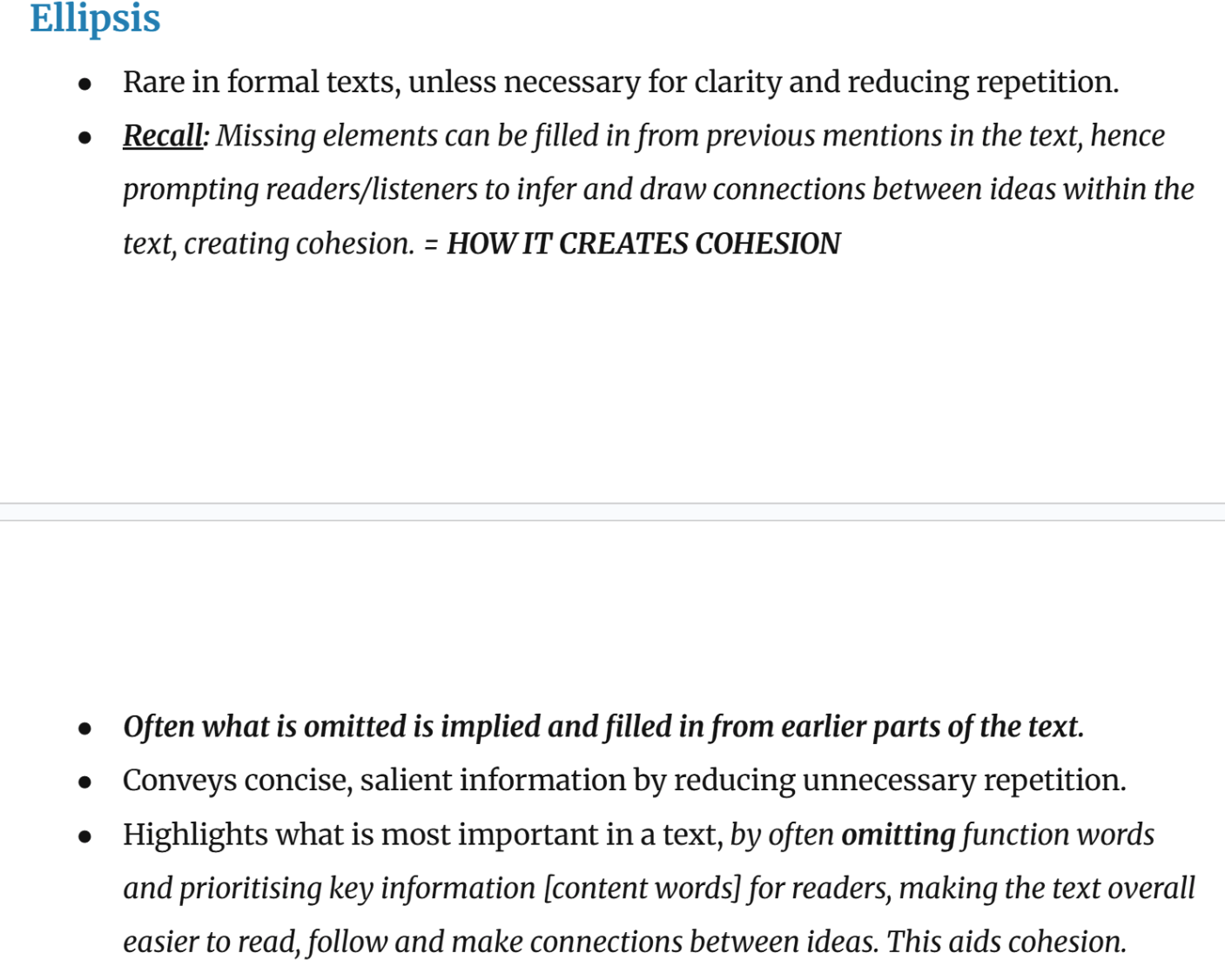
Ellipsis
How To Analyse
Your role is NOT to just say that ellipsis for example creates cohesion. HOW does it do this? - by filtering out unnecessary words and making the flow of a text more understandable. Then, to really ‘flex’ your knowledge, suggest to examiners WHY the author has made the text cohesive? Does it aid their persuasive function, for example?
Substitution
Replacement of a lexical phrase
Relies on reader’s ability to infer the text - creating intra-connections
reduces lexical overload
helps avoid repetition
Conjunctions
Shoiws relationships between the texts - dependent (subordinating) or equal (coordinating)
Adverbials
Help signpost + structure ideas logically + help establish the sequential order of the text
Conjunctions and adverbials can do the following:
Provide additional information
Contrast ideas
Provide links between ideas
Sequence ideas
Signpost ideas
Collocation
Two words that go together
Creates predictability
Common in formal texts - especially in prestigious fields
Drive growth
Financial performance
Foster innovation
Build trust
Inference (Coherence)
Not common
Formal texts want to be more inclusive and wider - not based ion assumed knowledge, unless really known
Want to avoid potential exclusion
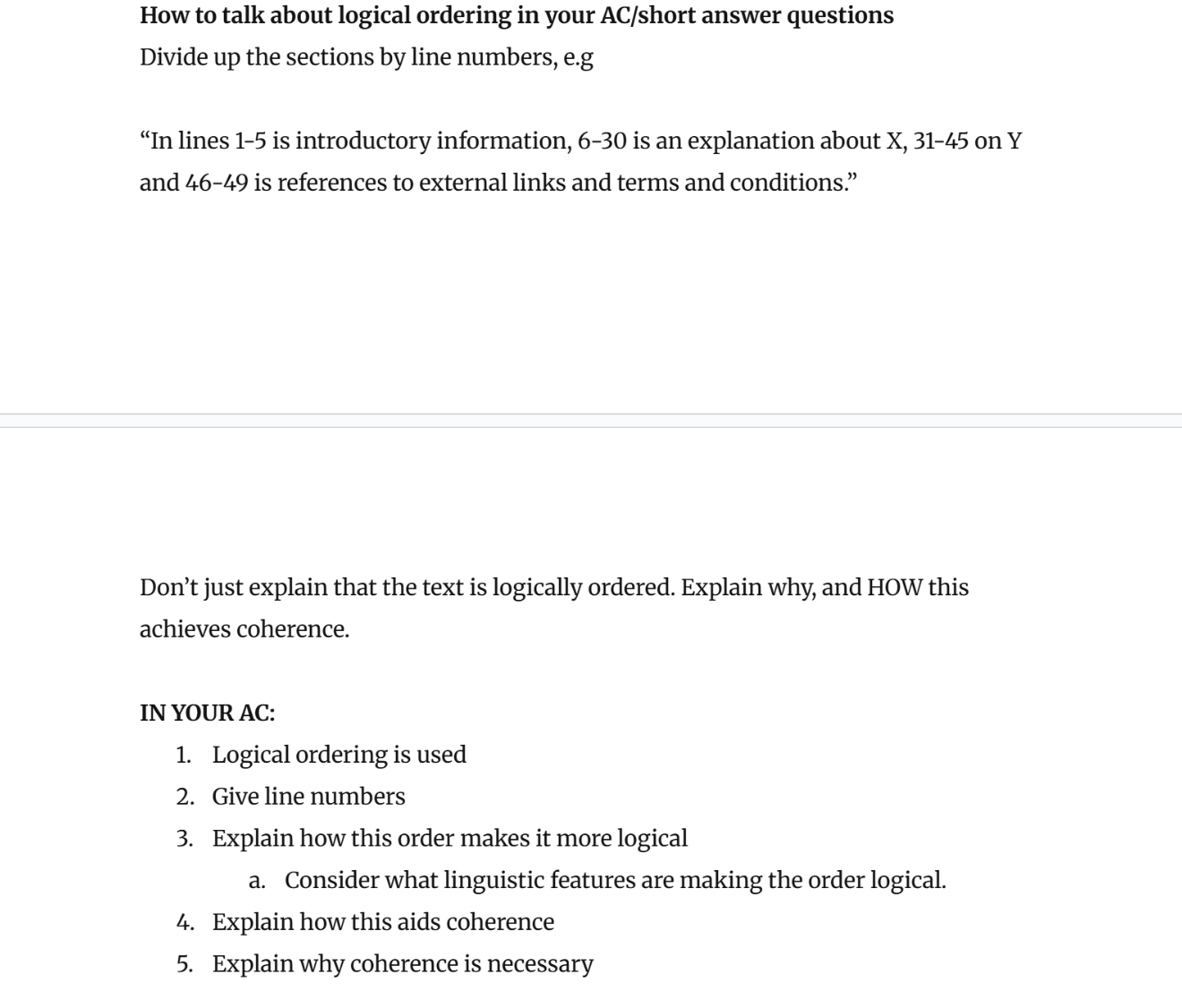
Logical Ordering
Is typically well ordered and logical
To make the text flow better and to help the reader to understand the overall meaning better - establishing coherence
Logical Ordering Guide To Explanation
Formatting
Can help with overall clarity + understandability as well as navigability
Text type may dictate how text is formatted
Conventions, Consistency (Same as informal)
Refer to informality
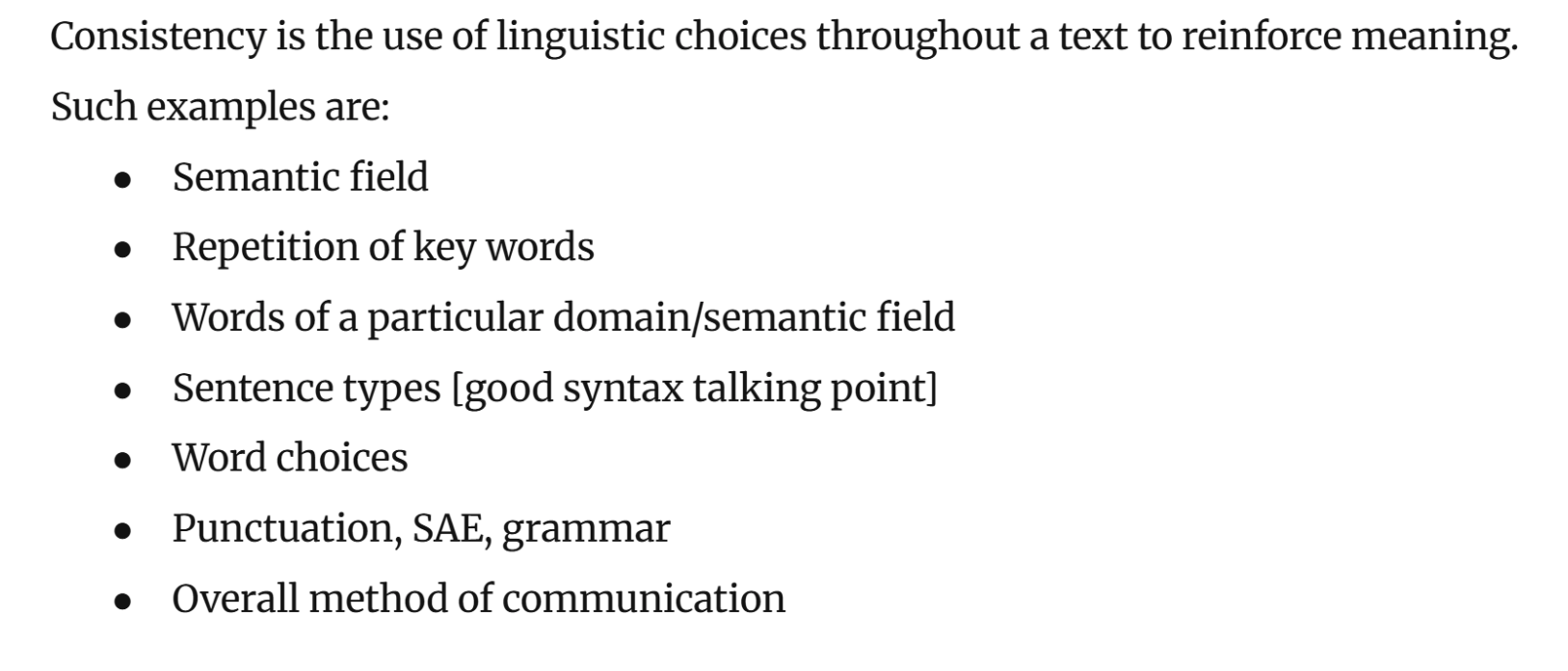
Consitency
Is not always individual words - just a repetition of a language feature
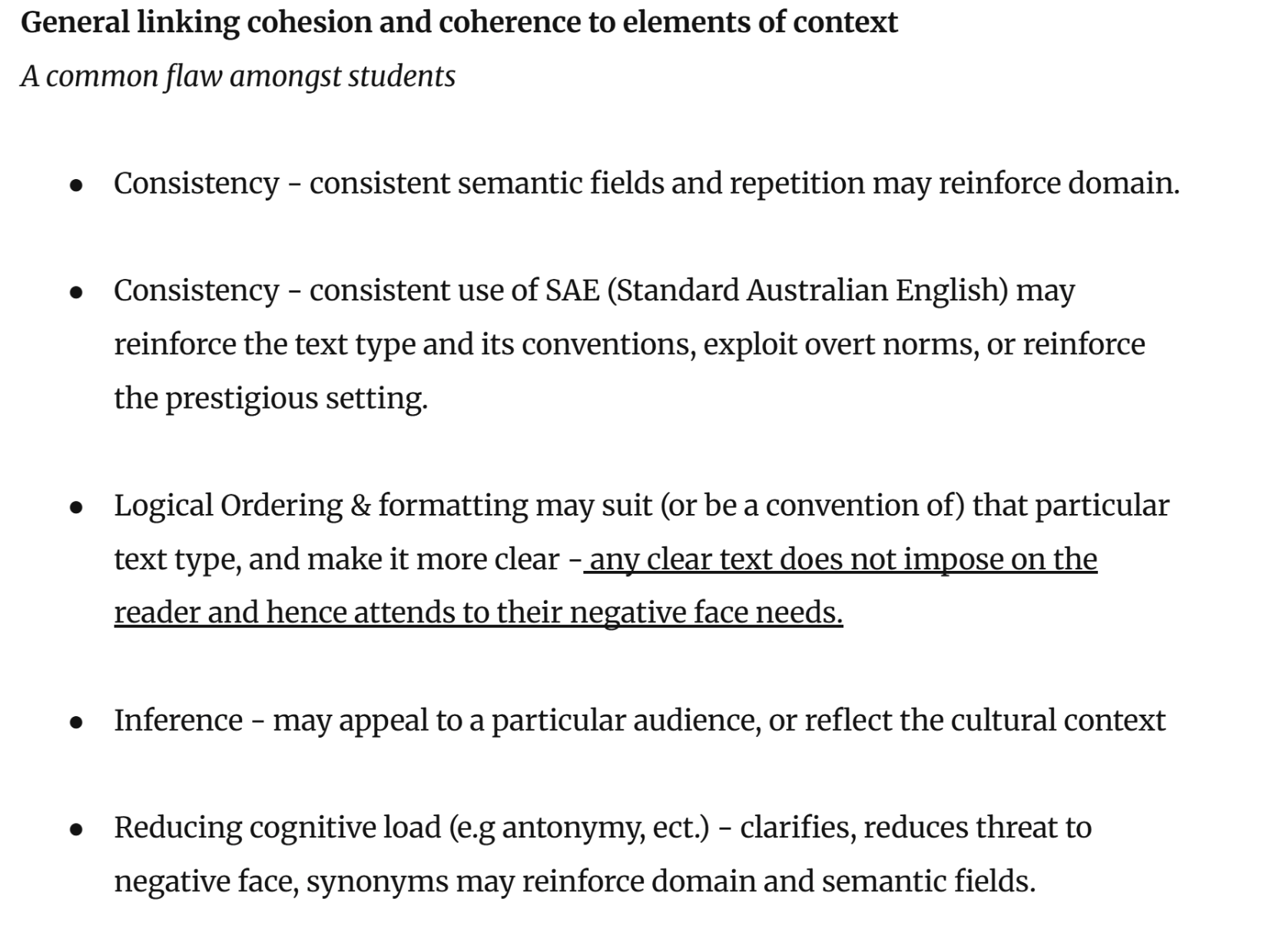
Linking Consistency & Coherence To Context
 Note
Note  Flashcards (88)