Human Resource Management: 2.1, 2.2, 2.3, 2.4, 2.6
 Call Kai
 Learn
Learn Practice Test
 Spaced Repetition
 Match
Match Flashcards
 Knowt Play
1/171

There's no tags or description
Looks like no tags are added yet.
Name | Mastery | Learn | Test | Matching | Spaced | Call with Kai |
|---|
No analytics yet
Send a link to your students to track their progress
172 Terms
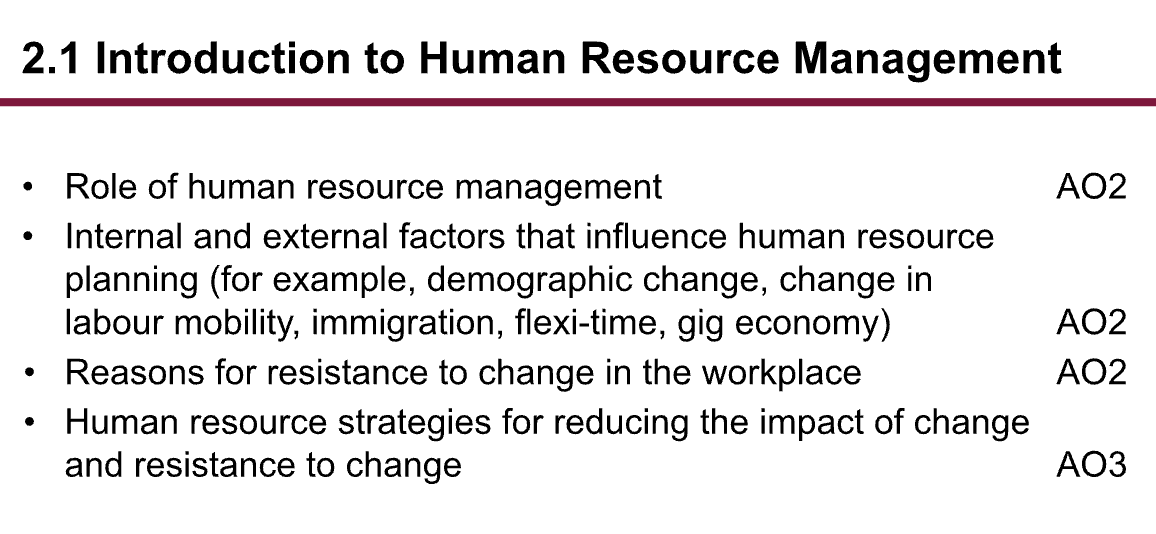
2.1 Introduction to HRM
Human resource management
Comprises the acquisition, training, motivation and reward of employees and workers within a business.
The role of Human resource management
Develop employees’ skills to meet the future needs of the organization
Training
Offering existing employees new roles and responsibilities within the business
Create and keep a loyal workforce
Recruit the right employees who fit with the organization’s needs and culture
Ensure that employees stay committed to their jobs and find them challenging
Respond to changing external environments
Ensure that during times of external change, the organization continues to meet its objectives as fully as possible.
Human resource plan / workforce plan
A human resource plan assesses the current and future capacity of a business’s workforce and sets out actions necessary to meet the business’s future human resource needs.
Appraisal
As a role of HRM, appraisal is the formal procedure of assessing the performance and effectiveness of employees in relation to their job description.
Dismissal
the role of letting go of workers, usually due to underperformance or misconduct in the workplace.
Recruitment
Refers to the practice of hiring appropriately qualified and suitable workers at the right times to fill job vacancies.
Redundancy
Refers to when a business lets go of workers if/when their jobs are no longer needed or no longer exist
Retention
Refers to the act of retaining/keeping workers at the organization by meeting the needs of employees.
Training and development
refers to the process of improving the competencies, productivity, and skills of employees.
Labour turnover
The percentage of employees leaving in a year as a proportion of the workforce
Workforce
The total number of employees in a business organization at any particular point in time.
Internal factors that influence human resource planning
Labour turnover
Description
The percentage of employees leaving in a year as a proportion of the workforce
Effect
Higher labour turnover → more recruitment and retention
Lower labour turnover → retention
Change in company objectives
Long-term profits? Reduce wages and make the most effective use ot the workforce
Best products? Recruit the most talented and creative individuals
Productivity of employees
Increased productivity could lead to
less need to hire more workers
And vice versa
Automation
Effect:
Could lead to redundancies but may need to hire a machine specialist
Type of product sold
Effects
Businesses with products or services that need highly skilled workers might need to
provide training
Businesses whose products are mainly produced by machinery and require less skilled workers will focus on
Minimizing labour costs through having the fewest number of employees
Flexi-time
Description
A way of working that allows employees to fit their working hours around their individual circumstances
Effect
Develops employee loyalty and helps maintain a skilled and experienced workforce → reduces the need to plan for recruitment and training
Can make it easier for businesses to meet changes in customers’ needs by accommodating working times easily
External factors that influence human resource planning
Demographic change
Description
Demand for goods and services due to high birth rates for example
Effect:
HR must modify the number of employees to adjust to changes in demand
Changes in labour mobility
Description
The ability and willingness of people to move to jobs in different areas or in different occupations
Effect:
If there is an increase, it leads to a greater supply of labour for businesses in a specific area.
It may reduce the need to redeploy existing employees to different areas within the business.
It can encourage HR managers to continue to use labour rather than machinery or technology
Reduction of labour mobility will have the opposite effect on all of the above
Immigration
Description
Takes place when a person moves to live in a different country.
Effect:
Increase the labour supply available to any business
Can help hold wages down
It can encourage HR managers to continue to use labour rather than machinery or technology
Economy
Description
A recession might decrease demand for the product
Effect
Reducing the income of many employees
Change in laws
Description:
E.g. max 40 hour week
Effect:
could impact productivity and might lead to recruitment planning needed
Gig economy
Description
A labour market in which short term contracts or freelance work are common
Effect:
Allows businesses to control labour costs based on changes in demand to improve price competitiveness
Reasons for resistance to change in the workplace
Self-interest
Resistance because they think they will be worse off
Preference of the present situation
People may not be willing to come out of their comfort zone or may not like change in general
Misinformation and misunderstandings
People may have been given the wrong or insufficient information about the change taking place and what the benefits of it may be, leading to a lack of understanding of why the change is taking place
Different assessments of the situation
Some may resist because they do not think it is the right plan
Human resource strategies for reducing the impact of change and resistance to change
Education and communication
Facilitation and support
Participation and involvement
Manipulation and co-option
Negotiation and bargaining
Explicit and implicit coercion
Participation and involvement (Define, Advantages, disadvantages)
Description
Involving employees in the decision making process so they know what is happening and when, and so they can have input in the process
Advantages
Can increase commitment of staff to the change
Participation may lead to new insights on how to make the change more effective
Disadvantages
Managers and employees may disagree on how much involvement is appropriate
Participation may lead to delays and obstacles in the process
Education and communication
Description
Managers explain to employees
Why the change is occurring
Why it is needed
Why it will work
Advantage
Establishes trust and helps stakeholders see the rationale for change
Reduces any unsubstantiated claims and rumours about the proposed change
Disadvantage
Can be slow to bring about because there can be many employees with different perspectives and levels of understanding
Facilitation and support
Description
Occurs when managers ensure employees have the support they need to cope with the change, for example the equipment they need, training or emotional support required to cope
Advantage
Averts potential resistance to change by becoming supportive of staff during difficult times
Disadvantage
Could divert from the main objective of the change taking place
Manipulation and co-option (Define, Advantages, disadvantages)
Description
Identifying the key people likely to resist the change and bring them into the process - their role is usually symbolic and the reason is only to convert the representative’s thinking to see the advantages of change
Advantages
Can win over key influencers and get them to be ambassadors for the change taking place
Disadvantages
Seen as unethical and can backfire if those resisting change discover what the management are really trying to do
Negotiation and bargaining (Define, Advantages, disadvantages)
Description
Occurs when managers make a deal with employees, offering incentives or higher wages for any changes or improvements they expect from employees or expect them to comply with
Advantages
Could lead to possibly better changes than originally intended
Disadvantages
Employees still do not find this change in their best interest and only agree because they get something else in return - this could imply future disagreements if not compensated similarly again
Explicit and implicit coercion
Description
Forcing the change despite any resistance, and posing threats such as redundancies or pay cuts. These can be stated plainly or implied by saying opposition would have negative consequences
Only used as a last resort
Advantages
If the change helps the business, employees may accept it and eventually agree
Disadvantages
Could lead to bad will in the workplace for some time before an employee accepts the change. It is not the ideal way for HR to deal with resistance.
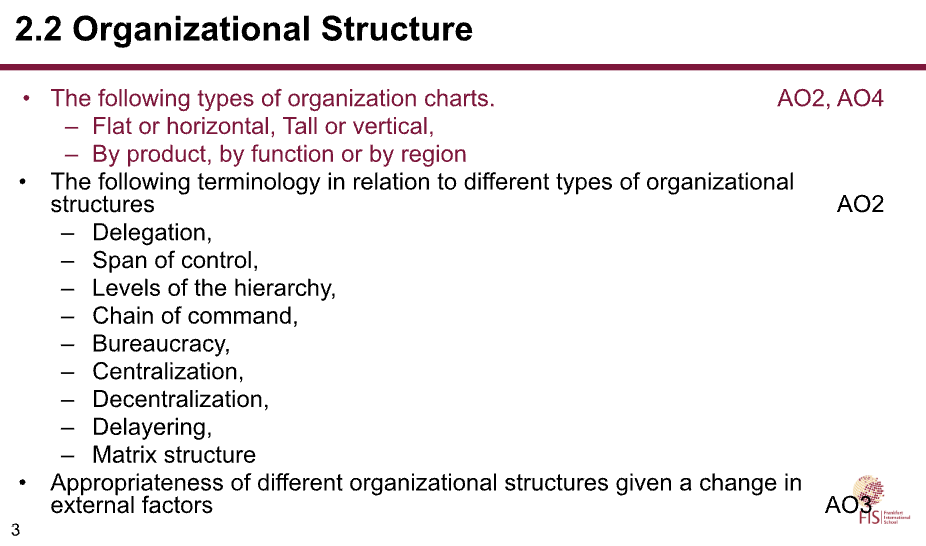
2.2 Organizational Structure
Types of Organizational charts [A02, A04]
Organizational Structure
Refers to the system of formal relationships between individuals within a firm.
Tall organization / vertical organization.
This is an organizational structure with many layers in the organizational hierarchy
The organizational structure is centralized, decisions are passed down the hierarchy from directors and senior managers.
There is a clear career path throughout the organization
Some employees can eventually achieve promotion to top levels
Narrow span of control
Can be bureaucratic
Advantages of Tall organization
Easier to control/manage each team
As each team is smaller
Team morale may be higher
Smaller teams may offer better opportunities for building strong working relationships
Fulfills social needs in Maslow's hierarchy
More opportunities for promotion
Maslows hierarchy of needs
Self-esteem
Clear hierarchy and structure
It is more clear who to report to if more skilled employees/managers are a higher level
May fullill Maslow's safety needs
Give move clarity to the employees.
Less confusion, higher morale.
Junior employees may receive support from managers
May improve performance.
Disadvantages of Tall organization
Decision-making can be slow
Long chain of command
May lead to ineffective reaction to changes in the extermal environment
E.g. Changing customer needs
Costs may be high
Since there will be higher labour costs with more levels in the hierarchy
Also Bonuses/benefits.
Communication can be ineffective
A message needs to be passed down multiple levels of management
There are likely to be more misunderstandings/misinterpretations
Leads to slower decision-making and lower efficiency
Flat organization
A type of organizational structure with fewer levels in the hierarchy.
Wide span of control
May result in a more decentralized organization.
More delegation
Managers at all levels have to lead larger numbers of employees
Advantages of Flat organization
Less Labour costs.
less managers required
Quicker communication and decision making
Messages from higher levels have to passed down through as many Layers
More delegation and responsibility
Builds a trusting environment
Employee's social needs.
Being trusted by their Manager
Employees self-actualization needs
More responsibility
Employees may feel more empowered
With fewer levels in the hierarchy employees are closer to the top levels
Esteem needs - Maslow
Disadvantages of Flat organization
Managers may be overworked
with too many subordinates
Due to wide span of control
Can increase labour turnover, lower efficiency
High training costs.
Employees at lower levels must be able to handle the higher complexity, and amount of tasks delegated to them.
A large and growing business may have to divide itself into smaller divisions
Due to the wider span of control, it is likely that employees at the same levels will be doing vastly different tasks
May end up splitting into smaller divisions
Employees may not feel as if they are part of a large organization
Increase labour turnover
Organization by function
Refers to when a workforce is structured according to business functions, such as marketing or finance.
Employees may specialize in one function
Advantages of Organization by function
Employees can operate within their area of expertise
Due to specialisation
Can generate new and innovative ideas
Increased motivation and loyalty to one department
Employees may feel like they belong (social needs) in a department that only focuses on one function
Increased motivation & loyalty.
Lower Labour turnover
Higher quality output
Functional areas are given a significant degree of control over finances
May consider more possibilities within budget
More innovation —> Higher quality output
Disadvantages of Organization by function
New ideas in one sector of the business may be difficult to coordinate
As the business is divided by function
Innovations in one sector may go unnoticed in another
Managers may only consider their function in decision making
May limit effectiveness and creativity of decisions
Reducing quality of output
Organization by region
Structuring a workforce according to different geographical areas based on where the firm’s operations are.
Advantages of Organization by region
Easier communication
All departments in a region have Similar cultures
Business can better operate in every region
All employees there may have local knowledge of market & suppliers
All functions can operate to cater to these in every region
Higher sales.
Disadvantages of Organization by region
Possible job duplication
With employees having similar tasks at similar levels
Only in different regions
Which may lead to ineffective functioning as a proportion to Labour costs
Lack of consistency across areas
Different divisions may be having different objectives and Strategies
May lead to an inconsistent brand image for the company
Organization by product
Refers to when a business's workforce is structured according to the goods or services sold. Each department focuses on a different product within the business's portfolio
Advantages of Organization by product
Better understanding of customer needs
Each department specializes in one product
May lead to higher customer satisfaction & higher sales.
Quicker decision making.
Departments are more focused and smaller
Higher quality decision-making.
Departments are more focused which lead to a deeper level of innovation
Higher sales
Disadvantages of Organization by product
Possible lack of coordination
Many departments may generally be researching the same market
Can lead to inefficiency and diseconomies of scale
Terminology in relation to different types of organizational structures [A02]
Delegation
Refers to when managers entrust and empower employees with the authority to successfully complete a particular task, project, or job role
Advantages of Delegation
Reduces manager workload.
More tasks managed by employees
Lower Labour turnover
Empowers/motivates employees.
Social needs (Maslow)
Safety needs (Herzberg)
Trust
Self-actualization needs (Maslow)
Herzberg motivator Responsibility, work itself
Disadvantages of Delegation
High training costs
Employees at lower levels must be able to handle the higher complexity and amount of tasks delegated to them.
Employees may not have the skill level to manage delegated tasks
Inefficiency, lower quality output
Bureaucracy
Refers to the administrative systems within an organization such as the formal policies and procedures of the business
Formal rules, regulations, procedures of the organization
Usually prevalent in large and well-established firms with tall structure and centralized decision-making
Advantages of Bureaucracy
Certainty
Employees know exactly how to respond to a situation
As bureaucratic procedures have been laid out
Disadvantages of Bureaucracy
Inefficient
Carrying out actions requires many procedures and paperwork
Output generation is slower
Lack of flexibility
New and innovative ideas are harder to implement
Can lead to slower progress.
Less competitive
Levels of hierarchy
The number of layers of formal authority in an organization.
It is represented in an organizational chart
Employees at the same level in the hierarchy have the same authority and similar responsibilities.
Tall —> Many Levels
Flat —> Few Levels
Span of control
Refers to the number of workers a line manager directly oversees
Chain of Command
Refers to the formal path in an organization's structure that information, decisions and responsibility take
Tall structure - Long chain of command
Flat Structure - Short chain of command
Delayering
Occurs when an organization removes one or more layers in its hierarchical structure. The number of layers of management is reduced.
Structure becomes flatter
Chain of command becomes shorter
Span of control becomes wider
Advantages of Delayering
Reduces costs
less manager salaries are paid
Quicker communication
Chain of command becomes shorter
Can respond quicker to changing customer
Better brand image, higher sales
Move power to lower levels
Esteem needs (Maslow)
Self-actualisation needs (Maslow)
Herzberg motivator-work itself/ responsibility
Higher quality output, Lower Labour turnover
Disadvantages of Delayering
Redundancy costs
Managers must be compensated for being made redundant
CEO & Managers may feel overworked
Wider span of control as the structure is wider.
Fewer opportunities for promotion,
Employees may feel less motivated to perform
Lower quality output
Lower customer satisfaction
Security needs of other employees.
A security need is that the employee has a secure job
As managers are made redundant, employees may feel that their job is at risk as well
Lower morale Lower performance
Lower quality output
Centralisation
Refers to when key decisions in an organization are made predominantly by a very small group of senior managers (within HQ) at the top of the organisational hierarchy
Advantages of Centralisation
Quick & Easy decision-making
Decisions are few individuals
With fewer inputs, less time is taken
Can respond quicker to changing customer needs
Standardised brand image.
Key decisions are influenced by the same group of director's
Making decisions consistent leads to move brand loyalty and customer satisfaction
Disadvantages of Centralisation
Employee demotivation.
Responsibility not given
Self-actualisation needs (Maslow)
Herzberg motivator
lower quality output due to lower employee performance.
More pressure of decision-making at the Head office
Can lead to lower quality decision making
slower customer satisfaction.
Lack of flexibility/innovation
Decisions are made by the same group of people
New ideas may not prevail
less competitive in the market
Decentralisation
Refers to when decision-making authority in an organization is passed down to middle- or junior-level managers within the business rather than from a central authoritative group
Advantages of Decentralisation
Decisions can be more tailored to the local culture
If the business is organized by region
Lower-level managers have a better understanding of customer needs.
They are closer to the market
Decisions made meet customer needs better
Better brand image (higher customer satisfaction)
Lower level managers and employees are empowered motivated
Responsibility of decision-making given
Herzberg motivator Work itself
Self-actualization Maslow
Disadvantages of Decentralisation
Inconsistent brand image.
Decisions can vary from manager to manager
Leads to varying output
Inconsistent brand image.
Lower brand loyalty
Decisions may not be made with the whole business in mind
Middle-and junior-level managers may be more inclined to make favourable decisions for their department, as they have a more narrow view of the company
Can lead to inefficient decision-making lower quality products, thus lower customer satisfaction.
Matrix Structure
Refers to a flexible organizational structure that uses teams of employees with suitable skills and qualifications drawn from different departments or divisions of the business
Vertical chain of command with horizontal project or product teams
Advantages of Matrix Structure
Focuses on tasks necessary for the business's success
As it is organized based on tasks
And employees from each department with the right skills are involved
Can better fulfil customer needs
Higher sales.
Varied and challenging tasks provided for employees
Employees will be in different task teams over time with different objectives
Herzberg motivator interesting tasks
Maslow Self-actualization needs
Interesting tasks.
Encourages organisations to be flexible and responsive to customers' needs
Tasks can be shifted and teams organized for new products
Can be competitive
Disadvantages of Matrix Structure
Can create confusion
Employees belong to departments as well as project team
Security needs employees may be unsure how to proceed with a task
Herzberg hygiene factors-a sense of order is Packing
Demotivating
Conflicts between project and departmental managers can occur
Tasks may clash with the nature of departmental expertise
Can lower morale, reduce performance (social needs)
Lower quality output, potentially higher labour turnover
Heavy expenditure on support staff may be required.
Appropriateness of different organisational structures given a change in external factors [A03]
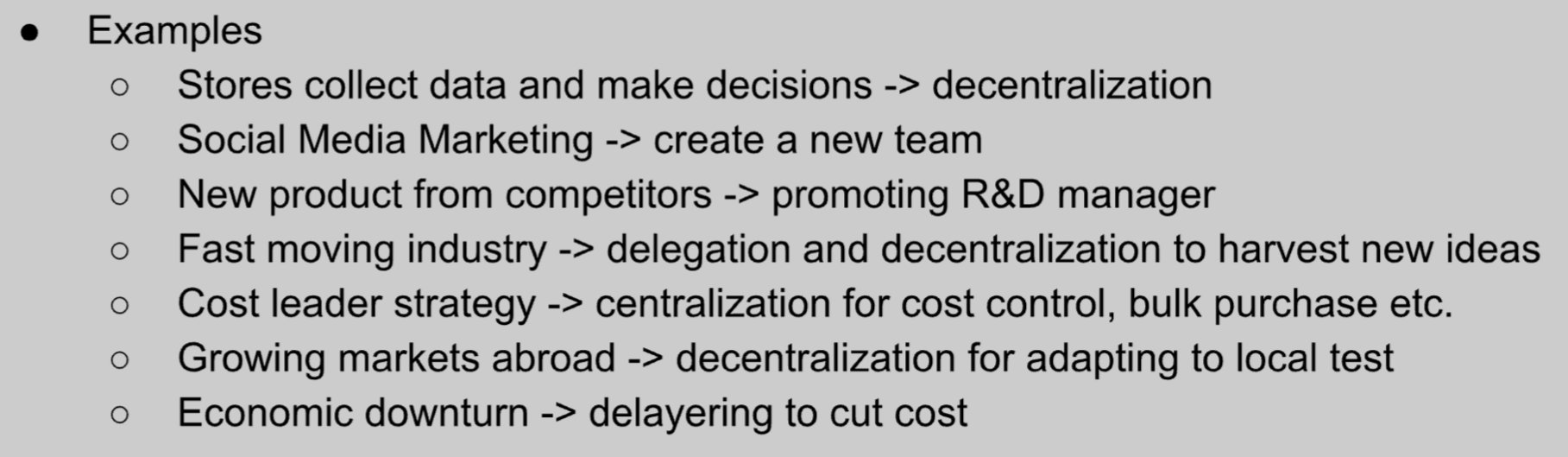
External factors to consider for organizational structures based on the case:
Changes in technology
Technology allows for more access to information
May encourage decentralization (managers collect information and Let employees
Also encourage the use of Platter organizational structures
Social media facilitates fast spread of negative
Organizations forced to respond quickly
Decentralized flat organisational structure more suitable
Changes in competition,
Organizations must be adaptable and flexible to meet customer needs as fully and quickly as possible.
Delegation & decentralization innovation,
Flat organizational structure
Short chain of command
Quicker decision making
Economic changes
Strongly performing economy
more consumer spending
Organizations may grow rapidly
Encourages decentralization as large companies are harder to control by one authority
Difficult economic conditions
Centralize & reduce costs, standardized procedures
Leadership
Includes the functions of ruling, guiding and inspiring other people within an organization in pursuit of agreed objectives.
The functions of leadership
Creating a vision for the organization
Deciding objectives for the organization
Providing expertise and setting standards for the organization
Planning every role in determining the structure for the organization
Becoming a role model for individuals within the organization
Management
Refers to planning, organizing, directing and controlling all or part of a business.
The functions of management
Planning
Organizing
Directing
Controlling
Coordinating
Autocratic leadership
Refers to when managers keep control of information and take major decisions on their own without consulting subordinates, then announce the decision to them.
Autocratic leadership communication style
One-way communication downwards from manager to subordinate.
Close supervision is kept
Autocratic leadership decision making style
Objectives are set and tasks allocated. The leader retains control throughout.
Advantages of Autocratic leadership
Quick decision making
Higher productivity
Link: Emergency
Suitable when employees are unskilled
more experienced leaders’ directions will lead to higher productivity
The business’s image can be seen as confident and well-led
As the business’s decisions are consistent as they are controlled by the leadership without room for discussion
Higher quality output
Control and close oversight within the organization
Clear hierarchy
Employees do not question decisions made and execute
effect: Could potentially increase productivity and thus output and revenue
Employees have a clear sense of goals and direction
Less confusion, effect: more productivity, more output
Disadvantages of Autocratic leadership
Does not nurture leadership among employees, damaging future competitiveness of the company
Demotivates workers as their ideas are not valued
Relevant especially if employees are highly skilled, talented, motivated and creative
Could cause poor decision making
If taking complex decisions requiring diverse knowledge & skills of the employees
Stifles initiative and creativity as employees are not involved in decision making
Effect: A poor decision is made as a result; employees may be unhappy
Business may be seen as uninnovative
Since leadership retains control over decisions, this can stop fresh ideas from the staff, which can deteriorate the brand’s innovativeness from the customer’s perspective.
Employees may become dependent on leaders and not make decisions, making them ineffective when the leader is absent
Effect: leadership may also feel overworked and can lead to diseconomies of scale due to resulting inefficiency
Paternalistic leadership
Refers to a style in which managers take decisions they believe are in the best interests of their subordinates.
Paternalistic leadership communication style
Mainly downwards towards subordinates, though feedback will take place.
Paternalistic leadership decision-making style
Leader explains decisions and ensures social and leisure needs are met
Advantages of Paternalistic leadership
Builds loyalty, morale, and motivation
Because employees feel heard and accounted for
Lower staff turnover
Economies of scale
Due to better relationships at work as there is feedback involved leading to less conflict or resentment
The business’s image can be seen as confident and well-led
As the business’s decisions are consistent as they are still controlled by the leadership
Clear hierarchy employees know who is in charge, tasks are done without confusion as a result
effect: Could potentially increae productivity and thus output and revenue
Consistent goals and direction
Less confusion, effect: more productivity, more output
Suitable when employees are unskilled
more experienced leaders’ directions will lead to higher productivity
Disadvantages of Paternalistic leadership
Poor decision making
due to lack of participation of employees in decision-making
Employees may become dependent on leaders and not make decisions
Effect: leadership may also feel overworked and can lead to diseconomies of scale due to resulting inefficiency
Still downward communication which could lead to dissatisfaction
Democratic Leadership
Occurs when a manager or leader shares information with subordinates, is able to delegate authority as well as consult subordinates in the decision-making process.
Democratic leadership communication style
Extensive
Two-way communication
Contributions from subordinates are encouraged
Democratic leadership decision making style
Participation of subordinates is encouraged and delegation of authority is used.
Decisions are made collectively depending on what the majority decides
Could be through voting
Or through informal discussions
Advantages of Democratic Leadership
Employees have higher morale,
Workers feel their opinions and input are valued
Lower potential staff turnover
Can lead to better decision making for the business/better output quality
Due to collaborative environment/healthy communication
(link) Suitable when employees are fairly skilled OR when morale is low!!!
Can lead to innovation
As ideas are shared in the workplace
Can allow for better competitiveness in the long-term
Disadvantages of Democratic Leadership
Slow decision-making as more members are involved
Slower revenue generation
Less consistent brand image
decisions may change depending on opinions of the majority
Since delegation is given to subordinates, frequent disagreements may occur
Diseconomies of scale
Laissez - faire
Takes place when a manager or leader trusts and allows employees the freedom to make their own decisions and delegates authority to them.
Laissez-faire communication style
There is little communication between leadership and subordinates, and all that does occur is between members at the same level in the organization
Laissez-faire decision making style.
Leader evades duties and decisions and delegation of tasks is uncoordinated
Advantages of Laissez-faire
Nurtures innovation
Since employees are trusted to come up with ideas and make decisions
Suitable when a team is highly driven, talented and creative
Could improve competitiveness of the company in the future
Higher motivation for staff
Increase staff retention
Disadvantages of Laissez-faire
Lack of focus and direction
Goals are set by subordinates and not by management
Management is not aware of what the employees are doing
Lead to more mistrust
There is no standardized output
Could impact the company’s image projected to consumers, possibly leading to lower brand awareness and brand loyalty
Situational leadership
Refers to when a leader adjusts their leadership style to best suit a particular situation or task.
Advantages of Situational leadership
Suitable to each employee and task
Can ideally maximize the success of each project
Workers may benefit from different leadership styles as they can change their mindset based on more directive activities vs. support from leaders.
Disadvantages of Situational leadership
Can be confusing for employees, in terms of when they can take part in decision-making and when not.
Internal diseconomies of scale due to disagreements and unsatisfactory output
Leaders have a natural style, so changing style according to different situations may be difficult
less effective leadership overall
Leader may lose credibility with employees
Due to inconsistency
Leading to lower productivity as there is less sense of authority
Motivation
Describes the factors that arise, maintain and channel behaviour towards a goal
The intrinsic desire to do something when workers really want to rather than because they have to.
Demotivation
Exists when an employee has no interest in or enthusiasm for their work.
Signs of Motivation
Higher productivity
Higher quality of good or service
Low labour turnover
Low absenteeism
Lower production costs and lower prices, increasing sales – growth & higher profits
Maintaining of price levels and enjoying consistent profits
Signs of demotivation
High labour turnover
Poor quality of goods and more importantly services (e.g. customer service)
Lower productivity
Internal diseconomies of scale
Higher production costs
Fluctuating prices, meaning fluctuating demand, fluctuating profits, decline
High absenteeism
Absenteeism
Describes a situation in which an employee is absent from work without a good reason
Taylor’s Motivation Theory
Taylor’s Motivation theory states that people are solely motivated by money
Theories that payment should be linked to output through a piece rate system
Encourages close supervision of the workforce
Division of labour
Refers to the breaking down of production into a series of small tasks carried out repetitively by relatively unskilled employees
Maslow’s Hierarchy of needs
A theory that outlines that employees have successive requirements that can be fulfilled through work.
A business can give employees the chance of fulfilling the needs at a higher level once a lower one is satisfied.
Once a lower level is satisfied, more of the same thing do not indicate anymore.
Maslows Hierarchy levels (list)
5: Self-actualisation
4: Esteem needs
3: Social needs
2: Security needs
1: Physiological needs
Self-actualisation (ways of satisfying)
Providing opportunities to:
Take new responsibilities
To develop new skills.
To contribute to the environment or society
To fulfil one’s potential completely

