BIOL 325 Thrust & Wing Loading
 Studied by 0 people
 Call Kai
 Learn
Learn Practice Test
 Spaced Repetition
 Match
Match Flashcards
 Knowt Play
1/17

There's no tags or description
Looks like no tags are added yet.
Name | Mastery | Learn | Test | Matching | Spaced | Call with Kai |
|---|
No analytics yet
Send a link to your students to track their progress
18 Terms
Aerodynamic Resultant
Net force exerted on the aerofoil by a passing fluid.
Sum of drag and lift forces
Thrust
Component of the aerodynamic resultant directed forwards
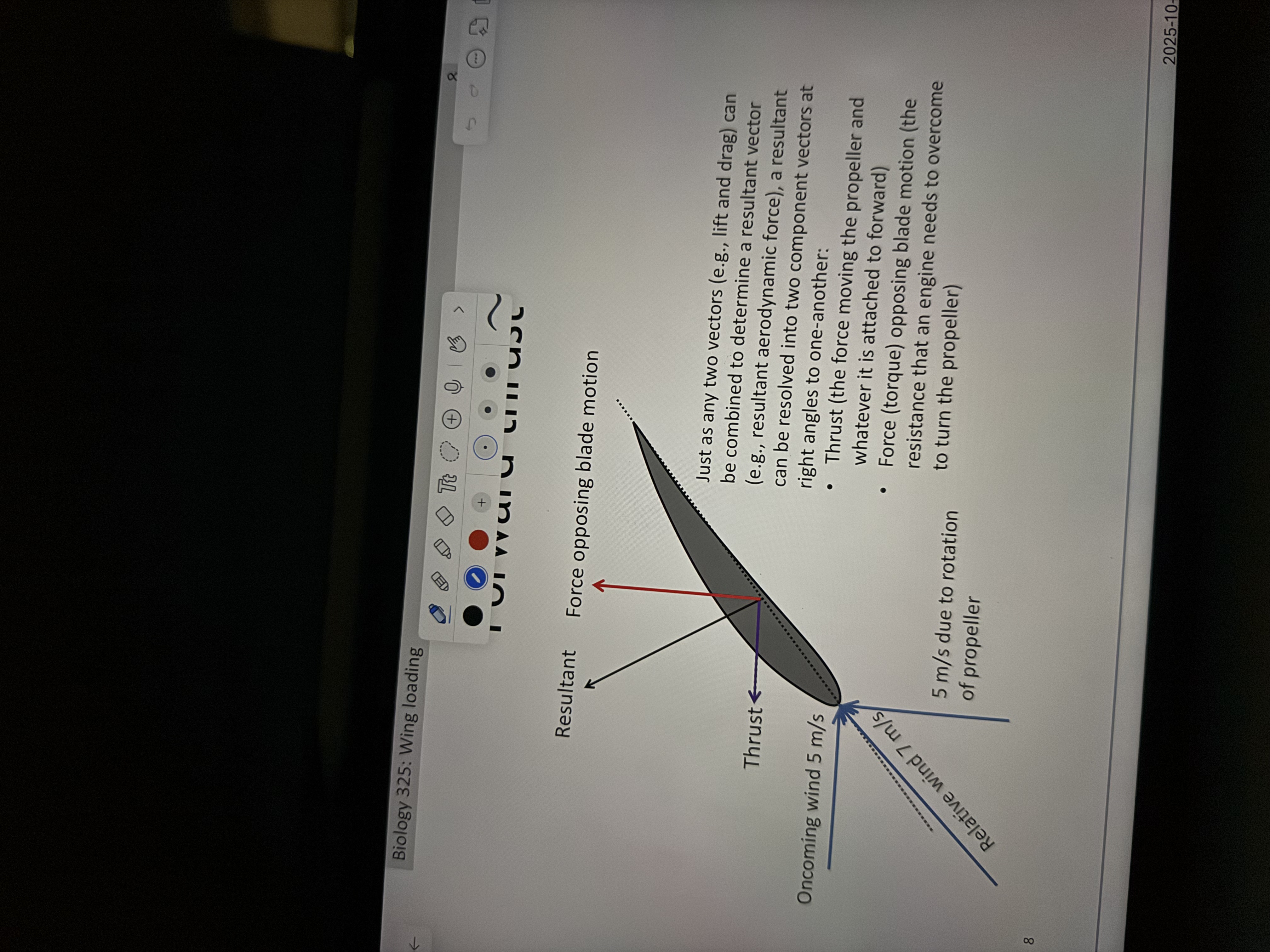
Aerodynamic resultant can be resolved into 2 components-
Thrust - force moving a propeller and whatever is attached to it forward
Force (torque) opposing blade motion (resistance that engine needs to overcome to turn propeller)
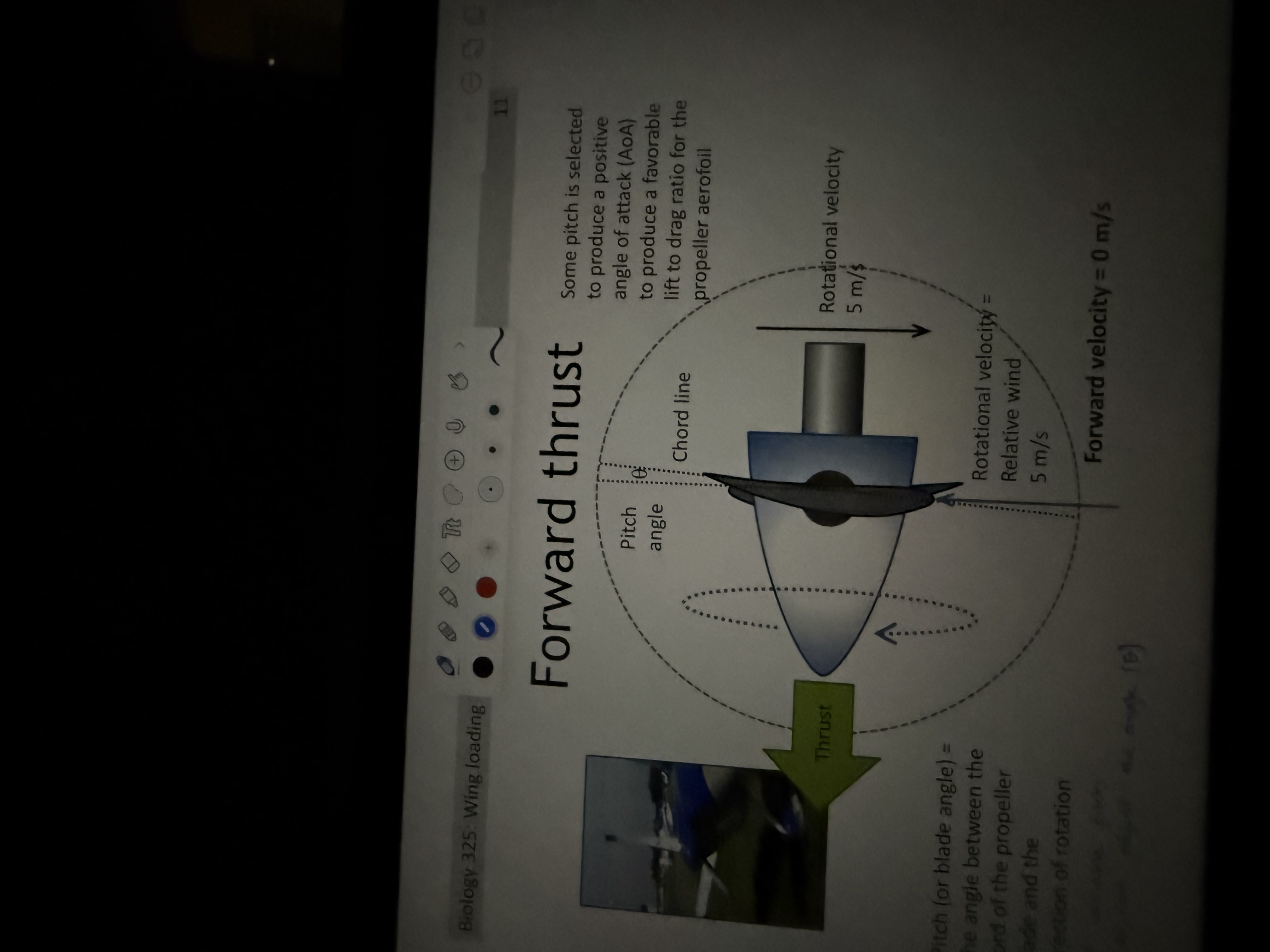
Pitch or blade angle
Angle between the cord of the propeller blade and the direction of rotation.
2 drag types acting on flying animals
Induced drag
Parasitic drag
Parasitic drag
Also called form drag
Drag due to animal’s shape
Combination of pressure drag, friction drag across body surface, and interference drag
Interference drag
Drag caused by the mixing of airflow components between wing and the body
Induced drag
Any surface producing lift, will have it as it is drag due to production of lift
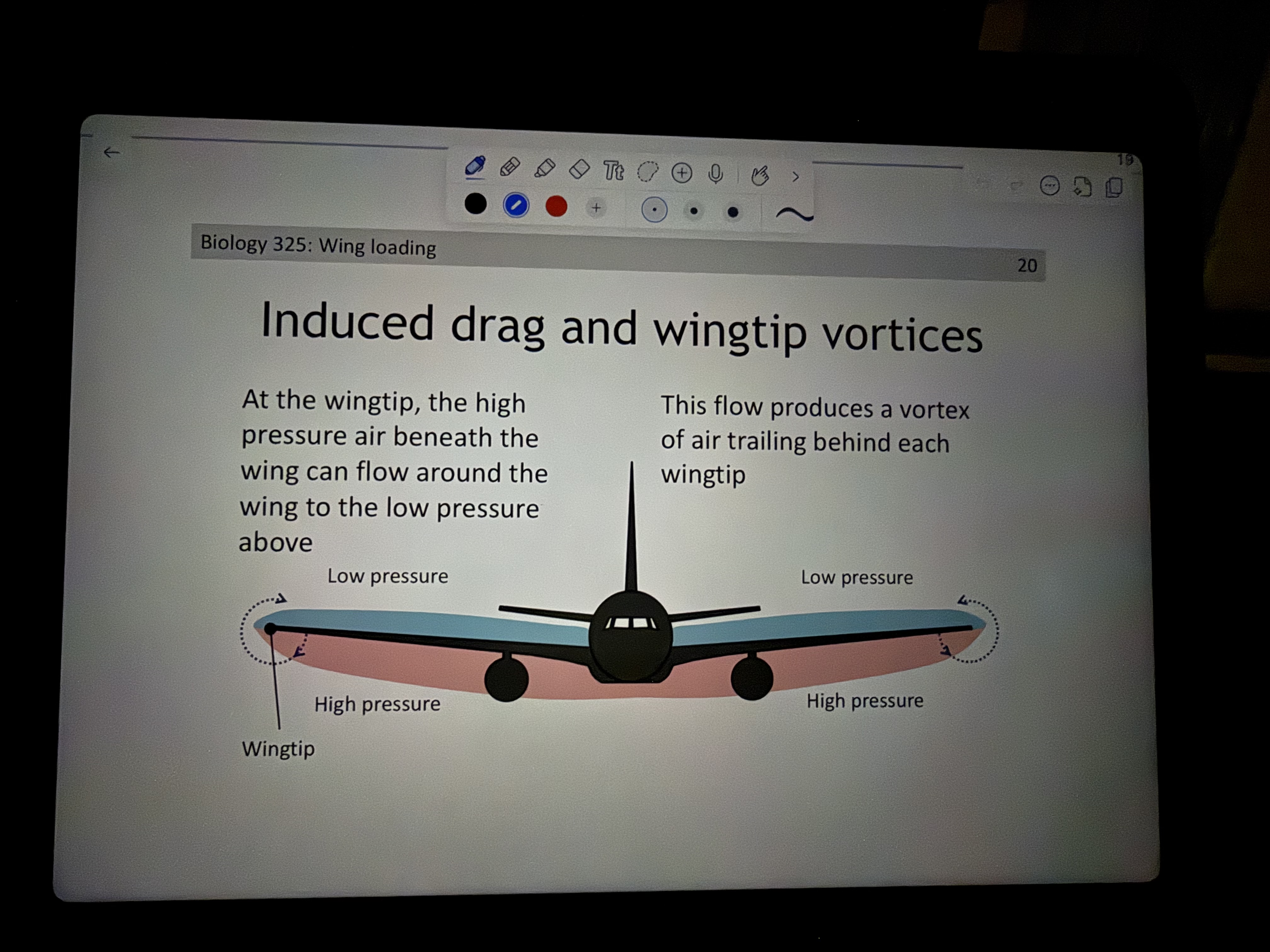
Wingtip vortices
At the wingtip, high pressure air beneath the wing can flow around the wing to the low pressure above
Generated a vortex of air trailing behind each wingtip
Induced Drag
The wing and the wingtip vortices produce downwash behind the wing. The causes the effective AoA of the wing to decrease, causing lift to be directed downstream, which is the induced drag. It is induced by the downwash.
Drag (induced and parasitic) vs Airspeed
High airspeed, Induced drag decreases
High airspeed, parasitic drag increases
Aspect Ratio
Indication of how wide : how high
relationship of width : height
AR = span2/Planform area
dimensionless quantity
low AR, short, stubby wings
high AR, long, large wings
Aspect Ratio and Induced Drag
low AR, short wings, suffer more form induced drag due to greater influence of downwash and vice versa.
Inversely proportional
low AR, more Induced Drag & vice versa
AR values for birds and their needs
Low AR - 5.9: Rapid takeoff, not for extended flight (partridge)
Medium AR - 6.5: good for hovering (hawk)
High AR - 9.5: more lift than drag, less induced drag, good for gliding and soaring (gull)
More AR for birds that need to fly more.
Wing Loading (def, unit, measure of what?, used for?)
weight of the flying animal/machine divided by the total wing area
units - N/m2
Measure of amt. of lift needs to be produced/ unit area of wing
used for quantitative comparison of lift a bird must produce per unit area of wing to support animal’s weight
= m x g/ area
Low wing loading meaning
high wing loading meaning
a bird (thrush) can take off easily and fly at lower speeds
problem for take-off and landing, to get airborne and remain in air, needs to generate high amt. of lift, so, need high airspeed
Wing Area and scaling in terms of Mb (birds, hummingbird, bat)
Birds - M0.71 to M0.78
Hummingbirds - M1
Bats - M0.49 to M0.69 but small bats have larger wings relative to weight than birds
Wing Loading can be calculated with Wing area
increases with increase in body weight for all birds and bats
Wing loading = Weight/area → M1/M0.71 to 0.79 = M0.22 to M0.29
Large birds have high wing loading, need more lift, need more air speed, so more run up to take off (swan)
 Note
Note  Flashcards (96)